The stickman barks out, "Horn High Yo!" Chips fly toward the center of the table. The shooter releases the dice, and for a split second, the entire table holds its breath waiting to see if a specific pair of dots lands face up.
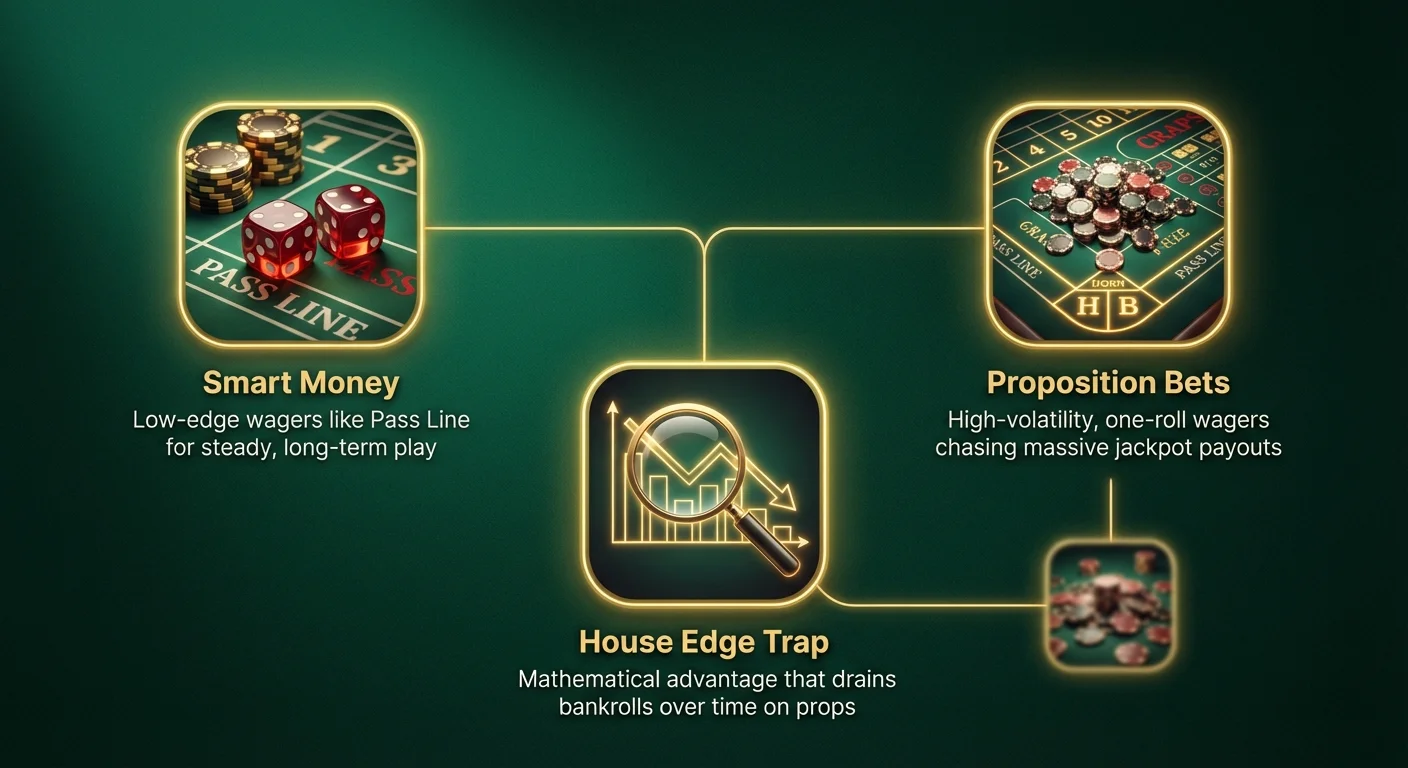
Craps is a game of two distinct personalities. On the perimeter of the table, you have the "smart" money - the Pass Line, the Come bets, and the Odds - where the house edge is razor-thin, and steady grinders make their living. Then, there is the center of the table: the domain of the Proposition Bets (or "Props").
These are the bets that promise massive payouts, screaming action and adrenaline. They turn a $5 chip into $150 in a single toss. They are the jackpot hunters' dream. However, veteran players and mathematicians often have a different name for them: Sucker Bets.
In this guide for CryptoGambling.com, we are going to dissect the high-risk, high-reward world of Craps Prop Bets. We will analyze the math that makes them dangerous to your bankroll, identify the specific scenarios where they might be worth the risk, and discuss how playing with cryptocurrency changes the dynamic of these volatile wagers.
The Center of Action: What Are Proposition Bets?
Proposition bets are located in the center of the craps layout, usually managed by the stickman in a live game. Unlike the Pass Line or Place Bets, which often require multiple rolls to resolve, the vast majority of Prop Bets are "One-Roll Bets."
This means exactly what it implies: you win or you lose immediately upon the next roll of the dice. There is no "point" established, and there is no waiting. This instant gratification (or instant pain) makes them incredibly popular in the fast-paced world of crypto craps, where players can spin through rolls much faster than at a physical table.
The Allure of the Longshot
Why do players make these bets if the odds are generally poor?
- Low Barrier to Entry: You can often bet small amounts (like $1) on props, even if the table minimum is higher.
- High Payouts: While a Pass Line win pays 1:1, a Prop bet can pay up to 30:1.
- Hedge Strategies: Some players use them to try and "insure" other bets (more on why this is mathematically flawed later).
The "One-Roll" Wonders: Analyzing the Worst Offenders
Let's break down the most common one-roll proposition bets. To understand why these drain bankrolls, we have to look at the difference between True Odds (the actual mathematical probability) and the Casino Payout (what you actually get paid).
1. Any Seven (The "Big Red")
This is widely considered the worst bet on the craps table. You are betting that the very next roll will be a 7.
- The Math: There are 6 ways to roll a 7 out of 36 possible combinations. The true odds are 5 to 1.
- The Payout: The casino typically pays 4 to 1.
- The House Edge: A staggering 16.67%.
Verdict: This is the definition of a sucker bet. While you will see the 7 roll often (it is the most common number), the payout is so far below the true probability that it decimates your bankroll over time. In crypto craps, where you can play hundreds of hands an hour, betting Any Seven is the fastest way to hit a zero balance.
2. The Horn Bet
The Horn is a four-way bet on the 2, 3, 11, and 12. If you bet $4 on the Horn, you are essentially putting $1 on each of those numbers.
- Outcomes:
- If 2 or 12 rolls: You win big (usually 30:1 on that $1), but lose the other three $1 chips.
- If 3 or 11 rolls: You win (usually 15:1 on that $1), but lose the other three chips.
- Any other number: You lose all $4.
- The House Edge: Approximately 12.5% depending on the specific payouts of the 2 and 12.
Variant - "Horn High": This is a 5-unit bet where you double the wager on one specific number (e.g., "Horn High Yo" doubles the bet on the 11). It doesn't change the math favorability; it just increases the variance.
3. The "Yo" (Eleven)
Betting exclusively on the 11 is a favorite among gamblers because "Yo-leven" is fun to say and fun to hit.
- The Math: There are only 2 ways to roll an 11 (5-6 and 6-5). True odds are 17 to 1.
- The Payout: Usually 15 to 1.
- The House Edge: 11.11%.
4. Any Craps (Three-Way)
This creates a hedge against the 7 during a Come Out roll for some players, though it remains a losing proposition long-term. You win if a 2, 3, or 12 rolls.
- The Payout: 7 to 1.
- The House Edge: 11.11%.
The Hardways: The "Patient" Props
Unlike the one-roll bets above, Hardways (Hard 4, Hard 6, Hard 8, Hard 10) are not resolved immediately unless a 7 rolls or the number rolls.
How They Work
A "Hard" number means the dice show pairs (e.g., 2-2 is a Hard 4). If the shooter rolls a 3-1 (an "Easy" 4) or a 7, the Hardway bet loses. It stays on the table working until it wins or loses.
Many intermediate players confuse Hardways with Place Bets.
- Place Bet 8: Wins on any 8 (Hard or Easy). Pays 7:6. House Edge 1.52%.
- Hard 8: Wins only on 4-4. Loses on any 7 or any Easy 8 (2-6, 3-5, etc.). Pays 9:1. House Edge 9.09%.
The Mathematical Breakdown
The following table illustrates why Hardways are considered poor bets compared to simply Placing the number, despite the attractive payouts.
| Bet Type | Winning Combinations | Losing Combinations (Easy Way + 7) | True Odds | Casino Payout | House Edge |
|---|---|---|---|---|---|
| Hard 6 / 8 | 1 (3-3 or 4-4) | 10 | 10 to 1 | 9 to 1 | 9.09% |
| Hard 4 / 10 | 1 (2-2 or 5-5) | 8 | 8 to 1 | 7 to 1 | 11.11% |
Strategy Note: As mentioned in expert guides, seasoned players often avoid Hardways entirely because the "easy" roll kills the bet. If you Place the 6 or 8, you are rooting for any 6 or 8. If you bet the Hard 6, you are actually rooting against the most common ways to make a 6.
The Field: The Borderline Prop
The Field bet is a massive section on the layout, often not grouped with the center props, but it functions similarly as a one-roll bet. You win if the next roll is 2, 3, 4, 9, 10, 11, or 12.
- The Trap: It looks like you have a lot of winning numbers (7 winning numbers vs. 4 losing numbers: 5, 6, 7, 8). However, the losing numbers are the most frequently rolled combinations in the game.
- The Math: There are 16 ways to win and 20 ways to lose.
- The Edge:
- If 2 and 12 pay double: 5.56% House Edge.
- If 2 pays double and 12 pays triple (common in some crypto casinos): 2.78% House Edge.
Is it a Sucker Bet?
At 5.56%, yes, it is high risk. However, if you find a Crypto Casino paying triple on the 12, the house edge drops to 2.78%, making it a reasonable "action" bet, though still worse than the Pass Line (1.41%).
Strategy: When to Hunt for Jackpots
If the math is so bad, should you ever play these bets?
Gambling is ultimately about entertainment. The Pass Line is smart, but it can be slow. Proposition bets offer volatility and excitement. If you are going to play them, you need a strategy to ensure you aren't just donating Bitcoin to the casino.
1. The "Fun Money" Allocation
Never use your main bankroll for Prop bets. A good rule of thumb for intermediate players is the 10% Rule.
- If you buy in for $200 (or equivalent in BTC/ETH), allocate $20 strictly for high-risk props.
- If that $20 runs out, you stop betting props.
- If you hit a Hardway or a Horn, put the original stake back in the "Fun" pile and move the profit to your main bankroll.
2. The "Two-Way" Karma Bet
In live dealer crypto craps, you can make a "Two-Way" bet. For example, a "Two-Way Hard 8" means you bet one chip for yourself and one for the dealers.
- Even though the house edge remains high, this builds rapport with the crew.
- It slows down your betting (psychologically) and makes the game more social.
3. Pressing Your Luck (Parleys)
The only time Props truly pay off is when you hit them back-to-back. This is called "parlaying."
- Scenario: You bet $5 on Hard 8. It hits. You win $45.
- The Move: Instead of taking the $45, you tell the dealer "Press it." You now have a $50 Hard 8.
- The Jackpot: If it hits again, that $50 pays $450. You turned $5 into $450 in two rolls.
- The Risk: It is incredibly unlikely to happen. But this is the "Jackpot Hunter" mentality. If you are going to play high-house-edge bets, you should aim for a payout that actually changes your day, rather than grinding small wins.
4. Avoid the "Hedge" Myth
Many players bet "Any Seven" to protect their Pass Line bet on the Come Out roll. Do not do this.
- You are betting against yourself.
- You are paying a 16.67% "tax" (the house edge on Any 7) to protect a bet with a 1.41% edge.
- Over time, the cost of the hedge costs you far more than the losses on the Pass Line.
Crypto Craps: The Speed Trap
Playing Craps at a crypto casino introduces nuances that don't exist in Las Vegas.
Provably Fair & Variance
Many crypto-native craps games use "Provably Fair" technology. This allows you to verify the seed and hash of every roll to ensure the result wasn't manipulated.
- Why this matters for Props: When you bet the "Midnight" (12) and miss 30 times in a row, it's easy to feel the game is rigged. Provably Fair tech proves that it's just cold, hard variance. The odds of a 12 are 1 in 36. Missing 30 times is statistically normal.
The Speed Factor
In a physical casino, a stickman takes time to set up prop bets, pay winners, and collect losers. A roll happens perhaps once a minute.In online crypto craps, you can click "Roll" every 3 seconds.
- Danger Zone: Betting the "Any Seven" with a 16.67% edge at 20 rolls per minute will liquidate a bankroll in minutes.
- Strategy: If playing automated (RNG) crypto craps, consciously slow down. Force yourself to wait. Or, use "Auto-Bet" features with strict loss limits set on your Prop allocations.
Instant Payouts
The benefit of crypto craps is the instant withdrawal. If you do hit that parlayed Hard 6 and win 0.5 BTC, you can cash it out immediately. In traditional setups, you might be tempted to leave the chips on the table and give it all back.
- Tip: Set a "Cash Out" trigger. If your Prop bets hit a specific profit target (e.g., 5x your buy-in), withdraw the winnings immediately.
Comparative Analysis: Smart Bets vs. Sucker Bets
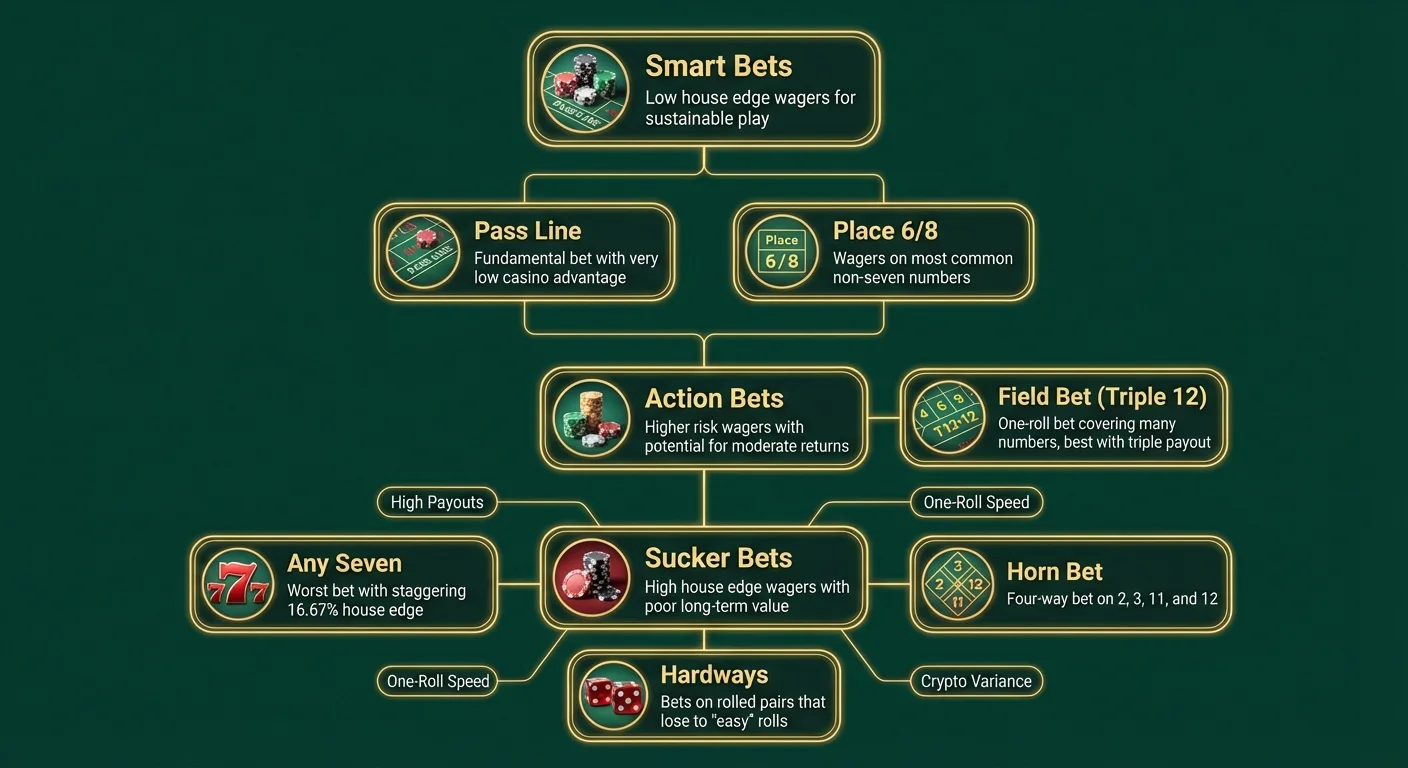
To visualize why professional gamblers stick to the perimeter, look at this House Edge comparison.
| Bet Category | Specific Bet | House Edge | Risk Level |
|---|---|---|---|
| The "Smart" Bets | Don't Pass + Max Odds | ~0.01% - 0.5% | Very Low |
| Pass Line + Max Odds | ~0.01% - 0.5% | Very Low | |
| Place 6 or 8 | 1.52% | Low | |
| The "Action" Bets | Field (Triple 12) | 2.78% | Medium |
| Place 5 or 9 | 4.00% | Medium | |
| The "Sucker" Bets | Field (Double 12) | 5.56% | High |
| Big 6 / Big 8 | 9.09% | High (Avoid!) | |
| Hard 6 / 8 | 9.09% | High | |
| Any Seven | 16.67% | Extreme |
Note: The "Big 6" and "Big 8" are often found on corners of the table. They pay 1:1 on a 6 or 8. Since a Place Bet on 6 or 8 pays 7:6, the Big 6/8 are essentially "idiot taxes" for people who don't know they can make a Place bet. Never play them.
Summary: Are You a Sucker or a Hunter?
So, are Proposition bets for suckers or jackpot hunters? The answer lies in your intent.
If you are betting the Hardways or the Horn because you believe you have a "feeling" or because you think they are good ways to make steady money, you are falling into the sucker trap. The math is brutal, and the house edge is insurmountable in the long run.
However, if you are a disciplined gambler allocating a small percentage of your crypto bankroll to "Jackpot Hunting," understanding that you will likely lose that money in exchange for the thrill of a potential 30:1 payout, then you are playing the game with your eyes open.
Key Takeaways:
- Avoid Any Seven: It is mathematically the worst bet on the table.
- Hardways are for Action: They carry high risk compared to Place bets. Only play them if you are chasing the high payout, not steady wins.
- Check the Field: Only play the Field if the 12 pays Triple.
- Bankroll Management: In crypto craps, the speed of play turns a 10% house edge into a buzzsaw. Bet small on props, or not at all.
Craps is designed to be a rollercoaster. The Pass Line provides the safety bar; the Proposition Bets are the loop-de-loops. Enjoy the ride, but don't fall out.
Disclaimer: Gambling involves risk. The house always has an advantage. Strategies discussed here are for entertainment and informational purposes and do not guarantee winnings. Please gamble responsibly.