To the uninitiated observer, a slot machine is a chaos engine - a spinning kaleidoscope of colors and sounds governed by pure luck. But to the seasoned player, beneath the flashing lights and spinning reels lies a rigid architectural structure built on mathematics.
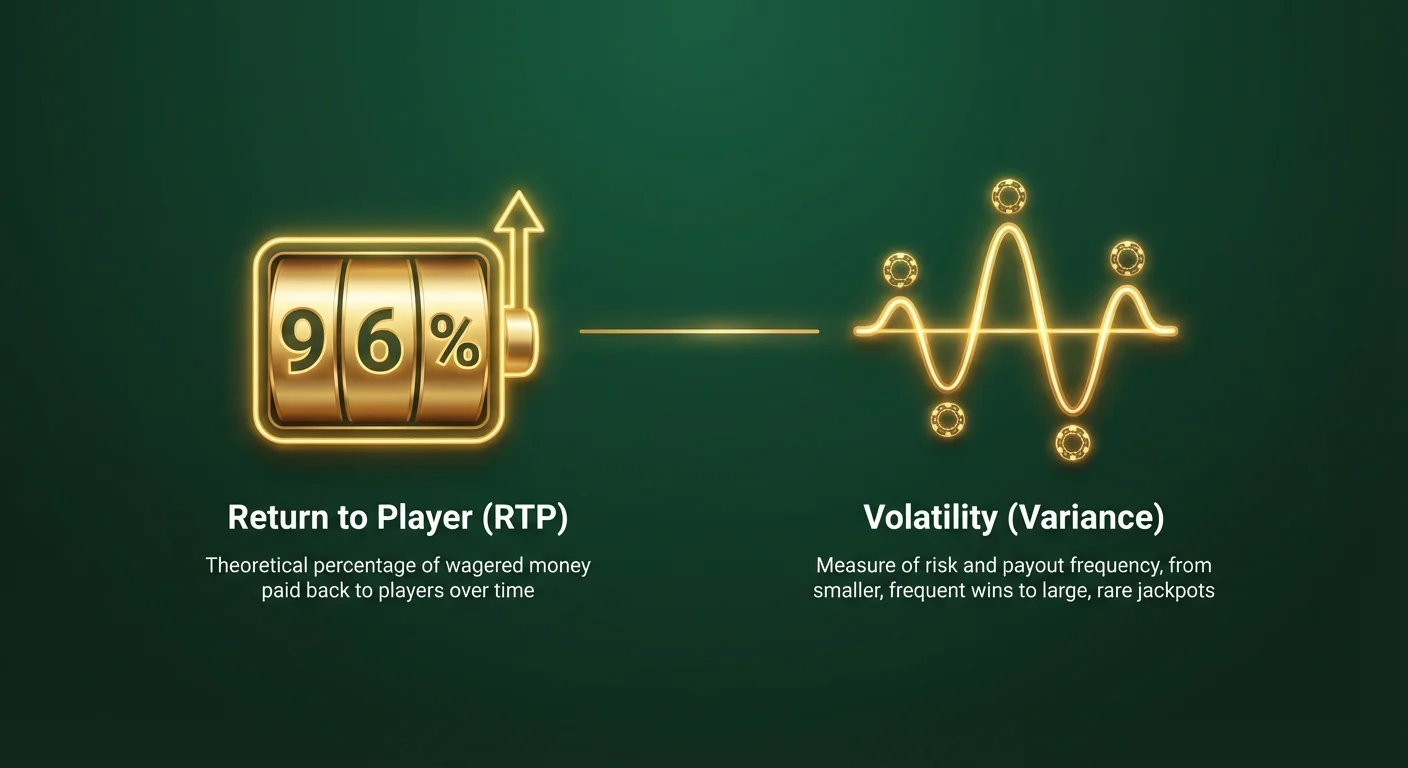
Every slot machine, whether a vintage mechanical arm bandit or a cutting-edge Bitcoin video slot, operates according to a specific DNA code. This code is comprised of two primary components: Return to Player (RTP) and Volatility (Variance).
Understanding the math of money isn't about finding a "system" to beat the house - because the house edge is a mathematical certainty. Instead, it is about understanding how you will lose and how you can win. It is about matching your bankroll, your risk tolerance, and your playstyle to the specific mathematical profile of a game. This guide will take you beyond the "Spin" button and deep into the mechanics of slot machine math, helping you make informed decisions every time you deposit crypto.
The Foundation: RTP Explained
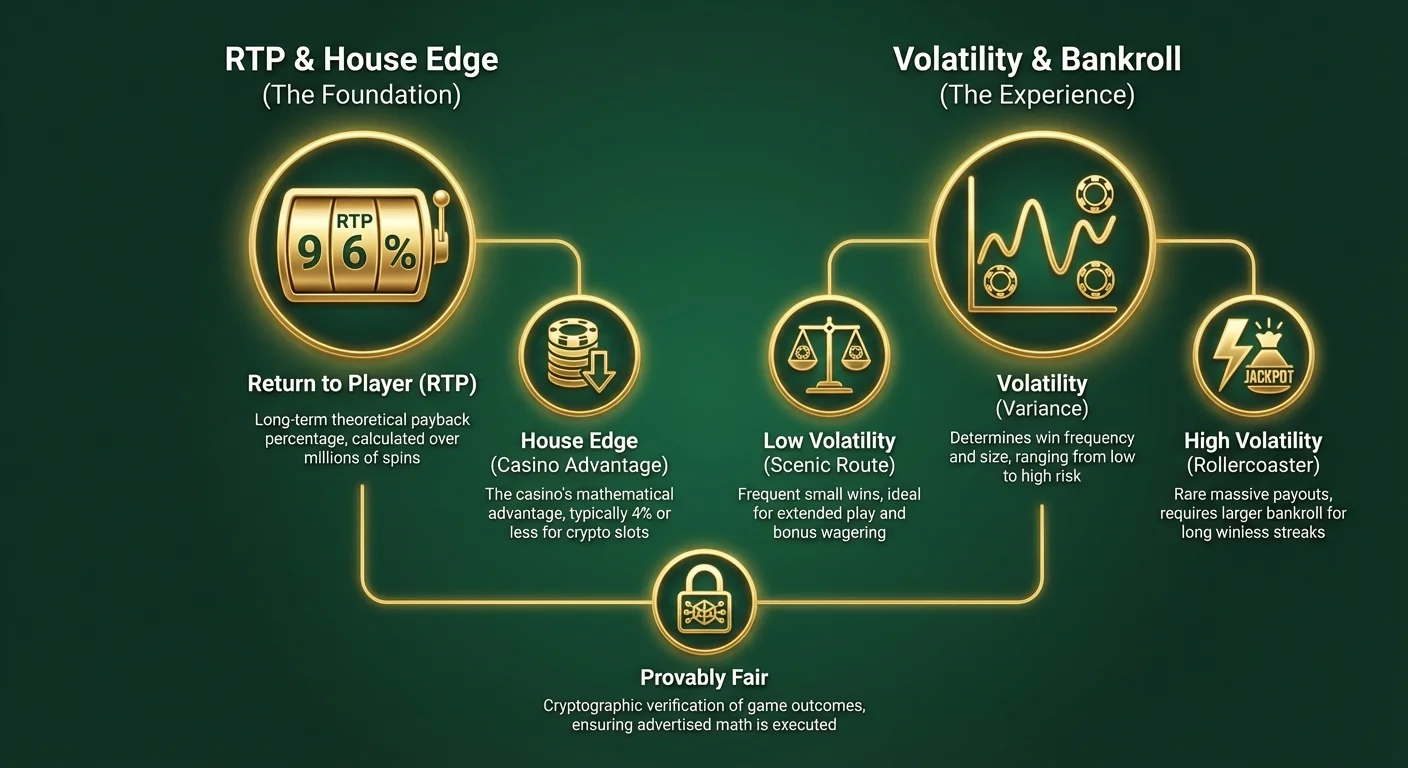
RTP, or Return to Player, is the most common metric used to gauge the generosity of a slot machine. It is a percentage that indicates how much of the wagered money a slot is programmed to pay back to players over time.
How RTP is Calculated
The math behind RTP is theoretical and calculated over millions, sometimes billions, of spins. It is not a prediction of what will happen in a single session.
If a game has an RTP of 96%, the math suggests:
- For every $100 wagered...
- The machine returns $96 to players in winnings.
- The casino keeps $4 (This is the House Edge).
However, this does not mean you will get back $96 if you bet $100 today. You might lose the entire $100, or you might trigger a jackpot and turn that $100 into $10,000. The RTP is the long-term average.
The Crypto Casino Difference
One of the distinct advantages of playing at crypto casinos compared to land-based establishments is the RTP standard.
| Casino Type | Typical RTP Range | Why? |
|---|---|---|
| Land-Based Casino | 70% - 90% | High overhead costs (staff, electricity, building maintenance). |
| Online Fiat Casino | 92% - 96% | Lower overheads, but often taxed heavily by local jurisdictions. |
| Crypto Casino | 96% - 99% | Lower transaction fees, decentralized operations, and fierce competition. |
Key Takeaway: Always check the "Info" or "Help" file within the game. In the crypto gambling world, playing a slot with an RTP below 96% is generally considered a bad bet unless it offers a massive progressive jackpot.
The Thrill Factor: Volatility (Variance)
While RTP tells you how much a slot pays back over time, Volatility (often called Variance) tells you how it pays it back.
Think of RTP as the destination and Volatility as the journey. Two games can both have a 96% RTP but offer completely opposite experiences.
Low Volatility: The Scenic Route
Low variance slots are designed for extended play sessions. They are "low risk" in the sense that your bankroll is unlikely to vanish quickly.
- Behavior: Frequent wins, but the amounts are usually small (often 1x to 5x your bet).
- Goal: Entertainment, unlocking bonuses, or meeting wagering requirements on a deposit bonus.
- The Experience: A steady hum of activity. You win often enough to stay in the game, but you rarely hit a life-changing sum.
Medium Volatility: The Balanced Ride
The most popular category for casual players. These slots offer a compromise.
- Behavior: A mix of small frequent wins and the occasional sizable payout (50x - 100x).
- Goal: A realistic shot at a decent win without burning through a bankroll in minutes.
High Volatility: The Rollercoaster
This is where the "Jackpot Hunters" live. High variance slots are brutal but potentially lucrative.
- Behavior: Long periods of "dead spins" (losing rounds) interspersed with massive, sudden payouts (1,000x, 5,000x, or even 50,000x your bet).
- Goal: Hitting the maximum win potential.
- The Experience: High stress, high adrenaline. You will likely see your balance drain significantly while chasing the one bonus round that pays for everything.
The Relationship Between RTP and Volatility
Many intermediate players make the mistake of looking only at RTP. However, slot machine math requires you to weigh both factors simultaneously.
The "Trap" of High RTP/High Volatility
Imagine a slot with a 98% RTP (excellent) but Extreme Volatility. You might assume this is the best game to play. However, because the volatility is extreme, that 98% return is heavily weighted toward the top 1% of payouts.
If the game collects $1,000,000 in bets:
- It pays back $980,000.
- However, $800,000 of that payback might go to just 10 lucky players who hit the grand jackpot.
- The remaining thousands of players split the crumbs.
Visualization of Variance
To visualize this, compare two hypothetical games with the exact same 96% RTP:
| Metric | Game A (Low Volatility) | Game B (High Volatility) |
|---|---|---|
| Hit Frequency | 40% (Win every 2.5 spins) | 15% (Win every 6.6 spins) |
| Average Win | 2.4x Bet | 30x Bet |
| Max Win | 500x Bet | 20,000x Bet |
| Session Feel | "I'm maintaining my balance." | "I'm losing... losing... HUGE WIN." |
Hit Frequency vs. Win Frequency
In the mechanics of slot machines, there is a subtle but vital distinction between Hit Frequency and specific volatility.
- Hit Frequency: The percentage of spins that result in any payout.
- Win Frequency: The percentage of spins that result in a profit (a payout larger than the wager).
In modern slot design, especially in complex 5-reel or 7-reel video slots, you will often encounter "False Wins." This occurs when you bet $1.00 and the machine flashes lights and plays a celebratory sound, but the payout is only $0.50.
Mathematically, this counts towards the Hit Frequency and the RTP. Psychologically, it feels like a win. Financially, it is a loss. High volatility slots often utilize lower hit frequencies, meaning you simply don't get paid at all on most spins, which is actually more honest than the "death by a thousand cuts" approach of false wins.
Advanced Slot Math: The "Max Exposure"
When browsing slots on crypto platforms, you may see the term Max Exposure or Max Win. This is the hard cap on what the math allows a single round to pay out.
For strategy, this is vital.
- If you are betting 0.001 BTC per spin.
- Slot A has a max win of 500x. The most you can win is 0.5 BTC.
- Slot B has a max win of 50,000x. The most you can win is 50 BTC.
Strategic Tip: If your goal is to change your life with one spin, playing a Low Volatility game with a capped Max Exposure is mathematically futile. You must accept the risk of High Volatility to access the high Max Exposure.
Advantage Play: When the Math Tips in Your Favor
Is it possible to beat the math? Generally, no. However, there is a niche strategy known as Advantage Play. This involves identifying slot machines that are in a "persistent state."
Some modern slots require players to collect symbols (like scarabs, coins, or wild counters) over several spins to trigger a feature.
- The Scenario: A casual player spins a game, collects 9 out of 10 required tokens, runs out of money, and leaves.
- The Advantage Player: Recognizes the machine is "primed." The cost to collect the final token is small compared to the guaranteed payout of the triggered feature.
In this specific, short-term window, the RTP can momentarily exceed 100%. While rare in online crypto slots (as game states are often tied to individual user accounts rather than the "machine"), some games do retain state across sessions. Always check if a game saves your progress on collection bars; if you leave a bar 90% full, you are leaving equity behind.
Practical Strategy: Choosing Your Game
Now that you understand the math, how do you apply this to your next session at a crypto casino? It depends entirely on your profile.
Profile 1: The Bonus Hunter (Grinder)
Goal: You have a deposit bonus with a 35x wagering requirement. You need to churn through a specific amount of bets without losing your principal.
- Strategy: Filter for Low Volatility.
- Target RTP: 97%+.
- Why: You don't care about big wins; you care about recycling your money. The low variance minimizes the swings, allowing the math of the high RTP to work in your favor over thousands of spins, slowly clearing your bonus.
Profile 2: The Casual Crypto Gamer
Goal: You have 0.05 ETH and want to play for an hour on Friday night. You want entertainment and a chance to double up.
- Strategy: Filter for Medium Volatility.
- Target RTP: 96%+.
- Why: This provides the best balance. You likely won't go bust in 10 minutes, and the game features (Free Spins, Wilds) will trigger often enough to keep it fun.
Profile 3: The Jackpot Hunter
Goal: You are playing with "scared money" or profit from a previous win. You want a Lambo or nothing.
- Strategy: Filter for High / Extreme Volatility.
- Target RTP: 95-96% (High volatility games often have slightly lower RTPs to compensate for the massive top-end payouts).
- Why: You are paying for the opportunity to win big. You accept that you will likely lose the entire session bankroll, but the math offers a slight probability of a massive multiplier.
Bankroll Management Based on Volatility
The most practical application of slot math is adjusting your bet size according to volatility. You cannot bet the same way on Starburst (Low Volatility) as you do on Money Train (High Volatility).
The 100/500 Rule:
- For Low Volatility Slots: You need a bankroll of roughly 100 bets.
- Example: If you have $100, you can comfortably bet $1.00 per spin. The frequent small wins will sustain your balance.
- For High Volatility Slots: You need a bankroll of roughly 300 to 500 bets.
- Example: If you have $100, you should bet no more than $0.20 or $0.30 per spin.
- The Math: High variance games can easily go 50+ spins without a significant win. If you bet too big, the math of variance will bankrupt you before you hit the statistical upswing (the bonus round).
The Crypto Factor: Provably Fair and Transparency
One final element of "The Math of Money" unique to our audience is the concept of Provably Fair.
In traditional slots, you trust the regulator. In crypto slots, specifically those built on blockchain tech, you can trust the cryptographic hash.
- The Mechanism: The server creates a seed (the result), hashes it, and sends it to you before you spin. You add a client seed. The result is generated.
- The Verification: After the spin, you can unhash the server seed to verify that the outcome was predetermined by math and not altered after you clicked "Spin" based on your bet size.
While this doesn't change the RTP or Volatility, it guarantees that the math advertised is the math being executed.
Summary: Your Checklist for Smart Play
Before you load up your next slot game, run through this mental checklist:
- Check the RTP: Is it above 96%? If not, does the jackpot justify the lower return?
- Identify the Volatility: Is this a rollercoaster (High) or a scenic drive (Low)?
- Adjust Bet Size: Does my bankroll support the volatility? (Remember the 500-bet rule for high variance).
- Set Limits: The math dictates the house wins eventually. Set a "Win Limit" (e.g., if I double my money, I withdraw) and a "Loss Limit."
By understanding the interplay of RTP and Volatility, you stop viewing slots as magical boxes and start viewing them as probability engines. You may not be able to change the math, but you can certainly choose the equation that solves for the experience you want.