
For many players, the first foray into the world of crypto craps begins and ends with the Pass Line. It is the safe harbor of the casino floor, offering a low house edge and a simple cheering interest: you want the shooter to win. But once you have mastered the basics and understand the rhythm of the virtual dice, the Pass Line can start to feel a little too passive.
If you are reading this, you are likely ready to graduate from being a spectator to a strategist. You want to cover more numbers, see more action, and use your crypto bankroll to maximize table coverage.
This guide covers two of the most respected advanced strategies in the game: The Iron Cross and the 3-Point Molly. These systems sit on opposite ends of the spectrum. One is designed for maximum action and frequent payouts, while the other is a mathematical fortress designed to slice the house edge down to its absolute minimum.
Whether you are betting with Bitcoin, Ethereum, or USDT, the mechanics of the game remain the same, but the speed of online play requires a sharper understanding of these systems. Let's move beyond the basics.
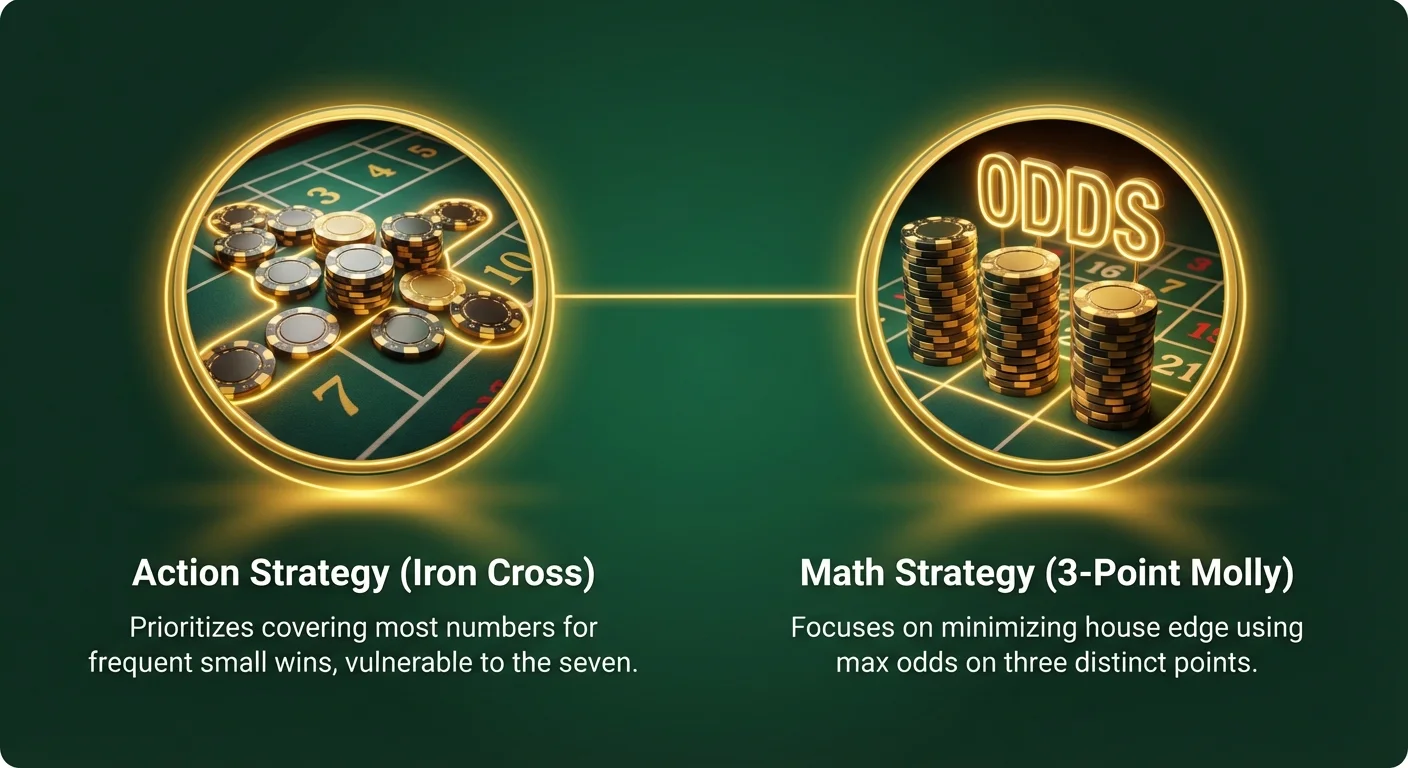
The Difference Between "Action" and "Math"
Before dissecting the specific moves, understand the philosophy behind these two systems. In the world of craps, you generally trade "coverage" for "house edge."
- The Action Player (Iron Cross): You want to win on every roll. You are willing to accept a slightly higher house edge in exchange for the dopamine hit of seeing chips stack up constantly. You fear only one number: the 7.
- The Math Player (3-Point Molly): You are playing the long game. You only care about making bets where the casino has the smallest possible mathematical advantage. You are willing to endure rolls where nothing happens, provided that when you do win, you are paid at true odds.
Understanding which type of player you are is the first step in managing your crypto bankroll effectively.

Strategy 1: The Iron Cross System
Also known as: The "No Seven" System or "Dinner Bet."
Difficulty: Medium
Risk Profile: High frequency wins, vulnerable to the 7.
The Iron Cross is arguably the most popular betting system for players who crave constant action. The premise is incredibly simple: You place a wager that covers every single number on the dice, except for the 7.
If the shooter rolls anything other than a 7, you collect winnings. If the shooter rolls a 7, you lose the board. It is a strategy of accumulation: grinding out small wins repeatedly to build a stack before the inevitable 7 resets the table.
How to Execute the Iron Cross with Crypto Chips
To set up the Iron Cross, you need to combine two different types of bets: Place Bets and the Field Bet.
The Setup:
- Place the 5, 6, and 8: You make standard Place bets on these numbers.
- Bet the Field: You place a wager in the Field box. The Field is a one-roll bet that covers 2, 3, 4, 9, 10, 11, and 12.
The Coverage Map:
| Number Rolled | Winning Bet | Losing Bet | Result |
|---|---|---|---|
| 2 | Field (Pays 2:1 or 3:1) | None | Big Win |
| 3 | Field (Pays 1:1) | None | Win |
| 4 | Field (Pays 1:1) | None | Win |
| 5 | Place 5 (Pays 7:5) | Field | Net Win |
| 6 | Place 6 (Pays 7:6) | Field | Net Win |
| 7 | None | All Bets | Total Loss |
| 8 | Place 8 (Pays 7:6) | Field | Net Win |
| 9 | Field (Pays 1:1) | None | Win |
| 10 | Field (Pays 1:1) | None | Win |
| 11 | Field (Pays 1:1) | None | Win |
| 12 | Field (Pays 2:1 or 3:1) | None | Big Win |
The Mechanics of the Payout
The genius of the Iron Cross lies in the interplay between the Field and the Place bets.
- When a Field Number Hits (2, 3, 4, 9, 10, 11, 12): Your Place bets on 5, 6, and 8 stay up (they are safe). You win the Field bet. You collect your profit and re-bet the Field (or let it ride, depending on the interface).
- When a Place Number Hits (5, 6, 8): This is where it gets tricky. If a 5 rolls, you win your Place bet, but you lose your Field bet.
- Example: You bet $10 on the Field and $10 on the 5. The 5 rolls. You lose the $10 Field bet. However, the 5 pays $14. Your net profit is $4.
- Even though you lost a wager, the payout from the Place bet covers the loss and provides a small profit.
Pros and Cons of the Iron Cross
Pros:
- Constant Feedback: You win on roughly 83% of rolls (30 out of 36 combinations).
- Bonus Clearing: Because you are churning through bets constantly, this strategy can be effective for meeting wagering requirements on crypto bonuses (check terms to ensure low-risk betting is allowed).
- Excitement: There are no "dead rolls" where you just watch the dice.
Cons:
- The House Edge: The Field bet generally has a higher house edge (2.78% or 5.56% depending on the payout for 2 and 12) compared to the Pass Line.
- The "Seven" Wipeout: Since you have money spread across four different betting areas, a single 7 destroys a significant portion of your stack. You need several winning rolls just to recoup the initial investment of setting up the Cross.
Expert Tip: In crypto craps, look for tables that pay triple (3:1) on the 12 in the Field. This reduces the house edge on the Field bet significantly, making the Iron Cross much more viable mathematically.
Strategy 2: The 3-Point Molly
Also known as: The "Max Odds" Strategy.
Difficulty: Advanced
Risk Profile: Low house edge, high volatility, requires larger bankroll.
If the Iron Cross is a shotgun spreading pellets everywhere, the 3-Point Molly is a sniper rifle. This strategy is revered by professional gamblers because it aggressively attacks the casino's weakest point: the Free Odds bet.
The goal is to have three distinct numbers working for you, all backed by maximum odds. This ensures that when you win, you are getting paid at true mathematical odds, diluting the house edge to below 1%.
How to Execute the 3-Point Molly
This strategy involves a specific sequence of betting. You are essentially managing a conveyor belt of bets.
Phase 1: The Pass Line
- Place a standard Pass Line bet.
- Wait for the shooter to establish a Point.
- Once the Point is established, take Max Odds on your Pass Line bet. (In crypto casinos, this is usually 3x, 4x, or 5x your flat bet).
Phase 2: The First Come Bet
- Immediately place a Come Bet.
- Roll the dice.
- If a 7 or 11 hits, your Come bet wins immediately.
- If a 2, 3, or 12 hits, your Come bet loses.
- If any other number rolls (e.g., a 5), your Come bet travels to that number (the 5).
- Once the Come bet travels to a number, take Max Odds on that Come bet.
Phase 3: The Second Come Bet
- Place another Come Bet.
- Repeat the process. Wait for it to travel to a number, then back it with Max Odds.
The Result:
You now have three "points" working:
- The main Pass Line Point.
- Your first Come point.
- Your second Come point.
Phase 4: Maintenance
- If a number hits: You get paid heavily on the Odds. That specific bet comes down. You immediately place a new Come bet to replace it, ensuring you always have three numbers working.
- If a 7 hits: You lose all three flat bets and all three odds bets. Game over. Start from Phase 1.
Why "Molly" Loves Crypto Odds
The heart of this strategy is the Odds Bet.
- House Edge: 0.00%.
- Payout: True odds (e.g., 6 and 8 pay 6:5, 4 and 10 pay 2:1).
By placing a small flat bet (which has a house edge) and a large odds bet (which has no house edge), you dilute the casino's advantage.
- Example: A $10 Pass Line bet has a 1.41% house edge. If you add $50 in Odds, the combined house edge on your total $60 wager drops significantly, often below 0.5%.
Pros and Cons of the 3-Point Molly
Pros:
- Best Odds in the House: Aside from the Don't Pass, this is mathematically the strongest way to play craps.
- Scalability: If a shooter gets hot and rolls for 20 minutes, hitting various numbers, the 3-Point Molly funnels massive winnings into your wallet because you are constantly replacing winning bets.
- Protection: Come bets act as a partial hedge. If a shooter rolls a 7 on the roll you place a new Come bet, that Come bet wins (offsetting some losses).
Cons:
- Bankroll Heavy: You need enough crypto to cover three flat bets and three sets of max odds simultaneously.
- Volatility: If the table is "choppy" (point, seven, point, seven), you will lose your flat bets before you can establish the odds, draining your balance quickly.
Comparative Analysis: Which System Fits You?
Choosing between the Iron Cross and the 3-Point Molly depends on your goals and your risk tolerance.
| Feature | Iron Cross | 3-Point Molly |
|---|---|---|
| Primary Goal | Win on every non-7 roll (Coverage) | Lower the House Edge (Math) |
| House Edge | Higher (due to Field/Place bets) | Lowest Possible (due to Free Odds) |
| Bankroll Swing | Gradual accumulation, sudden drops | Large swings, massive potential upside |
| Action Level | High (Paid almost every roll) | Medium (Paid only when points hit) |
| Hit Frequency | ~83% of rolls | ~30-40% of rolls (depending on points) |
| Best For | Bonus wagering, short sessions | Long sessions, pure gambling |
The Crypto Factor: Speed and Interface
When playing online at CryptoGambling.com recommended sites, game speed is an important factor.
- Iron Cross: In a physical casino, the dealer places these bets. Online, you have to click them yourself. Look for a "Rebet" button. If the interface is clunky, the Iron Cross can be tedious to set up every roll.
- 3-Point Molly: This is easier to manage online. The UI usually highlights where your Come bets have traveled, and clicking to add odds is intuitive.
Practical Tips for Crypto Craps Grinders
Advanced strategies require advanced discipline. Here is how to keep your head in the game when the Bitcoin is on the line.
1. Provably Fair vs. Dice Control
You will see source material online discussing "dice control" or "setting the dice." Ignore this completely for online crypto craps. Unless you are playing a Live Dealer game with a physical arm tossing dice, the result is determined by a Random Number Generator (RNG).
- Tip: Check the "Provably Fair" hash on your crypto casino. This ensures the roll was predetermined by a seed and not manipulated by the site, but it also confirms that physics strategies do not apply. Stick to the math of the 3-Point Molly.
2. Managing the "Contract"
In the 3-Point Molly, remember that the Pass Line and Come bets are Contract Bets. Once they travel to a number, you cannot remove them until they win or lose. But the Odds are not contracts.
- Strategy: If you feel your luck turning or your bankroll dipping too low, you can turn off or remove your Odds bets. You can't take down the Come bet, but you can save the bulk of your wager by pulling the Odds.
3. The "Press" Move
For Iron Cross players, the temptation is to pocket every win. However, the payouts on the 5, 6, and 8 are small. A popular variation is to "Press" (double) the bet after a win.
- Example: You have $12 on the 6. It hits, paying $14. Instead of racking the chips, tell the dealer (or click the UI) to press the 6 to $24. Now, if it hits again, you win $28. This allows you to use the casino's money for larger wins.
4. Bankroll Sizing
These strategies are expensive.
- Iron Cross: Minimum 10x your total board layout. If your total layout cost is $44 ($10 field + $34 inside), you need $440 to weather the variance.
- 3-Point Molly: Minimum 20x your Pass Line bet. If you bet $10 on the Pass, you need $200+ because you will have $60-$80 on the table at once when fully loaded.
Summary
Craps is a game of organized chaos. The Iron Cross tries to tame the chaos by throwing a net over the entire table, catching small fish on every roll but fearing the shark (the 7). The 3-Point Molly tries to swim with the current, using the mathematical purity of the Odds bet to neutralize the casino's advantage.
For the crypto gambler, the 3-Point Molly is generally the superior choice for preserving capital and playing a mathematically sound game. However, if you are looking for a short, high-adrenaline session to try and double a small deposit quickly, the Iron Cross provides the action you crave.
Remember, no system overcomes the house edge permanently. The dice have no memory, and every roll is independent. Bet with your head, manage your crypto wisely, and may the shooter never seven-out.