
For decades, the craps table has been the heartbeat of the casino floor. It is the loudest, most energetic, and often the most intimidating section of any gambling establishment. The transition to the digital world has split this classic game into two distinct experiences: Live Dealer Craps and RNG (Random Number Generator) Craps.
If you are playing with cryptocurrency, you have the unique advantage of instant deposits and often higher betting limits, but the question remains: which format gives you the best chance to win, and which provides the most enjoyment?
This guide breaks down the mechanics, pros, cons, and strategic adjustments required for both versions. Whether you are a "Dark Side" bettor looking for speed or a traditionalist seeking the camaraderie of the table, understanding the differences is key to managing your bankroll effectively.
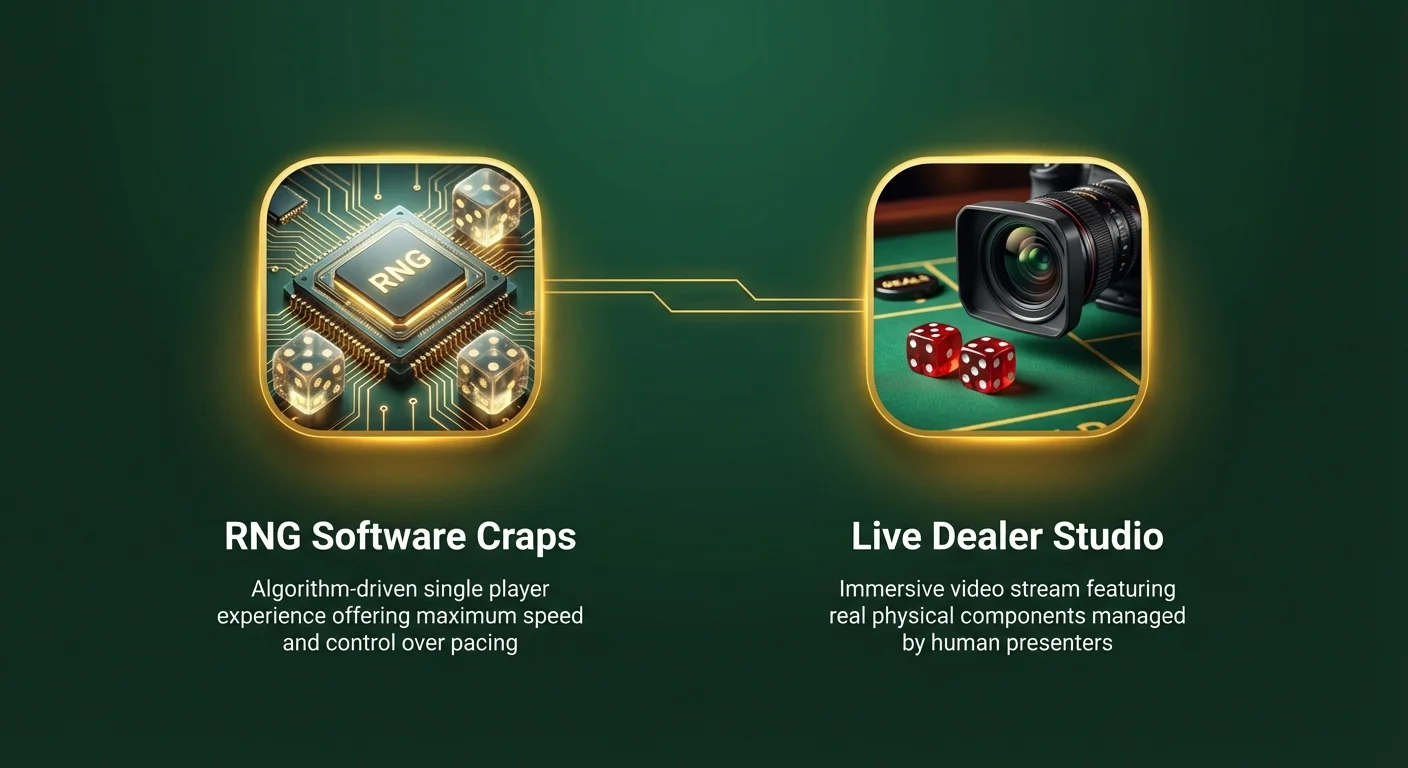
Understanding the Two Contenders
Before diving into strategy, it is essential to define exactly what happens behind the screen in each version.
RNG Craps: The Software Approach
RNG Craps is a single-player experience powered by a computer algorithm. When you press "Roll," the software instantly generates a result based on mathematical probabilities that mirror real dice. There are no other players, no dealers, and no physical dice. There is no better way to understand how the system generates a result than looking at the blockchain.
Live Dealer Craps
Live Dealer Craps streams a video feed from a specialized studio (often located in Europe or Asia) directly to your device. A human presenter manages the table, but to ensure fairness and speed, the dice are often launched by a mechanical arm (a "shooter") or rolled by the host under strict supervision. You play alongside hundreds of other users, seeing their chats and wins in real-time.
The RNG Craps Experience: Speed and Control
For many crypto gamblers, software-based craps is the superior choice for one specific reason: Control. In RNG craps, you are the master of time. There is no timer counting down your betting window, and the dice don't roll until you say so.
The Pros of RNG Craps
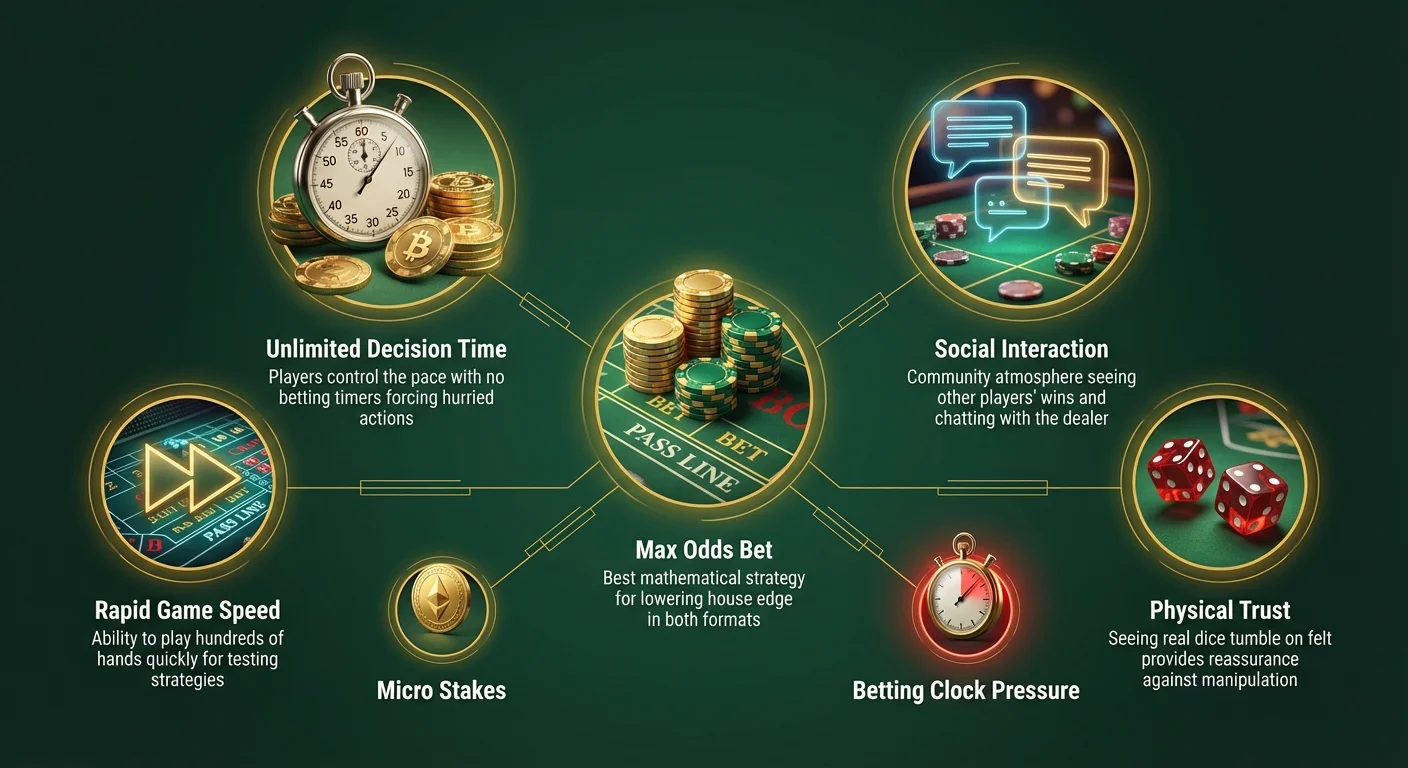
- Unlimited Decision Time: If you are a beginner learning the difference between a Place Bet and a Hardway, RNG is your training ground. You can pull up a cheat sheet, calculate the house edge, and place your chips without a stickman rushing you.
- Game Speed: You control the pace. If you want to play 100 hands in 10 minutes to test a specific betting system, you can. If you want to take a break to answer a text, the game waits for you.
- Lower Minimums: RNG tables often allow bets as low as $0.10 or $1.00 (or the crypto equivalent). This is ideal for bankroll management.
- Provably Fair Technology: Many crypto-specific crash and table games use "Provably Fair" algorithms. This allows tech-savvy players to verify the randomness of every roll on the blockchain, ensuring the casino didn't manipulate the result.
The Cons of RNG Craps
- Zero Atmosphere: It can feel clinical. There is no cheering, no social interaction, and winning a big Parley feels less celebratory when you are alone.
- Trust Issues: Despite audits, some players simply do not trust a computer program to generate random numbers as much as they trust physical gravity.
The Live Dealer Experience: Immersion and Realism
Live Studio Craps attempts to bridge the gap between Las Vegas and your laptop. Leading providers like Evolution Gaming have created stunning studios that replicate the "speakeasy" vibe of a physical casino.
The Pros of Live Dealer Craps
- Social Interaction: You can chat with the dealer and other players. Seeing a stream of "Winners!" scroll up the screen when a Point is hit creates a sense of community.
- Visual Trust: You watch the dice fly. For many, seeing physical dice tumble and land on a felt table is the only way they feel comfortable betting big amounts of Bitcoin or Ethereum.
- Realistic Pacing: The game flows like a real casino game. There is a betting period, a rolling period, and a payout period. This natural pause can help prevent "tilt" (betting emotionally) compared to the rapid-fire nature of RNG.
The Cons of Live Dealer Craps
- The "Betting Clock": You typically have 15 to 20 seconds to place your bets. If you are trying to set up a complex strategy like the Iron Cross or 3-Point Molly, you must be fast with your mouse clicks.
- Higher Minimums: Live tables usually have higher entry points (often $5 to $10 minimums) because running a studio with human staff is expensive.
- Mechanical Shooters: To prevent the "host" from influencing the dice, many live studios use a mechanical arm to shoot the dice. While fair, some purists feel this lacks the "soul" of a human shooter.
Comparison: RNG vs. Live Studio
| Feature | RNG (Software) Craps | Live Dealer Craps |
|---|---|---|
| Pace of Play | Player-controlled (Fast or Slow) | Dealer-controlled (Steady) |
| Minimum Bet | Low (Micro-stakes available) | Medium to High |
| Immersion | Low (2D or 3D graphics) | High (HD Streaming, Audio) |
| Strategy Time | Unlimited | Restricted (approx. 15-20 sec) |
| Free Play | Often available (Demo Mode) | Rarely available |
| Fairness | Audited RNG / Provably Fair | Physical Dice / Mechanical Shooter |
Strategic Adjustments for Each Format
The math of craps - the odds and house edge - remains the same regardless of the format. A Pass Line bet generally has a house edge of 1.41% in both versions. However, how you execute your strategy should change.
1. The "Dark Side" Strategy (Don't Pass)
- Best Format: RNG
- Why: Betting the Don't Pass (betting against the shooter) is mathematically superior (1.36% House Edge) but socially awkward in a live setting. In a physical casino, you are betting against the rest of the table. In Live Dealer online, you might still feel that "social pressure." In RNG, you are playing against a machine. You can bet the Don't Pass all day without feeling like the villain.
2. The Odds Bet
- Best Format: Both (Vital Strategy)
- Strategy: As referenced in standard craps guides, taking "Odds" on your Pass Line bet is the best bet in the casino because the house edge is 0.00%.
- The Adjustment: In RNG, taking max odds is easy - you just click. In Live Dealer, check the table limits. Some live tables limit odds to 2x or 3x, whereas some RNG crypto games allow up to 100x odds, significantly lowering the combined house edge.
3. Complex Betting Systems (Iron Cross / 3-Point Molly)
- Best Format: RNG (for beginners) or Live (for pros)
- Why:
- The Iron Cross involves betting the Field plus placing the 5, 6, and 8.
- The 3-Point Molly involves a Pass Line bet followed by continuous Come bets with odds.
- The Problem: These require placing chips on multiple areas of the layout after every single roll. In Live Dealer, the betting timer places immense pressure on you to click accurately. In RNG, you can utilize "Repeat Bet" buttons comfortably or take your time setting chips.
4. Prop Bets and Hardways
- Best Format: Live Dealer (for entertainment only)
- Why: Hardways (e.g., betting a Hard 8) have high payouts but terrible odds (House Edge around 9-11%).
- The Trap: In RNG craps, the speed of the game is dangerous. Because you can roll 10 times a minute, you can deplete your bankroll on Hardways in seconds. The slower pace of Live Dealer protects your bankroll from these high-variance bets simply because fewer rolls happen per hour.
The Myth of Dice Control in Online Play
In physical casinos, some players practice Dice Control or "Rhythmic Rolling" - setting the dice in a specific V-shape or 3-V set to influence the outcome.
Does this apply online?
- RNG: Absolutely not. The result is determined by a random number generator the millisecond you click "Roll." The animation of the dice is just a video playing out a pre-determined result.
- Live Dealer: No. You are not the shooter. The shooter is either a mechanical arm or a TV presenter. You cannot influence the physics of the roll through a screen.
Strategy Tip: Ignore any "systems" sold online that claim to predict dice patterns based on previous rolls in online craps. This is known as the Gambler's Fallacy. The dice have no memory. If a 7 has rolled five times in a row, the odds of it rolling again are exactly the same (1 in 6).
Why Crypto Craps is Different
Playing craps with Bitcoin, Ethereum, or Litecoin adds a layer of utility that traditional banking cannot match.
- Bankroll Segmentation: Crypto allows you to keep your gambling funds separate from your main bank account.
- Micro-Transactions: If you want to test a strategy like the "Field Bet Martingale" (doubling your bet after a loss), you need a massive bankroll compared to your minimum bet. Crypto casinos often allow bets in fractions of a coin, allowing you to test these high-risk strategies with pennies before scaling up.
- Instant Payouts: There is nothing worse than hitting a hot streak on the craps table and waiting 5 days for a bank transfer. Crypto withdrawals are usually processed in minutes.
Which Version Suits You?
Choose RNG Craps If:
- You are a beginner learning the ropes.
- You want to play purely by the math (Don't Pass + Max Odds).
- You have a smaller bankroll and want to play micro-stakes.
- You want to play a quick session (5-10 minutes).
- You prefer the "Provably Fair" cryptographic verification.
Choose Live Dealer Craps If:
- You crave the casino atmosphere and human connection.
- You are superstitious and trust physics over algorithms.
- You have a larger bankroll and can absorb higher minimums.
- You tend to "tilt" and need a slower pace to keep your betting disciplined.
Conclusion
Craps is a game of variance, excitement, and, if played correctly, one of the lowest house edges in the casino. Whether you choose the immersive studio lights of Live Dealer or the rapid-fire precision of RNG, the fundamentals of winning remain the same: avoid the prop bets, take the free odds, and manage your crypto bankroll wisely.
For the ultimate beginner experience, start with RNG Craps in "Demo Mode" or with low stakes. Once you can place a "Inside Place Bet" without thinking twice, graduate to the Live Dealer tables and enjoy the show.