
The search for a mathematical edge in blackjack is as old as the game itself. While card counting remains the only proven method to gain a long-term statistical advantage over the house, it requires immense skill, concentration, and often gets you ejected from land-based casinos. For the vast majority of players, particularly those playing online at crypto casinos, betting systems represent a different kind of allure: the attempt to manage bankroll and volatility through structured wagering patterns.
This guide analyzes the three most prominent betting systems: the Martingale strategy, the Paroli system, and the Fibonacci sequence. We will test these theories against the mathematical realities of blackjack, review the risks of negative progression, and show why "positive progression" is generally the better approach for disciplined players.
The Foundation: Strategy Before Systems
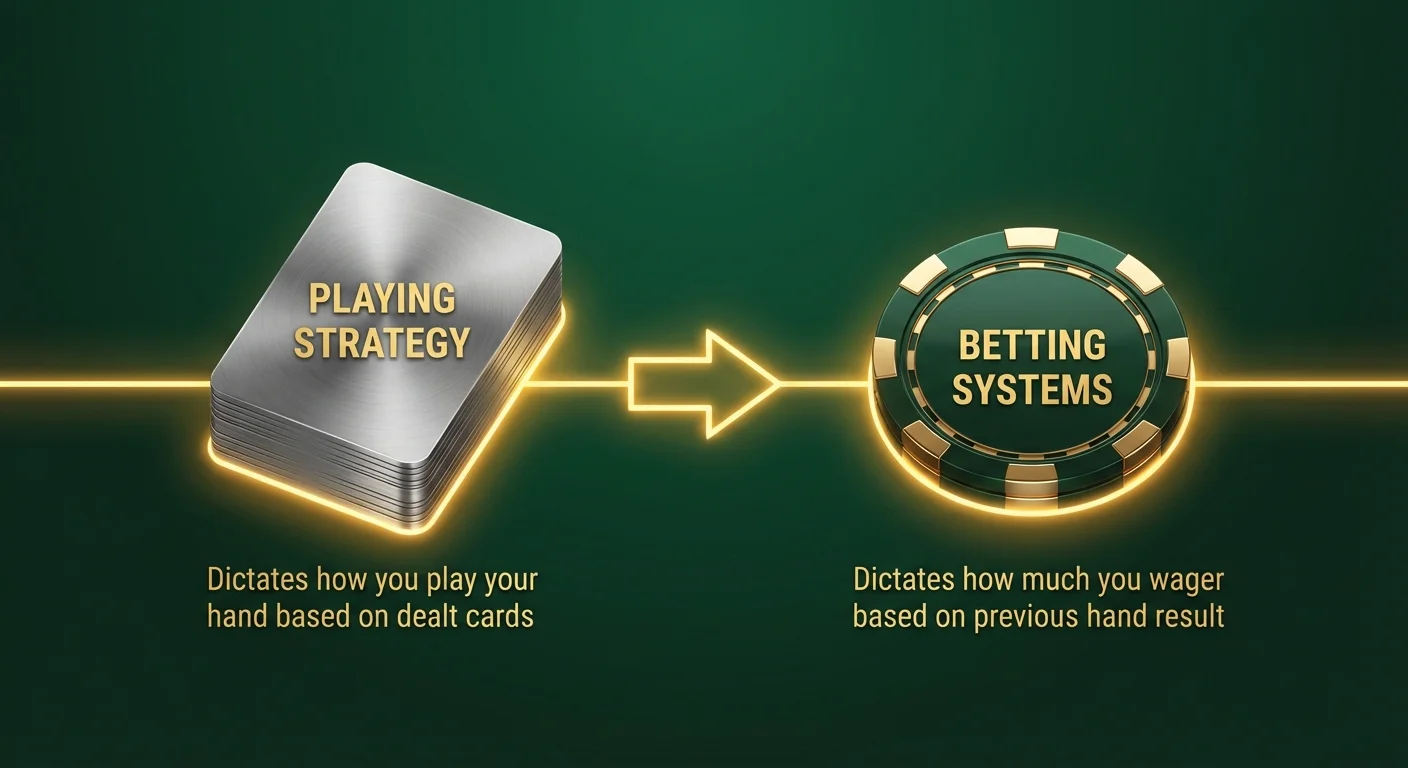
Before applying any betting system, you must distinguish between playing strategy and betting systems.
- Playing Strategy dictates how you play your hand (Hit, Stand, Double, Split) based on the cards dealt.
- Betting Systems dictate how much you wager based on the result of the previous hand.
No betting system can overcome a lack of Basic Strategy. If you are playing by "feel" rather than mathematical probability, you are increasing the House Edge (HE) significantly. A standard blackjack game with decent rules has a House Edge of roughly 0.5%. However, if you play poorly, that edge can skyrocket to 2% or 3The Golden Rule: You must master Basic Strategy charts before attempting any progressive betting system. Without it, you are simply accelerating your losses.es.
The Importance of Table Rules
The effectiveness of a betting system relies heavily on the Return to Player (RTP) percentage. You must seek out tables that offer 3:2 payouts for a blackjack.
Many casinos are shifting to 6:5 payouts. The difference is mathematically devastating. On a $10 bet, a 3:2 table pays $15 for a blackjack, while a 6:5 table pays only $12. This shift alone increases the House Edge by approximately 1.39%, effectively neutralizing the benefits of any variance-based betting system.

The Gambler's Fallacy: The Myth of "Due" Wins
The engine that drives most negative progression systems (like the Martingale) is the "Gambler's Fallacy." This is the psychological belief that if an event has happened frequently in the past, it is less likely to happen in the future (or vice versa).
In blackjack, this manifests as: "I have lost five hands in a row; the law of averages says I am due for a win."
The Reality: The cards have no memory. In a fresh shoe (or a Continuous Shuffling Machine used in many online RNG games), the odds of winning the next hand remain constant regardless of the previous ten outcomA betting system that relies on the concept of being "due" is mathematically flawed. However, systems can still be useful for bankroll management - controlling how much you lose during a cold streak and how much you extract during a hot streak. This relates directly to surviving betting variance.eak.
The Martingale System: Aggressive Negative Progression
The Martingale is the most famous, and infamous, betting strategy in existence. It is classified as a negative progression system, meaning you increase your bet when you lose.
How It Works
The premise is theoretically sound in a world with infinite bankrolls and no table limits: You double your bet after every loss. The goal is to recover all previous losses plus a profit equal to the original unit bet with a single win.
The Sequence:
- Bet 1 Unit ($10). Result: Lose. (Total Loss: $10)
- Bet 2 Units ($20). Result: Lose. (Total Loss: $30)
- Bet 4 Units ($40). Result: Lose. (Total Loss: $70)
- Bet 8 Units ($80). Result: Lose. (Total Loss: $150)
- Bet 16 Units ($160). Result: Win. (Total Win: $320 - $160 stake = $160 profit).
Net Result: You regain the $150 lost in previous hands and profit $10 (the original unit).
The Fatal Flaws
While the Martingale looks unbeatable on paper, it fails in practice due to two primary factors:
- Exponential Growth: Doubling numbers grow terrifyingly fast. By the 8th loss, a $10 starting bet requires a $1,280 wager just to win back your original $10.
- Table Limits: Every blackjack table has a maximum bet. If you hit a losing streak of 7 or 8 hands (which is statistically not uncommon over a long session), you will hit the table limit, a risk professional bettors calculate using optimal bet sizing. Once you cannot double your bet, the system collapses, and the accumulated losses are locked in.
The Crypto Advantage?
Crypto gambling sites often boast significantly higher table limits than traditional casinos (sometimes up to 5 BTC or more). While this technically extends the "runway" for a Martingale player, allowing for a longer losing streak before hitting the cap, it also exposes the player to massive financial risk. Losing 10 hands in a row is rare, but losing 1 BTC trying to win 0.001 BTC is a risk-to-reward ratio that most professional gamblers avoid. This necessitates strong bankroll management with volatile assets.
The Fibonacci Sequence: The "Natural" Grind
For players who find the Martingale too volatile, the Fibonacci system offers a softer negative progression. It uses a mathematical sequence found in nature (1, 1, 2, 3, 5, 8, 13, 21...) where each number is the sum of the two preceding numbers.
How It Works
In betting terms, you move one step up the sequence when you lose, and two steps back when you win.
The Scenario:
- Bet $10 (1): Lose.
- Bet $10 (1): Lose.
- Bet $20 (2): Lose.
- Bet $30 (3): Lose.
- Bet $50 (5): Lose.
- Bet $80 (8):): Win.
The Recovery:
After the win at $80, you do not reset to the beginning. You move two steps back in the sequence (from 8, past 5, to 3). Your next bet is $30.
Analysis
The Fibonacci is less aggressive than the Martingale because it does not aim to recoup all losses in a single win. Instead, it aims to grind your way back to even over a series of wins.
- Pros: It protects your bankroll longer than Martingale. You can survive a longer losing streak without hitting table limits.
- Cons: It is complex to track. Also, a single win does not wipe out the deficit; you need a cluster of wins to recover from a deep hole.
The Paroli System: Positive Progression (The Recommended Approach)
In contrast to the previous systems, the Paroli (often called the Reverse Martingale) is a positive progression system. This means you increase your bet only when you win.
How It Works
The philosophy of Paroli is to capitalize on "hot streaks" while minimizing damage during "cold streaks." You maximize risk only when playing with the casino's money (your previous winnings).
The Paroli "Rule of Three":
- Bet 1 Unit ($10): Win. (Profit: $10)
- Bet 2 Units ($20): Win. (Profit: $30 total)
- Bet 4 Units ($40): Win. (Profit: $70 total)
- STOP. Reset to 1 Unit.
Why It Is Superior
The Paroli system addresses the main psychological and mathematical trap of gambling: the fear of losing what you have won vs. the desire to chase what you have lost.
- Risk Mitigation: If you lose Hand 1, you lose a flat unit. If you lose Hand 3 (the $40 bet), you have technically only lost your original $10 investment, as the other $30 was profit from the streak.
- No Table Limit Issues: Because you reset after three wins, you rarely approach table maximums.
- Psychological Ease: It is far less stressful to bet big when you are "up" than when you are frantically trying to recover a massive loss.
Paroli Strategy Table
| Step | Bet Amount | Outcome: WIN | Outcome: LOSS | Net Position (if Loss) |
|---|---|---|---|---|
| 1 | 1 Unit | Move to Step 2 | Restart at Step 1 | -1 Unit |
| 2 | 2 Units | Move to Step 3 | Restart at Step 1 | -1 Unit (Original Stake) |
| 3 | 4 Units | Take Profit & Reset | Restart at Step 1 | -1 Unit (Original Stake) |
Note: In Step 3, if you lose, you lose the profit from hands 1 and 2, plus your original stake. However, the feeling is often that you "broke even" on the session, despite the mathematical loss of the original unit.
System Comparison: Risk vs. Reward
To help you decide which system aligns with your playstyle, consider this comparison based on a standard 6-deck blackjack game.
| Feature | Martingale | Fibonacci | Paroli |
|---|---|---|---|
| Progression Type | Negative (Increase on Loss) | Negative (Increase on Loss) | Positive (Increase on Win) |
| Risk Level | Extremely High | High | Low to Medium |
| Bankroll Required | Massive (to sustain doubling) | Large | Moderate |
| Recovery Ability | Instant (One win fixes all) | Slow (Requires multiple wins) | N/A (Focuses on streaks) |
| Best For | Short sessions, High Rollers | Mathematical grinders | disciplined players, Beginners |
| Fatal Flaw | Table Limits | Complexity & "The Grind" | Requires winning streaks |
Advanced Considerations for Crypto Blackjack Players
Playing blackjack with cryptocurrency introduces factors that affect how these systems perform.
1. Provably Fair Algorithms
Unlike physical card shoes, many crypto-native blackjack games use "Provably Fair" technology. This allows you to verify the randomness of every shuffle and deal on the blockchain. For system players, this ensures that the game isn't "rigged" to break a Martingale progression intentionally. However, remember that a fair RNG still produces long losing streaks purely by chance.
2. Speed of Play
Crypto blackjack (especially non-live dealer versions) is incredibly fast. You can play 600+ hands per hour.
- Danger: Fast play devastates a Martingale player. You can wipe out a bankroll in 5 minutes if you hit a bad variance pocket.
- Strategy: If using negative progression, deliberately slow your play. If using Paroli, the speed allows you to hunt for streaks more efficiently.
3. European vs. American Rules
When playing online, you will encounter both American and European blackjack.
- American: Dealer peeks for Blackjack. If they have it, the round ends immediately.
- European: Dealer takes no hole card until you finish playing.
- System Impact: European rules are riskier for doubling down and splitting (essential parts of Basic Strategy). If you double your bet (via system) AND double down (via game rules) against a dealer 10, and the dealer ends up with Blackjack, you lose everything. In American blackjack, you would only lose the original bet. Stick to American rules (Dealer Peeks) when playing aggressive systems.
4. Surrender is Your Friend
If your casino offers "Late Surrender," use it. Surrendering allows you to forfeit half your bet on a losing hand (e.g., 16 vs. Dealer 10).
- System Tip: In a Martingale, surrendering breaks the math slightly, but saving 50% of a large wager is often better than risking the double-up on a statistically doomed hand.
Summary: The Verdict
After testing and analyzing the mechanics of these three systems, the conclusion for the intelligent gambler is clear.
Avoid the Martingale unless you have a bankroll that can withstand a 10-hand losing streak and are playing at a table with exceptionally high limits. The risk of "ruin" is simply too high relative to the small unit profit you gain.
The Fibonacci serves as a middle ground but often results in a long, slow bleed where you spend hours grinding just to break even.
The Paroli System is the better choice for most players. It aligns with the fundamental rule of asset management: protect your principal and speculate with profits. By capping your winning streaks at three or four hands, you lock in profits regularly. It turns the hunt for a "hot streak" into a disciplined strategy rather than a reckless gamble.
Remember, no betting system changes the House Edge. The casino will always have the statistical advantage. The goal of these systems is not to magically alter the odds, but to structure your betting in a way that maximizes entertainment and gives you a roadmap for when to bet big and when to walk away.