
Craps is a game defined by its distinct rhythm. It is a game of manic highs, where the shooter can do no wrong, and crushing lows, where the "seven-out" call seems to echo every time the dice hit the felt. For the crypto gambler, this volatility is a familiar friend. You are already accustomed to market charts that swing wildly; the craps table is simply the gamified version of that same adrenaline rush.
However, surviving the table requires more than just hoping for a "hot roll." It requires a disciplined approach to managing your digital assets. When you are betting with Bitcoin, Ethereum, or stablecoins, the stakes often feel different than physical chips. The speed of online play combined with the volatility of the underlying asset creates a unique environment that demands intermediate to advanced bankroll management.
This guide moves beyond the basic rules of how to play. Instead, we will focus on how to size your bets, protect your portfolio during cold streaks, and leverage your stack when the dice heat up.
The Intersection of Crypto Volatility and Game Variance
Before placing a chip, it is vital to understand the "Double Volatility factor" unique to crypto gambling. In a traditional casino, a $10 chip is always worth $10. In crypto casinos, your bankroll fluctuates based on two vectors:
- Game Variance: The mathematical swings inherent to Craps.
- Asset Volatility: The market value of the coin you are betting with.
If you are betting with a volatile asset like Bitcoin (BTC) or Solana (SOL), a market dip during your session can compound your losses. Conversely, a market pump can make a small win massive in fiat terms.
The Golden Rule: To manage this, many professional crypto gamblers prefer using Stablecoins (USDT, USDC) for the actual gameplay to isolate the game variance. If you choose to play with volatile coins, your bankroll management must be more conservative to account for the potential of a double-downswing.
Defining Your Unit Size and Session Bankroll
The most common mistake intermediate players make is betting arbitrary amounts based on "gut feeling." To survive the house edge, you must mathematically define your betting unit.
1. The Total Bankroll vs. Session Bankroll
Your Total Bankroll is the amount of crypto you have set aside strictly for gambling. This should never be money required for bills or investments.
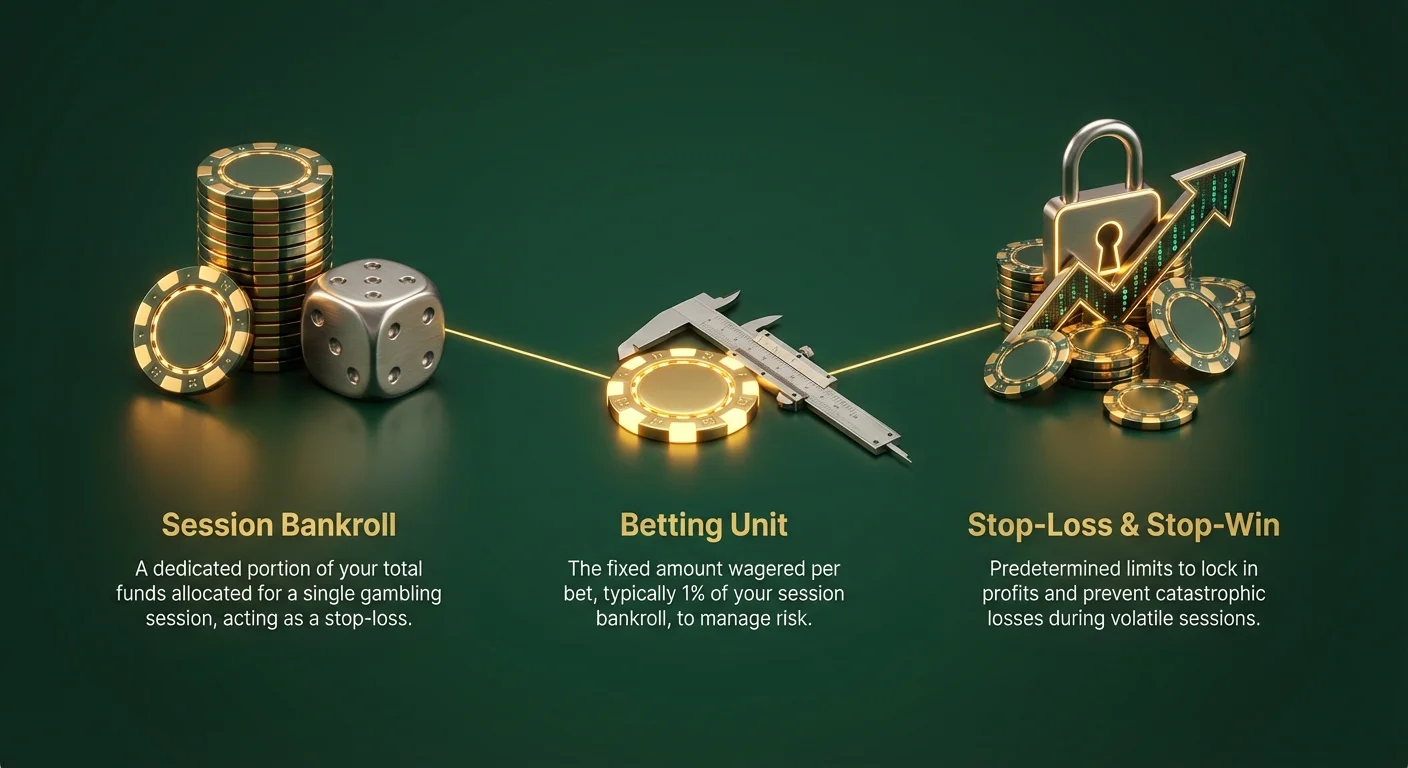
Your Session Bankroll should be 10% to 20% of your Total Bankroll. This is the "Stop Loss" for the day. If this amount vanishes, the session ends immediately.
2. Calculating the Betting Unit
In Craps, you often have multiple bets working simultaneously (e.g., a Pass Line bet + Odds + two Place bets). Therefore, your "Unit" isn't just one chip; it is the total liability on the table.
A safe strategy for volatile markets is the 1% Rule: Your base bet (Pass Line) should not exceed 1% of your Session Bankroll.
| Metric | Conservative Approach | Aggressive Approach |
|---|---|---|
| Total Bankroll | 1000 USDT | 1000 USDT |
| Session Bankroll | 100 USDT (10%) | 200 USDT (20%) |
| Base Unit (Pass Line) | 1 USDT | 5 USDT |
| Max Exposure Per Roll | 5 USDT | 25 USDT |
Low-House-Edge Strategies: The Foundation of Survival
To manage your stack effectively, you must focus on bets that offer the best return on investment (ROI) and the lowest House Advantage (HA). High HA bets drain your bankroll like a leaking wallet; low HA bets allow you to tread water until a winning streak hits.
The Pass Line and Taking Odds
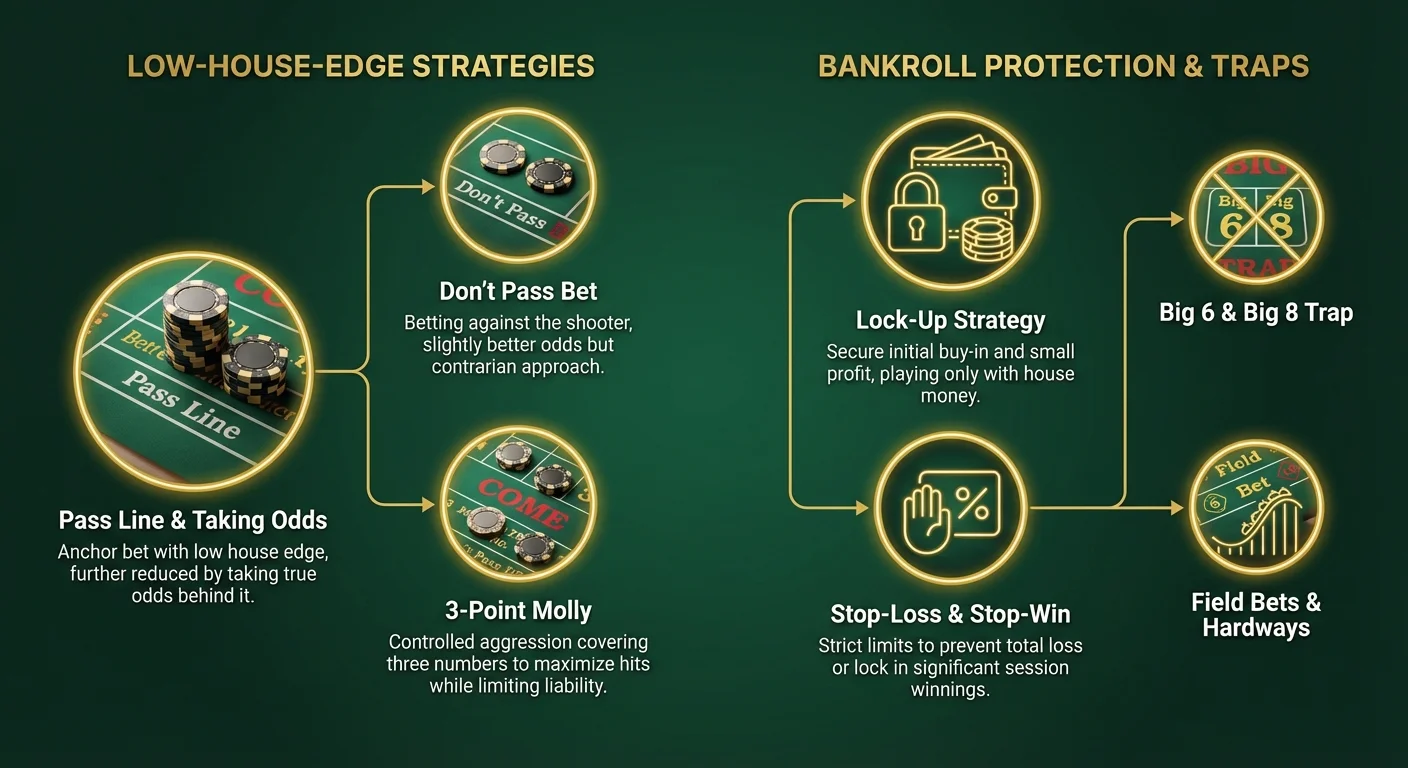
The Pass Line is the anchor of craps strategy. It has a low HA of 1.41%. However, the true secret to bankroll preservation is "Taking the Odds."
Once a point is established, you can place an additional bet behind your Pass Line wager. This is the only bet in the casino with zero house edge (0.00%). It pays true odds.
- Strategy: Bet the minimum table limit on the Pass Line and the maximum your bankroll allows on the Odds.
- Why it works: By weighting your wager toward the Odds bet rather than the flat bet, you dilute the total house edge.
Combined House Edge by Odds Taken:
| Odds Taken | Combined House Edge | Effect on Bankroll |
|---|---|---|
| No Odds | 1.41% | Slow Drain |
| 1x Odds | 0.85% | Good |
| 2x Odds | 0.61% | Better |
| 3x-4x-5x Odds | ~0.37% | Excellent |
| 100x Odds | 0.01% | Near Even Money |
Note: While 100x odds exist in some casinos, they require a massive bankroll to sustain variance. Stick to 3x-5x odds for intermediate play.
The Don't Pass (The "Dark Side")
Mathematically, the "Don't Pass" bet (betting against the shooter) is slightly superior to the Pass Line, with a house edge of 1.36%.
- The Strategy: You are betting that the shooter will seven-out before hitting the point.
- Bankroll Implication: This is a "contrarian" strategy. In crypto terms, this is like shorting the market. It is highly effective on "cold" tables where shooters are sevening-out quickly. It protects your stack by aligning you with the statistics (the 7 is the most common number rolled).
Intermediate Strategies: The 3-Point Molly
For players looking to capitalize on a hot shooter without exposing their entire stack to ruin, the 3-Point Molly is the standard for controlled aggression. This strategy ensures you have coverage on three numbers, maximizing your chances of hitting a payout while maintaining a ceiling on your liability.
How to Execute:
- Bet Pass Line: Place your unit bet.
- Back it up: Once a point is established, take maximum odds on the Pass Line.
- Place a Come Bet: Drop a unit on the "Come" area. This acts exactly like a new Pass Line bet for the next roll.
- Repeat: When the Come bet travels to a number (e.g., the shooter rolls a 5), take odds on that Come bet. Place one more Come bet.
- Hold: Once you have a Pass Line bet and two Come bets established (all with odds), stop placing new bets.
Why this protects your stack:
If the shooter rolls a 7, you lose everything on the table. By capping yourself at three numbers ("Three Points"), you limit the catastrophic damage of a "Seven-Out" while ensuring that if the shooter rolls a 4, 5, 6, 8, 9, or 10, you likely have money on it.
The Leaks: Bets That Destroy Bankrolls
In crypto trading, "fees" kill profits. In Craps, "Prop Bets" and bad math kill bankrolls. To survive volatile markets, you must ruthlessly eliminate high-house-edge wagers from your portfolio.
The Big 6 and Big 8 Trap
On many tables, you will see a large "Big 6" and "Big 8" section.
- The Payout: 1:1 (Even Money).
- The House Edge: 9.09%.
- The Alternative: Placing the 6 or 8 directly pays 7:6.
- The Verdict: Never make this bet. It is an "idiot tax." By choosing the Big 6/8 over a Place bet, you are voluntarily giving the casino a massive chunk of your equity.
Field Bets: The High-Variance Rollercoaster
The Field is a one-roll bet that wins if 2, 3, 4, 9, 10, 11, or 12 is rolled.
- The Reality: While it covers many numbers, the house edge ranges from 2.78% to 5.56% depending on if the casino pays double or triple on the 12.
- Bankroll Impact: Because it is a one-roll bet, it doesn't stay working. You have to pay every single roll to keep it active. This churns through a bankroll significantly faster than a Pass Line bet that might stay on the table for 10 rolls. Use this only sparingly to spice up a session, never as a core strategy.
Hardways
Betting on the Hard 4, 6, 8, or 10 offers high payouts (7:1 or 9:1), but the house edge is punishing (between 9% and 11%). These are lottery tickets. In a strategic bankroll management plan, lottery tickets have no place.
Advanced Money Management Techniques
Knowing what to bet is only half the battle. Knowing how to handle your chips (or crypto balance) determines longevity.
1. The "Lock-Up" Strategy
This is crucial for volatile assets.
- Scenario: You start with 0.5 ETH. You hit a hot streak and go up to 0.8 ETH.
- The Move: Immediately "lock up" your initial buy-in (0.5 ETH) plus a small profit (0.05 ETH).
- The Result: You are now playing with "House Money" (0.25 ETH). If you lose it all, you still walk away with a profit. Psychologically, this allows you to play aggressively with the winnings without the fear of ruin.
2. Regressive Betting (Press and Pull)
Many players "press" (double) their bets when they win. This works until the inevitable 7 wipes out the compounded profit.
Try Regressive Betting:
- Start with a larger wager (e.g., $12 on the 6 and 8).
- After the first hit (winning $14), reduce the bet to minimum ($6).
- Why: You have now banked a profit and still have action on the table. You have effectively paid for your bets for the rest of the shooter's roll.
3. The Stop-Loss and Stop-Win
In crypto, you set stop-losses to prevent liquidation. Do the same here.
- Stop-Loss: If your Session Bankroll drops by 50%, take a break. If it hits 0%, the session is over. Do not reload from your cold wallet.
- Stop-Win: Ambition is the enemy of profit. If you double your session bankroll, end the session or withdraw the original amount immediately.
Place Bets vs. Place to Lose
For players accessing European or specific Crypto Craps variants, you may see "Place to Lose" bets.
- Concept: You bet that a 7 will roll before a specific number (e.g., 4 or 10).
- Strategy: This is a conservative grinder strategy. The 7 is the most likely number. By placing to lose on the 4 or 10, you have the odds in your favor.
- Warning: The payouts are low (you have to bet more to win less), meaning one bad streak where the shooter hits multiple 4s and 10s can devastate the stack. Use this only on "cold" tables.
Crypto-Specific Features: Provably Fair and Instant Payouts
One advantage of playing Craps on crypto platforms is the Provably Fair algorithm. Unlike traditional casinos where you trust the physical dice or the opaque software, crypto casinos often allow you to verify the seed of the random number generator.
- Tip: While this doesn't change the odds, it eliminates the paranoia that the game is "rigged" against your betting patterns. This psychological clarity helps you stick to your math-based bankroll strategy rather than tilting because you suspect foul play.
Furthermore, utilize instant withdrawals. If you hit a Stop-Win target, withdraw the profit to your personal wallet immediately. Removing the funds from the casino balance removes the temptation to "bet it all back."
Summary: The Survivor's Mindset
Managing your stack in Crypto Craps is about balancing the thrill of the dice with the cold logic of mathematics.
- Structure your bankroll: Define your unit based on 1% of your session capital.
- Stick to the best odds: Pass Line/Don't Pass with max Odds are your bread and butter.
- Use the 3-Point Molly: Maximize coverage while capping liability.
- Avoid the traps: Ignore the Big 6/8 and Hardways.
- Lock up profits: Withdraw your initial buy-in as soon as you are up.
Craps is a negative expectation game in the long run, but in the short term, variance can make you rich. By employing strict bankroll strategies, you ensure that you are still at the table when that life-changing hot roll finally arrives. Play smart, protect your crypto, and never chase losses.