
The roar of the crowd, the rattle of the dice, and the suspense of the throw - craps is the heartbeat of the physical casino floor. But when the game transitions to the digital realm, that visceral connection is often replaced by a lingering doubt: can I trust this software? In traditional online casinos, you are forced to rely on third-party auditors and regulatory badges. In the world of crypto gambling, you don't have to trust anyone. You can verify everything.
This isn't just about rolling virtual dice; it is about leveraging cryptographic algorithms to ensure that every outcome is mathematically random and unmanipulated. Provably fair craps represents a paradigm shift from physical uncertainty to digital transparency.
This guide moves beyond the basic rules of the game. We are diving deep into the architecture of blockchain-based randomness, how to manually verify your rolls, and how to adapt professional strategies like the "Three Point Molly" and "Dark Side" betting for the high-speed, high-stakes environment of crypto casinos.
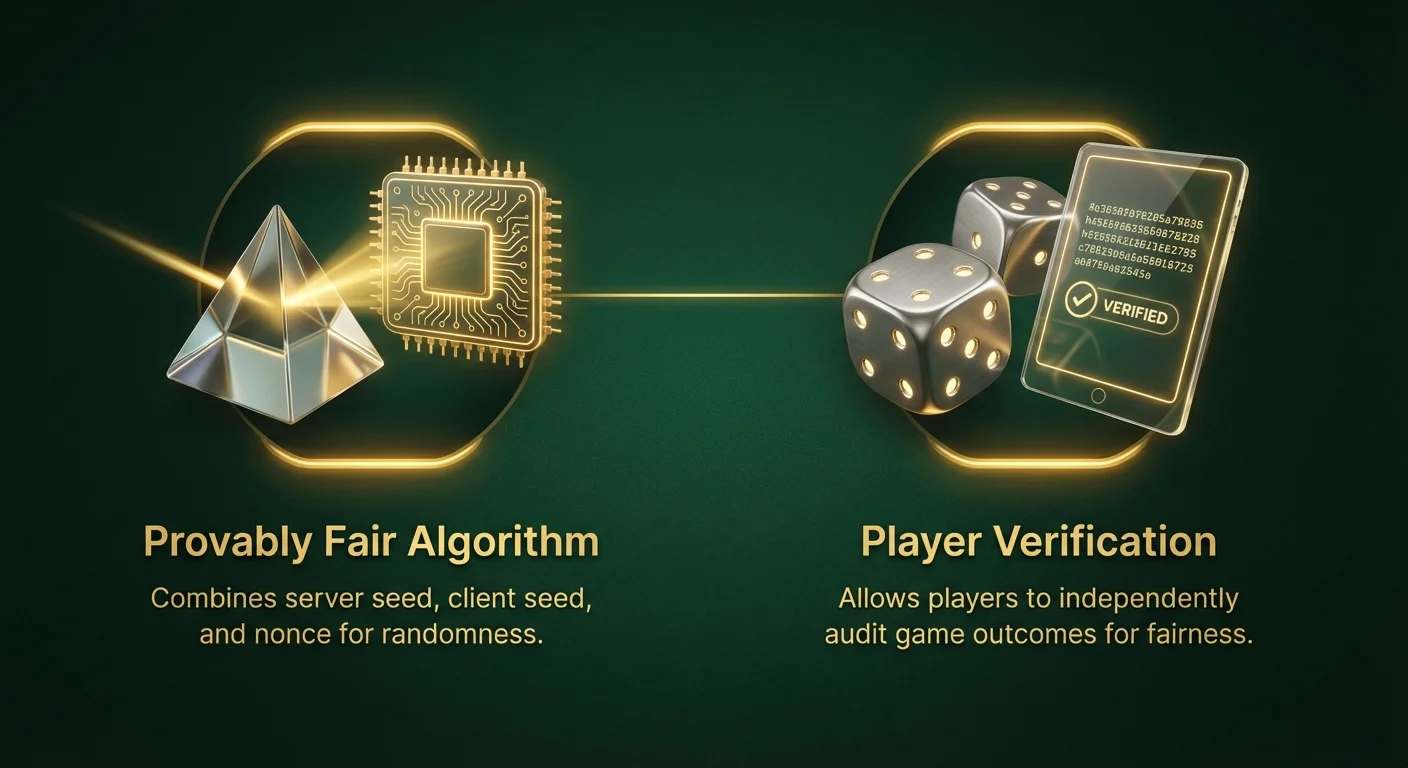
The Architecture of Fairness: How RNG Craps Works
In a brick-and-mortar casino, fairness is physical. It relies on sharp-edged precision dice, pyramid rubber back walls to randomize the bounce, and the watchful eye of the Boxman. In crypto craps, fairness is cryptographic. It relies on the Commit-Reveal Scheme.
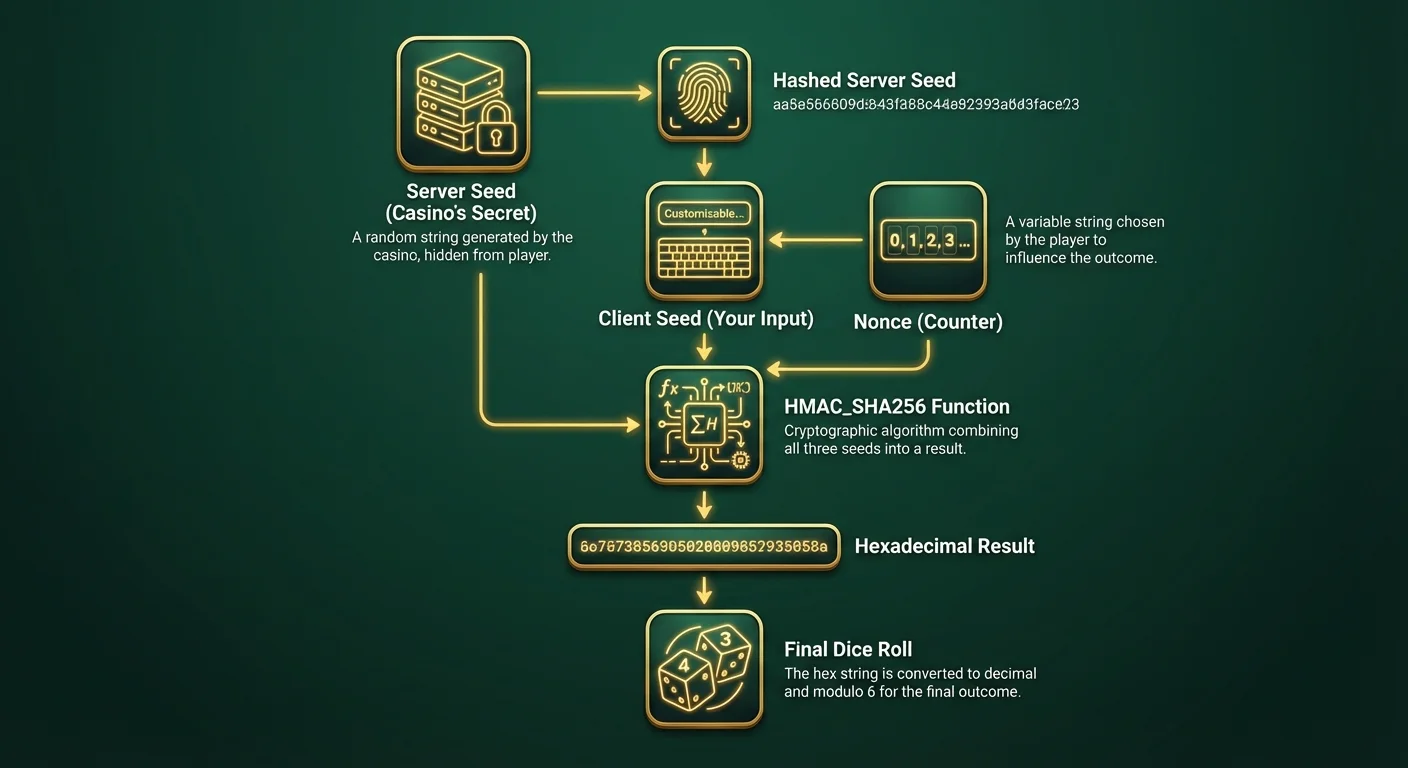
To understand how a pair of dice is generated on the blockchain, you must understand the three core components of the provably fair algorithm: the Server Seed, the Client Seed, and the Nonce.
1. The Server Seed (The Casino's Secret)
Before you even place a bet, the casino generates a random string of text called the Server Seed. However, showing you this seed immediately would allow you to predict the roll. Instead, the casino shows you the Hash of this seed.
Think of the Hash as a digital fingerprint. It is a cryptographic guarantee that the casino has determined the starting point of the random number generator and cannot change it later. If they alter the Server Seed after you bet, the Hash will not match, and you will know they cheated.
2. The Client Seed (Your Input)
This is where the power shifts to the player. The Client Seed is a string of text that acts as a variable you control. Most crypto casinos assign a default client seed, but for true fairness, you should generate your own or randomize it frequently.
Because the casino does not know what Client Seed you will choose, they cannot manipulate the outcome in their favor. The final result is derived from a combination of their secret and your input.
3. The Nonce (The Counter)
The Nonce is simply a number that increments with every bet you make (0, 1, 2, 3...). It ensures that even if you keep the same Server and Client seeds, every roll produces a different result.
The Algorithm in Action
When you click "Roll," the system runs a function - typically HMAC_SHA256 - combining these three elements:
Result = HMAC_SHA256(Server Seed + Client Seed + Nonce)
This produces a long hexadecimal string. The software then takes the first few characters of this hexadecimal string and converts them into decimal numbers. It applies a mathematical modulo operation to force those numbers into a range of 1 to 6. This process happens twice, once for each die, resulting in your final roll (e.g., 4 and 3 for a Natural 7).
Manual Verification: Trust, but Verify
Many players see the "Provably Fair" badge and assume the game is safe. However, the true advantage of crypto gambling is the ability to manually verify the outcome. Here is how you can audit a session after you have finished playing.
Step-by-Step Verification Process
- Rotate Your Seed: In your game settings, click to change your Client Seed. This usually triggers the "reveal" of the previous Server Seed used in your last session.
- Copy the Data: You will need the unhashed Server Seed, your Client Seed, and the Nonce number of the specific roll you want to check.
- Use a Third-Party Verifier: While the casino provides a verification tool, for maximum security, use an independent HMAC-SHA256 calculator or a third-party provably fair verifier.
- Input the Values: Paste the keys into the calculator.
- Compare the Hash: The resulting hash from the calculator must match the hashed Server Seed you were shown before you placed the bet.
- Calculate the Modulo: If you are technically inclined, convert the first 8 characters of the hex output to a decimal, then calculate
(Decimal % 6) + 1. If the math outputs a 4, and your screen showed a 4, the game is fair.
The Death of Dice Control and the Rise of Math
In physical casinos, "dice mechanics" or "shooters" attempt to influence the roll by setting the dice in specific V-formations (like the 35-42 set) and tossing them with a controlled backspin to avoid the 7.
In crypto craps, dice control is impossible.
There is no physics engine to exploit. There is no muscle memory. The outcome is purely derived from the SHA-256 hash. This implies two things for your strategy:
- Ignore "Hot" Shooters: In a live game, you might bet heavily on a shooter who seems to have a "rhythm." In crypto craps, the "Gambler's Fallacy" is even more dangerous. The dice have no memory, and the algorithm does not care about streaks.
- Focus on House Edge: Since you cannot alter the physical outcome, your sole mechanism for success is minimizing the mathematical edge the casino holds over you.
Optimal Strategies for Blockchain Craps
Because we are dealing with pure randomness, we must look at the math. The strategies below utilize the statistical probabilities outlined in standard craps theory but are optimized for the speed and interface of crypto gambling.
1. The Crypto Pass Line + Max Odds
The Pass Line is the fundamental bet of craps. You win on a 7 or 11 on the come-out roll, and lose on 2, 3, or 12. If a point is established, you must hit that point again before a 7.
The Strategy:
The House Edge on a flat Pass Line bet is 1.41%. However, crypto casinos often allow for significantly higher "Odds" bets than land-based casinos - sometimes up to 100x.
The "Odds" bet in craps is the only bet in the casino with 0.00% House Edge. It pays out at true probabilities. By maximizing your odds bet behind your Pass Line bet, you dilute the total house edge significantly.
| Bet Type | House Edge | Payout |
|---|---|---|
| Pass Line (Flat) | 1.41% | 1:1 |
| Pass Line + 1x Odds | 0.85% | Varies (True Odds) |
| Pass Line + 5x Odds | 0.33% | Varies (True Odds) |
| Pass Line + 10x Odds | 0.18% | Varies (True Odds) |
| Pass Line + 100x Odds | 0.01% | Varies (True Odds) |
Pro Tip: In crypto craps, verify the table limits. If you have a limited bankroll, bet the table minimum on the Pass Line and save your capital to back it up with maximum odds once the point is established.
2. The "Dark Side" Algorithm (Don't Pass)
In a live casino, betting on the "Don't Pass" (betting against the shooter) makes you a pariah. You are literally cheering for everyone else to lose. In online crypto craps, there is no crowd to offend. You are playing against a script.
The Don't Pass bar has a slightly lower house edge than the Pass Line at 1.36%.
The Strategy:
Place a Don't Pass bet. If a point is established (4, 5, 6, 8, 9, 10), you are now the favorite to win, because a 7 is statistically the most likely number to roll. You can then "Lay Odds" against the point. You have to put up more money than you will win (e.g., laying $40 to win $20 on the 4), but the probability is in your favor.
3. The Modified Three Point Molly
This is an aggressive strategy for players who want action on multiple numbers. It involves keeping three numbers working simultaneously to maximize coverage.
- Bet the Pass Line.
- Back it with Odds once the point is established.
- Place a Come Bet. This acts as a secondary Pass Line bet.
- If the Come Bet moves to a number, take odds on it immediately.
- Place another Come Bet.
- Stop adding bets once you have three points covered (The Pass Line point + 2 Come Bet points).
If one of your Come Bets wins, verify your profit and place a new Come Bet to keep three numbers working. This strategy requires a larger bankroll but ensures you capitalize on any streak of non-7 numbers.
Bets to Avoid: The Mathematical Traps
Crypto interfaces often make it very easy to click "Field" or "Big 6/8" buttons. However, convenience often costs money.
The Field Bet Trap
The Field bet is a one-roll wager that the next number will be 2, 3, 4, 9, 10, 11, or 12. It feels rewarding because so many numbers win. However, looking at the math:
- Winning combos: 16
- Losing combos: 20 (5, 6, 7, 8)
Unless the casino pays triple on the 12, the House Edge is roughly 2.78%. If they only pay double on the 2 and 12, the edge spikes to 5.56%. Always check the "Game Rules" or "Help" file in the crypto casino to see the specific payouts for the 2 and 12 before placing this bet.
The Big 6 and Big 8
These bets reside in the corners of the table and pay 1:1 if a 6 or 8 rolls before a 7.
- The Trap: You can make a "Place Bet" on the 6 or 8 which pays 7:6.
- The Math: A $6 bet on "Big 6" wins $6. A $6 "Place" bet on the 6 wins $7.
- Conclusion: Never bet the Big 6 or Big 8. It is a "sucker bet" with a 9.09% house edge compared to the 1.52% edge of the Place bet.
Crypto-Specific Advantages
Beyond fairness, playing craps with cryptocurrency offers specific logistical advantages that change how you manage the game.
Micro-Betting and Satoshis
In a Vegas casino, the table minimum might be $15 or $25. This forces a high barrier to entry, especially if you want to play strategies like the Iron Cross or Three Point Molly which require multiple bets.
Crypto casinos often allow bets as low as 0.00000001 BTC (1 Satoshi) or equivalent small amounts in USDT/ETH. This allows you to:
- Test complex strategies with cents before risking dollars.
- Survive longer variance swings.
- Precisely calculate your bankroll units (e.g., ensuring you have 500 betting units for a session).
Automated Betting Scripts
Many advanced crypto gambling sites offer an "Auto-Bet" feature or script editor. While craps is complex, you can script simple behaviors, such as:
- "If Pass Line wins, increase next bet by 10%."
- "If Point is 4 or 10, place max odds."
Warning: Scripts execute instantly. A coding error can drain a bankroll in seconds. Always test scripts in "Fun Mode" or with minimum bets first.
Instant Settlement
In traditional online casinos, clearing a bonus or withdrawing winnings can take days. Blockchain transactions settle in minutes. This changes the psychological dynamic; knowing you can secure your profit instantly encourages better discipline. When you hit your win goal (e.g., +30%), withdraw the profit to your private wallet immediately.
Conclusion: The Future of the Roll
Provably fair craps is the ultimate fusion of classic gambling excitement and modern cryptographic security. By removing the physical limitations of the table and the opacity of centralized servers, it offers a cleaner, faster, and fairer game.
However, transparency is not a guarantee of winning. The house still maintains a mathematical edge on every bet except the Odds. Success in blockchain craps comes from understanding the technology enough to trust it, but respecting the math enough to fear it. Stick to the Pass/Don't Pass line, take your maximum odds, verify your seeds, and never let the speed of the blockchain outpace your bankroll management.