
The digital evolution of bingo has bifurcated the game into two distinct experiences. On one side, you have the high-octane, solitary efficiency of RNG (Random Number Generator) Bingo. On the other, the atmospheric, community-driven engagement of Live Caller Bingo.
For the modern crypto gambler, choosing between these two isn't just a matter of preference - it is a decision that fundamentally alters your strategy, your bankroll management, and your hourly win/loss rates. While the core mechanic - matching numbers on a card - remains identical, the execution varies so wildly that they can almost be considered different genres of gambling.
This guide explores the structural differences between algorithmic instant bingo and live dealer rooms, providing intermediate to advanced strategies for navigating both landscapes using cryptocurrency.
Defining the Contenders
Before diving into strategy, we must establish the mechanical differences that dictate the pace of play.
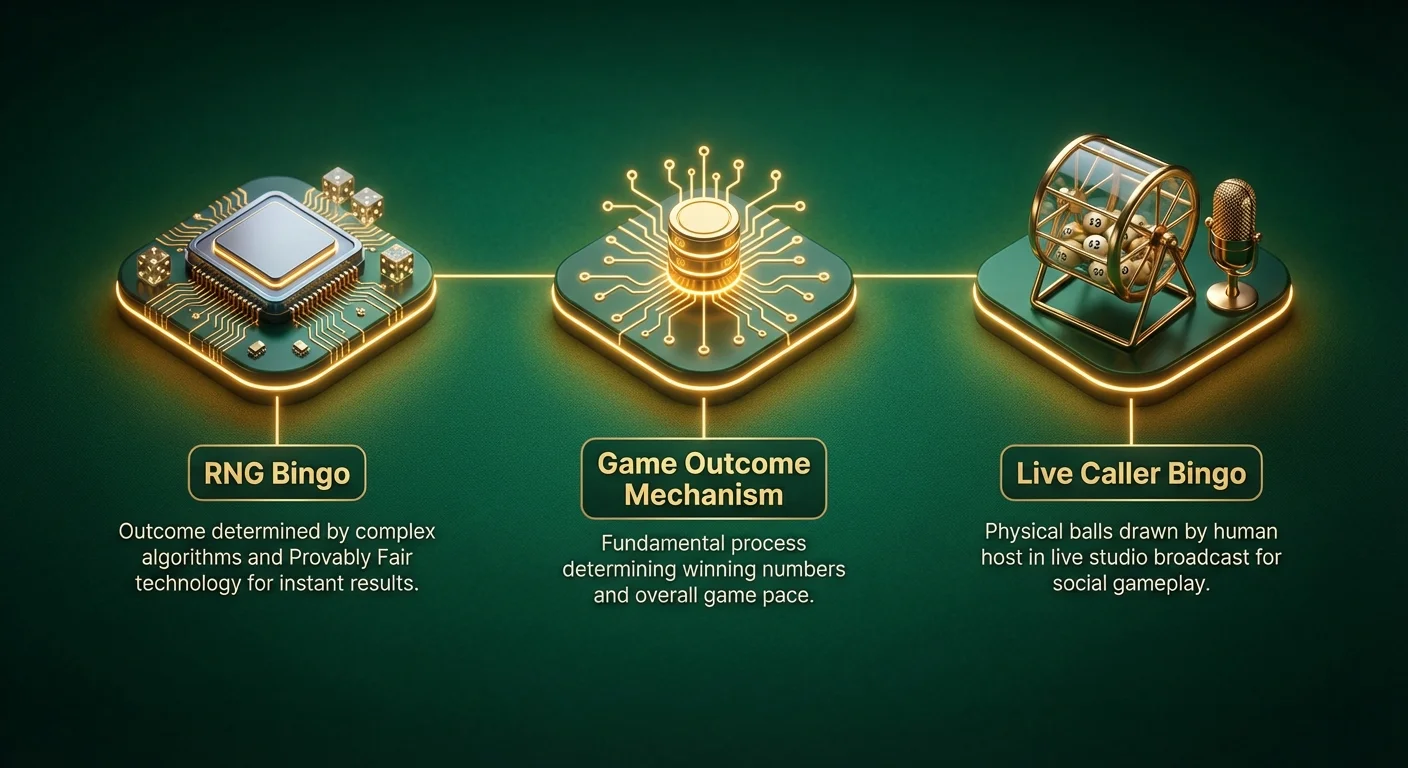
RNG Bingo: The Digital Speedster
RNG Bingo is software-based. There is no ball machine and no human element. The outcome of every game is determined the millisecond you click "Buy Ticket" or "Play."
- Mechanism: A complex algorithm selects numbers based on a seed. In crypto casinos, this is often "Provably Fair," allowing you to verify the fairness of the draw on the blockchain.
- Interface: Often resembles a slot machine or a Slingo interface.
- Capacity: Infinite. You are usually playing alone against the house odds, or in a pool where the software instantly calculates winners among thousands of virtual players.
Live Caller Bingo: The Casino Experience
Live Bingo streams a real human host from a studio. They operate a physical ball blower (often 90-ball or 75-ball).
- Mechanism: Physical balls are drawn from a machine. Optical Character Recognition (OCR) technology scans the ball as it pops up and transmits the data to your digital interface.
- Interface: A video feed takes center stage, with your cards and a chat box overlaid on the screen.
- Capacity: Limited by the room's server constraints, but usually accommodates hundreds of simultaneous players competing for a shared pot.
The Pace Factor: Impact on "Cost Per Hour"
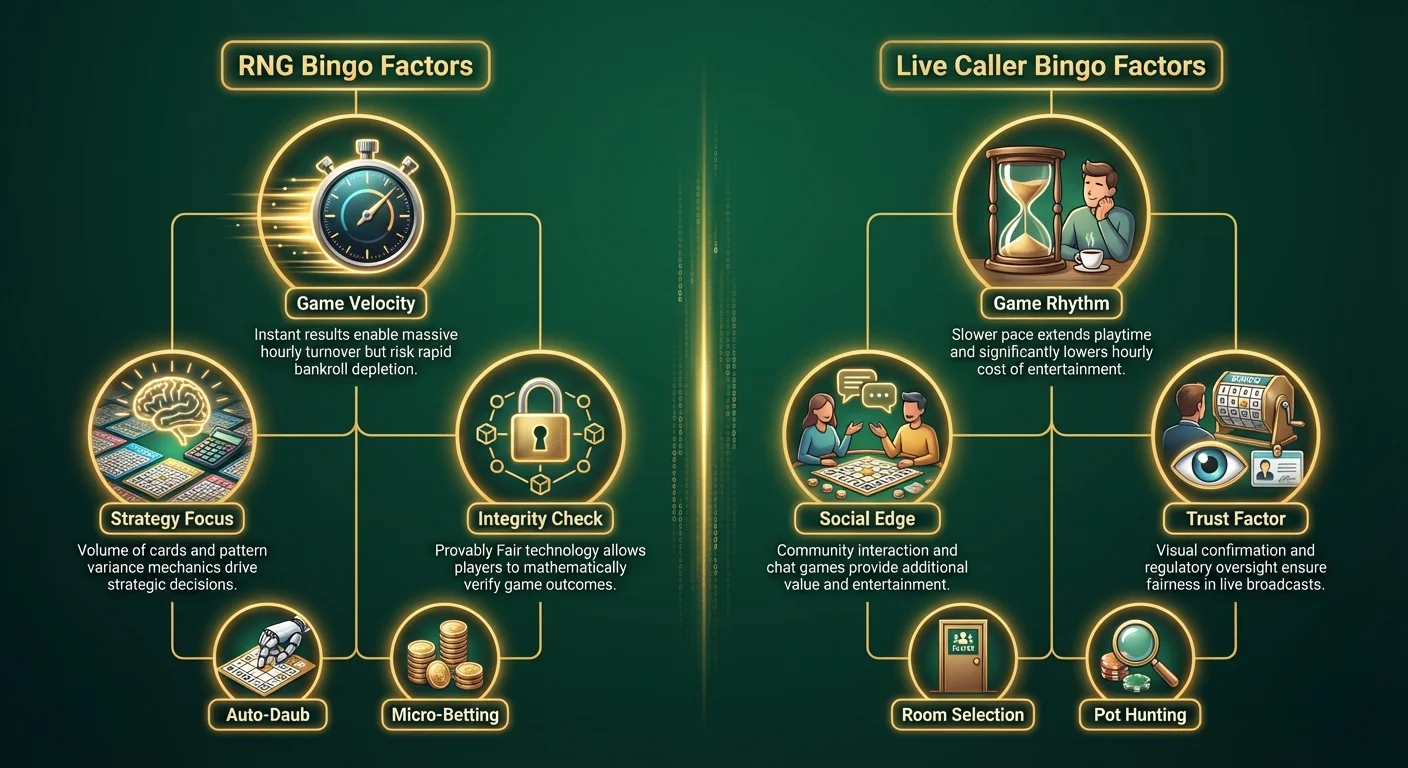
The most significant difference between RNG and Live Caller bingo is Game Velocity. Understanding this is critical for bankroll management.
The RNG Velocity Trap
In an RNG game, you control the tempo. If you enable "Turbo Mode" or "Instant Reveal," you can complete a 75-ball bingo game in under five seconds.
- The Math: If you bet 0.0005 BTC per card and play 10 games per minute, your hourly turnover is massive.
- The Risk: Without strict discipline, RNG bingo can deplete a bankroll faster than almost any other casino game. The "near-miss" psychology (seeing you were one number away) encourages rapid re-betting.
- The Strategy: You must set a strict "stop-loss" limit or a time limit. Treat RNG bingo like a slot machine; the House Edge will eat your bankroll quickly due to the sheer volume of rounds played.
The Live Caller Rhythm
Live bingo is inherently slower. The caller must wait for the balls to mix, draw the ball, call the number, and allow a few seconds for players to react (though auto-daubing handles the marking).
- The Math: A standard round of 90-ball live bingo, including the buy-in period and post-game breakdown, takes 3 to 6 minutes. You might only play 10 to 15 rounds per hour.
- The Benefit: Your bankroll lasts significantly longer. Even with a higher cost per card, the "cost per hour" of entertainment is generally lower than RNG versions.
- The Strategy: This format allows for "pot hunting." You have time to analyze the number of players in the room and the size of the jackpot before committing to buying tickets for the next round.
Strategy: Algorithms vs. Human Element
While Bingo is a game of chance, the way you approach winning differs based on the format.
RNG Strategies: Volume and Variance
Since you are often playing against a payout table (like video poker) rather than other players, your strategy should focus on probability mechanics.
1. The Auto-Daub Advantage
In RNG games, you can often play a massive number of cards simultaneously - sometimes up to 100. Since the computer marks them instantly, you maximize your coverage of the board.
- Tip: Check the paytable. If the game pays out for complex patterns (like "Windmill" or "Arrow"), buying more cards increases the statistical likelihood of hitting disparate numbers.
2. Pattern Volatility
RNG bingo often features "Exotic Patterns" that are too complex for live callers to track efficiently.
- Standard Patterns: Lines, Four Corners (Low variance, low payout).
- Complex Patterns: Blackout, Specific Shapes (High variance, massive payout).
- Crypto Strategy: If you are playing a Provably Fair RNG game, check the volatility setting. Some crypto bingo games allow you to adjust the "risk" level, essentially choosing between frequent small wins (Lines) or rare big wins (Blackout).
3. Slingo Mechanics
Many RNG bingo games at crypto casinos are actually "Slingo" (Slots + Bingo). Here, the strategy involves managing your "Spins." You often get a choice to buy extra spins at the end of a round to complete a Full House.
- Warning: The cost of buying extra spins usually increases exponentially. A common leak for intermediate players is buying too many extra balls in an RNG game hoping to hit a jackpot, destroying the Expected Value (EV) of the round.
Live Caller Strategies: The Social Edge
In live rooms, you are competing against other humans for a prize pool. The house takes a "rake" (a percentage of the pot), but the rest goes to the winner.
1. The Granville and Tippett TheoriesWhile controversial, these probability theories are easier to apply in the slow pace of Live Bingo.
- Tippett Theory: Suggests that in longer 75-ball games, numbers gravitate toward the median (38). In shorter games, they stick to the extremes (1 and 75).
- Application: In a live room playing a complex pattern (long game), you might prefer cards with numbers closer to 38. In a "Speed Bingo" live room (short game), you look for cards with numbers near 1 and 75.
2. Room Selection (The Golden Rule)
This is the single most effective strategy for Live Bingo.
- The Logic: Your odds of winning are inversely proportional to the number of cards in play.
- The Move: Play at "off-peak" hours. If a live room has 50 players compared to 500, your chances of winning the pot skyrocket. While the pot will be smaller, the frequency of wins will increase, stabilizing your variance.
3. Chat Games and Side Bets
Live dealers often run "Chat Games" where you can win free bets or small crypto bonuses by answering trivia or typing a specific number when it's called.
- Strategy: Always keep the chat open. These are essentially "freerolls" (free chances to win money) that RNG games do not offer.
Game Integrity: Provably Fair vs. Visual Trust
For the crypto gambler, trust is paramount. The way these two formats establish trust is fundamentally different.
RNG: The Mathematical Proof
Crypto-native RNG Bingo utilizes Provably Fair technology.
- How it works: Before the round starts, the server creates a "seed" (the outcome) and hashes it. You are provided with a "client seed."
- The Check: After the game, you can unhash the server seed to verify that the numbers drawn were predetermined by the algorithm and not altered based on your bet size.
- Verdict: This offers the highest level of mathematical security, provided you are playing at a reputable crypto casino.
Live Caller: The Visual Confirmation
Live bingo relies on the transparency of the physical world.
- How it works: You see the machine mix the balls. You see the ball exit the tube. You hear the caller announce it.
- The Safeguards: Reputable live studios (like Evolution Gaming or Pragmatic Play) have strict regulatory oversight. Monitors usually show a live news feed in the background to prove the broadcast is not pre-recorded.
- Verdict: While you cannot mathematically verify the ball physics, the regulatory licenses required to run these studios offer a high degree of safety.
Comparison: RNG vs. Live Dealer
| Feature | RNG / Instant Bingo | Live Caller Bingo |
|---|---|---|
| Pace | Extremely Fast (Instant - 5 secs) | Slow / Relaxed (3 - 6 mins) |
| Social Interaction | None (Solitary) | High (Chat, Dealer interaction) |
| Bankroll Burn Rate | High (Requires discipline) | Low (Extended playtime) |
| Competition | House / Paytable | Other Players |
| Strategy Focus | Volume of cards, Payout variance | Room selection, Chat bonuses |
| Integrity | Provably Fair Algorithms | Visual / Regulatory License |
| Ideal for... | Quick sessions, mobile play, crypto mining | Evening entertainment, socializing |
Crypto-Specific Considerations
When playing bingo with Bitcoin, Ethereum, or USDT, specific nuances apply to each game type.
1. Transaction Speed and Micro-Betting
RNG Bingo is excellent for "micro-betting." Because there is no human overhead, casinos allow you to play cards for fractions of a cent (Satoshi bets). This is ideal for testing strategies or clearing deposit bonuses.
2. Network Latency
Live Bingo requires a stable internet connection. If your stream lags, you might miss a number (though auto-daub protects the win, it ruins the experience). RNG bingo is much lighter on data, making it the superior choice for playing on mobile data or unstable connections.
3. Smart Contract Bingo
Some decentralized casinos offer bingo entirely on smart contracts. These are almost exclusively RNG-based. The advantage is that payouts are instant and automated directly to your wallet, bypassing the casino cashier entirely. Live dealer games usually require the standard deposit/withdraw process.
Summary: Which Style Suits You?
Choose RNG Bingo If:
- You have limited time (e.g., a 10-minute break).
- You prefer playing multiple cards (50+) simultaneously to maximize pattern coverage.
- You enjoy the "slot machine" dopamine loop of instant results.
- You want to verify every result using Provably Fair hashes.
- You are grinding through a wagering requirement for a casino bonus (the high volume clears bonuses faster).
Choose Live Caller Bingo If:
- You treat gambling as an evening's entertainment.
- You want to socialize with other crypto enthusiasts in the chat.
- You have a limited bankroll and need it to last for several hours.
- You enjoy the anticipation and the "near-miss" excitement of waiting for that one final number.
- You want to hunt for value in rooms with fewer players during off-peak hours.
Conclusion
The divide between RNG and Live Caller bingo represents the duality of the modern crypto casino: the efficiency of code versus the engagement of community. Neither is objectively superior; they serve different psychological needs and strategic goals.
If your goal is to maximize the number of hands played and trust in the math, RNG is your arena. If your goal is to stretch your Bitcoin further while enjoying a communal atmosphere, the Live Caller rooms await. As always, regardless of the pace you choose, ensure your bankroll management is strict - because in Bingo, the only number that truly matters is the one in your wallet balance.