
For many sports bettors, the evolution of strategy begins with straight bets, moves quickly into the high-risk, high-reward allure of multi-leg parlays, and often settles there. However, intermediate and sharp bettors know that there is a middle ground - a sophisticated territory of conditional wagering that allows for superior bankroll management and risk mitigation. This territory is occupied by If Bets and Reverse Bets.
In the fast-paced world of crypto sports betting, where liquidity is instant and markets move in milliseconds, understanding conditional wagers is a powerful tool. The rapid execution speed allows you to chain wagers together, using the potential winnings from one game to fund the stake of the next, all while mitigating the "all-or-nothing" nature of a standard parlay.
This guide will demystify the mechanics of If Bets and Reverse Bets, explain the mathematics behind the payouts, and demonstrate how to utilize them effectively using cryptocurrency.
What is a Conditional Wager?
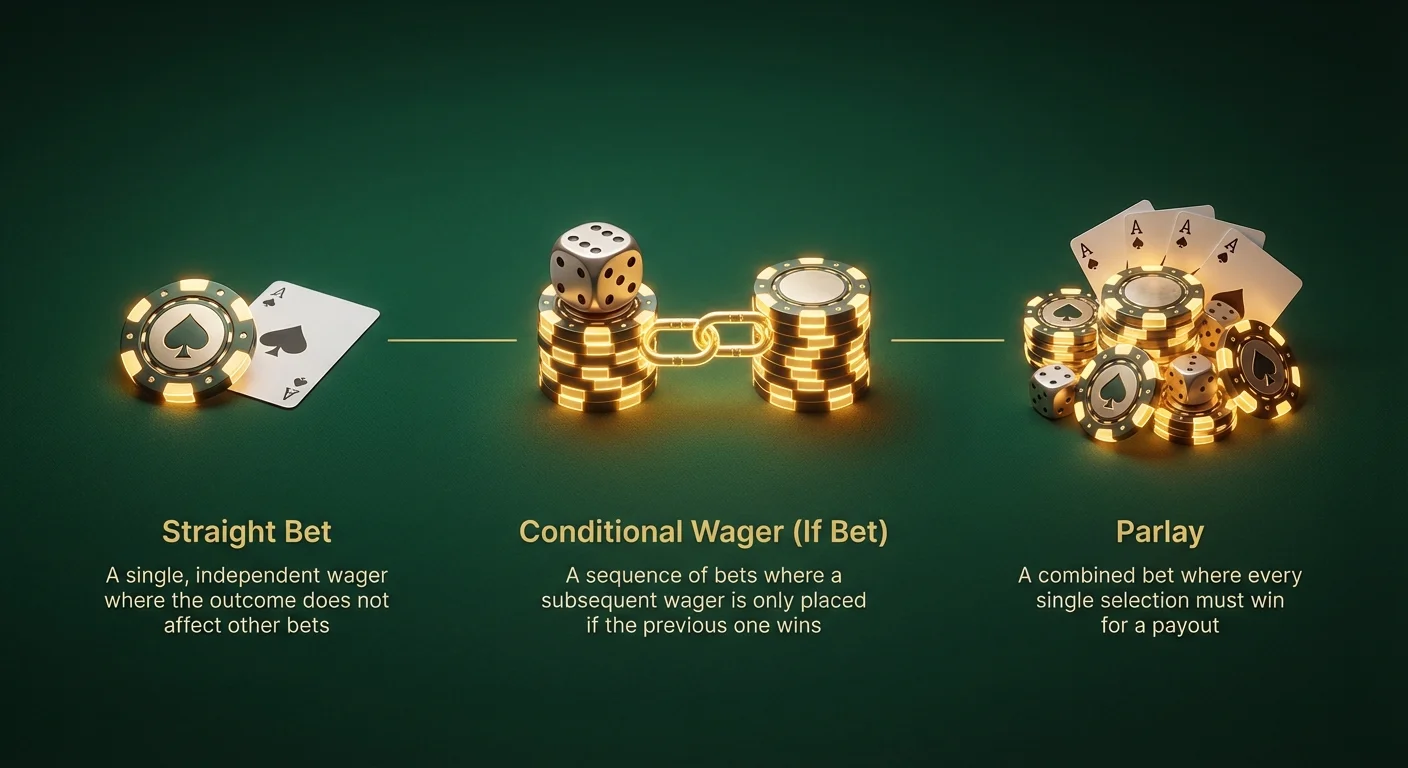
Before diving into the specifics, it is essential to understand the concept of a conditional wager. In standard betting, every bet stands alone (straight bet) or depends on every leg winning (parlay).
A conditional wager dictates that a secondary bet is only placed if a primary condition is met. Usually, this condition is that the first bet in the sequence wins or pushes (ties).
The Crypto Bankroll Advantage
For crypto bettors, conditional wagers are excellent for inventory management. If you are betting with Bitcoin or Ethereum, managing your volatile assets requires discipline. Conditional wagers allow you to commit a smaller initial stake (e.g., 0.02 BTC) and attempt to "run it up" through multiple games, effectively reusing the same capital without depositing more funds.
The "If Bet": The Chain Reaction
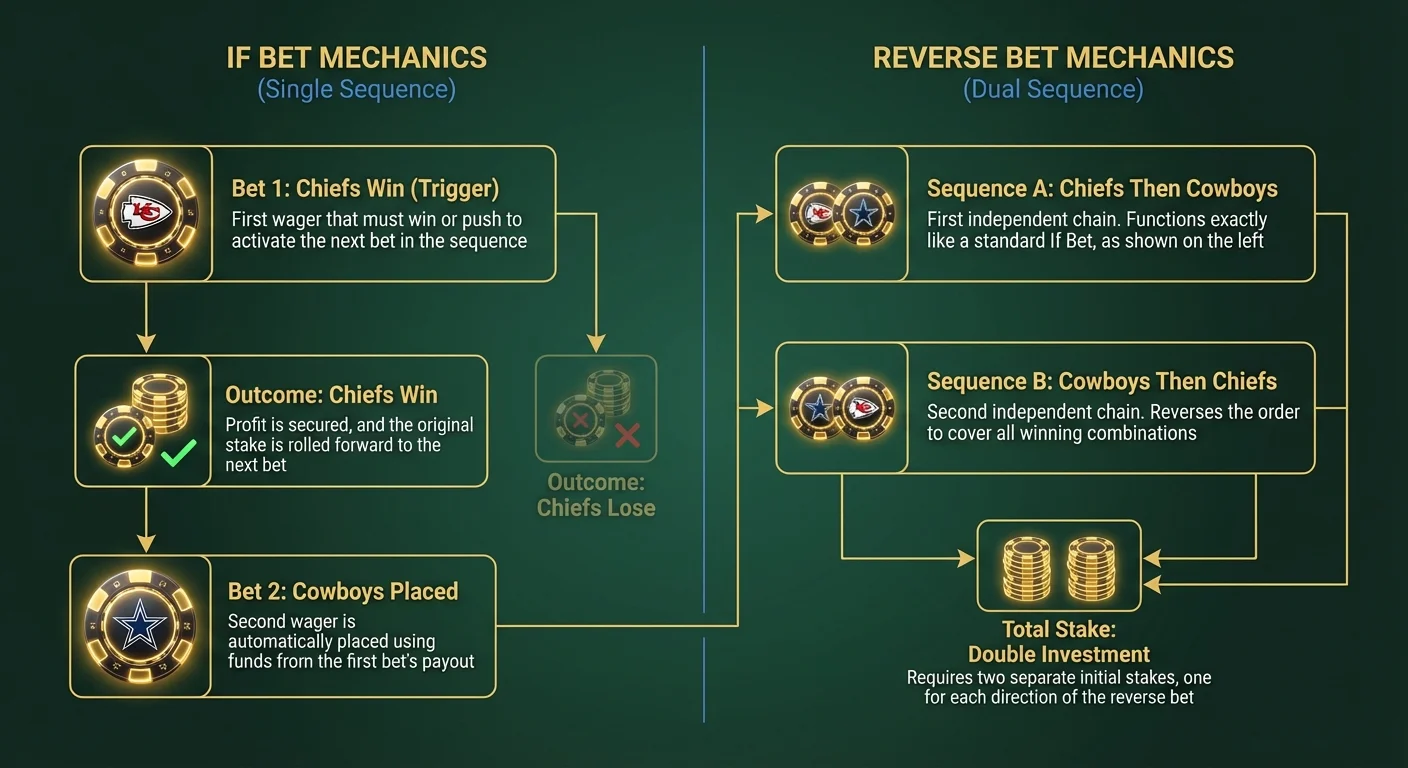
An If Bet is a sequence of two or more independent wagers joined by a conditional clause. The most common form is "If Bet A wins, then place Bet B."
If the first selection (Bet A) loses, the chain is broken. The sportsbook collects your stake for Bet A, and Bet B is never placed. You do not lose money on Bet B; it simply ceases to exist.
How It Works: The Sequence
- Selection 1 ( The Trigger): You place a wager on Team A.
- The Condition: You stipulate "If Win Only" or "If Win or Push."
- Selection 2 (The Follow-up): You select Team B.
The Cash Flow:
- Scenario 1: Team A loses. You lose your initial stake. Action stops.
- Scenario 2: Team A wins. You get your payout + stake back. The sportsbook immediately takes a portion of those funds to place the wager on Team B.
Single Action vs. Double Action
When placing If Bets at crypto sportsbooks, you will often see options for the condition:
- Single Action (If Win Only): The second bet is only placed if the first bet wins outright. If the first bet pushes (ties), the chain stops, and your stake is returned.
- Double Action (If Win or Push): The second bet is placed if the first bet wins or pushes. This is generally the preferred option for bettors to keep the action alive.
An If Bet Scenario
Let's look at a practical NFL Sunday example using USDT (Tether) for easy math.
- Your Bankroll: $110 USDT.
- Goal: You like the Chiefs (-3) at 1:00 PM and the Cowboys (-7) at 4:25 PM.
- The Wager: $110 If Bet on Chiefs -> Cowboys.
Outcomes:
- Chiefs Lose: You lose $110. The Cowboys game is irrelevant.
- Chiefs Win, Cowboys Lose:
- Chiefs bet wins $100. You now have $210 ($110 stake + $100 profit).
- The book automatically bets $110 (or a specified amount) on the Cowboys.
- Cowboys lose. You lose the $110 on the second leg.
- Net Result: You profit $100 from Game 1, lose $110 on Game 2. Total loss is only the "juice" ($10).
- Chiefs Win, Cowboys Win:
- Chiefs win $100.
- Cowboys bet triggers and wins $100.
- Net Result: Profit $200.
The Key Difference vs. Parlays:In a parlay, if the Chiefs won and the Cowboys lost, you would lose your entire $110 stake. In an If Bet, you actually walk away roughly even (minus the vigorish) because the profit from the first win covered the loss of the second.
The "Reverse Bet": Covering All Angles
The main flaw of the If Bet is the sequence. If you bet Team A -> Team B, and Team A loses, you have no action on Team B. If Team B ends up covering the spread easily, you will be frustrated that you never got to bet on them.
Enter the Reverse Bet.
A Reverse Bet is essentially two If Bets working in opposite directions.
- Bet Sequence 1: If Team A wins -> Bet Team B.
- Bet Sequence 2: If Team B wins -> Bet Team A.
The Cost of Reversing
Because you are placing two distinct starting wagers, a Reverse Bet costs double the stake of a standard If Bet. If you want $110 action on each sequence, you must put up $220 total.
Action Reverse
Most crypto sportsbooks offer "Action Reverse" bets. These function exactly as described above. They are fantastic for situations where two games overlap in time, or when you are unsure which game will finish first.
A Reverse Bet Scenario
Using the same Chiefs/Cowboys example. You place a standard $110 Reverse Bet. Total risk: $220 ($110 on Sequence A, $110 on Sequence B).
- Scenario 1: Both Teams Win
- Sequence A (Chiefs->Cowboys) wins both. Profit ~$200.
- Sequence B (Cowboys->Chiefs) wins both. Profit ~$200.
- Total Profit: $400.
- Scenario 2: Chiefs Win, Cowboys Lose
- Sequence A: Chiefs win (+$100), triggers Cowboys bet. Cowboys lose (-$110). Net: -$10.
- Sequence B: Cowboys lose (-$110). Action stops. Chiefs bet never triggers. Net: -$110.
- Total Loss: -$120. (Compare this to a $220 Parlay loss, or two $110 straight bets where you'd break even minus juice).
- Scenario 3: Both Teams Lose
- Sequence A: Lose $110.
- Sequence B: Lose $110.
- Total Loss: $220.
Comparison: Straight vs. Parlay vs. If vs. Reverse
To help you decide which structure fits your strategy, review this comparison table based on a standard 2-team scenario (assuming -110 odds).
| Feature | Straight Bets (x2) | Parlay (2-Team) | If Bet | Reverse Bet |
|---|---|---|---|---|
| Initial Risk | High (2x Stake) | Low (1x Stake) | Low (1x Stake) | High (2x Stake) |
| Payout Potential | Moderate (1:1 per bet) | High (~2.6:1) | Moderate (Accumulated) | High (Accumulated) |
| Risk of Ruin | Moderate | High | Low | Moderate |
| Dependency | None (Independent) | Total (All must win) | Sequential (A triggers B) | Bilateral (Two chains) |
| Best Used For | Value betting | Small stake, huge win | Bankroll preservation | Hedging sequence risk |
Why Use Conditional Wagers?
If straight bets offer the best mathematical odds over the long run (due to variance), why use If Bets or Reverses?
1. Bankroll Efficiency with Crypto
In the crypto ecosystem, moving funds between wallets or waiting for blockchain confirmations can take minutes. If you have a limited amount of ETH in your sportsbook wallet, an If Bet allows you to get action on the late night game using the potential winnings from the afternoon game, without needing to deposit more ETH.
2. The "House Money" Psychology
An If Bet enforces discipline. It forces you to only bet on the second game if you have won the first. This prevents "chasing losses." If the first game loses, you are automatically cut off from losing more money on the second game.
3. Correlated Outcomes
While books block obvious correlated parlays (e.g., betting the Over on a game and the QB to throw 3 TDs), you can sometimes find soft correlations in If Bets. For example, if you believe a specific weather system moving across the country will affect the 1 PM games first and then the 4 PM games, you can daisy-chain the "Under" bets.
How to Calculate Payouts and Risk
Understanding the math is vital. Unlike fixed-odds betting, conditional wagers are dynamic.
The "If Bet" Formula
To calculate your potential return, treat each stage as a straight bet.
- Stage 1: Stake Odds = Win Amount.
- Stage 2: (Original Stake or Win Amount) Odds = Win Amount.
Note: In most If Bets, you risk the original stake amount on the second bet, not the total winnings. However, some books allow "If All" bets where the entire payout of Game 1 rolls into Game 2.
Calculating the Reverse
Simply calculate two separate If Bets and sum the total.
- Part A: Team 1 Team 2
- Part B: Team 2 Team 1
If you split the games (1 Win, 1 Loss), you will usually lose a small amount of "juice" (vigorish) on one side and the full stake on the other side.
Practical Tips for Betting Ifs and Reverses
If you are ready to add these to your arsenal, follow these strategic guidelines to ensure you aren't just burning money on juice.
1. Order Matters (For If Bets)
Always place the game with the highest probability of winning or the earliest start time first.
- Chronological Order: Usually, you must bet on the earlier game first. Crypto sportsbooks with automated grading make this seamless. As soon as the smart contract/oracle verifies the first win, the second bet is live.
- Confidence Order: If games start at the same time, put your "lock" (highest confidence) first. If your lock loses, you save the money you would have risked on the riskier second bet.
2. Avoid "If All" unless necessary
Some books give the option of "If All" (rolling the entire payout + stake) vs "If Action" (rolling only the original stake amount).
- If Action: Conservative. You pocket the profit from Game 1 and only risk the original stake amount on Game 2.
- If All: Aggressive. This essentially turns the wager into a parlay. If you are going to do "If All," you might as well play a parlay because parlays usually offer slightly better true odds.
3. Use Reverses for volatile sports
Reverse bets are excellent for high-variance sports like NHL or MLB, where moneyline favorites can lose easily but covering the spread is less of a concern. If you are betting underdogs in MLB, a Reverse Bet can be very profitable if both dogs win, while protecting you if only one comes through.
4. Leverage Crypto Speed
One of the distinct advantages of crypto gambling sites is settlement speed. On traditional fiat sites, an If Bet might hang in limbo while the bookie manually grades the first game. On top-tier crypto sites (like Stake, BC.Game, or Sportsbet.io), grading is automated. This means you can chain an If Bet from a game ending at 3:55 PM to a game starting at 4:00 PM without fear of the system "timing out" and missing the second bet.
Summary: When to Pull the Trigger
Conditional wagering is not for every bet. It introduces complexity and, in the case of Reverse bets, increases the juice you pay if you split your games. However, they are essential tools for:
- Bankroll Management: When you want action on two games but only have the liquidity for one.
- Discipline: Preventing yourself from chasing losses on late games.
- Risk Mitigation: Avoiding the "all-or-nothing" heartbreak of parlays.
Key Takeaways:
- If Bets allow you to chain wagers; if the first loses, the second is canceled, saving you money.
- Reverse Bets are bidirectional chains that cover you regardless of game order but require double the stake.
- Crypto Advantage: Utilize the speed of blockchain settlement to ensure your conditional legs trigger instantly between games.
By mastering If and Reverse bets, you move beyond simple gambling and into the realm of handicapping strategy, treating your crypto bankroll like an investment portfolio rather than a lottery ticket.