
Entering the world of high-stakes Baccarat is akin to stepping into the VIP room of a grand casino, but with the added velocity and innovation of the cryptocurrency world. For decades, Baccarat has been the game of choice for "whales" - high-net-worth players drawn to its low house edge, simplicity, and elegance. However, playing with Bitcoin, Ethereum, or Tether introduces a unique set of dynamics that requires more than just luck; it demands rigorous discipline.
When you combine the volatility of crypto markets with the swing of the cards, your capital is exposed to two fronts of risk. Therefore, smart bankroll management isn't just a suggestion; it is the single most critical skill for survival and success. This guide will walk you through the essentials of managing your funds, understanding the mathematics of the game, and navigating the psychological pitfalls of high-stakes crypto Baccarat.
The Foundation: What is a Gambling Bankroll?
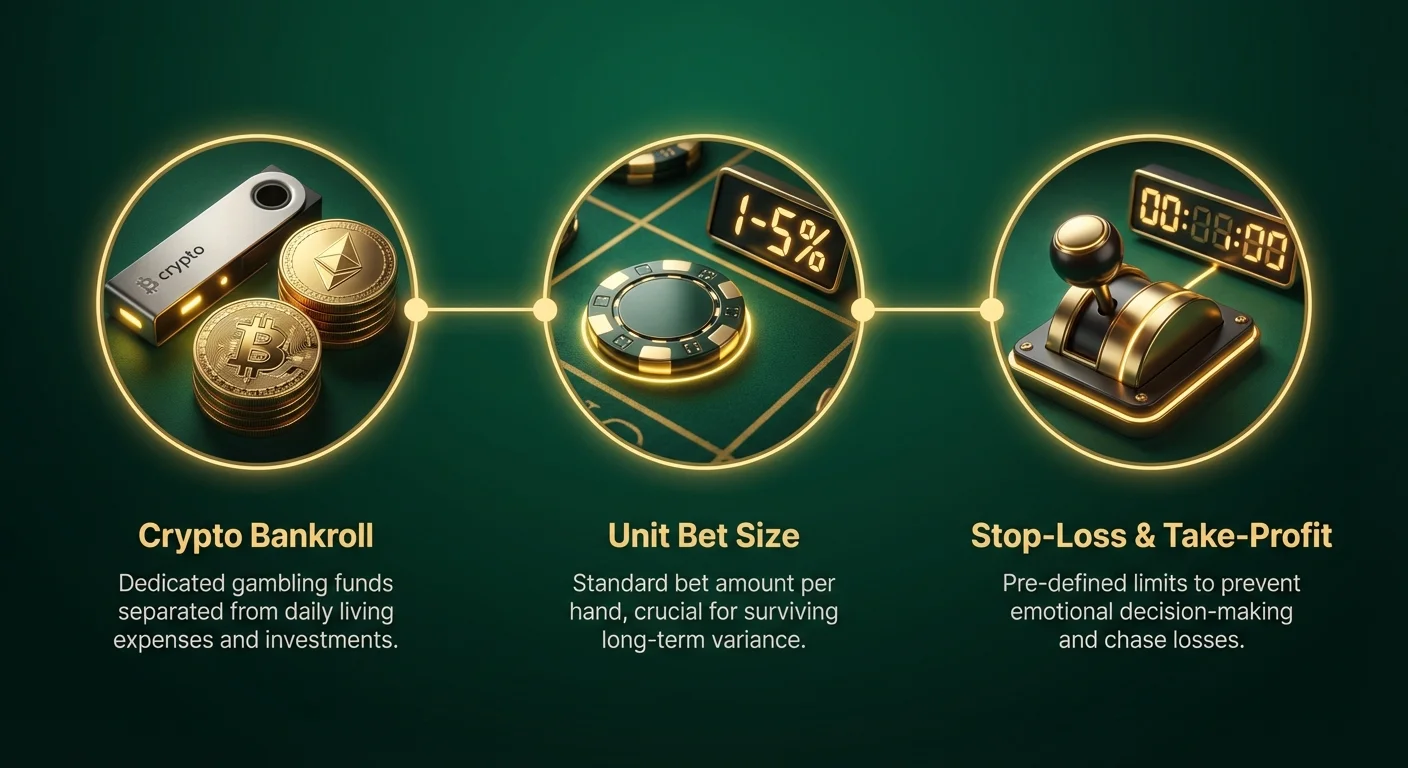
Before placing your first chip or Satoshi, you must define your bankroll. In the context of professional gambling, a bankroll is a dedicated sum of money set aside exclusively for betting purposes.
It is not:
- Money needed for rent or bills.
- Your entire crypto portfolio.
- Funds you plan to "invest" later.
It is:
- Money you are psychologically prepared to lose entirely.
- A tool used to weather the natural variance of the game.
The Crypto Variance Factor
In traditional fiat casinos, a $10,000 bankroll stays $10,000. In crypto gambling, if you are playing with a volatile asset like Bitcoin (BTC) or Ethereum (ETH), the value of your bankroll fluctuates even while you aren't playing.
Pro Tip: For high-stakes Baccarat, consider converting your gambling bankroll into Stablecoins (like USDT or USDC). This ensures that your wins and losses are based solely on your gameplay, not the market performance of the token. This eliminates "double gambling" - where you might win at the table but lose value because the coin dropped 10% that day.
Determining Your Unit Size
Once your bankroll is established, the next step is determining your "unit size." A unit is the standard amount you bet on a single hand. A common mistake among beginners is betting inconsistent amounts based on "gut feelings."
For high-stakes players, preserving capital is key to surviving long losing streaks (which mathematically will happen) so you can be present for the winning streaks.
The 1% to 5% Rule
Conservative bankroll management suggests you should never bet more than 1% to 2% of your total bankroll on a single hand. Aggressive players might push this to 5%, but in a game of variance like Baccarat, this increases the risk of ruin (going broke).
| Player Style | Bankroll Size | Recommended Unit % | Bet Size |
|---|---|---|---|
| Conservative | 10,000 USDT | 1% | 100 USDT |
| Moderate | 10,000 USDT | 2-3% | 200 - 300 USDT |
| Aggressive | 10,000 USDT | 5% | 500 USDT |
| High Roller | 1 BTC (~$60k) | 1% | 0.01 BTC |
Why stick to 1%?
Baccarat is effectively a coin flip (slightly weighted). Even with a 50/50 chance, it is statistically possible to lose 10 or 15 hands in a row. If you are betting 10% of your bankroll, a streak of 10 losses wipes you out. If you bet 1%, you still have 90% of your funds left to mount a comeback.
Understanding Baccarat Odds to Protect Your Funds
You cannot manage your money effectively if you do not understand the "price" of the bets you are making. Baccarat offers some of the best odds in the casino, but it also features "sucker bets" designed to drain your bankroll.
The Breakdown of Bets
According to mathematical probabilities:
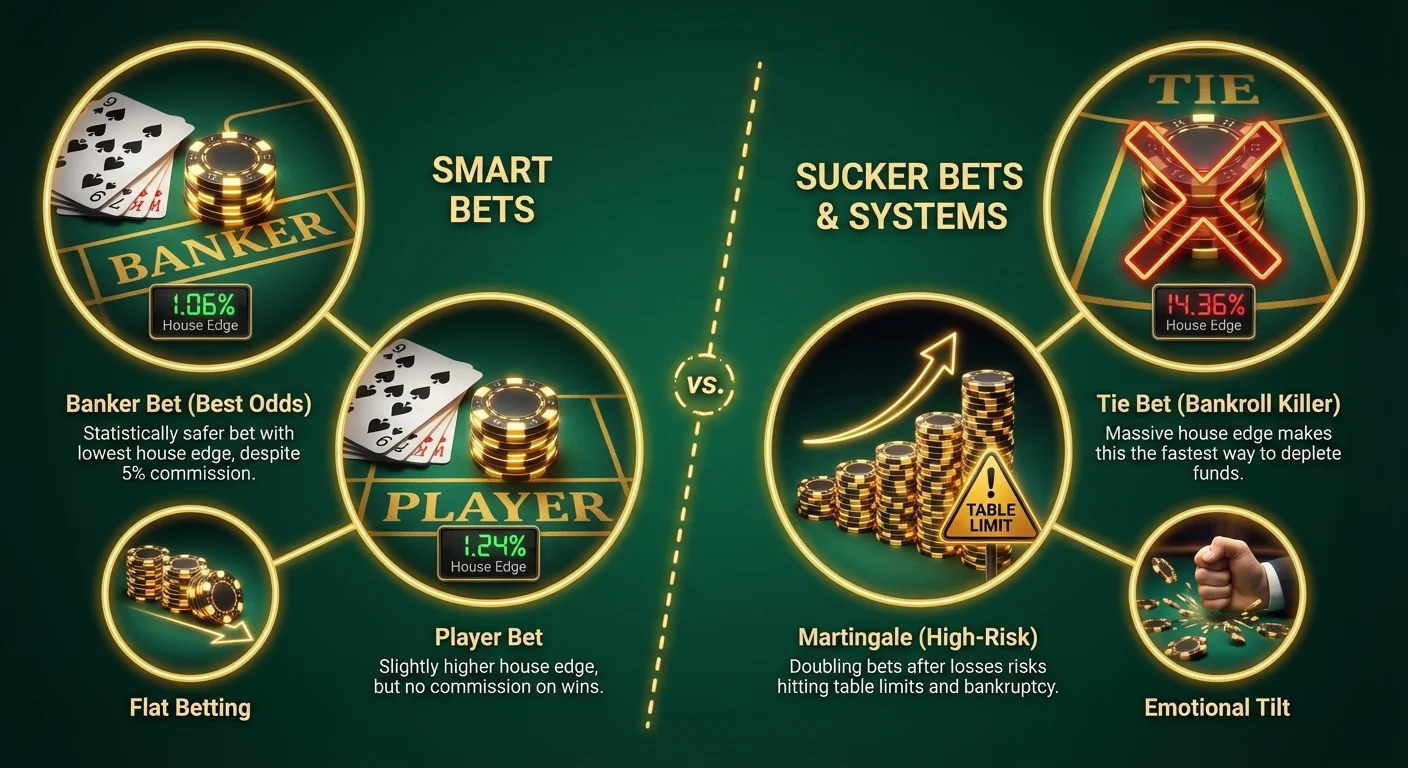
- The Banker Bet: This is statistically the safest bet. It wins 45.86% of the time. Even with the 5% commission taken by the house on wins, the House Edge is a remarkably low 1.06%.
- The Player Bet: This wins 44.62% of the time. There is no commission, but the House Edge is slightly higher at 1.24%.
- The Tie Bet: This is the bankroll killer. While it offers a tempting payout (usually 8:1 or 9:1), the House Edge is a massive 14.36%.
Strategic Implication: To protect your bankroll, never bet on the Tie. In high-stakes play, longevity is the goal. Feeding a 14% house edge is the fastest way to deplete your crypto funds. Stick to the Banker or Player.
The Commission Consideration
When managing a crypto bankroll, remember that the casino takes 5% of Banker wins. If you bet 100 USDT on Banker and win, you receive 195 USDT back (your 100 stake + 95 profit).
- Note on No-Commission Baccarat: Some crypto casinos offer "No Commission" Baccarat. Be careful - usually, this variant alters the payouts (e.g., if the Banker wins with a 6, it pays 50% rather than 100%). This often raises the house edge slightly on specific hands. Always check the rules.
Setting Critical Limits: Stop-Loss and Take-Profit
High-stakes gambling requires the discipline of a day trader. You must enter every session with an exit strategy. Without these limits, the ease of instant crypto deposits can lead to chasing losses until the wallet is empty.
The Stop-Loss Limit
This is the absolute maximum amount you are willing to lose in a single session. Once you hit this number, you close the browser tab.
- Recommendation: Set your stop-loss at 20% to 30% of your total bankroll. If you lose 30% of your funds, it is not your day. Walk away to preserve the remaining 70%.
The Take-Profit Limit
Many players know how to handle losing, but few know how to handle winning. It is common to be up significantly, get greedy, and give it all back.
- Recommendation: Set a goal of winning 20% to 50% of your session bankroll. If you start with 1,000 USDT and reach 1,500 USDT, cash out the 500 profit or end the session.
The Time Limit
Fatigue leads to mistakes. In Baccarat, where the game speed is fast - especially in online "Speed Baccarat" or software-based RNG games - you can play hundreds of hands an hour. Decision fatigue sets in, leading to impulsive increasing of bets.
- Rule: Play for max 45-60 minutes, then take a break.
Managing Variance: Betting Systems
Players often use betting systems to manage their funds. While no system can overcome the house edge, they can help structure your betting so you don't bet haphazardly.
1. Flat Betting (The Professional's Choice)
This is the safest method for high-stakes bankroll management. You bet the exact same amount (your 1% unit) on every hand, regardless of wins or losses.
- Pros: protects against rapid losses; maximizes time at the table.
- Cons: requires a long winning streak to make massive profits.
2. The Martingale (The High-Risk Trap)
The Martingale system involves doubling your bet after every loss, theoretically guaranteeing you break even plus one unit of profit when you eventually win.
- The Danger: In high-stakes crypto baccarat, you run into two walls:
- Table Limits: Casinos have maximum bet limits. If you double 7 or 8 times, you might hit the table limit and be unable to double again, locking in a massive loss.
- Bankroll Depletion: Exponential growth is terrifying. Starting with $100, a string of just 8 losses requires a $25,600 bet on the 9th hand.
- Verdict: Avoid Martingale for high-stakes play. The risk-to-reward ratio is poor.
3. The 1-3-2-4 System (Positive Progression)
This system is designed to capitalize on winning streaks while minimizing losses. You adjust your bet multiplier based on the sequence 1, 3, 2, 4.
- How it works:
- Bet 1 Unit. If you win, Bet 3 Units.
- If you win, Bet 2 Units.
- If you win, Bet 4 Units.
- If you win again, start over.
- If you lose at any point, go back to the start (1 Unit).
- Why it's smart: If you win the first two bets, you have locked in a profit even if you lose the third bet. This "banks" winnings while allowing for aggressive upside.
Dealing with "The Tilt"
"Tilt" is a poker term for when emotional frustration causes a player to abandon their strategy. In crypto gambling, tilt is dangerous because transactions are instant and irreversible.
Signs you are tilting:
- Increasing bet sizes to "win it back quickly."
- Switching from Banker to Player frantically trying to guess the pattern.
- Depositing more funds immediately after a stop-loss is hit.
The Solution:
If you feel your heart rate spike or frustration mounting, utilize the "Sit Out" feature. Most live dealer Baccarat games allow you to watch hands without betting. Watch 10 hands pass. If you are still angry, log off. The blockchain will still be there tomorrow.
Crypto-Specific Bankroll Tips
Managing a crypto bankroll involves technical nuances that fiat players don't face.
1. Provably Fair Verification
If you are playing software-based (RNG) Baccarat, ensure the casino offers Provably Fair technology. This allows you to cryptographically verify that the hand was not manipulated. While this doesn't save money directly, it ensures you aren't losing to a rigged deck, which protects your long-term Expected Value (EV).
2. Watch the Gas Fees
If you are moving funds between your wallet and the casino frequently, be mindful of network transaction fees (gas).
- Bitcoin/Ethereum: High fees can eat into your profits if you deposit/withdraw small amounts frequently.
- Litecoin/Ripple/Tron: These networks have negligible fees, making them better for moving bankrolls in and out.
3. Segregate Your Winnings
When you hit a "Take-Profit" target, withdraw the winnings immediately to a cold wallet (hardware wallet). Do not leave winnings on the casino site.
- Psychology: Seeing the money leave the casino balance and enter your private wallet makes the "win" real. If it stays on the site, it is just "credits" waiting to be lost.
Summary: The High-Stakes Checklist
To master high-stakes Baccarat, you must master yourself. Use this checklist before every session:
- Bankroll Check: Am I playing with money I can afford to lose?
- Volatility Check: Am I using a stablecoin, or am I comfortable with the token's price fluctuation?
- Unit Size: Have I calculated 1% of my session bankroll?
- Limits Set: What is my Stop-Loss number? What is my Take-Profit number?
- Strategy: Am I sticking to Banker/Player and avoiding the Tie bet?
- Mindset: Am I calm and ready to accept the variance of the cards?
Baccarat is a game of chance, but bankroll management is a game of skill. By controlling your exposure, optimizing your bets, and respecting the math, you ensure that you stay in the game long enough to let the probabilities work in your favor. Play smart, play responsible, and may the shoe be in your favor.