
Walking into a traditional sportsbook or logging into a decentralized betting platform for the first time can feel like visiting a foreign country where you don't speak the language. You hear people talking about "hedging against the chalk," looking for "steam moves," or complaining about the vig.
If you don't understand the terminology, you aren't just out of the loop - you are losing money.
In the high-stakes world of sports betting, language is precision. A misunderstanding of terms like "push," "rollover," or "action" can lead to accidental wagers, voided winnings, or poor bankroll management. Furthermore, the rise of crypto sports betting has introduced a new layer of vocabulary involving blockchain transactions, gas fees, and wallet addresses.
This guide is designed to take you from a novice looking at lines to a "sharp" analyzing the market. We will break down the essential sports betting glossary, categorized by function, and explain how these terms apply to modern crypto betting strategies.
Part 1: The Fundamentals (A-E)
Before you can place sophisticated wagers, you need to understand the bedrock terms of the industry. These are words you will encounter every time you look at a betting slip.
Action
Simply put, "action" is a bet of any kind. If you have "action" on a game, you have a financial interest in the outcome. In some contexts, bookmakers might note that "action is required" for a bonus, meaning you must bet a certain amount.
- Tip: In baseball, "Listed Pitchers" must start for the bet to have "action." If a pitcher changes, the bet might be voided.
Against the Spread (ATS)
This term refers to a bettor taking points (the underdog) or laying points (the favorite) rather than betting on the straight winner. It is also used in statistics.
- Example: " The Chiefs are 10-2 ATS this season" means they have covered the point spread in 10 out of 12 games, regardless of whether they won the game outright.
American Odds
The default odds format used in the United States, centered around the number 100.
- Minus (-): Indicates the favorite. (-110) means you must bet $110 to win $100.
- Plus (+): Indicates the underdog. (+150) means a $100 bet wins you $150.
Arbitrage (Arb)
The practice of betting on all possible outcomes of an event across different sportsbooks to guarantee a profit regardless of the result. This is possible when different bookmakers have significantly different odds.
- Crypto Advantage: Crypto betting allows for rapid movement of funds between sportsbooks, making "arbing" much easier than with traditional banking.
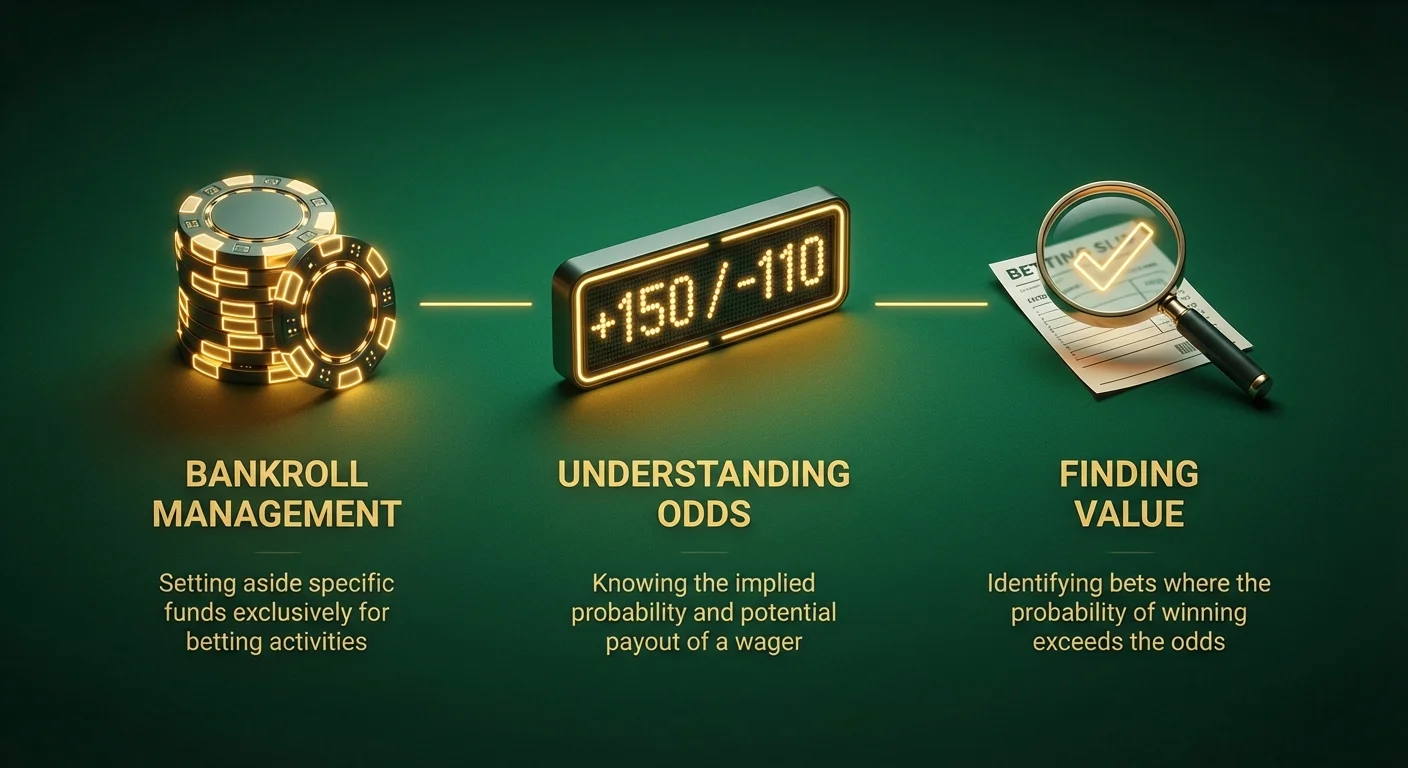
Bankroll
The total amount of money you have set aside exclusively for betting. This should be money you can afford to lose, separate from your rent or grocery money.
- Strategy: Never bet your entire bankroll on one game. Professional bettors rarely wager more than 1-3% of their bankroll on a single event.
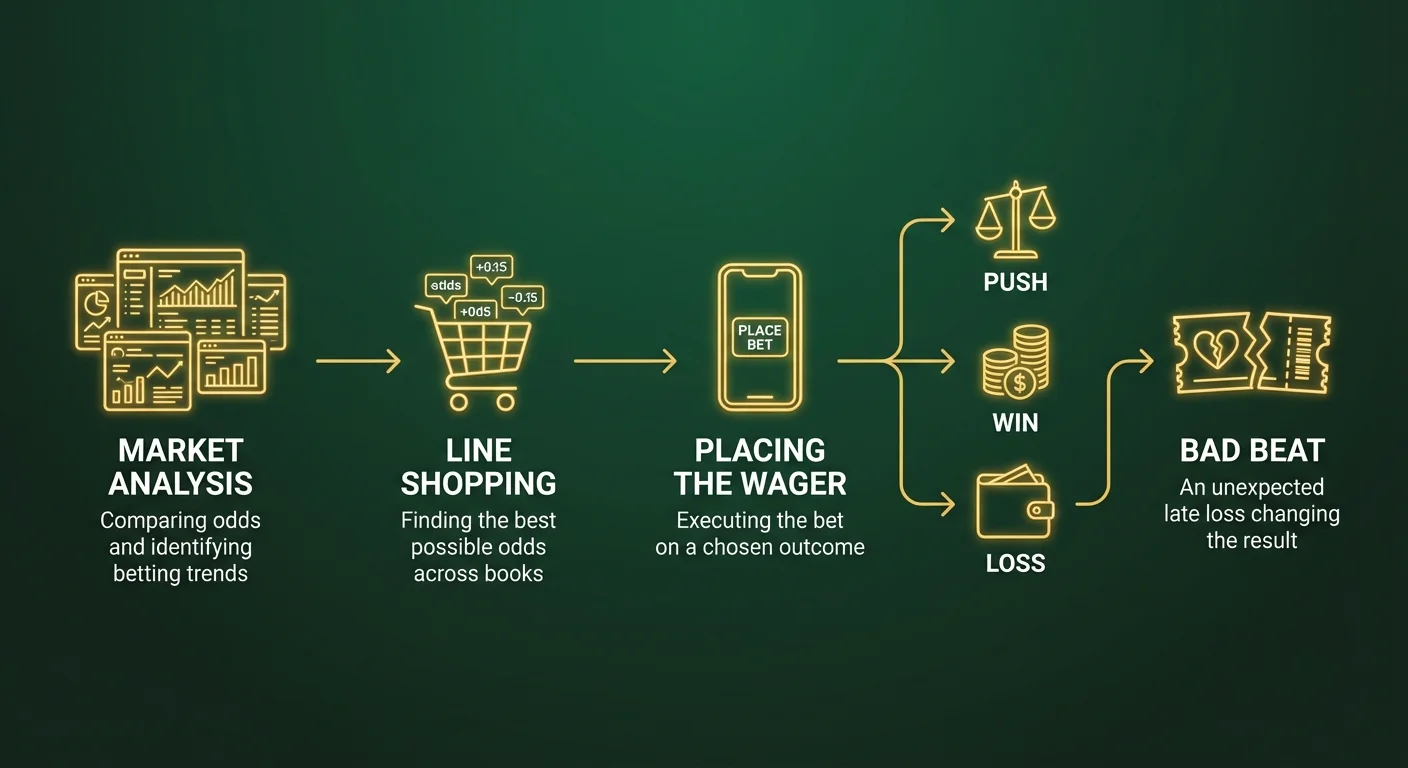
Bad Beat
A loss that happens in the final moments of a game due to an unexpected event, like a meaningless touchdown in the final seconds that affects the point spread, or a "garbage time" basket.
Chalk
Slang for the "favorite" - the team expected to win. A "chalk player" is someone who consistently bets on favorites. While favorites win often, the payouts are low, making it difficult to maintain long-term profitability just by betting chalk.
Closing Line
The final odds posted before the game begins. Beating the closing line (getting better odds earlier in the week than what is available at kick-off) is a hallmark of a professional bettor.
Part 2: Crypto-Specific Betting Terms
Modern betting often takes place on the blockchain. To use CryptoGambling.com recommended sites effectively, you must understand the intersection of finance and gambling.
Address (Wallet Address)
A string of alphanumeric characters representing the destination for your cryptocurrency deposit.
- Warning: Crypto transactions are irreversible. Always copy and paste the sportsbook's deposit address; never type it manually.
Confirmations
When you deposit Bitcoin or Ethereum, the blockchain network must verify the transaction. A sportsbook might require "3 confirmations" before your funds appear in your betting account. This can take anywhere from a few minutes to an hour, depending on the coin.
Gas Fees
The transaction fee paid to network validators (miners) to process your crypto transfer.
- Tip: If betting with Ethereum (ETH), gas fees can be high. Consider using Litecoin (LTC), Ripple (XRP), or USDT on the TRON network for near-zero fees and faster settlements.
Provably Fair
While more common in casino games, some crypto sportsbooks use cryptographic algorithms to prove that their RNG (Random Number Generator) for virtual sports or dice games has not been tampered with.
Stablecoin
Cryptocurrencies pegged to the value of a fiat currency (usually the US Dollar), such as USDT (Tether) or USDC.
- Strategy: Using stablecoins prevents your bankroll from fluctuating due to Bitcoin's market volatility. If you win a bet, you want your winnings to hold their value.
Part 3: The Mechanics of the Wager (F-M)
This section covers the different types of bets and the mechanics of how money moves.
Fixed Odds
Odds that are locked in at the time you place the bet. Even if the line changes later, your payout is determined by the odds at the moment you clicked "confirm."
Futures
A long-term bet on an event that will be decided in the future, such as betting on the Super Bowl winner before the NFL season starts.
- Risk: Your money is tied up for months, meaning you cannot use that liquidity for other bets.
Handle
The total amount of money wagered on a specific game or event. Sportsbooks track the handle to adjust lines and manage their risk.
Handicap
Another word for the "Spread." It is a numerical advantage or disadvantage applied to a team to level the betting field.
- Example: If the Celtics are -6.5, they must win by 7 or more. If you bet the Heat at +6.5, you win if they win outright OR lose by 6 or fewer points.
Hedging
Placing a bet on the opposite side of your original wager to lock in a profit or minimize a loss.
- Scenario: You bet on a team to win the championship at high odds. They make it to the final game. You might bet on the other team in the final just to ensure you walk away with money regardless of who wins.
Hook
A half-point (.5) added to betting lines. The hook ensures there is no tie (push).
- Tip: Buying the hook means paying a little extra "juice" to move a line from -3.5 to -3.0, saving you from a loss if the team wins by exactly a field goal.
Juice (or Vig/Vigorish)
The commission the sportsbook charges for taking your bet. This is the house edge.
- Standard Juice: Usually -110. To win $100, you bet $110. The extra $10 is the juice.
- Goal: Look for "reduced juice" sportsbooks (often crypto sites) that offer lines at -105 or -108.
Limit
The maximum amount a sportsbook will allow you to wager on a specific market.
- Note: Crypto sportsbooks generally offer significantly higher limits than traditional fiat bookmakers, sometimes allowing wagers up to 100 BTC on major events.
Moneyline
The simplest bet: Who will win? No point spreads, no math.
- If you bet the favorite, you have to risk more to win less.
- If you bet the underdog, you risk less to win more.
Part 4: Advanced & Sharp Terminology (N-Z)
These are the terms used by professional "sharps" who bet for a living.
Off the Board
A game is "off the board" when the sportsbook refuses to accept bets on it. This usually happens when there is uncertainty regarding a key player's injury or suspicious betting activity.
Over/Under (Total)
A bet on the combined score of both teams. You wager on whether the total points will be Over or Under the number set by the bookmaker.
Parlay (Accumulator)
A single bet that links together two or more individual wagers. To win the parlay, every leg of the bet must win.
- Risk Profile: High risk, high reward.
- Math: The true probability of hitting a 4-team parlay is usually lower than the odds the sportsbook pays you, making these "sucker bets" in the long run, though fun for entertainment.
Pick'em (PK)
A game where neither team is favored. The spread is zero. You simply pick the winner.
Point Spread
The estimated margin of victory. The bookmaker predicts Team A is 5 points better than Team B. You bet on whether Team A will outperform that prediction.
Push
A tie between the bettor and the sportsbook. If the spread is -3 and the team wins by exactly 3, it is a push. Your original stake is refunded.
ROI (Return on Investment)
A measurement of your betting efficiency.
If you bet $1,000 total over a month and have $1,050, your profit is $50, and your ROI is 5%.
Sharp
A professional, sophisticated sports bettor. Sharps move lines. When a sportsbook sees "sharp money" comes in on a team, they will quickly adjust the odds to discourage others from betting that side.
Steam
When odds change rapidly across the entire betting market. This usually indicates that a syndicate or major betting group has placed heavy wagers, forcing all books to adjust simultaneously. "Chasing steam" means betting on the same side as the sharp money, but usually at worse odds.
Teaser
A type of parlay that allows you to adjust the point spread in your favor in exchange for a lower payout.
- Common Strategy: The "Wong Teaser" in the NFL involves teasing lines through the key numbers of 3 and 7.
Unit
A standard measure of bet size. Instead of saying "I bet $500," a bettor says "I bet 1 unit." This allows bettors with different bankroll sizes to compare strategies.
- Standard: 1 Unit = 1% of total bankroll.
Value
The holy grail of betting. Value exists when you believe the probability of an outcome is higher than the implied probability of the odds.
- Example: If the odds suggest a team has a 33% chance to win, but your analysis says they have a 50% chance, that bet has positive expected value (+EV).
Zig-Zag Theory
A betting strategy specifically for NBA and NHL playoff series. The theory suggests that a team coming off a loss is more likely to cover the spread in the next game due to increased motivation and public overreaction to the previous game.
Comparing Odds Formats
Understanding different odds formats is vital, especially since crypto sportsbooks serve a global audience and may default to Decimal odds.
| Format | Favorite Example | Underdog Example | Meaning |
|---|---|---|---|
| American | -150 | +130 | Risk $150 to win $100 / Risk $100 to win $130 |
| Decimal | 1.67 | 2.30 | Total return (Stake + Profit). $100 x 1.67 = $167 |
| Fractional | 2/3 | 13/10 | Profit relative to stake. Win $2 for every $3 wagered |
Tip: Decimal odds are the easiest to use for calculating parlay payouts - simply multiply the decimal odds of each leg together.
3 Practical Strategies for Beginners
Now that you speak the language, here is how to apply it to improve your game immediately.
1. Stop Betting "Money," Start Betting "Units"
The emotional attachment to money is the bettor's enemy. If you think about a bet as "rent money" or "a steak dinner," you will make emotional decisions.
- The Fix: Convert your crypto deposit into "Units." If you deposit $1,000 USDT, your unit size is $10 or $20. Stick to betting 1 unit on standard plays and 2 units on high-confidence plays. Never chase losses with 5 or 10 units.
2. Shop for the Best Lines (Line Shopping)
Because you are using crypto, you are not tied to slow bank transfers. You can keep funds in a personal wallet and deposit instantly to whichever sportsbook has the best odds.
- Scenario: Site A has the Bills at -6.5. Site B has the Bills at -7.0.
- Action: If you like the Bills, you must bet at Site A. That half-point (the hook) is the difference between winning and pushing. Over a year, line shopping can improve your ROI by 2-3%.
3. Understand "Implied Probability"
Don't just look at the potential payout; look at the likelihood of winning.
- Use a calculator to convert odds to percentage.
- -200 odds implies a 66.7% chance of winning. If you think the team only wins 60% of the time, betting -200 is a losing strategy, even if the team is "likely" to win.
Summary
Mastering the glossary of sports betting is about more than sounding smart in a Discord chat or Reddit thread. It is about understanding the mechanics of the market.
- Bankroll Management: Terms like Unit, Action, and Limit keep you disciplined.
- Finding an Edge: Terms like Closing Line, Steam, and Value help you identify winning opportunities.
- Crypto Efficiency: Terms like Confirmations and Gas Fees ensure you move your money cheaply and securely.
The next time you log into your crypto sportsbook, don't just place a bet. Look for the vig, check the handle, watch for steam, and make sure you're getting the best value for your unit. That is how you stop gambling and start investing.