
Sports betting is often portrayed as a game of intuition, data analysis, and predicting the future. While handicapping games effectively is certainly a skill, it is not the primary reason most bettors fail. The silent killer of sports betting careers is poor money management. You can pick 60% winners, a rate that puts you among the professional elite, and still go broke if you do not know how to manage your funds.
In cryptocurrency sports betting, the stakes are even higher. Not only are you battling the variance of the games themselves, but you are also dealing with the inherent volatility of assets like Bitcoin, Ethereum, and Litecoin. A sudden market dip can shrink the fiat value of your bankroll overnight, even if you are winning your bets.
This guide is designed for beginners who want to move beyond "gut feeling" wagers and treat sports betting as a disciplined investment. We will explore the mathematics of unit sizing, the discipline of flat betting, and the specific strategies required to protect a crypto bankroll from both losing streaks and market crashes.
What is a Betting Bankroll?
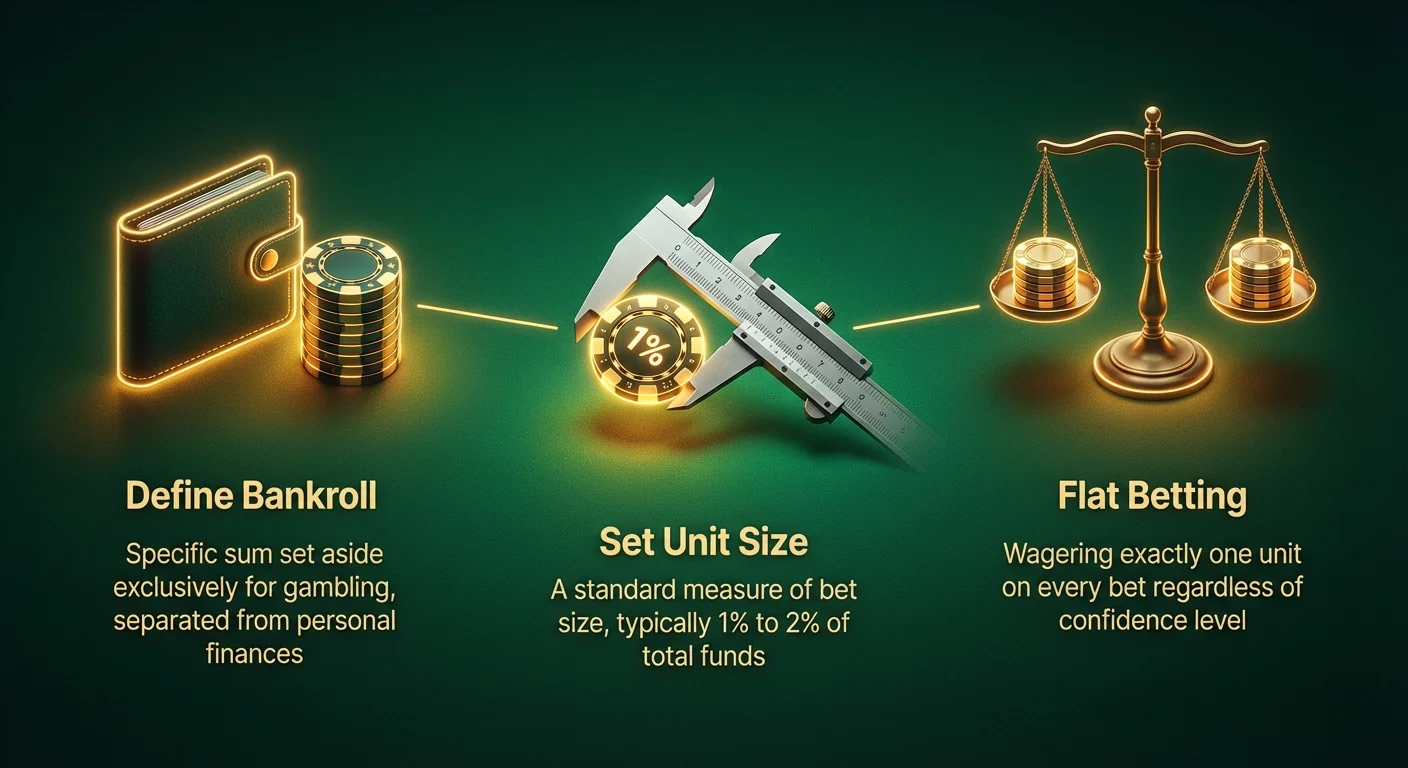
Before you place your first wager, you must define your betting bankroll. This is a specific sum of money set aside exclusively for gambling. It is not your rent money, it is not your grocery budget, and it is not your long-term crypto "HODL" stack.
To be a successful bettor, you must mentally separate this money from your personal finances. Once funds enter your sports betting account, consider them "at risk." If you lost 100% of this bankroll tomorrow, it should be annoying, but it should not impact your lifestyle.
Segregating Funds in Crypto
In traditional fiat betting, segregation is easy: you deposit cash into the sportsbook. In crypto betting, the lines can blur if you aren't careful.
- The Exchange Wallet: Do not bet directly from an exchange wallet where you keep your savings.
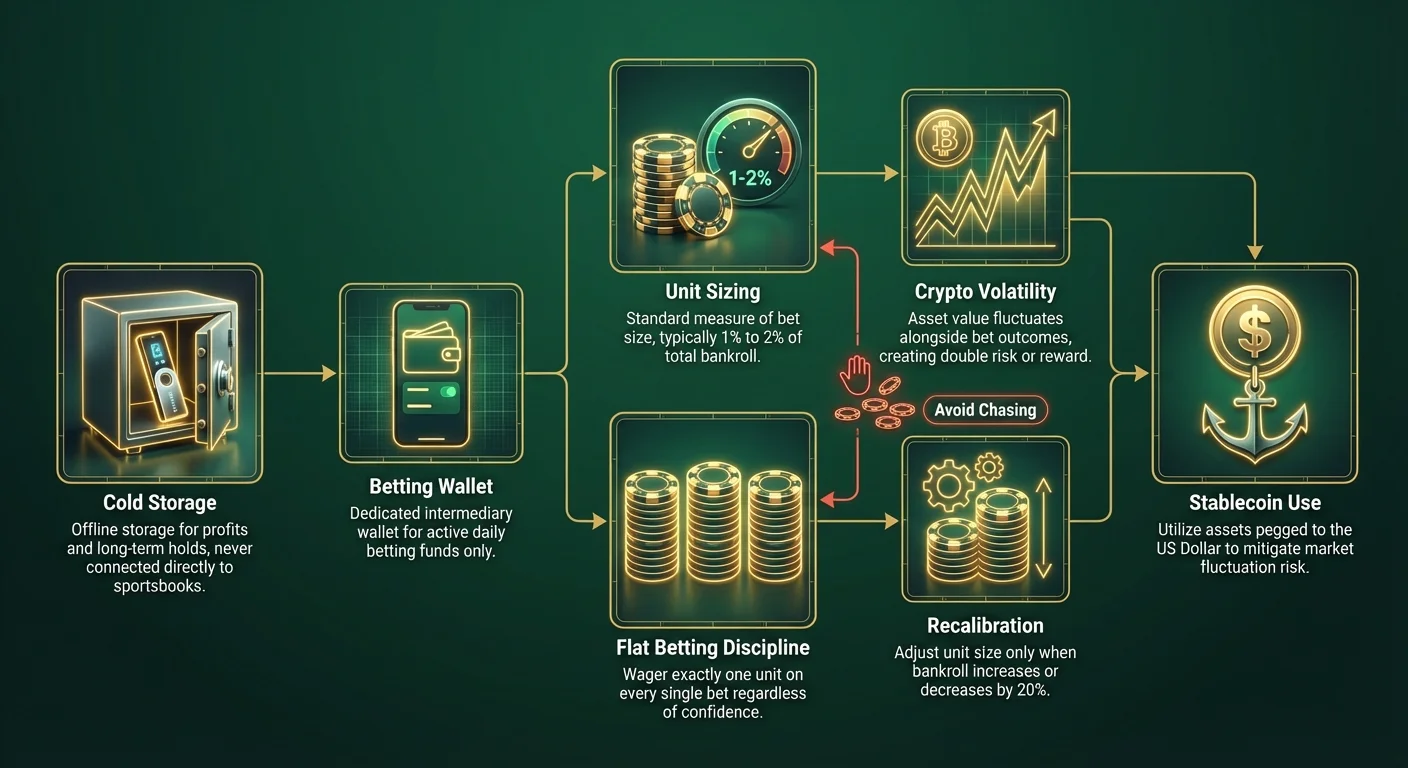
- The Betting Wallet: Create a specific intermediary wallet (like a dedicated MetaMask or Exodus wallet) or strictly monitor the balance within the sportsbook itself.
- Cold Storage: Never connect your cold storage (Ledger/Trezor) directly to a betting site for daily wagers. Keep your profits and long-term holds offline.
The Concept of Unit Sizing
Once you have established a bankroll, let's say 0.1 BTC, you need to determine how much to wager on a single game. This is where "Unit Sizing" comes in.
A "Unit" is a standard measure of the size of your bet. Instead of saying, "I bet $50," professional bettors say, "I bet 1 unit." This allows bettors with different bankroll sizes to compare strategies and success rates accurately.
The Golden Rule: 1% to 3%
The most common mistake beginners make is betting too much on a single game. If you bet 10% of your bankroll on one game, a bad weekend can wipe you out.
Standard money management dictates the following unit sizes:
- Conservative (1%): This is the safest route. If you have a $1,000 bankroll, your unit size is $10. This allows you to weather massive losing streaks without going broke.
- Standard (2%): A balanced approach for bettors who have some experience and a proven edge.
- Aggressive (3%): The absolute maximum recommended for sustainability. Betting 3% per game implies high confidence and high risk tolerance.
- Suicidal (5%+): Betting 5% or more per game is statistically proven to lead to bankruptcy over a long enough timeline due to variance.
Calculating Your Unit in Crypto
Because the value of crypto fluctuates, you have two choices for calculating your unit size:
- Fixed Crypto Amount: You bet 0.001 BTC per game, regardless of the price of Bitcoin.
- Fixed Fiat Value: You bet $50 worth of BTC per game, adjusting the crypto amount based on the current exchange rate.
For beginners, Fixed Fiat Value is usually safer for bankroll preservation, as it protects you from over-betting when crypto prices skyrocket, though we will discuss volatility management later.
Flat Betting vs. Variable Betting
Now that you know how much a unit is, how do you apply it? There are two schools of thought: Flat Betting and Variable Betting. For beginners, there is only one correct answer.
What is Flat Betting?
Flat betting means you wager exactly one unit on every single bet you place, regardless of how "confident" you feel.
If your unit is $20, you bet $20 on a heavy favorite, $20 on an underdog, and $20 on a prop bet.
Why Flat Betting is Superior for Beginners:
- Protects Against Bias: Humans are terrible at estimating probability. You might feel a bet is a "lock" (a sure thing), but in sports, there are no locks. Flat betting prevents you from losing triple your normal amount on a "sure thing" that loses.
- Eases Math: It makes tracking your Return on Investment (ROI) incredibly simple.
- Surviving Slumps: A 50% win rate with flat betting loses only the "juice" (the sportsbook's fee). A 50% win rate with variable betting can bankrupt you if your big bets lose and your small bets win.
The Danger of Variable Models
Variable betting involves rating plays (e.g., 1-unit play, 3-unit play, 5-unit "whale" play). While some professionals do this based on complex mathematical edges (using the Kelly Criterion), beginners usually do it based on emotion.
When you start assigning "5 units" to a game you really like, you introduce massive variance. If you lose two "5-unit" plays, you have lost 10% to 30% of your bankroll instantly. Stick to flat betting until you have tracked at least 500 bets with a positive ROI.
Managing the Crypto Volatility Factor
This is the section that separates a generic betting guide from a crypto bankroll guide. When you bet with Bitcoin or Ethereum, you are gambling on two things simultaneously: the outcome of the game and the price of the asset.
The "Double Win" and "Double Loss"
- Double Win: You bet 0.01 BTC on a game and win. Simultaneously, the price of BTC goes up 10%. You have increased your stack and the value of that stack.
- Double Loss: You bet 0.01 BTC and lose. Simultaneously, the price of BTC crashes 10%. Your remaining bankroll is now smaller in quantity and worth less in purchasing power.
Strategy: Using Stablecoins
To mitigate this risk, many smart crypto bettors use Stablecoins (USDT, USDC, DAI). These coins are pegged to the US Dollar.
Comparison: Native Token vs. Stablecoin Betting
| Feature | Betting with BTC/ETH | Betting with USDT/USDC |
|---|---|---|
| Volatility | High. Bankroll value fluctuates hourly. | None. 1 USDT always equals ~$1. |
| Upside | Potential for asset appreciation while betting. | No appreciation. Purely betting profit. |
| Mental Game | Harder. "I won the bet but lost money." | Easier. Profits are clear and tangible. |
| Best For | Long-term holders who want to accumulate more coins. | Bettors focused on sports ROI and income. |
Tip: If you are a beginner, consider keeping 50% of your bankroll in Stablecoins for your day-to-day betting. This isolates your sports betting performance from the crypto market performance.
The Psychology of Loss: Avoiding the Chase
The fastest way to destroy a well-planned bankroll is "chasing losses." This occurs when a bettor has a losing day (or week) and increases their bet size to try and win it all back in one go.
The "Tilt" Phenomenon
"Tilt" is a poker term that applies perfectly to sports betting. It is an emotional state of frustration and confusion that leads to irrational decisions.
Signs you are chasing:
- You are betting on sports you don't know (e.g., betting on late-night Russian Table Tennis because you lost on the NFL earlier that day).
- You are doubling your unit size to "get even."
- You are depositing more crypto from your cold storage because your betting wallet is empty.
The Martingale Fallacy
Some bettors discover the "Martingale System" and think they have found a cheat code. The strategy involves doubling your bet after every loss.
- Bet $10 (Lose)
- Bet $20 (Lose)
- Bet $40 (Lose)
- Bet $80 (Win) -> Net profit $10.
Why this fails:
- Table Limits: Sportsbooks have maximum bet limits. Eventually, you won't be allowed to double down.
- Bankroll Limits: Exponential growth is terrifying. If you start at $10 and lose 8 bets in a row (which happens often in sports), your 9th bet would need to be $2,560 just to win $10.
- Crypto Speed: Because crypto deposits are instant, it is dangerously easy to keep funding a Martingale disaster.
The Solution: Stick to your flat unit sizing. If you lose 5 units, you accept the loss. You do not bet 5 units on the next game to make it back. You bet 1 unit. You grind it back slowly.
Recalibrating Your Unit Size
A bankroll is not static. It grows and shrinks. Therefore, your unit size should not be fixed forever. You must recalibrate.
The 20% Rule
A good rule of thumb for beginners is to recalibrate your unit size every time your bankroll increases or decreases by 20%.
Scenario A: The Winning Streak
- Starting Bankroll: $1,000 (Unit: $20 / 2%)
- You go on a hot streak. Bankroll grows to $1,200.
- Recalibrate: New Unit is $24 (2% of $1,200).
- Why? This allows you to leverage compound interest. You are betting more with "house money."
Scenario B: The Losing Streak
- Starting Bankroll: $1,000 (Unit: $20 / 2%)
- You hit a slump. Bankroll drops to $800.
- Recalibrate: New Unit is $16 (2% of $800).
- Why? This is your defensive shield. By lowering your bet size, you extend your runway and ensure you don't go broke. It is painful to bet smaller to win back losses, but it is necessary for survival.
Practical Tips for Crypto Bankroll Management
Here is a step-by-step checklist to set up your system today.
1. Choose Low-Fee Networks
If your unit size is small (e.g., $10 or $20), do not use Ethereum (ERC-20) for deposits and withdrawals unless you are a whale. Gas fees of $5-$10 will eat your ROI alive.
- Recommended: Litecoin (LTC), Ripple (XRP), Tron (TRX), or Bitcoin via Lightning Network. These have negligible fees, meaning more of your money goes toward the wager.
2. Use a Tracker
You cannot improve what you do not measure. You need to know your exact win percentage and ROI.
- Spreadsheets: A simple Excel or Google Sheet tracking Date, Sport, Bet Type, Odds, Stake (Units), and Result.
- Apps: Platforms like Action Network (US) or various crypto-specific betting logs allow you to track your record.
3. Understanding Implied Probability
Bankroll management isn't just about how much you bet, but *what* you bet on.
- American Odds (-110): Implies a 52.38% probability.
- Decimal Odds (1.91): The standard for most crypto books.
If you are flat betting on outcomes with odds of -110 (1.91), you must win 52.4% of your bets just to break even (due to the vigorish/juice). Your goal is to hit 55%+. If you can hit 55% winners long-term using flat betting, you will be profitable.
4. Withdraw Profits Regularly
One of the best feelings in gambling is realizing a profit.
- The 50/50 Rule: If you end the month up 10 units, withdraw 5 units back to your cold storage or bank account, and add 5 units to your betting bankroll to increase your unit size.
- Reality Check: Seeing the money leave the betting site and enter your real wallet reinforces that this is real money, not just digits on a screen.
Summary: The Pillars of Survival
To summarize, successful sports betting is 20% picking winners and 80% managing money. The graveyard of gamblers is filled with people who could pick winners but couldn't manage a bankroll.
Here are your key takeaways for crypto bankroll management:
- Define the Bankroll: Set aside a specific amount of crypto you are willing to lose.
- Determine Unit Size: Stick to 1-2% of your total bankroll per bet.
- Flat Bet: Bet the same amount on every game. Do not vary bet sizes based on "feelings."
- Manage Volatility: Consider using Stablecoins to avoid market fluctuation, or be prepared for the swings of BTC betting.
- Never Chase: If you lose, stop. Tomorrow is another day.
- Recalibrate: Adjust your unit size up or down as your bankroll changes.
By adhering to these strict rules, you transform gambling from a chaotic gamble into a disciplined pursuit. The goal is not to get rich in one weekend, but to stay in the game long enough for your edge to play out. Stay disciplined, bet responsibly, and let the math work in your favor.