
The rise of decentralized finance (DeFi) has introduced revolutionary concepts that fundamentally change how financial transactions occur. Chief among these innovations are liquidity pools. These pools are not just buzzwords; they are the fundamental infrastructure—the engine—that powers decentralized exchanges (DEXs) and allows users to trade digital assets without relying on central authorities, banks, or traditional order books.
For newcomers to crypto, understanding liquidity pools is the essential first step into navigating the DeFi landscape. They represent a paradigm shift: instead of finding an individual counterparty for every trade, users now interact with a massive, shared pool of capital governed by automated software.
This comprehensive guide breaks down what liquidity pools are, how they function using smart contracts, why they are essential for decentralized trading, and how you can participate safely in this new financial ecosystem.
Decentralizing the Market: Why Pools are Necessary
To appreciate the genius of liquidity pools, we must first understand the limitations of the traditional financial systems they seek to replace.
The Problem with Traditional Exchanges (Order Books)
In traditional centralized exchanges (CEXs) and stock markets, trading is driven by an order book. This is a ledger that matches specific buy orders (bids) with specific sell orders (asks).
For a trade to execute, two conditions must be met:
- A buyer must exist at the price the seller demands.
- A seller must exist at the price the buyer offers.
If there aren't enough buyers or sellers for a specific asset—a situation known as low liquidity—it becomes impossible to trade quickly, and the price jumps wildly when large orders are placed. This system requires constant maintenance and a large volume of active traders to function efficiently. For new or niche crypto tokens, generating this depth of liquidity is incredibly difficult.
The DEX Solution: Peer-to-Pool Trading
Decentralized exchanges needed a way to facilitate trades instantly, 24/7, without relying on matching individual buyers and sellers. This is where liquidity pools come in.
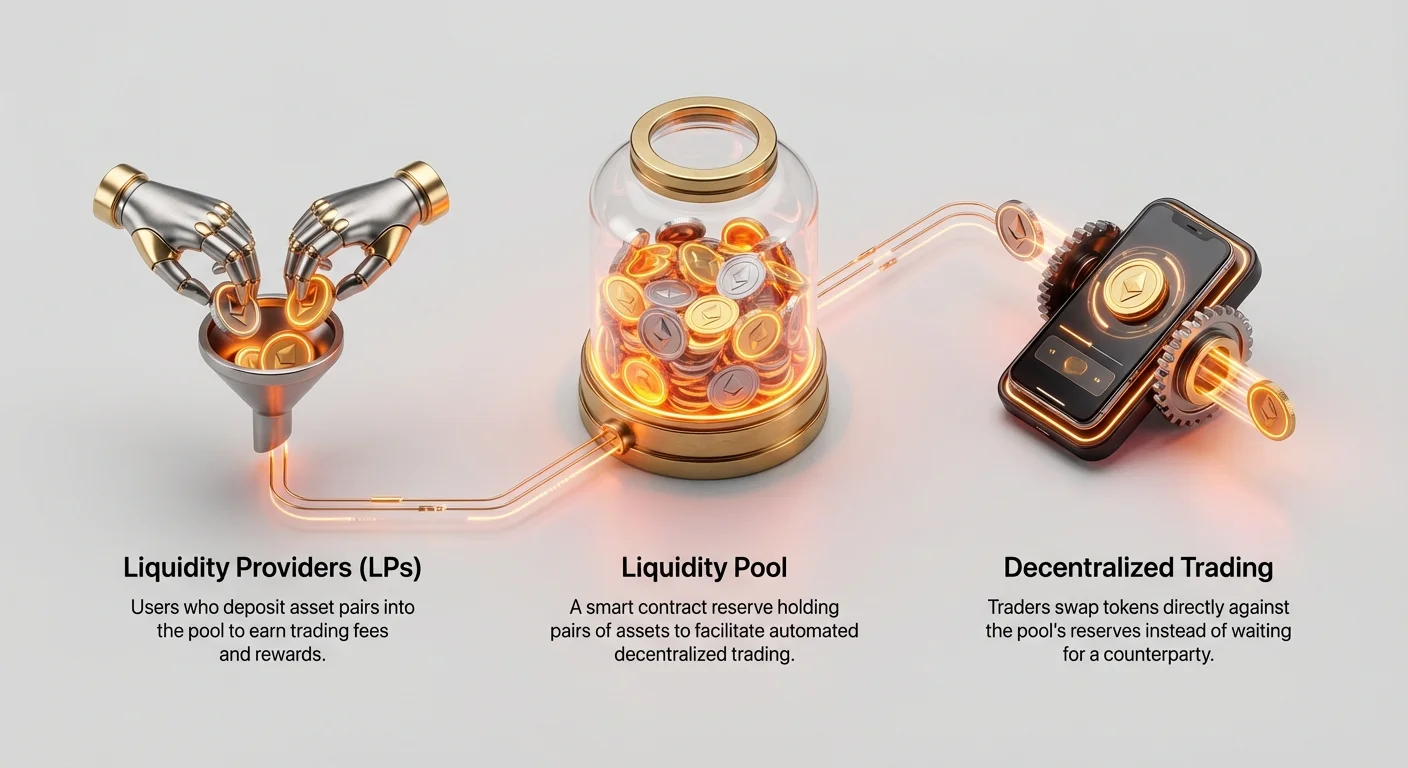
A liquidity pool is simply a reserve of two or more tokens locked into a smart contract. Instead of trading with another person, traders interact directly with the pool.
- You want to buy Token Y? You put Token X into the pool and take Token Y out.
- You want to sell Token Y? You put Token Y into the pool and take Token X out.
The pool itself acts as the constant counterparty for every transaction, guaranteeing that a trade can always be executed, regardless of how many buyers or sellers are currently active.
The Role of Liquidity Providers (LPs)
Liquidity pools don't fill themselves. They require capital from users—the Liquidity Providers (LPs).
An LP is any user who deposits their crypto assets into the pool’s smart contract. By doing so, they provide the necessary inventory for others to trade. In exchange for committing their capital and taking on the inherent risks (which we will discuss later), LPs receive a share of the transaction fees generated by the pool.
LPs are, effectively, the decentralized market makers. They ensure the market functions smoothly, and they are compensated for their service.
Defining the Liquidity Pool and its Core Function
At the most fundamental level, a liquidity pool is a mechanism for facilitating automated, permissionless trading.
The Anatomy of a Pool (Token Pairs)
Every liquidity pool on a DEX is defined by the assets it holds, typically in pairs. The most common structure involves a high-value anchor asset paired with a more volatile asset.
Common examples of liquidity pairs include:
| Token A (Anchor) | Token B (Volatile/Novel) | Use Case |
|---|---|---|
| ETH (Ethereum) | SHIB (Shiba Inu) | Trading volatile altcoins. |
| USDC (Stablecoin) | ETH (Ethereum) | Providing a stable anchor for high-demand assets. |
| DAI (Stablecoin) | USDC (Stablecoin) | Swap pair for users needing low-volatility transfers. |
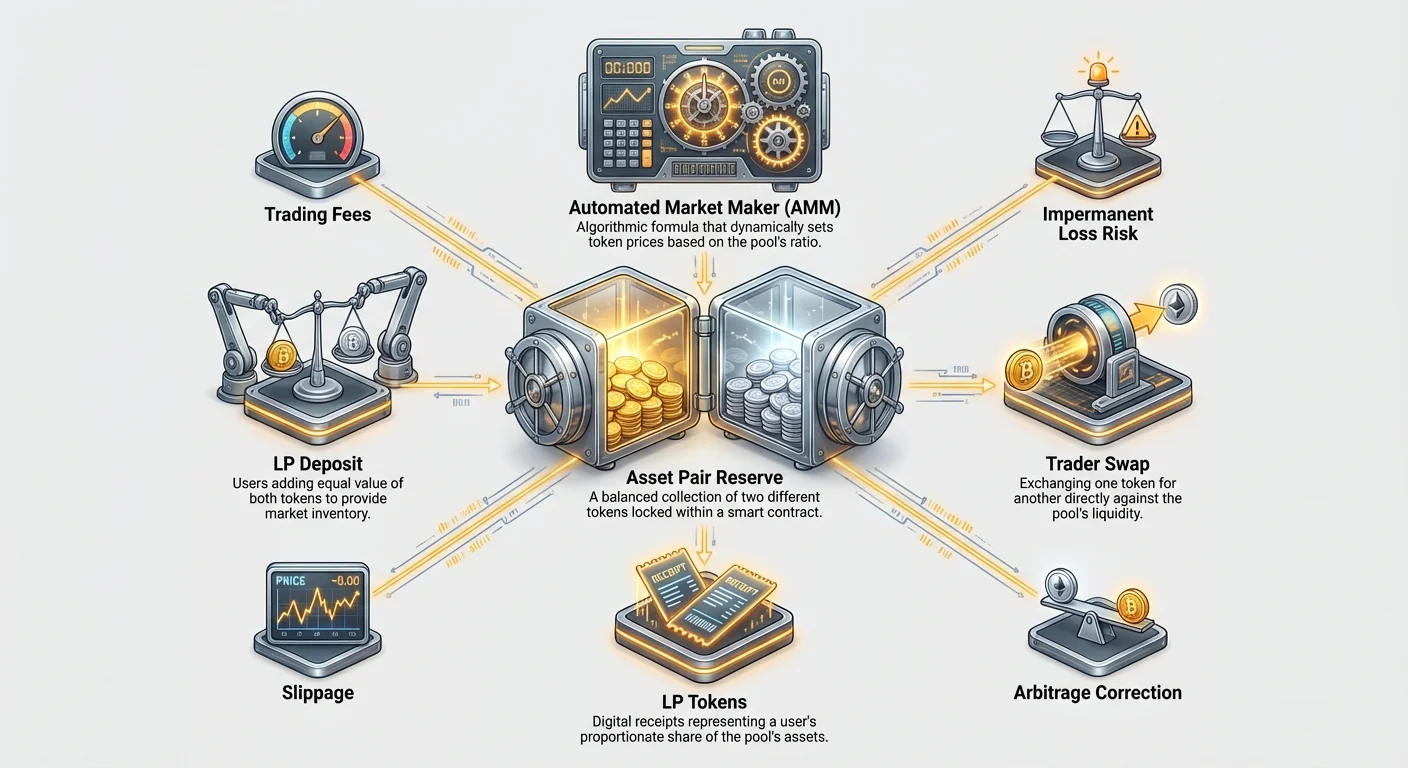
When an LP deposits assets, they must typically deposit both Token A and Token B simultaneously, ensuring the pool remains balanced.
Smart Contracts: The Pool's Manager
The entire operation of a liquidity pool is governed by a smart contract. This smart contract is a piece of code deployed on the blockchain (such as Ethereum, Solana, or Polygon) that executes automatically when certain conditions are met.
The smart contract performs several crucial functions:
- Holds the Funds: It securely locks the deposited assets (the liquidity).
- Calculates Price: It uses a specific mathematical formula (the Automated Market Maker, or AMM) to determine the exchange rate for every swap.
- Collects Fees: It automatically collects a small trading fee from every transaction.
- Distributes Rewards: It automatically distributes the collected fees back to the Liquidity Providers based on their share of the pool.
Because this code is immutable and transparent on the blockchain, users can verify exactly how the pool operates, fostering trust that is not required in centralized institutions.
The 50/50 Composition Rule (The Classic Example)
In the earliest and most prevalent form of liquidity pools (established by platforms like Uniswap V2), the assets within the pool must maintain a 50/50 value ratio.
This does not mean 50 tokens of X and 50 tokens of Y. It means the total dollar value of Token X must equal the total dollar value of Token Y.
Example: Imagine an ETH/USDC liquidity pool.
- If the price of 1 ETH is $3,000.
- To create a balanced pool with $10,000 in total liquidity, the composition must be:
- 5,000 USDC (Token A)
- 1.66 ETH (Token B, since 1.66 * $3,000 = $5,000)
If the price of ETH rises to $3,500, the pool will automatically rebalance through trading activity to ensure that the value of the ETH side still matches the value of the USDC side. This process of rebalancing is the core function of the Automated Market Maker.
How Liquidity Pools Power Automated Market Makers (AMMs)
The liquidity pool provides the assets, but the Automated Market Maker (AMM) is the mathematical engine that determines the price and ensures stability. An AMM is simply a protocol that uses a mathematical formula to determine the price of assets dynamically, based on the ratio of tokens within the pool.
Moving Beyond Buyers and Sellers
The AMM replaces the traditional order book model. Instead of looking for matching orders, the AMM uses the ratio of assets within the pool to calculate how much of one token you will receive for another.
If a pool holds a lot of Token A and very little of Token B, the AMM will automatically increase the price of Token B relative to Token A to incentivize traders to bring more Token B into the pool (or remove Token A).
The Constant Product Formula: $X * Y = K$
The most famous and foundational formula used by AMMs, first popularized by Uniswap, is the Constant Product Formula:
Where:
- X is the quantity of Token A in the pool (e.g., ETH).
- Y is the quantity of Token B in the pool (e.g., USDC).
- K is a constant value that must remain unchanged after any trade.
This constant $K$ is the key stabilizer. If someone takes some quantity of X out of the pool, they must deposit enough Y to ensure that the product (X multiplied by Y) remains the same.
How the Formula Sets the Price
- Starting Point: If the pool has 100 ETH (X) and 100,000 USDC (Y). $K = 10,000,000$. The price of 1 ETH is $1,000 USDC (100,000 / 100).
- A Trader Buys ETH: A trader deposits 1,000 USDC into the pool.
- The pool now has 101,000 USDC (Y).
- To keep $K$ at $10,000,000$, the pool must only allow the trader to withdraw enough ETH (X) to maintain the balance.
- New X must be .
- The trader received ETH.
- The Resulting Price Change: Because the pool is now slightly depleted of ETH, the next trade will be more expensive for ETH buyers. The price of ETH has effectively risen to reflect its lower availability in the pool.
This immediate price adjustment, based purely on the supply/demand ratio within the pool, is how AMMs facilitate continuous, automated trading without human intervention.
Price Discovery and Arbitrage
While the AMM sets the price internally, the crypto market is global. The price of an asset on a decentralized exchange must stay synchronized with the price of that same asset on centralized exchanges (like Binance or Coinbase). This synchronization is maintained through arbitrage.
Arbitrageurs are sophisticated traders who constantly monitor prices across different exchanges.
- If the price of ETH on a DEX pool is $3,100, but on a CEX it is $3,000, arbitrageurs will immediately buy ETH on the CEX and sell it into the DEX pool.
- By selling ETH into the DEX pool, they increase the supply of ETH and decrease the supply of the paired token (e.g., USDC), causing the DEX price to drop back towards $3,000.
Arbitrage is the mechanism that ensures the liquidity pool’s internal price reflects the true market price, making it a self-correcting and highly efficient system.
Becoming a Liquidity Provider: How LPs Earn Rewards
The entire DEX ecosystem is reliant on individuals willing to lock up their assets. Liquidity Providers (LPs) take on risks, and they are compensated for this service primarily through trading fees.
The Reward Structure: Trading Fees
For every swap that occurs on a liquidity pool, a small fee is charged to the trader. This fee is typically a tiny percentage, often ranging from 0.05% to 0.30%, depending on the platform and the pool type (e.g., stablecoin swaps often have lower fees).
These collected fees are immediately distributed proportionally back to the LPs.
Example:
- A pool has $1,000,000 in total liquidity.
- You deposited $10,000, meaning you own 1% of the pool.
- If the pool generates $5,000 in trading fees today, you, as a 1% owner, will automatically receive $50.
These fees are often added back into the pool itself, compounding the LP’s share and continuously increasing their ownership value.
Liquidity Pool Tokens (LPTs) and Proof of Contribution
When you deposit assets into a liquidity pool, you don't just receive a receipt; you receive special tokens known as Liquidity Pool Tokens (LPTs), sometimes called LP tokens or pool shares.
These LPTs serve two key functions:
- Proof of Ownership: They represent your proportionate stake in the pool (e.g., if you hold 5% of the LPTs, you own 5% of the underlying assets and 5% of the fees).
- Redemption: To withdraw your initial deposit plus accumulated earnings, you must return your LPTs to the smart contract, which then releases the corresponding assets.
LPTs can often be used in other DeFi protocols, creating opportunities for further yield generation—a concept known as "yield farming."
Yield Farming and LP Incentives
While basic LPs earn fees, many DEXs and DeFi projects offer additional rewards to incentivize liquidity provision for their specific tokens. This practice is called yield farming or liquidity mining.
In yield farming, users stake their LPTs in another protocol (or the same DEX’s governance mechanism) to earn a reward in a different token—often the native governance token of the platform (e.g., staking Uniswap LPTs to earn UNI tokens).
This mechanism serves to deepen liquidity, especially for newer tokens, by offering LPs a higher return than they would get from just trading fees alone.
Actionable Tip: When assessing a liquidity pool, look beyond the trading fee percentage. Check if the pool offers additional token incentives (yield farming rewards) to determine the total potential Annual Percentage Yield (APY).
Practical Example: Trading on a Liquidity Pool
Let’s trace the journey of a simple asset swap on a DEX powered by liquidity pools, such as swapping USDC for ETH.
Step 1: Connecting the Wallet
A trader initiates the process by connecting their personal, non-custodial wallet (like MetaMask or Trust Wallet) to the decentralized exchange interface. This ensures the trader remains in full control of their private keys and funds at all times—a key benefit of DEXs.
Step 2: Executing the Swap (Pool Interaction)
The trader selects the amount of USDC they want to sell and the token they wish to receive (ETH).
- Approval: Since the smart contract needs to access the USDC in the trader's wallet, the trader first approves the smart contract to spend that specific amount of USDC.
- Transaction: The trader executes the swap transaction.
- AMM Calculation: The AMM smart contract instantly checks the current ratio of USDC to ETH in the pool and determines how much ETH the trader will receive, factoring in the trading fee.
- Exchange: The smart contract deducts the USDC (plus fee) from the trader’s wallet, adds it to the pool, and then immediately transfers the corresponding amount of ETH from the pool back to the trader’s wallet.
The entire process is atomic—it happens in one verifiable transaction on the blockchain.
Step 3: Understanding Slippage
A critical concept for traders interacting with liquidity pools is slippage.
Slippage refers to the difference between the expected price of a trade and the actual executed price. This occurs because the AMM formula adjusts the price during the transaction.
If a pool has high liquidity (a large $K$ value), even a massive trade won't significantly change the ratio, resulting in low slippage.
If a pool has low liquidity (small $K$ value), even a modest trade can drastically alter the token ratio, forcing the AMM to adjust the price significantly, resulting in high slippage.
For traders, high slippage means they receive fewer tokens than expected. Users are usually allowed to set a "maximum tolerable slippage" (e.g., 0.5% or 1%). If the market moves too much, or if the trade size is too large for the liquidity, the transaction will fail to protect the trader from a poor execution price.
Key Risks and Considerations for Liquidity Pools
While providing liquidity can be highly profitable, it is crucial for beginners to understand the unique risks associated with staking capital in an AMM environment.
Understanding Impermanent Loss (IL)
The single biggest risk facing Liquidity Providers is Impermanent Loss (IL). This is a complex topic, but its core definition is simple: IL is the temporary loss of funds due to the volatility of the deposited assets compared to simply holding them in a wallet.
IL occurs when the price of one deposited asset changes significantly relative to the other asset in the pair. The AMM’s constant rebalancing forces the LP to hold less of the asset that has appreciated in value and more of the asset that has depreciated.
The result: If you withdrew your assets, you might find that the dollar value of the assets you held outside the pool would be higher than the dollar value of the assets you have in the pool. The loss is called "impermanent" because it only becomes permanent when you withdraw the funds.
Setting the stage for further study: LPs often calculate whether the trading fees earned are enough to offset the potential impermanent loss. High-fee, high-volume pools are generally preferred to maximize fee earnings and minimize the net impact of IL. (This topic requires a deep dive, which is reserved for a dedicated article.)
Smart Contract Risks and Security
Liquidity pools are managed by smart contracts, and code is susceptible to bugs or exploits. If a pool’s smart contract contains a vulnerability, malicious actors could potentially drain the funds held within it.
This risk underscores the importance of choosing established, battle-tested platforms (like Uniswap, SushiSwap, or Curve) whose smart contracts have been rigorously audited by third-party security firms. Newer, unaudited protocols carry significantly higher smart contract risk.
Gas Fees and Transaction Costs
Interacting with liquidity pools—whether depositing, withdrawing, or trading—requires paying transaction fees (gas) to the underlying blockchain network (e.g., Ethereum).
- Depositing/Withdrawing: These are complex transactions requiring significant computation and therefore command higher gas fees. If the value of your deposit is small, the gas fees might wipe out months of potential fee earnings.
- Trading: While smaller trades incur lower fees, high gas prices can make small swaps uneconomical.
LPs must consider the cost of entering and exiting a pool when calculating potential profitability, especially on high-traffic networks like Ethereum.
Evolution of Liquidity Pools: From Basic to Advanced
Since the initial constant product pool model ($X * Y = K$) was launched, the DeFi industry has innovated rapidly to improve capital efficiency and reduce risks. Modern DEXs utilize several specialized types of pools designed for specific asset behaviors.
Stablecoin Pools (Low Volatility)
Standard AMMs are optimized for volatile assets but are highly inefficient for assets that should maintain parity (like two stablecoins, e.g., USDC and DAI). Since stablecoins should always trade close to 1:1, forcing them through the $X * Y = K$ curve results in high slippage near the 1:1 peg.
Protocols like Curve introduced new, specialized AMM formulas designed for correlated assets. These formulas allow for massive swaps between stablecoins with near-zero slippage, using capital much more efficiently than a traditional 50/50 pool.
Concentrated Liquidity
A major breakthrough in capital efficiency came with the introduction of Concentrated Liquidity (popularized by Uniswap V3).
In the classic 50/50 model, liquidity is spread evenly across the entire price spectrum (from $0 to $\infty$). However, most trading volume occurs within a very narrow price range (e.g., ETH usually trades between $2,000 and $4,000). The liquidity outside this range is rarely used and is therefore inefficient.
Concentrated Liquidity allows LPs to dedicate their capital to specific, narrow price ranges.
Benefits:
- Higher Fees: If an LP concentrates $10,000 of liquidity in the $3,000–$4,000 range, they might earn the same fees as an LP with $100,000 spread across the whole price spectrum.
- Better Prices: Traders benefit from deeper liquidity within the active range, leading to lower slippage.
Drawbacks:
- Active Management: If the price moves outside the LP’s set range, their entire position converts to the less valuable asset, and they stop earning fees, requiring the LP to actively rebalance and reposition their liquidity. This requires advanced knowledge.
Cross-Chain Pools (Interoperability)
Traditional liquidity pools are constrained to the single blockchain on which they operate (e.g., an ETH/USDC pool on Ethereum cannot natively interact with a SOL/USDC pool on Solana).
New infrastructure, including dedicated bridging protocols, is working to create "cross-chain" liquidity solutions. These allow assets to be wrapped or moved seamlessly between different blockchains, allowing LPs to earn fees from trading volume across multiple chains, significantly broadening the market for decentralized liquidity.
Conclusion
Liquidity pools are the invisible force driving the decentralized financial system. They replaced slow, inefficient order books with self-regulating pools of capital, enabling instant, transparent, and permissionless trading for anyone with a crypto wallet.
For the beginner, understanding liquidity pools is the key to unlocking DEX functionality. By transitioning from a passive user to an active Liquidity Provider, you are not just trading; you are participating in the core infrastructure of Web3. While the risks, particularly impermanent loss, demand careful research and calculated risk management, the potential rewards and the opportunity to contribute to truly decentralized markets make liquidity provision one of the most exciting and foundational activities in DeFi.