
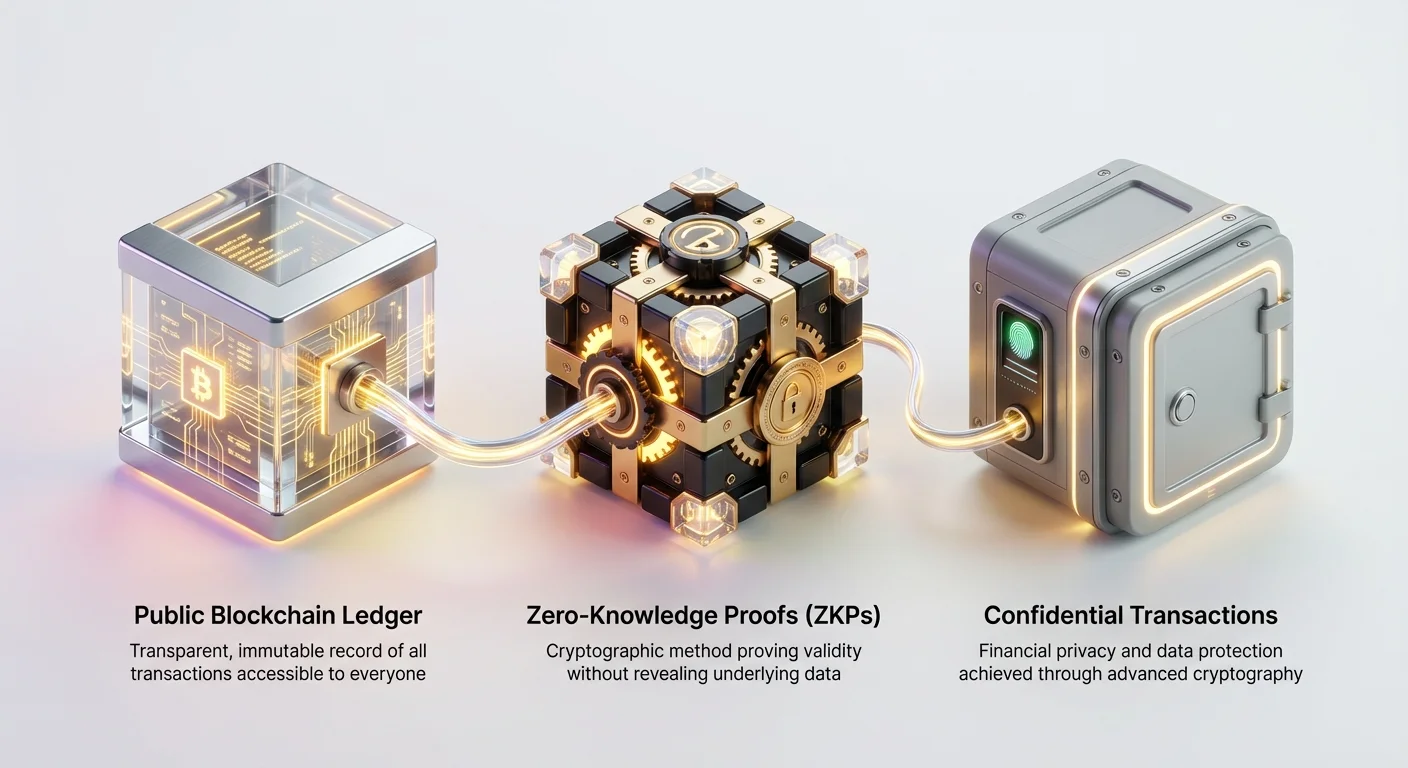
The revolutionary appeal of blockchain technology lies in its transparency. Every transaction, every balance, and every contract execution is recorded on a public, immutable ledger accessible to anyone in the world. This radical openness eliminates the need for trusted intermediaries.
However, this inherent transparency presents a significant engineering challenge: global, unselective visibility is incompatible with real-world financial privacy. If every neighbor can see your bank account balance, income sources, and purchasing history, the system is unlikely to achieve mainstream adoption. While Bitcoin introduced partial pseudonymity, this is only a partial solution, as transaction patterns can often be traced back to real identities.
To move past mere pseudonymity and achieve true confidentiality, blockchain engineers utilize highly complex cryptographic techniques. This page delves into the core infrastructure behind confidential blockchain transactions, focusing on how Zero-Knowledge Proofs (ZKPs) and related technologies solve the privacy paradox, transforming public ledgers into environments capable of handling sensitive data. We shift the focus from simple transaction obfuscation (like coin mixing) to the underlying math that ensures both verifiable integrity and absolute secrecy.
The Paradox of Public Ledgers: Why Privacy is Essential
At its core, blockchain is a database designed for maximum auditability. Anyone can verify that the rules were followed. This security model requires that the data supporting the verification must be public. For example, to verify a transfer of 10 coins, the verifier must see that the sender had at least 10 coins.
This necessity creates a conflict in commercial and personal finance.
The Cost of Global Transparency
In a fully transparent system, all data is broadcast. While this works for the technical integrity of the blockchain, it causes severe privacy leakage in the real world:
- Exposure of Financial Behavior: If a public address is linked to a business or an individual, competitors or malicious actors can track inventory levels, supply chain partners, customer volumes, and real-time liquid assets.
- Loss of Competitive Advantage: Companies dealing with proprietary information cannot afford to have their smart contract logic or input data exposed simply because the verification process demands it.
- Regulatory Conflict: Many jurisdictions require certain levels of financial privacy, contradicting the public nature of typical blockchain transactions.
Pseudonymity vs. True Anonymity
Early cryptocurrencies relied on pseudonymity—using a cryptographic address (a long string of characters) instead of a legal name. While this separates the user from their transactions initially, it is fragile.
- Pattern Analysis: Advanced data analytics and machine learning can often cluster addresses and de-anonymize users based on transaction timing, amounts, and flow.
- External Data Leakage: The moment a user links their public address to a centralized exchange, a KYC (Know Your Customer) process, or a real-world activity (like shipping an item), the entire history of that address can be linked back to their identity.
To achieve true anonymity (or more accurately, confidentiality), the system must allow a user to prove they followed the rules (e.g., "I have enough funds to send") without revealing the specific data ("I have exactly 500,000 coins in my wallet"). This is the fundamental purpose of Zero-Knowledge Proofs.
The Core Concept: Zero-Knowledge Proofs (ZKPs)
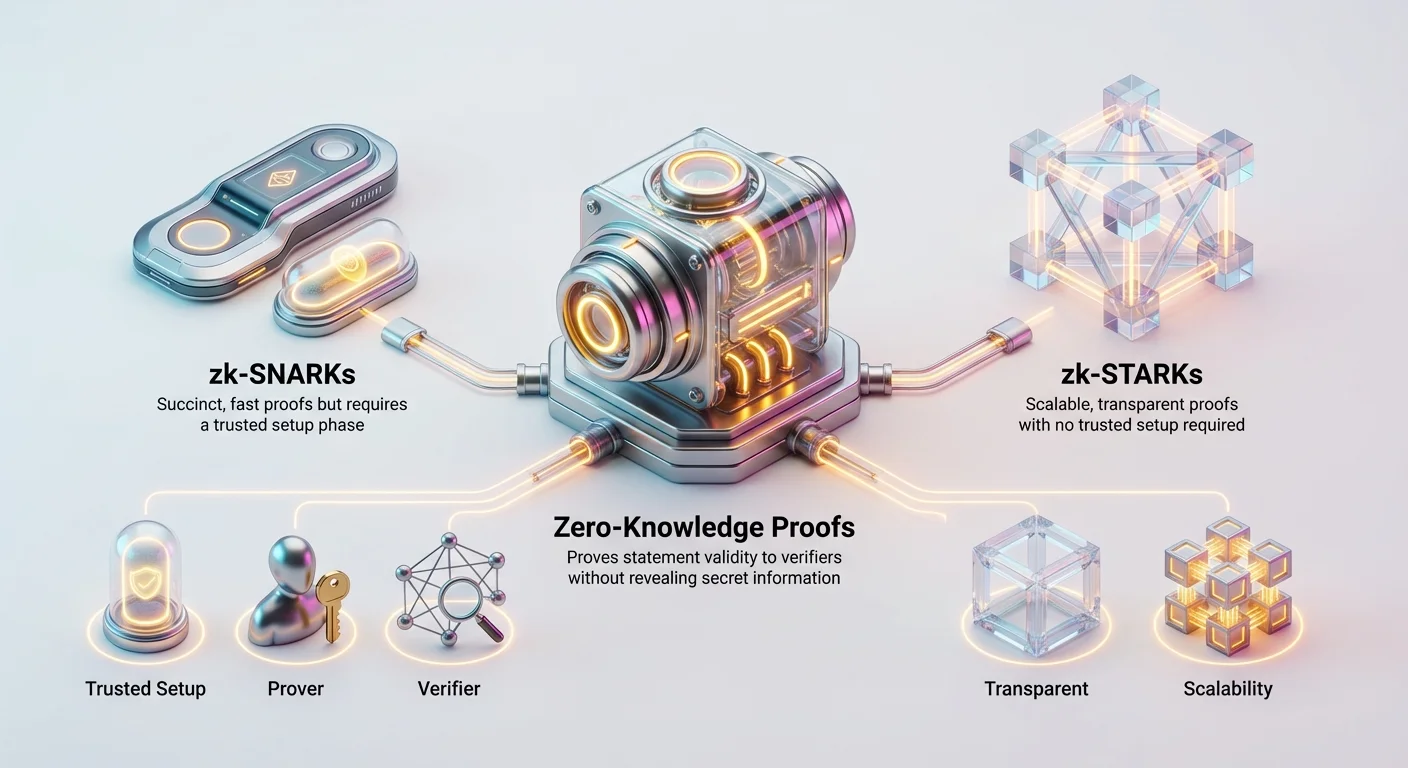
A Zero-Knowledge Proof (ZKP) is a cryptographic method where one party (the Prover) can prove to another party (the Verifier) that a statement is true, without revealing any information about the statement itself beyond the fact of its validity.
The Classic ZKP Analogy
Imagine you are trying to prove you know the secret password to a private club, but you cannot speak or write down the password (if you did, the Verifier would know the secret).
Instead, you use a magic box:
- The Verifier gives you an encrypted version of the password and a random piece of data.
- You, the Prover, use your secret password to unlock the encrypted version and combine it with the random data in a unique way.
- You then send a result back to the Verifier. The Verifier, knowing the expected outcome of the process (but not your password), can confirm that the result is correct.
You proved you knew the secret password, not by revealing the password, but by showing you could execute a specific cryptographic transformation only possible with the secret.
Defining the Prover and the Verifier
In the context of blockchain privacy, the two roles are:
- The Prover: The party initiating the confidential transaction. They generate the proof (the encrypted mathematical evidence).
- The Verifier: The public network (the thousands of decentralized nodes). They use the proof and the public rules of the protocol to confirm the transaction is legitimate, without seeing the private inputs (e.g., the amount transferred or the sender’s balance).
The Three Essential Properties of ZKPs
For a cryptographic proof system to be considered a true ZKP, it must satisfy three conditions:
- Completeness: If the statement is actually true, an honest Prover can always convince an honest Verifier. (If you know the secret, you can always prove it.)
- Soundness: If the statement is false, a dishonest Prover cannot convince an honest Verifier. (You cannot fake knowing the secret.) This prevents double-spending or unauthorized transactions.
- Zero-Knowledge: If the statement is true, the Verifier learns absolutely nothing about the secret information beyond the fact that the statement is true. (The Verifier knows you have the secret, but they never learn what the secret is.)
ZKPs in Practice: zk-SNARKs vs. zk-STARKs
While the abstract concept of ZKPs has existed for decades, modern blockchain engineering relies on highly optimized implementations that are efficient enough to run on decentralized networks. The two most prominent practical ZKP schemes are zk-SNARKs and zk-STARKs.
zk-SNARKs: Succinct, Non-Interactive Arguments of Knowledge
The term zk-SNARK is an acronym that describes its properties:
- Zero-Knowledge (zk): Privacy preserving.
- Succinct (S): The proofs are very short (compact) and fast to verify, regardless of the complexity of the computation being proved. This is vital for blockchain scalability.
- Non-Interactive (N): The Prover and Verifier do not need to exchange multiple rounds of communication. The Prover creates a single proof blob, which the Verifier checks instantaneously.
- Argument of Knowledge (ARK): It is highly likely, based on complexity assumptions, that the Prover actually knows the underlying information.
The Challenge of the Trusted Setup
The primary engineering challenge and point of debate surrounding zk-SNARKs is the Trusted Setup. Before the system can be used, a set of public parameters (known as the Common Reference String, or CRS) must be generated. This process involves generating a secret, random piece of data—the “toxic waste”—that must then be immediately destroyed.
If the "toxic waste" is not destroyed, the creator could potentially forge false proofs, undermining the system’s soundness. Protocols using zk-SNARKs, like Zcash, address this by performing complex, multi-party computations (MPC) involving numerous independent actors to minimize the chance that any single party retains the secret.
zk-STARKs: Scalable, Transparent Arguments of Knowledge
zk-STARKs were developed specifically to address the reliance on a Trusted Setup inherent in zk-SNARKs.
The key differences reflected in the acronym are:
- Scalable (S): STARKs are often better suited for proving very large computations (like verifying thousands of transactions simultaneously) because the proof size grows only logarithmically with the computation size.
- Transparent (T): STARKs eliminate the need for a Trusted Setup. They rely purely on publicly verifiable randomness, making the entire system permissionless and trustless from the start.
Engineering Trade-offs: SNARKs vs. STARKs
In the engineering world, choosing between SNARKs and STARKs involves clear trade-offs concerning resources and trust:
| Feature | zk-SNARKs | zk-STARKs |
|---|---|---|
| Trusted Setup | Required (Must destroy "toxic waste") | Not required (Transparent) |
| Proof Size | Extremely compact (Shorter) | Larger than SNARKs |
| Proof Generation Time | Generally faster to generate | Generally slower to generate |
| Verification Time | Very fast (Succinct) | Fast (but slightly slower than SNARKs) |
| Security Foundation | Relies on elliptic curve cryptography (less quantum-resistant) | Relies on hash functions (more quantum-resistant) |
The choice often depends on the application: systems where trust minimization is paramount (like new scaling layers) often lean toward STARKs, while applications prioritizing maximum compactness and low-cost verification often choose SNARKs.
Beyond ZKPs: Other Cryptographic Privacy Enhancers
While Zero-Knowledge Proofs are the current cutting edge for proving validity privately, other cryptographic tools exist, focusing on different aspects of confidentiality.
Ring Signatures and Transaction Obfuscation
Ring signatures are a unique type of digital signature that allows a user to sign a message as a member of a defined group (the "ring"), without revealing which specific member produced the signature.
- How they work: When a user executes a transaction, they include their own key and several other publicly available keys (decoys) in the signature ring. The signature validates that one of the keys in the ring authorized the transaction, but it is cryptographically impossible to determine which one.
- Use Case: This technique is foundational for projects focused on transaction obfuscation, effectively mixing potential signers to break the deterministic link between sender and transaction history. Unlike ZKPs, which hide the value of the transaction, ring signatures primarily hide the identity of the actor.
Homomorphic Encryption (HE): Computing on Encrypted Data
Homomorphic Encryption (HE) is an advanced field of cryptography that seeks to solve a critical problem: how to perform calculations on encrypted data without ever decrypting it.
In traditional computing, to process data, you must first decrypt it. If you are using a third-party cloud service, this means the service provider sees your data. HE eliminates this requirement.
- The Locked Box Analogy: Imagine you put sensitive data into a locked, opaque box (encryption). Homomorphic Encryption allows a third party to manipulate the box (perform mathematical functions like addition or multiplication) to change the data inside. When you receive the box back and unlock it with your key, the data is the correct, calculated result, even though the party who calculated it never saw the contents.
- Blockchain Application: HE is complex and computationally expensive, but promises future applications in decentralized finance (DeFi) where sensitive financial models or proprietary data could be processed by smart contracts without ever being revealed to the contract or the public network. This is a crucial area for facilitating enterprise adoption of Web3 solutions.
Real-World Use Cases for Privacy Cryptography
These advanced cryptographic tools are not just theoretical; they are rapidly becoming integral parts of the crypto ecosystem, serving both privacy and scalability needs.
1. Private Financial Transactions
The most obvious application is enabling truly confidential payments:
- Hiding Balances and Amounts: In protocols like Zcash, ZKPs allow a user to prove that their inputs are valid (i.e., they own the coins) and that their outputs balance the inputs (i.e., no new coins were created), all without revealing the sender, receiver, or transaction amount.
- AML/KYC Compliance Bridge: ZKPs are being developed to allow institutions to prove compliance without revealing sensitive data. For example, a user could generate a ZKP proving, "I am over 18 and a resident of X country," to a regulator, without revealing their exact date of birth or home address.
2. Confidential Identity and Data Control
Web3 promises users greater control over their digital identities, but this requires the ability to share only specific, verifiable claims:
- Selective Disclosure: A job applicant could prove they hold a specific, valid diploma from a university without revealing their transcript, GPA, or even the date they graduated.
- Decentralized Access Control: Smart contracts can use ZKPs to verify a user has met certain criteria (e.g., membership level, KYC clearance) before granting access to specific assets or functions, without the contract itself ever needing to store the user’s private credentials.
3. Scaling and Efficiency: ZK-Rollups
Perhaps the single most impactful use of ZKPs today is in solving the Blockchain Trilemma’s scalability problem. ZK-Rollups are Layer 2 scaling solutions that bundle thousands of off-chain transactions into a single batch and verify them with a single ZKP.
- Compression for the Main Chain: Instead of requiring the main network (like Ethereum) to process and verify every single transaction, the network only has to verify one highly compact ZKP. This proof acts as an iron-clad guarantee that all thousands of bundled transactions are valid.
- Increased Throughput: By moving the heavy computation off-chain and only relying on the succinct verification step on-chain, ZK-Rollups can massively increase transaction throughput while inheriting the full security of the underlying Layer 1 blockchain. This demonstrates how privacy tools are often intertwined with efficiency tools in cryptographic engineering.
The Regulatory and Ethical Landscape
The deployment of powerful privacy tools like ZKPs introduces profound challenges regarding regulation, ethics, and control, especially when contrasted with the parallel rise of state-backed digital currencies.
Privacy vs. Compliance: The AML/KYC Conflict
Global Anti-Money Laundering (AML) and Know Your Customer (KYC) regulations require financial institutions to track and report the origins and destinations of funds. The absolute secrecy offered by ZKPs directly challenges these mandates.
- The "Backdoor" Debate: Regulators often argue that absolute anonymity creates a haven for illicit activity. Proponents of ZKPs counter that building mandatory "backdoors" (mechanisms for authorities to view private data) fundamentally breaks the zero-knowledge property and destroys the security premise of the system.
- Auditable Privacy: The engineering focus is shifting toward "auditable privacy"—systems where funds remain confidential but can be selectively disclosed to designated regulatory bodies only under specific legal mandates, often using specialized ZK mechanisms called view keys or transparency sets.
The Centralized Privacy Counterpart: Central Bank Digital Currencies (CBDCs)
It is crucial to contrast the decentralized, user-controlled privacy offered by ZKPs with the controlled, centralized digital money envisioned by many governments.
Central Bank Digital Currencies (CBDCs), as discussed in related pages, are digital forms of fiat currency issued and controlled by a central bank. While CBDCs can offer transactional privacy from commercial banks, they are designed to maintain full transparency and ultimate control for the central authority.
| Feature | Decentralized Privacy (ZKPs) | Centralized Digital Currency (CBDC) |
|---|---|---|
| Control | User-controlled, determined by cryptography. | Central Bank/Government controlled. |
| Transparency | Publicly verifiable rules; private data. | Fully auditable by the issuer. |
| Monetary Policy | Defined by code; immutable supply rules. | Fully flexible; subject to government policy. |
| Goal | Enhance user sovereignty and network scalability. | Enhance state financial oversight and efficiency. |
The tension between ZKP-enabled decentralized systems and CBDCs highlights a fundamental political debate: who should have the ultimate authority over financial data—the individual or the state? ZKPs offer the technical pathway for individual sovereignty.
Conclusion: The Engineering of Trust
Zero-Knowledge Proofs and associated cryptographic tools represent a crucial evolution in blockchain engineering. They move the conversation beyond the initial hype of public ledgers and address the practical, real-world requirements for confidentiality.
By enabling the network to verify the truth of a claim without needing to know the underlying data, ZKPs solve the most pressing challenges of public blockchain design: privacy and scalability. Whether they are used to power confidential transactions (zk-SNARKs), ensure transparent infrastructure (zk-STARKs), or drive Layer 2 scaling (ZK-Rollups), these mathematical tools are essential infrastructure components, ensuring that future decentralized systems can support complex financial and commercial activity while upholding the user's right to privacy. As cryptography continues to advance, the ability to build trustless, verifiable, and confidential systems will define the mainstream success of the decentralized internet.