
In the world of online gambling, the most nagging question in a player's mind is almost always: "Is this machine rigged?"
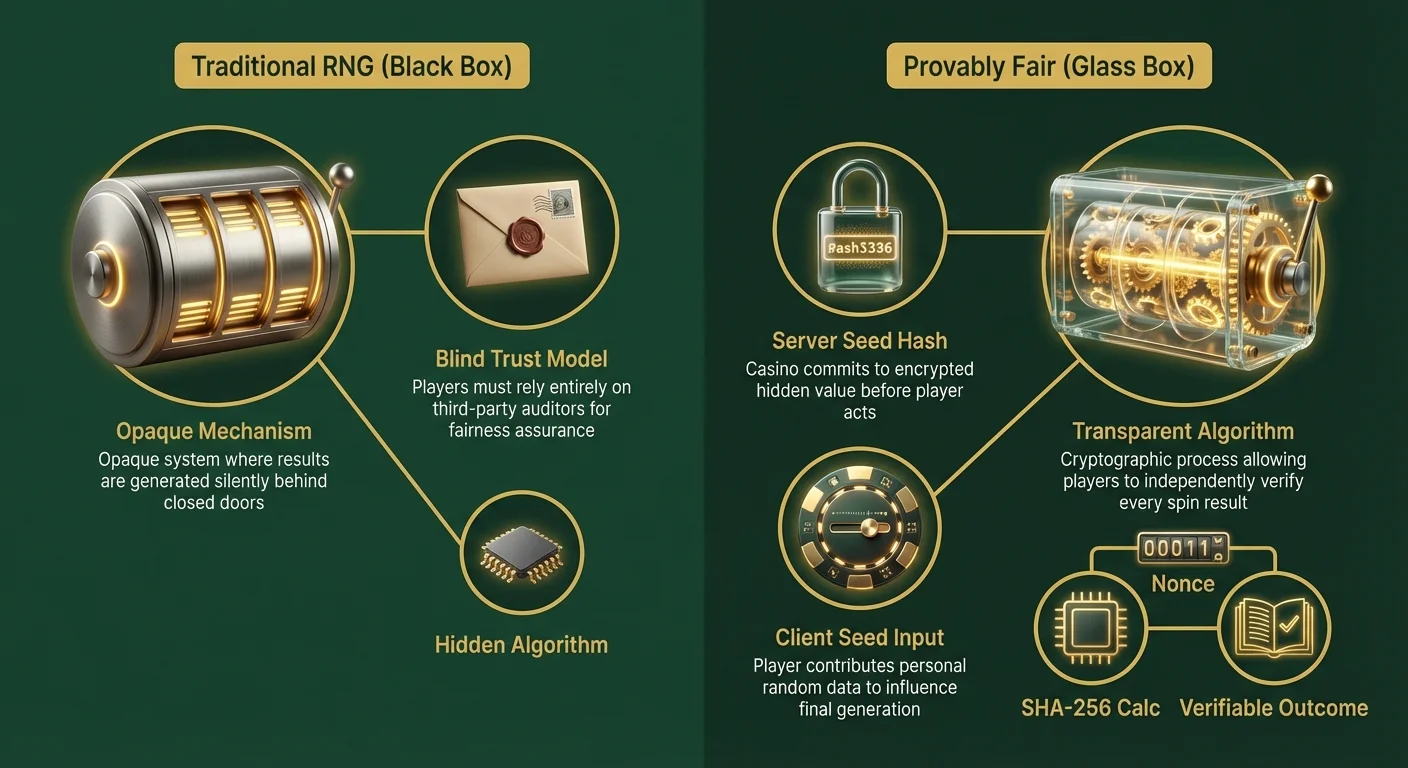
For decades, players at traditional online casinos have had to rely on a system of blind trust. You spin the reels, you lose, and you have to trust that a third-party auditor like eCOGRA has done their job correctly and that the Random Number Generator (RNG) is truly random. This is the "Black Box" model of gambling - you put money in, and a result comes out, but you can never see the mechanics inside.
Crypto gambling has revolutionized this dynamic by shattering the black box. Through the use of blockchain technology and cryptographic hashing, crypto casinos have introduced Provably Fair algorithms.
This guide moves beyond the basics of how slots work. We are diving into the intermediate-level mechanics of Provably Fair technology. We will strip away the marketing buzzwords and explain the mathematics that allow you to mathematically verify - without a shadow of a doubt - that the house did not cheat you on your last spin.
The Problem with Traditional RNG
To understand why Provably Fair is such a leap forward, we must briefly address the standard model described in most slot guides.
In a traditional online slot, the outcome is determined by a pseudo-random number generator (PRNG). As noted in standard casino manuals, these algorithms cycle through millions of number combinations per second. When you press "Spin," the software freezes on a specific number, which correlates to a specific arrangement of symbols on the reels.
The issue is not that these systems don't work; it is that they are opaque.
- Verification: You cannot verify the result yourself. You must trust a certification seal on the website footer.
- Timing: Audits happen periodically (monthly or yearly), not per spin.
- Control: The player has absolutely no input on the random number generation. The casino holds all the cards.
Provably Fair algorithms change this by turning gambling into a "cooperative" generation of randomness. The casino provides half the puzzle, and you (the player) provide the other half.
The Core Components of Provably Fair
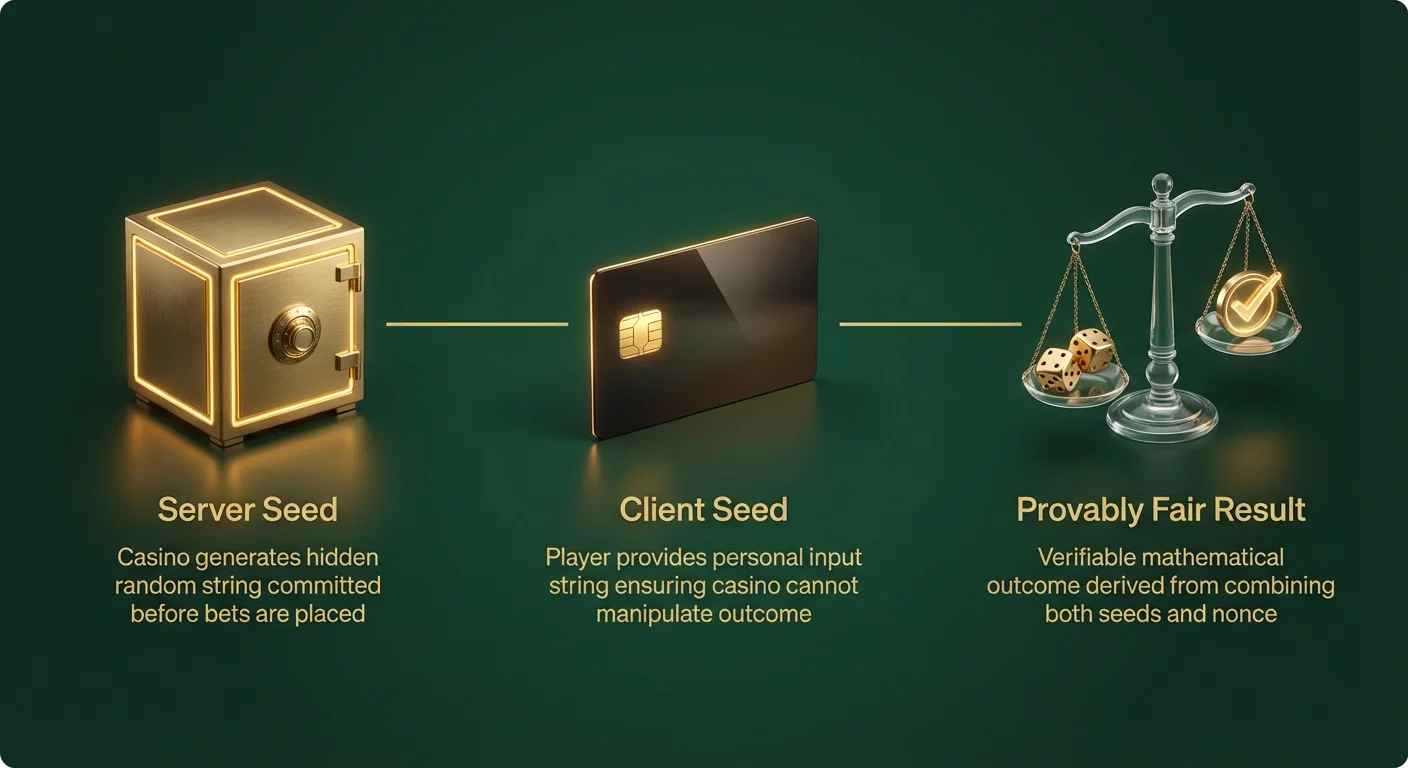
At the heart of every Provably Fair slot game are three distinct variables. Understanding how these interact is the key to verifying your gameplay.
1. The Server Seed (The Casino's Secret)
Before a round begins, the casino generates a random string of numbers and letters. This is called the Server Seed.
- The casino decides this outcome before you place your bet.
- However, they cannot show it to you yet, or you would know the result and cheat.
- Instead, they show you a Hash of the seed. Imagine putting a document in a glass safe that is locked. You can see the document is there (the Hash), but you can't read the contents (the unhashed seed) until the round is over.
2. The Client Seed (The Player's Input)
This is the game-changer. The Client Seed is a string of characters that belongs to you. In most crypto slots, the browser generates a random one for you, but you have the power to edit it.
- Because the casino has already committed to their Server Seed (locked in the glass safe), and then you provide your Client Seed, the casino literally cannot manipulate the outcome to counter your input.
- They don't know what Client Seed you will use until after they have locked in their choice.
3. The Nonce (The Counter)
The Nonce is simply a number that increments with every bet you make.
- Spin 1: Nonce 0
- Spin 2: Nonce 1
- Spin 3: Nonce 2
This ensures that even if you keep the same Server Seed and Client Seed pair, every spin produces a unique result.
The Cryptographic Handshake: How a Spin is Calculated
When you play a Provably Fair slot, the reel positions are not pulled from thin air. They are the result of a mathematical function combining the three elements above.
Here is the step-by-step lifecycle of a crypto slot spin:
- Initialization: The casino generates a Server Seed. They hash it using the SHA-256 algorithm and display this hash to you.
- Input: You set your Client Seed (or accept the random one) and place your bet.
- The Spin: You click "Spin." The game's algorithm calculates the result using this formula:
SHA256(Server Seed + Client Seed + Nonce) - The Outcome: This calculation produces a long string of hexadecimal characters (numbers 0-9 and letters a-f). The game converts chunks of this string into decimal numbers.
- Mapping: These numbers are mapped to the reel positions. For example, if the number is low, it might land on a Cherry; if it's high, it might land on a Scatter.
- The Reveal: After the spin is complete, the casino reveals the original, unhashed Server Seed.
Key Takeaway: Because you have the Hash (from step 1), the Client Seed (your input), and the Final Server Seed (from step 6), you can re-run the calculation yourself. If the result matches what happened on screen, the game was fair. If it doesn't, the casino cheated.
Practical Guide: How to Manually Verify a Slot Spin
Many players see the "Provably Fair" badge but never actually check the math. Here is a practical walkthrough on how to do it. You don't need to be a coder; you just need to know where to look.
Step 1: Locate the Fairness Tab
In almost all crypto-native slots (like those developed by BGaming, Spribe, or proprietary casino games), there is a settings gear or a specialized icon (often a shield or a balance scale). Click this to open the Provably Fair Settings.
Step 2: Set Your Client Seed
Before playing, click the "Change" button next to the Client Seed. You can type anything here.
- Fun Tip: Many players type "LuckySpin777" or a random string of keys.
- Why do this? By customizing the seed, you ensure the casino couldn't have predicted your default browser seed.
Step 3: Play a Few Rounds
Spin the reels. Let's say you play 10 spins. You lose 9 and win 1. You want to ensure those 9 losses were legitimate bad luck and not a manipulated algorithm.
Step 4: Rotate the Seed pair
To verify the previous rounds, you usually need to "reveal" the Server Seed. This requires generating a new Server Seed for future bets. Click "Rotate Seed" or "Change Seed" in the settings. This exposes the Unhashed Server Seed used for your previous 10 spins.
Step 5: Use a Third-Party Verifier
While casinos offer on-site verification tools, a true skeptic uses a third-party tool. You can search for "Provably Fair Verifier" online or use an open-source Python script.
You will need to input:
- The Server Seed (now revealed).
- The Client Seed (the one you typed in Step 2).
- The Nonce (the specific spin number you want to check).
The Result: The verifier will output a number (e.g., 48,239). The slot game's rules will explain how that number translates to the reels. For example, "Numbers 0-1000 map to Reel Strip A." If the verifier output matches the visual result you saw on the screen, the game is verified.
Mapping Randomness to Reel Positions
One intermediate concept that confuses players is how a "hash string" becomes a visual slot machine result.
Traditional slot guides explain that reels have "stops." A 3-reel slot might have 20 stops per reel. Modern video slots have virtual reels with hundreds of stops.
In Provably Fair crypto slots, the hexadecimal output is converted into decimals. Here is a simplified example of how the math translates to the screen:
| Component | Raw Data | Conversion | Game Result |
|---|---|---|---|
| Hash Output | a3f9... |
First 5 characters converted to decimal | Raw Value: 67,291 |
| Modulo Math | 67,291 % 50 |
The remainder of division by 50 (number of symbols) | Result: 41 |
| Reel Strip | Symbol #41 | Look up Symbol #41 on the paytable | Golden Bell |
If you verify the hash and the math says the result should be 41, but the screen showed a losing symbol (like a 10), the casino has manipulated the frontend display. With Provably Fair, you can catch this immediately.
Traditional vs. Provably Fair: A Comparison
To highlight the technological gap, here is how the two systems compare regarding player security.
| Feature | Traditional Slots (Fiat) | Provably Fair Slots (Crypto) |
|---|---|---|
| Trust Model | Trust the Auditor (eCOGRA, iTechLabs) | Trust the Code (Math) |
| Verification Speed | Monthly audit reports | Instant, per-spin verification |
| Player Influence | None (Passive observer) | High (Active participant via Client Seed) |
| Transparency | Black Box (Hidden algorithms) | Glass Box (Open source logic) |
| RTP Validation | Theoretical/Statistical | Verifiable per session |
Strategic Implications of Client Seeds
Intermediate players often ask: "Can I use Provably Fair seeds to win more?"
The short answer is no. You cannot predict the next number because you do not have the next Server Seed. However, understanding this technology helps avoid common gambling fallacies and manage your session better.
1. The Illusion of "Due" Wins
Traditional advice (like the "Advantage Play" theories in land-based casinos) suggests that machines can be "hot" or "cold." In Provably Fair slots, you can see mathematically that every spin is independent. Changing your Client Seed does not make a win more likely; it simply changes the point on the infinite number line where your result is pulled. It resets the timeline, but not the odds.
2. Changing Luck (Psychological Strategy)
If you are on a losing streak, many crypto gamblers recommend changing your Client Seed.
- Does it change the RTP? No. The Return to Player percentage remains the same (e.g., 96%).
- Does it change the outcome? Yes. If you had kept the old seed, you might have hit a losing number at Nonce 15. By changing the seed, Nonce 15 will generate a completely different number. It might be a win, it might be a loss, but it will be different. For many players, this creates a feeling of control over their destiny.
3. Verification as a Bankroll Stop
A great practical tip for bankroll management involves the verification process. After a big loss or a big win, stop playing to perform a manual verification of your last 10 spins.
- This creates a natural break in gameplay.
- It slows down your betting speed.
- It engages your logical brain rather than your emotional brain, helping you make better decisions about whether to continue.
Common Myths About Provably Fair Slots
Myth #1: Provably Fair means I will win.
Fact: "Fair" does not mean "Profitable." It means the game is behaving according to its advertised odds. A slot with a 96% RTP is Provably Fair even if you lose money, as long as the losses are random and consistent with the math.
Myth #2: I can hack the Server Seed.Fact: Server Seeds are hashed using SHA-256. This is the same cryptographic security used to secure Bitcoin transactions. With current computing power, it is impossible to reverse-engineer the seed from the hash in real-time.
Myth #3: All Crypto Slots are Provably Fair.
Fact: This is a dangerous assumption. Many crypto casinos host games from traditional providers (like NetEnt or Pragmatic Play). These games run on the provider's servers, not the blockchain casino's logic, and therefore act like traditional Black Boxes. Always look for the Provably Fair badge or filter for "In-house" games if you want this feature.
Conclusion: The Future of Fairness
Provably Fair technology is the most significant innovation in gambling transparency since the invention of the slot machine. It shifts the power dynamic from the house to the player.
While it requires a little more effort to understand than simply hitting the spin button, mastering the concepts of Server Seeds and Client Seeds elevates you from a casual gambler to an informed player. You are no longer just hoping the machine isn't broken; you are mathematically verifying that the game is honoring the rules.
Next time you log into your favorite crypto casino, don't just spin blindly. Open the settings, change your Client Seed, and take ownership of your randomness. The house still has the edge, but at least now you can verify the deck hasn't been stacked.