
For decades, the biggest mental hurdle for online poker players has been trust. When you play live poker in a casino, you watch the dealer shuffle. You see the cut. You see the cards glide across the felt. But online? You are staring at pixels generated by a server thousands of miles away.
Every online grinder has felt that suspicion after a particularly brutal "bad beat." When your Aces get cracked by a runner-runner straight for the third time in an hour, the thought inevitably creeps in: Is this game rigged?
In traditional online poker, the answer relies on "blind trust." You have to trust the casino's Random Number Generator (RNG) and the third-party auditors who check it once a year. However, the rise of blockchain poker and crypto gambling has introduced a revolutionary standard known as Provably Fair.
This technology replaces blind trust with cryptographic proof. It allows every player to verify that the deck was shuffled randomly and that the outcome was predetermined before the first bet was even placed - but remained encrypted until the hand concluded.
This guide will explain exactly how Provably Fair poker works, why it matters for your strategy, and how you can verify the fairness of the deal yourself.
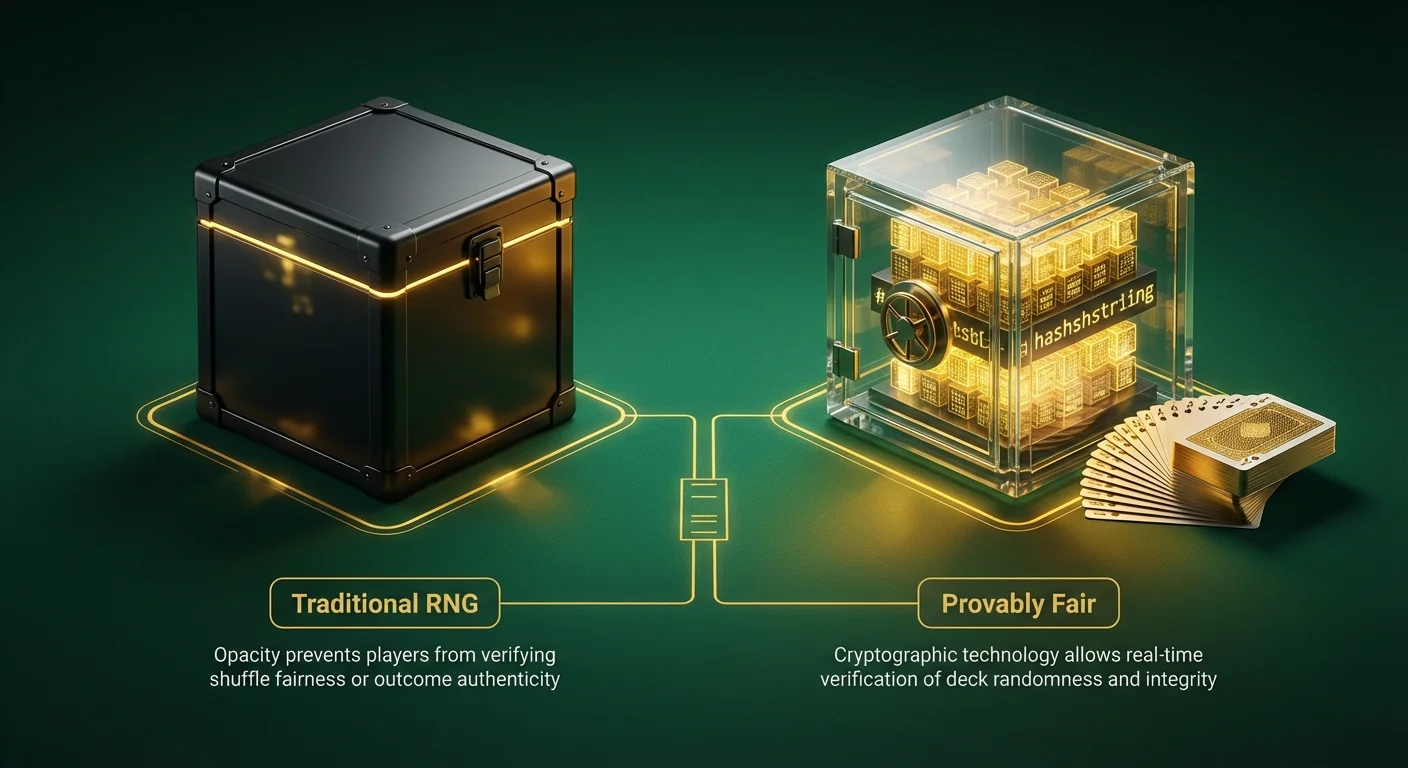
The Problem: The "Black Box" of Traditional RNG
To understand the solution, we must first understand the problem. Traditional online poker sites use a Random Number Generator (RNG) to shuffle the deck. This is a complex algorithm running on the casino's server.
From the player's perspective, this is a "Black Box." You send a request (clicking "Deal"), the box rattles, and a result comes out. You have no way of knowing what happened inside the box.
- Did the software analyze your betting history to induce action?
- Did a "super-user" account see your hole cards?
- Was the river card altered to create a bigger pot and generate more rake?
While major licensed casinos are audited to prevent this, the player has no power to verify it in real-time. You are playing against the house, and the house holds all the keys.
The Solution: What is Provably Fair?
Provably Fair is a system based on cryptographic technologies (the same math that secures Bitcoin) that makes it impossible for a casino or poker site to cheat a player without getting caught.
In a Provably Fair poker game, the shuffle is a collaborative effort between the casino and the player. Neither side can know the order of the cards beforehand, and once the deck is shuffled, it is cryptographically locked.
The Core Concept: The Digital "Cut"
Think of a physical card game.
- The Dealer shuffles the deck.
- The Dealer offers the deck to you.
- You "cut" the deck.
By cutting the deck, you have altered the order of the cards. Even if the dealer was a sleight-of-hand magician who stacked the deck, your random cut changes the outcome.
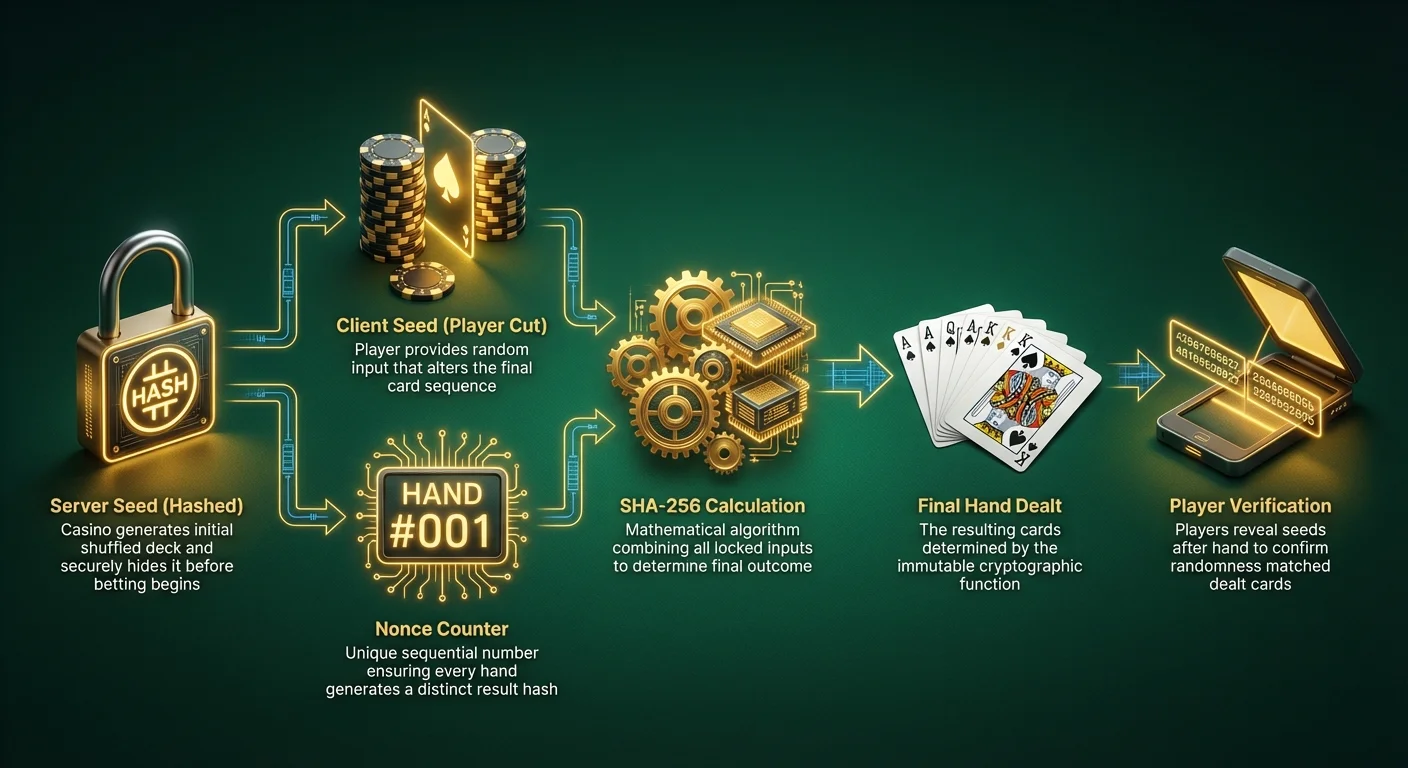
Provably Fair replicates this process digitally using three variables:
- The Server Seed: The casino's random input (The Shuffle).
- The Client Seed: The player's random input (The Cut).
- The Nonce: A counter (The Hand Number).
How It Works: The Step-by-Step Technical Process
You don't need a degree in computer science to understand the logic, though the math is complex. Here is the simplified workflow of a Provably Fair hand.
Step 1: The Initialization (Before the Hand)
Before the hand begins, the poker site's server generates a random string of text called the Server Seed. This represents the initial shuffled deck.
However, the site cannot show you this seed yet, or you would know the cards. Instead, they show you a Hash of the seed. Imagine the casino putting the shuffled deck inside a transparent, locked glass box. You can see the box (the Hash) and confirm it's there, but you cannot touch the cards or see their faces.
Step 2: The Player's Input
Your browser (or the poker client) generates a random Client Seed. On many crypto poker sites, you can actually set this seed yourself. This is the equivalent of you walking up to the glass box and saying, "Shift the cards by exactly 14 positions."
Because the casino already locked their seed in the "glass box" (the Hash) before you provided your seed, they cannot change their shuffle to counter your input.
Step 3: The Calculation
The final order of the deck is determined by a cryptographic function (usually SHA-256) that combines:
- The Server Seed
- The Client Seed
- The Nonce (Hand #1, #2, #3...)
The formula looks roughly like this:
Result = SHA-256(Server Seed + Client Seed + Nonce)
Step 4: The Reveal
After the hand is over, the casino reveals the original unhashed Server Seed.
Now, you verify. You take the revealed Server Seed, add your Client Seed and the Nonce, and run it through a standard SHA-256 calculator. If the result matches the cards you were dealt exactly, the game was fair. If even one character is different, it proves the deck was tampered with.
Why This Matters for Your Poker Strategy
You might be wondering, "I'm here to learn pot odds and bluffing frequencies. Why do I care about hash functions?"
The answer lies in the mathematics of poker. All poker strategy - from Pot Odds to Fold Equity - is built on the assumption of a random distribution of cards.
1. Validating Pot Odds
As discussed in standard poker theory, Pot Odds are the ratio of the pot size to the bet you must call. If you are drawing to a flush, you know there are 9 outs remaining in a 52-card deck. You calculate your equity based on these immutable numbers.
If a deck is rigged to induce action (action-flopping), your calculated odds are wrong. In a Provably Fair environment, you can grind with confidence knowing that the math of the game is pure. When you calculate a 4:1 shot, it is truly a 4:1 shot.
2. Tilt Control and the Mental Game
Poker is psychologically demanding. One of the biggest leaks in a beginner's game is "Tilt" - emotional frustration that leads to bad decisions.
In traditional online poker, a bad beat often leads to "Rigged Tilt," where a player plays recklessly because they believe the software is cheating them. In Provably Fair poker, you can verify the hand immediately. Seeing the mathematical proof that you simply got unlucky (variance) rather than cheated allows you to accept the result and move on, maintaining a healthy mental state.
3. High Stakes Trust (All-In Situations)
Moving All-In is the most dramatic move in poker. You are putting your entire stack on the line. In crypto poker, where deposits are often made in Bitcoin or Ethereum, the monetary value can be massive. Knowing that the outcome of an All-In is derived from a verifiable blockchain algorithm provides the peace of mind necessary to make those big calls.
Comparison: Traditional Poker vs. Provably Fair Crypto Poker
Here is how the two systems stack up against each other regarding transparency and fairness.
| Feature | Traditional Online Poker | Provably Fair Crypto Poker |
|---|---|---|
| RNG Source | Internal Server (Black Box) | Cryptographic Hash (Server + Client Seeds) |
| Verification | 3rd Party Audits (Quarterly/Yearly) | Player Verify (Instant/Every Hand) |
| Transparency | Low (Trust the license) | High (Trust the code) |
| Deck Integrity | Casino controls the shuffle | Casino & Player influence the shuffle |
| Cheating Potential | Possible (Super-users, God-mode) | Near Impossible (Mathematically verifiable) |
| Game Speed | Fast | Fast (Calculations happen in milliseconds) |
How to Verify a Hand: A Beginner's Guide
Verifying a hand sounds technical, but modern crypto casinos make it easy. Here is a step-by-step process you can use on most Provably Fair poker sites.
Step 1: Locate the Fair Check Tab
During or after a game, look for a shield icon or a menu item labeled "Fairness," "Provably Fair," or "Verification."
Step 2: Copy the Values
You will see three distinct strings of text:
- Server Seed (Hashed): This was shown before the hand.
- Server Seed (Unrevealed): This is shown after the hand.
- Client Seed: This is the seed attached to your account.
- Nonce: The number of the hand you just played.
Step 3: Use a Third-Party Verifier
While the casino usually provides a verification tool on-site, true skeptics use third-party tools. Search for "SHA-256 HMAC Calculator" or a specific "Provably Fair Poker Verifier" online.
Step 4: Input and Check
Paste the Unrevealed Server Seed, Client Seed, and Nonce into the calculator. Click "Generate Hash."
The Result: The hash generated by the calculator must match the Server Seed (Hashed) that was displayed to you before the hand started. If they match, the casino did not change the outcome.
Common Myths About Provably Fair Poker
Even with this technology, misconceptions persist. Let's clear up a few common myths regarding blockchain poker fairness.
Myth 1: "Provably Fair means I will win more."
False. Provably Fair guarantees randomness, not winnings. It ensures the deck is clean. If you play a weak hand aggressively or ignore position, you will still lose chips. The difference is that you are losing to better players or natural variance, not a rigged system.
Myth 2: "People can hack the Client Seed to predict cards."
False. The final shuffle requires both the Client Seed and the Server Seed. Since you only know the Client Seed (your part) and the Hashed Server Seed (the casino's locked part), you cannot reverse-engineer the deck order before the cards are dealt. The encryption (usually SHA-256) is currently impossible to break with modern computing power.
Myth 3: "It only works for Bitcoin games."
Mostly False. While the technology originated in Bitcoin dice and casino sites, the concept of hashing is not limited to currency. You can play with Fiat (USD/EUR) on a site that utilizes Provably Fair tech, although it is most common on crypto-exclusive platforms.
5 Tips for Choosing a Provably Fair Poker Room
Not all crypto casinos are created equal. If you are ready to switch to a transparent poker deck, look for these features:
- Open Source Algorithms: The best sites publish their code on GitHub so independent developers can inspect how they generate shuffles.
- Customizable Client Seeds: Ensure the site allows you to change your Client Seed manually. If you can't change your seed, you lose your ability to "cut the deck."
- Easy Verification: The history of your hands should be easily accessible with one click to verify past outcomes.
- Community Reputation: Check forums like BitcoinTalk or CryptoGambling.com reviews. Even with good tech, a site needs good liquidity (active players) to be fun.
- Rakeback and Bonuses: Since crypto casinos save money on payment processing and expensive licensing audits, they often pass these savings back to players in the form of higher Rakeback.
Conclusion
The evolution of poker has always been about information. In the game itself, you try to hide your information while uncovering your opponent's. But regarding the platform you play on, information should never be hidden.
Provably Fair poker represents a paradigm shift in online gambling. It removes the "House Advantage" of secrecy. By utilizing cryptographic hashing and blockchain principles, it ensures that every card dealt is the result of pure, unadulterated randomness.
For the beginner, this technology offers a safety net. It allows you to focus entirely on learning the game - mastering your opening ranges, understanding blind structures, and calculating pot odds - without the nagging fear that the software is working against you.
The deck is clean. The shuffle is verified. The rest is up to you. Shuffle up and deal.
Glossary of Terms
- Hash: A unique string of characters generated from a piece of data. Changing the data even slightly changes the hash completely.
- Seed: A starting variable used to initialize a random number generator.
- Nonce: "Number used once." A counter that increments with every bet or hand to ensure each result is unique.
- SHA-256: Secure Hash Algorithm 256-bit. The standard encryption method used by Bitcoin and Provably Fair systems.
- RNG: Random Number Generator. The software algorithm used to determine outcomes in digital games.