
Online poker is information warfare. In a live setting, you rely on physical tells: a trembling hand, a pulse seen in the neck, or the way a player stacks their chips. In the digital realm of CryptoGambling.com, those physical tells vanish. You are left with timing, bet sizing, and - most importantly - mathematical data.
For the serious player looking to transition from a "feel" player to a profitable grinder, the Heads-Up Display (HUD) is the cockpit of your poker strategy. While a HUD can display dozens of statistics, two metrics reign supreme: VPIP (Voluntarily Put Money in Pot) and PFR (Pre-Flop Raise).
Understanding these numbers transforms your opponents from anonymous avatars into open books. It allows you to visualize their ranges, predict their aggression, and mathematically exploit their leaks. Whether you are grinding Bitcoin cash games or playing high-stakes Ethereum tournaments, decoding these stats is the first step toward advanced poker mastery.
The Foundation of Poker Data: What is the HUD?
Before dissecting the specific metrics, it is vital to understand the tool itself. A HUD overlays real-time statistics next to your opponents' avatars. It tracks every hand played at the table and compiles a database of their tendencies.
In the fast-paced world of crypto poker, where transactions are instant and game speeds are often faster than traditional fiat sites, the ability to process information quickly is a massive edge. While some crypto-centric sites preserve anonymity by disallowing HUDs, understanding the concepts behind VPIP and PFR helps you manually profile players even without the software. You begin to "see" the stats in your head based on observation.
VPIP: The Barometer of Looseness
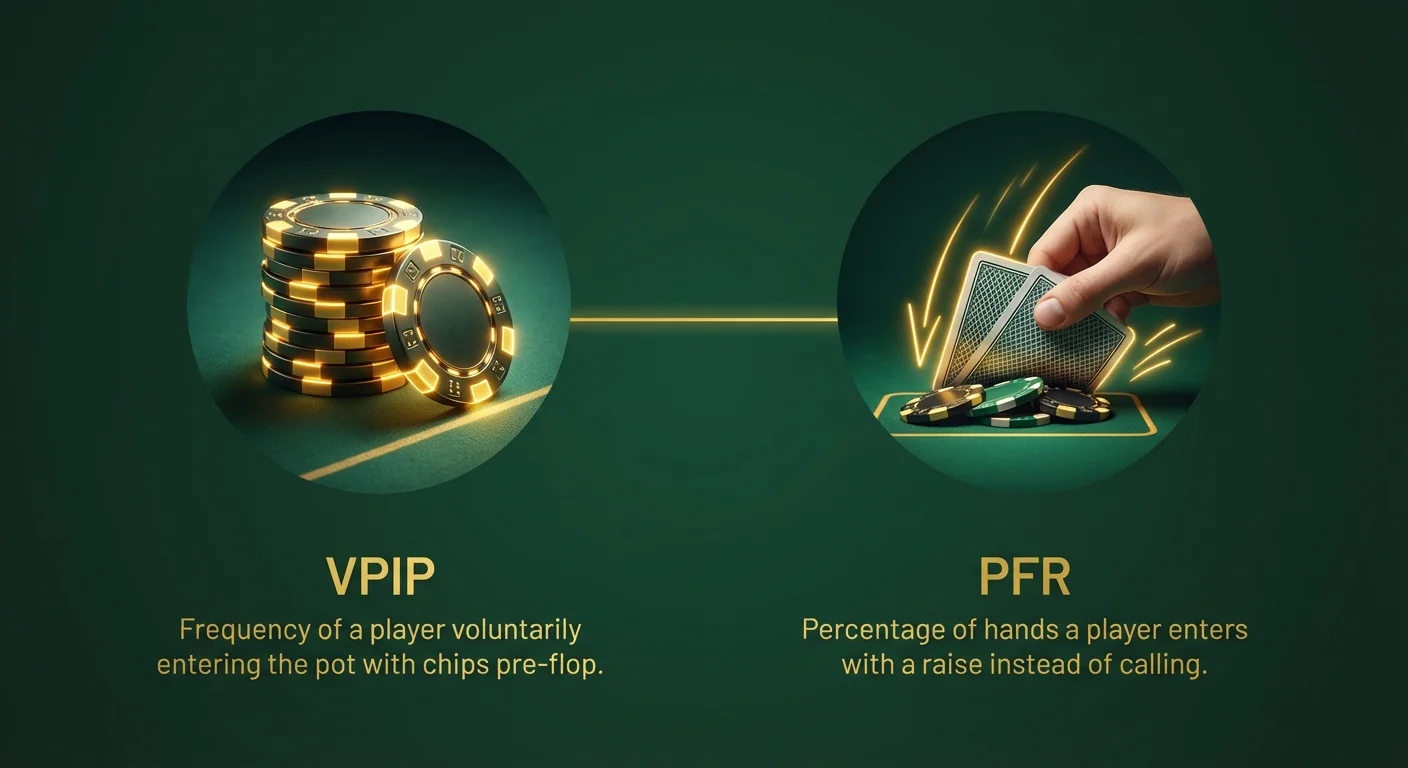
VPIP stands for Voluntarily Put Money in Pot. It is expressed as a percentage and answers the fundamental question: How often does this player choose to play a hand?
What Counts as VPIP?
As noted in general poker theory and blind structure guides, forced bets do not count as voluntary actions unless you put more money in.
- Voluntary Actions: Calling a bet, raising, limping (calling the big blind), or completing the small blind.
- Involuntary Actions: Posting the Small Blind or Big Blind and checking when no one has raised.
Interpreting the VPIP Percentage
The VPIP number tells you how selective a player is pre-flop.
- Low VPIP (0% - 14%): This player is extremely tight. They are "setting mining" or waiting for premium hands (Aces, Kings, AK). They rarely bluff and usually have the goods when they enter a pot.
- Medium VPIP (15% - 25%): This is the sweet spot for full-ring and 6-max tables. These players understand position and starting hand requirements. They are selective but not paralyzed.
- High VPIP (26% - 40%): This indicates a "loose" player. They play too many hands, including easily dominated cards like Ace-Rag or low suited connectors out of position.
- Extreme VPIP (40%+): This is a "whale" or a "maniac." They play almost half the deck. Against these players, you do not need to bluff; you simply wait for a decent hand and value bet them relentlessly.
PFR: The Barometer of Aggression
PFR stands for Pre-Flop Raise. This statistic tracks how often a player enters the pot with a raise rather than a call.
While VPIP tells you if a player likes to play, PFR tells you how they like to play. As emphasized in many strategy cheat sheets, aggression is a key component of winning poker. A player who raises puts pressure on opponents, winning pots uncontested and building value for strong hands.
Interpreting the PFR Percentage
- Low PFR (0% - 5%): This player is passive. If they enter a pot, they are usually limping or calling. If a player with a 5% PFR suddenly raises you, you should fold almost everything but the nuts. They have Monsters (AA, KK).
- Medium PFR (15% - 20%): A balanced aggressor. They raise with their strong hands and mix in raises with speculative hands to balance their range.
- High PFR (25%+): An aggressive player who is likely trying to steal blinds and pots frequently.
The Critical Ratio: The VPIP/PFR Gap
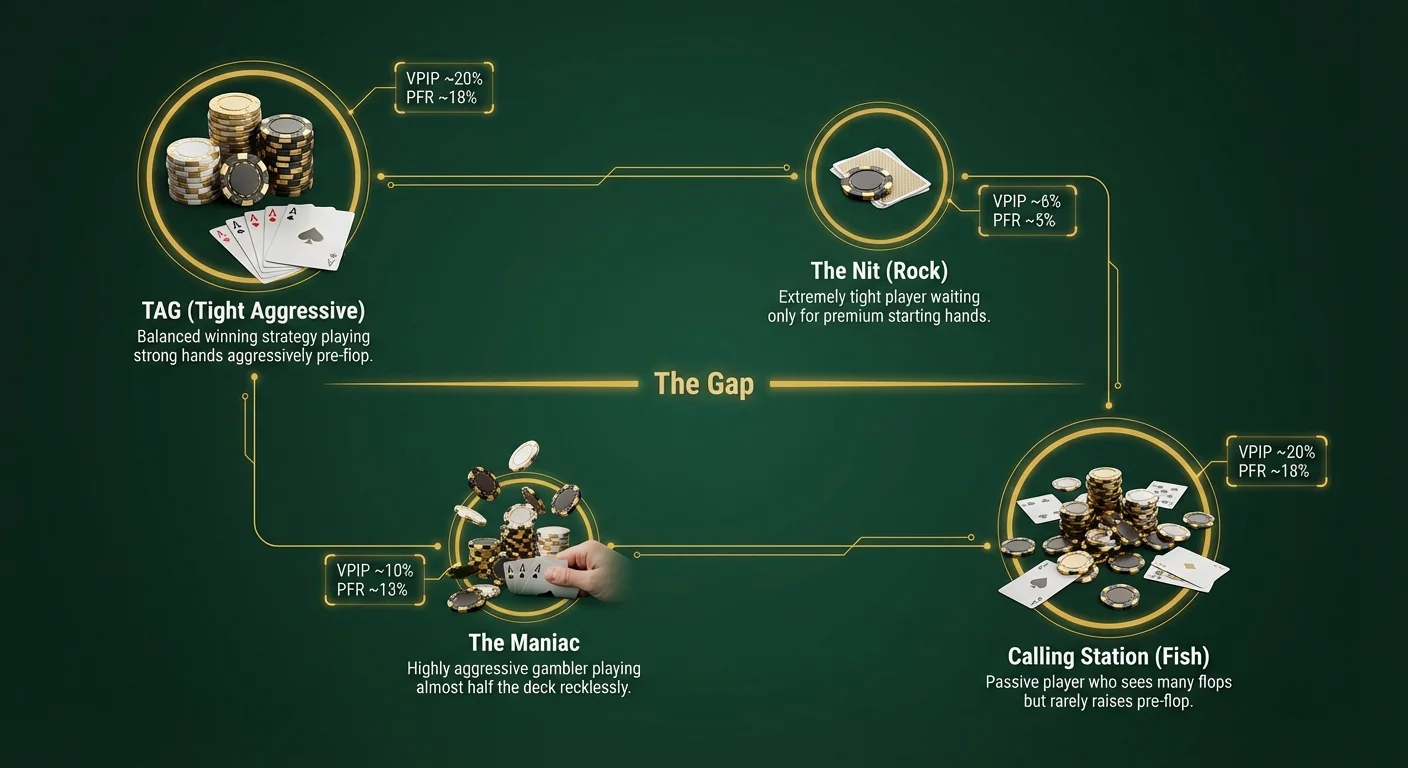
The true power of these stats lies not in viewing them in isolation, but in analyzing the gap between them.
VPIP - PFR = Cold Calling/Limping Frequency
If a player has a VPIP of 20% and a PFR of 18%, the gap is only 2%. This means almost every time they play a hand, they are raising. This is the mark of a strong, aggressive player.
Conversely, if a player has a VPIP of 40% and a PFR of 10%, the gap is 30%. This massive gap indicates they are calling and limping constantly. This is the definition of a "passive fish."
Player Archetypes Table
Use this reference table to quickly categorize opponents on your crypto poker tables (based on standard 6-max Hold'em strategy):
| Player Type | VPIP Range | PFR Range | The Gap | Description & Strategy |
|---|---|---|---|---|
| The Nit (Rock) | 8% - 12% | 6% - 10% | Very Small | Plays only premiums. Strategy: Steal their blinds relentlessly. Fold if they wake up and show aggression. |
| TAG (Tight Aggressive) | 18% - 24% | 15% - 21% | Small | The standard "winning" regular. Strategy: Mix up your play, don't pay them off lightly. |
| LAG (Loose Aggressive) | 25% - 32% | 22% - 30% | Small | Plays many hands aggressively. Strategy: Trap them. Let them bluff into your strong hands. 4-bet them light. |
| The Calling Station (Fish) | 35% + | 0% - 10% | Massive | Loves to see flops but hates to raise. Strategy: Never bluff. Value bet thin (bet with medium strength hands). |
| The Maniac | 50% + | 30% + | Large | Gambles with everything. Strategy: Induce bluffs, call down wider, expect high variance. |
Practical Application: Using Stats to Generate Profit
Knowing the definitions is step one. Step two is applying this knowledge to make profitable decisions (EV+). Here is how to use VPIP and PFR to exploit common scenarios.
1. Stealing Blinds Against Nits
As discussed in guides regarding poker blinds, the blind positions are bleeding chips by default. If you are on the Button and the Small Blind and Big Blind have VPIP stats of 10% and 12% respectively, you have a license to print money, assuming you use proper hand ranges.
- The Play: Raise with any two playable cards (ATC).
- The Math: Because their VPIP is so low, they will fold 85-90% of the time. You pick up the dead money in the pot risk-free. If they do call or raise, you can easily fold, knowing you are beaten.
2. Isolating the Limpers
When you see a player with a high VPIP and low PFR (e.g., 40/5) limp into the pot, they are announcing weakness. They have a hand they want to see a flop with, but not one strong enough to raise.
- The Play: Raise a larger amount than usual (Isolation Raise) to get heads-up with this player.
- The Objective: You want to play a pot in position against a weak player holding a mediocre hand. Even if you miss the flop, a continuation bet (C-bet) will often take it down because their range is filled with weak pairs and missed draws.
3. Calculating Fold Equity
Fold Equity is the percentage of the time an opponent folds to your bet. This concept, highlighted by pros like Ashley Adams, is directly linked to VPIP/PFR stats.
- Scenario: You are contemplating a bluff on the river.
- Opponent A (VPIP 55 / PFR 10): This is a Calling Station. They hate folding. Your fold equity is near zero. Do not bluff.
- Opponent B (VPIP 18 / PFR 15): This is a TAG. They play logically. If the board texture is scary and you represent strength, they are capable of folding a medium-strength hand. Your fold equity is high. Bluffing is viable.
4. Adjusting Pot Odds Calculations
Pot odds are the ratio of the pot size to the bet you must call. However, raw math isn't enough; you need to assign a range to your opponent.
- If a player with a PFR of 4% raises, their range is AA, KK, QQ, and maybe AK. If you have JJ, your equity against this specific range is poor (~20%).
- If a player with a PFR of 30% raises, their range includes suited connectors, small pairs, and broadway cards. Your JJ is a massive favorite (ahead of 70% of their range).
- Takeaway: VPIP/PFR stats refine your "Pot Odds" calculations by helping you accurately estimate the denominator (the opponent's hand strength).
Context Is Everything: Sample Size and Variants
A common mistake intermediate players make is trusting the HUD implicitly after only a few orbits.
The Sample Size Trap
If you sit down at a Bitcoin poker table and see a player raise 2 out of 2 hands, their VPIP/PFR will read 100/100. Is he a maniac? No. He just caught two good hands.
- < 50 Hands: The stats are mostly noise. Use them only for extreme outliers (e.g., someone playing 0 hands or every hand).
- 100 - 500 Hands: VPIP and PFR start to converge on accuracy. You can identify loose vs. tight.
- 1,000+ Hands: You have a reliable profile of the player's tendencies.
Game Variant Adjustments
The benchmarks listed above apply primarily to No Limit Texas Hold'em. If you are playing other variants often found on crypto sites, you must adjust your baseline.
- Omaha (PLO): As detailed in Omaha Hi-Lo guides, players are dealt four cards. Naturally, players want to see more flops because hand equities run closer together. A standard VPIP in PLO is often 25-35%. A player with 20% VPIP in Omaha is extremely tight.
- 5-Card Draw: In draw games, VPIP is less tracking-dependent and more about observing how many cards opponents draw (which signals hand strength), but the concept of "starting hand selection" remains the same.
The Crypto Poker Advantage: Provably Fair and HUDs
One of the distinct features of playing on blockchain-based platforms is the Provably Fair algorithm. This ensures that the shuffling of the deck is random and verifiable, eliminating the fear of "rigged" decks.
However, the intersection of Crypto Poker and HUDs is unique:
- Anonymity: Many crypto casinos allow you to change your alias or play without registration. This makes long-term database tracking (building up 10,000 hands on a specific opponent) difficult.
- Session Stats: Because of this, "Session VPIP" becomes your most valuable tool. You are profiling how the player is behaving right now.
- Bot Detection: High VPIP/Low PFR is rarely a bot. Bots are usually programmed to play mathematically sound (TAG) strategies. If you see wild stats (60/40), you are almost certainly playing against a human gambler, which is exactly what you want.
Advanced HUD Usage: Beyond the Basics
Once you have mastered VPIP and PFR, you can look at secondary stats that provide context to the primary two.
3-Bet Percentage
This tracks how often a player re-raises a pre-flop raise.
- High 3-Bet (8%+): They are re-raising light. You can call them with wider ranges or 4-bet bluff them.
- Low 3-Bet (2%): They only 3-bet Kings and Aces. Never call their 3-bet with dominated hands like AQ or JJ.
AF (Aggression Factor)
This is a post-flop ratio calculated as (Bet + Raise) / Call.
- AF < 1.0: Passive. They call down but rarely bet.
- AF > 3.0: Aggressive. They bet their draws and protect their hands.
- Correlation: A player with high VPIP and low AF is the classic "Whale." They enter many pots and passively call all the way to the river.
Practical Checklist for Improvement
To integrate these concepts into your daily grind, follow this checklist:
- Configure your HUD: Ensure VPIP, PFR, and 3-Bet% are the most visible numbers.
- Color Code: Set your HUD to change colors based on thresholds.
- Red for Tight (VPIP < 15%)
- Green for Loose (VPIP > 30%)
- This allows for instant visual recognition without reading the specific number.
- Review Your Own Stats: Look at your own database.
- Are you playing 22/19? Good.
- Are you playing 35/10? You are leaking money. Tighten up your starting requirements and stop limping.
- Target Selection: In the lobby of your chosen crypto poker site, look for tables with a high average VPIP. A table average VPIP of 30%+ is a goldmine. A table average of 15% is a graveyard - avoid it.
Conclusion: Data as a Weapon
In the world of online poker, VPIP and PFR are your radar and sonar. They allow you to navigate through the murky waters of variance with clarity. By understanding that a 12/10 player requires a different strategy than a 50/10 player, you stop playing your cards and start playing the opponent.
Remember, however, that statistics are descriptive, not prescriptive. They tell you what a player has done, which is a strong indicator of what they will do, but they are not infallible. Use them to inform your decisions, calculate your pot odds, and estimate your fold equity.
As you stack your Satoshis and climb the stakes, let the math guide you. Be the player with the balanced stats that opponents fear, and hunt the unbalanced stats that pad your bankroll.