
The allure of the biased roulette wheel is perhaps the most romanticized concept in the history of gambling. Tales of eagle-eyed players spotting a slight wobble in the rotor or a worn fret on the number 7, subsequently "breaking the bank" at Monte Carlo, have fueled the dreams of advantage players for over a century.
For the modern crypto gambling enthusiast, however, things have changed significantly. Whether you are playing at a high-end Live Dealer table streamed to your device or engaging with a Provably Fair digital interface, the physics of the game have evolved.
This guide examines the history of wheel physics, the mechanics of wheel bias, and the stark reality of modern casino security. We will explore why "clocking" wheels is a nearly extinct art form and how the industry, specifically the crypto casino sector, has replaced physical trust with cryptographic verification.
The Mechanics of a Biased Wheel: How It Works
To understand why biased wheels were once the Holy Grail for gamblers, one must understand the physical construction of a roulette wheel. A standard wheel is a precision instrument, but in the past, it was merely a well-crafted piece of wood and metal subject to the laws of entropy.
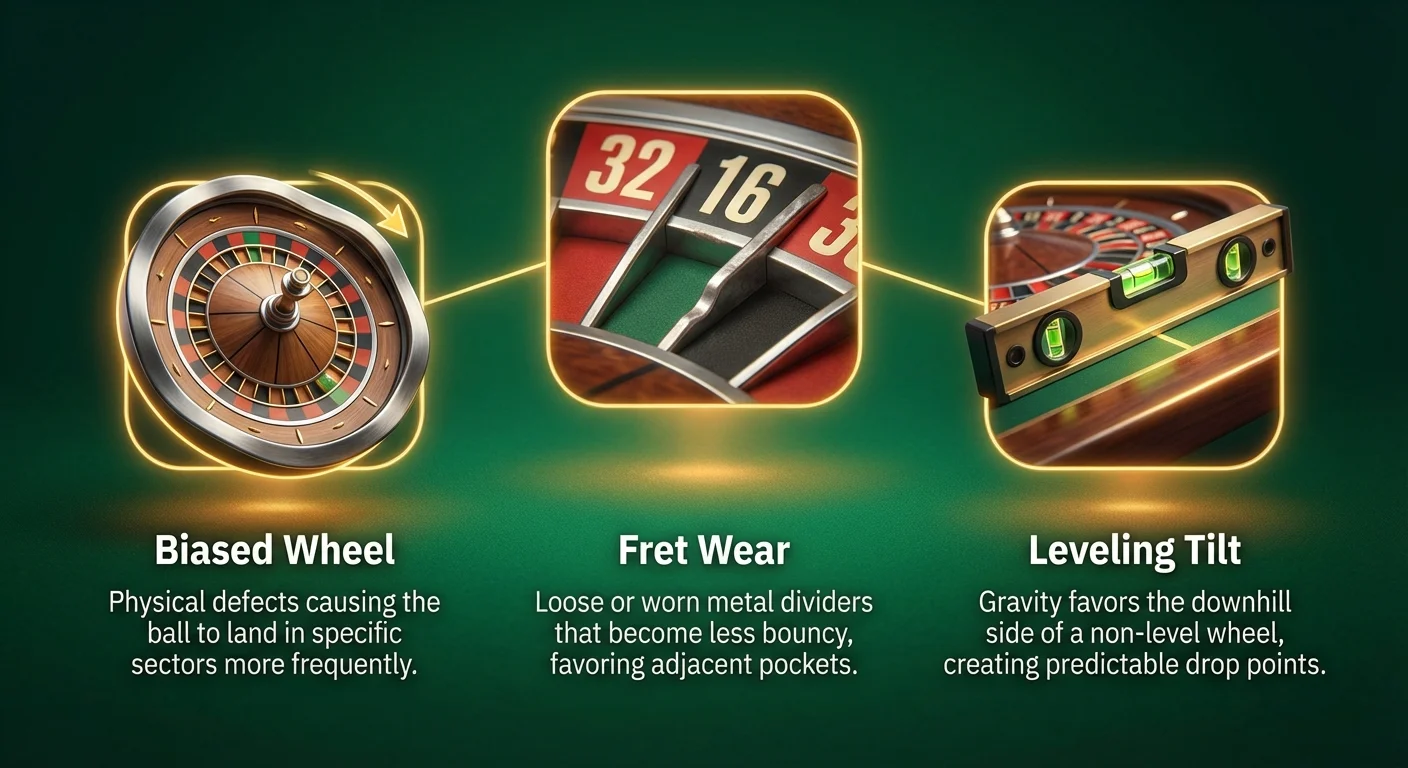
A "bias" occurs when a physical defect causes the ball to land in a specific number or sector (a group of numbers) more frequently than statistical probability suggests. In a perfectly random game, every number has an equal 1 in 37 (European) or 1 in 38 (American) chance of hitting.
The Physical Imperfections
Historically, wheel bias was caused by one of four primary physical failures:
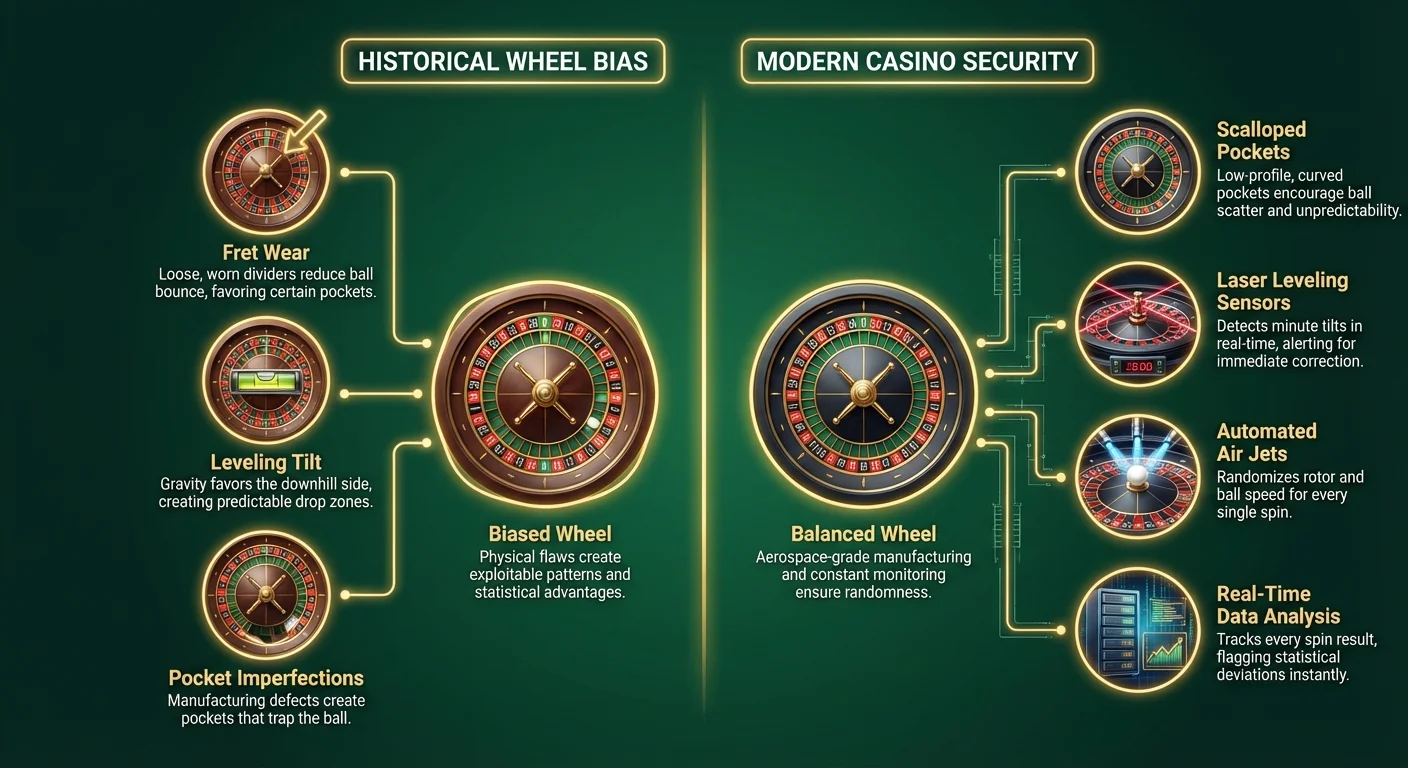
- Fret Wear: The frets are the metal dividers between the number pockets. In older wheels, some frets would loosen or wear down, becoming less "bouncy" than others. If the fret surrounding Red 9 is "dead," the ball is less likely to bounce out of that pocket, increasing its hit rate.
- Pocket Depth and Shape: Manufacturing inconsistencies sometimes led to one pocket being infinitesimally deeper or wider than others, acting as a vacuum for the ball.
- The Track and Friction: The ball track (the outer rim where the ball spins) can develop worn spots or accumulated grime. If friction increases at a specific point on the track, the ball is more likely to drop at that specific coordinate.
- Leveling (The Tilt): This was the most common exploit. If a wheel is not perfectly level, gravity will favor the "downhill" side of the wheel. The ball will tend to drop from the track into the rotor at the same physical point on the bowl.
The Math of Bias
You do not need a massive deviation to overcome the House Edge.
- European House Edge: 2.70%
- American House Edge: 5.26%
If a specific number on a European wheel is supposed to hit once every 37 spins, but a physical defect causes it to hit once every 30 spins, the player has a massive statistical advantage (roughly 18% edge over the house).
The Golden Age of Wheel Clocking
"Wheel Clocking" is the practice of recording thousands of spins to identify these biases. In the late 19th and roughly the first half of the 20th century, this was a viable, albeit tedious, strategy.
The most famous example is Joseph Jagger, who hired clerks to record outcomes at the Beaux-Arts Casino in Monte Carlo in 1873. He found a wheel where nine specific numbers hit more frequently due to a mechanical scratch. He won the modern equivalent of millions before the casino rearranged the wheels, ending his streak.
In the 1990s, teams like the chaotic Gonzalo Garcia-Pelayo family in Spain used computers to analyze thousands of spins, exploiting the fact that casinos were slow to maintain their equipment.
Why It Worked Then
During this era, wheels were often made of wood, which expands and contracts with humidity and temperature. Bearings were less sophisticated, and leveling was done with simple spirit levels. Casinos relied on manual observation rather than data analytics to spot losses.
Modern Reality: The Engineering of Randomness
If you are playing at a reputable crypto casino today, specifically one hosting Live Dealer games from providers like Evolution or Pragmatic Play, you are facing a piece of technology that shares more DNA with an aerospace component than a 19th-century gambling wheel.
The industry effectively declared war on wheel bias in the early 2000s. Here is how modern technology has neutralized physical exploits.
1. The Starburst and Scalloped Pockets
Traditional wheels had high frets (dividers). Modern wheels, particularly those manufactured by TCS John Huxley or Cammegh, often use "scalloped" pockets. The dividers are low-profile or non-existent (curved pockets). This encourages the ball to scatter. It increases the "scatter" distance, meaning where the ball drops from the track has less correlation with where it lands.
2. Automated Maintenance and Laser Leveling
Modern live studio wheels are equipped with sensors that detect tilt to a fraction of a degree. If a wheel shifts, the system alerts the pit boss immediately. You cannot exploit a tilt that the computer fixes before you even finish your coffee.
3. The Slingshot and Air Jets
In automated live roulette (where there is a real wheel but no dealer), the ball is launched by air jets. The pressure of these jets is randomized by a computer algorithm. This changes the rotor speed and the ball speed for every single spin, making "rhythm betting" or visual ballistics impossible.
4. Real-Time Data Analysis
This is the ultimate killer of wheel bias.In the old days, a casino knew a wheel was biased only after they lost money. Today, the software running the Live Casino interface tracks every single result in real-time.
- The Threshold: If the number 0 hits 4 times in 20 spins, the software flags it as a standard variance.
- The Alarm: If the number 0 shows a statistical deviation over 1,000 spins that exceeds the standard deviation curve, the wheel is automatically flagged for inspection. The wheel is swapped out long before a player can detect the pattern with the naked eye.
Live Dealer vs. RNG: The Crypto Casino Context
When browsing CryptoGambling.com for places to play, you will generally encounter two types of roulette: Live Dealer and RNG (Digital). The physics - and the strategies - apply differently to each.
Live Dealer Roulette
These games stream from studios in Riga, Malta, or Asia. They use real physical wheels.
- Bias Potential: Extremely Low.
- Why: These wheels are in constant use, spinning 24/7. They are rotated daily to ensure even wear. The betting windows are short, preventing players from using complex prediction software.
- Verdict: While "real," these are the most scrutinized wheels in history. Betting on bias here is a fast way to lose your bankroll.
Digital RNG Roulette & Provably Fair
This is where the "physics" discussion ends, and the "code" discussion begins. In digital roulette, there is no wheel, no ball, and no gravity. There is only a Random Number Generator (RNG).
However, crypto casinos offer a distinct advantage here called Provably Fair technology.
The "Perfect" Wheel
In a physical casino, you trust the regulations. In a crypto casino, you trust the math.Provably Fair algorithms allow you to verify the fairness of the spin after it happens.
- Server Seed: Generated by the casino (hidden).
- Client Seed: Generated by your browser or chosen by you.
- Nonce: The transaction number.
These are hashed together to produce the result. Because you control the Client Seed, the casino cannot pre-determine the outcome to make you lose. This is the digital equivalent of a wheel that never warps, never tilts, and has zero friction. It is statistically perfect.
Advanced Strategy: If You Can't Find Bias, What Do You Do?
Since we have established that finding a biased wheel in 2024 is nearly impossible, the advanced player must shift focus from exploiting defects to optimizing odds.
The "bias" you should be looking for is not in the wheel, but in the Ruleset.
1. The Table Selection Bias
The single most effective adjustment a player can make is avoiding the American Wheel. The presence of the "00" pocket is a mathematical tax on the player with no added benefit.
| Wheel Type | Pockets | Zeros | House Edge |
|---|---|---|---|
| American | 38 | 0, 00 | 5.26% |
| European | 37 | 0 | 2.70% |
| French | 37 | 0 | 1.35% (on even money bets) |
Tip: In crypto casinos, French Roulette is often hidden in the "Table Games" or "High Limit" sections. Always search for it specifically. The La Partage rule means if the ball lands on Zero, you get half your even-money bet back. This cuts the house edge in half.
2. Volatility Management over Prediction
You cannot predict the number, but you can predict the volatility.
- High Volatility: Straight-up bets (Pays 35:1). Long losing streaks, massive spikes in profit.
- Low Volatility: Even money bets (Red/Black, High/Low). Smooth equity curve, slow bleed due to house edge.
Sector Betting (The Racetrack):
Many advanced players use the "Racetrack" on European layouts. This allows you to bet on sections of the physical wheel, a remnant of the old bias strategies.
- Voisins du Zéro (Neighbors of Zero): Covers 17 numbers around the zero.
- Tiers du Cylindre (Thirds of the Wheel): Covers the 12 numbers opposite the zero.
- Orphelins (Orphans): The two slices of numbers not covered by the above.
While this doesn't overcome the house edge, it allows you to bet on "physical zones" of the wheel rather than numerical order, which mimics the feel of bias play without requiring a defect.
3. Understanding the Gambler's Fallacy
The death of wheel bias means that independent events remain independent.
Just because Red has hit 10 times in a row does not mean Black is "due." On a biased wheel, Red hitting 10 times might mean Red is physically favored. On a modern balanced wheel, it is just a statistical anomaly.
Strategies like Martingale or D'Alembert:These systems (doubling bets after losses) are often sold as ways to beat the wheel. They are not. They are bankroll management techniques that trade small frequent wins for the risk of a catastrophic loss (hitting the table limit).
- Martingale: Double bet after loss.
- D'Alembert: Increase bet by 1 unit after loss, decrease by 1 after win.
Use these cautiously. In the absence of wheel bias, no betting pattern can mathematically alter the House Edge.
Practical Tips for Crypto Roulette Players
If you are playing on CryptoGambling.com partners, here is your checklist for the best experience:
- Check the Provider: For Live Dealer, stick to Evolution, Playtech, or Pragmatic Live. They are audited and ensure the game is free of "rigging," even if it means you can't find a biased wheel.
- Verify the RTP: Digital crypto roulette games should clearly state an RTP (Return to Player) of 97.30% (European). If it's lower, you are playing a sub-par game.
- Speed Matters: If you are testing a system, use "Speed Roulette" or "Instant Roulette" formats. The faster spin times allow you to play more hands per hour, though this also exposes your bankroll to the house edge faster - manage your funds accordingly.
- Use Bitcoin/Stablecoins for High Limits: One advantage of crypto casinos is the ability to place larger bets than fiat casinos. If you are playing a progressive system like Martingale, the higher table limits in BTC games give you more "breathing room" before capping out.
Summary: The Evolution of the Game
The era of the biased wheel is essentially over. The combination of aerospace-grade manufacturing, laser sensors, and real-time algorithmic monitoring has purified the game of roulette.
- Historical Bias: Relied on wood warping and loose frets.
- Modern Security: Scalloped pockets, variable rotor speeds, and automated leveling make physical prediction impossible.
- The Crypto Frontier: Provably Fair technology replaces physical scrutiny with cryptographic certainty.
For the modern player, this is not bad news. It means the game is fairer than it has ever been. Your focus should shift from hunting for non-existent defects to mastering bankroll management, selecting the French/European rulesets, and enjoying the entertainment value of the spin. The wheel may no longer be broken, but the thrill of the game remains intact.