
For any player walking onto a casino floor or logging into a crypto casino interface, the Baccarat table offers an air of sophistication. It is the game of James Bond, high rollers, and mathematical simplicity. However, right in the center of the layout, flashing with the promise of a massive return, sits the Tie bet.
Usually paying out 8-to-1 or sometimes 9-to-1, the Tie bet is the siren song of the Baccarat table. It tempts beginners with the prospect of turning a small $10 chip into an $80 profit in seconds. But ask any professional gambler, mathematician, or casino insider, and they will tell you the same thing: The Tie bet is a trap.
In this comprehensive guide, we will dismantle the allure of the Tie bet. We will explore the brutal mathematics behind the house edge, explain why "pattern spotting" leads players astray, and show you how to protect your bankroll - especially when playing with cryptocurrency.
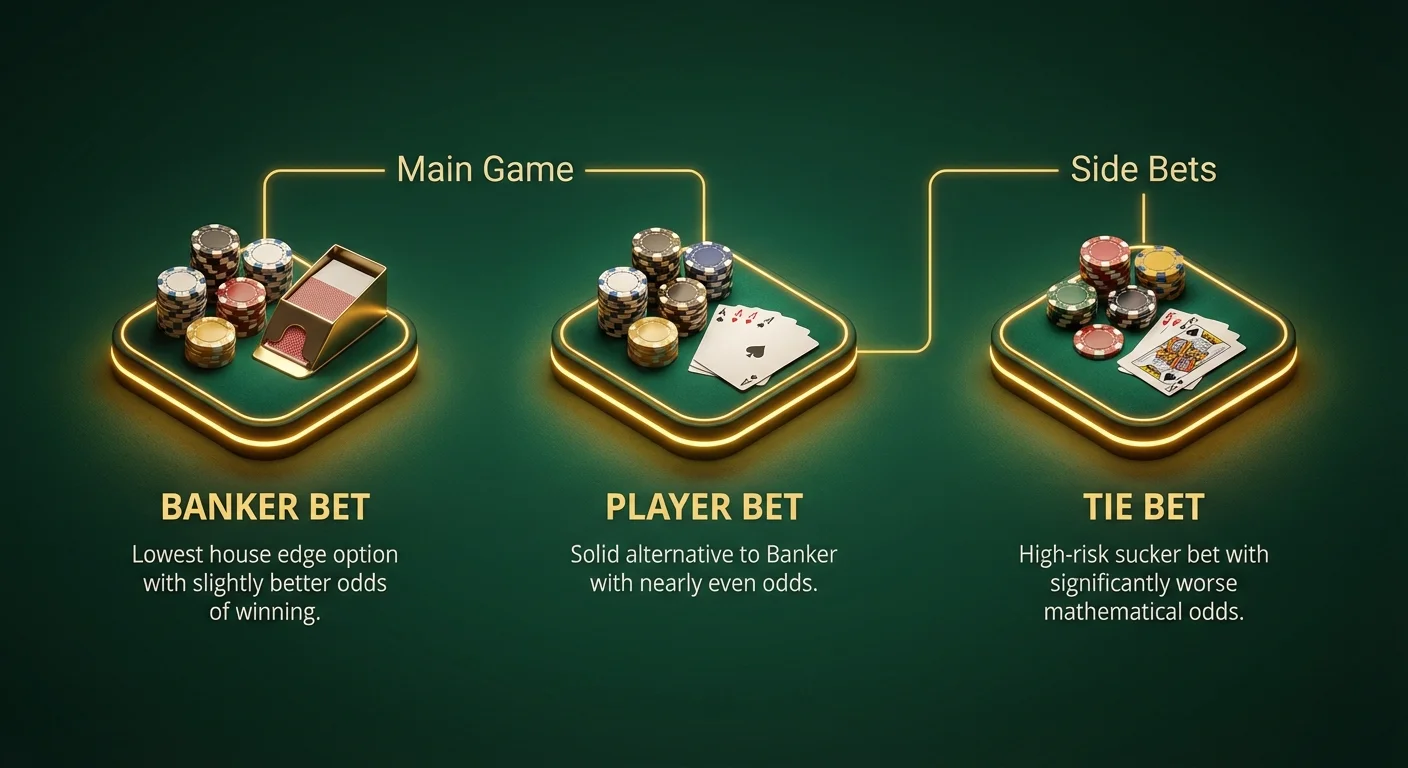
The Anatomy of a Sucker Bet
To understand why the Tie bet is dangerous, you first need to understand the mechanics of Baccarat. Unlike Blackjack, where you make constant decisions, or Poker, where you play against other players, Baccarat is a game of independent events where you bet on an outcome before the cards are dealt.
There are three main betting options:
- The Banker
- The Player
- The Tie
The objective is simple: predict which hand will end up with a point total closest to 9. Tens and Face cards count as 0, Aces are 1, and other cards are their face value. If a hand exceeds 9, the first digit is dropped (e.g., a 15 becomes a 5).
What constitutes a Tie?
A Tie occurs when both the Banker's hand and the Player's hand finish with the exact same point total. For example, if the Player draws a King and an 8 (Total 8), and the Banker draws a 5 and a 3 (Total 8), the result is a Tie.
If you bet on the Tie, you win. If you bet on Player or Banker, you generally do not lose; your bet pushes (is returned to you).
This sounds harmless enough. However, the casino incentivizes you to bet specifically on the Tie outcome by offering high odds. While Player and Banker bets pay essentially 1:1 (even money), the Tie bet dangles that lucrative 8:1 payout.
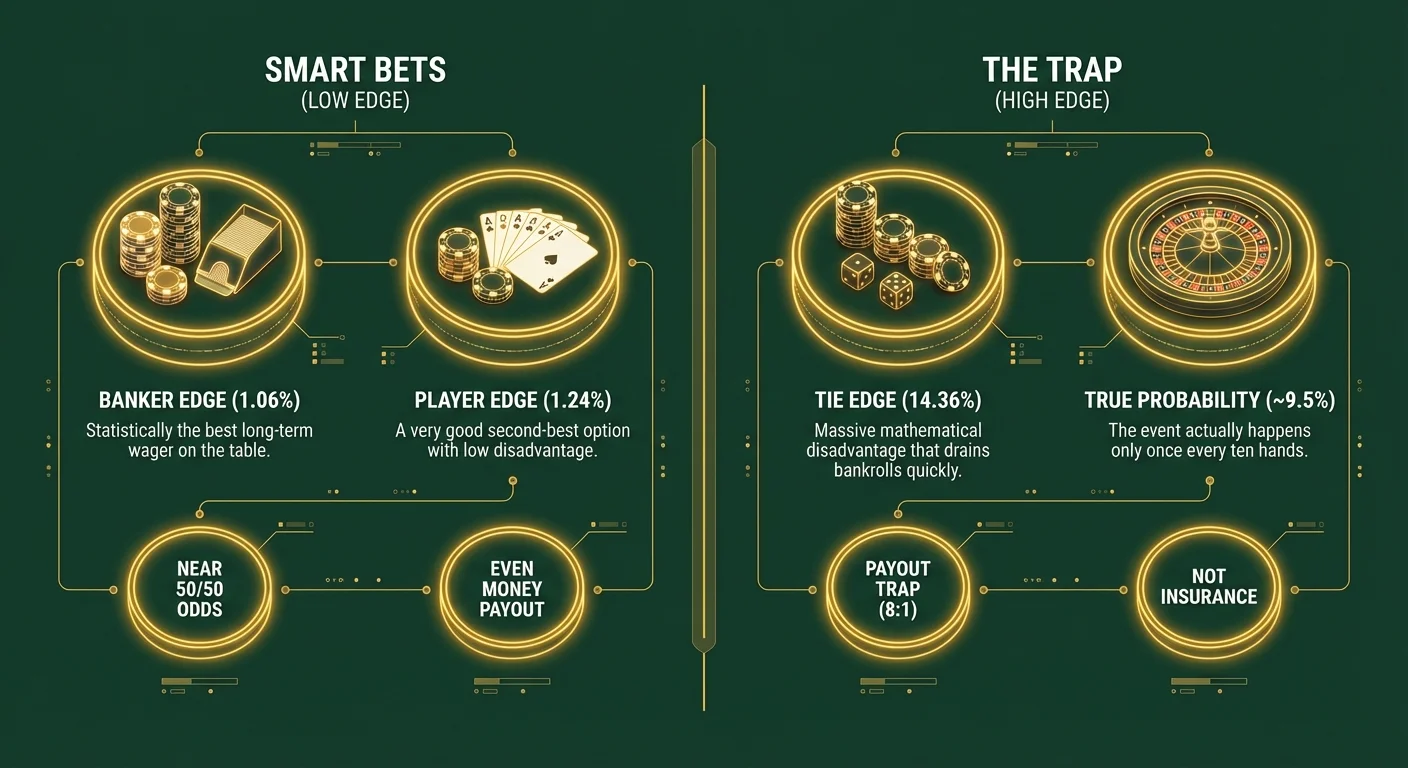
The Mathematical Reality: Why 8-to-1 is Insufficient
In gambling, a "sucker bet" is defined as a wager where the payout offered by the casino is significantly lower than the true odds of the event occurring. The discrepancy between the payout and the probability is where the casino makes its money. This is known as the House Edge.
Let's look at the hard numbers using a standard 8-deck shoe (the most common format in both land-based and crypto casinos).
The True Probability
In an 8-deck game, there are roughly 4,998,398,275,503,680 possible combinations of hands. When you run the simulations:
- Banker wins: ~45.86%
- Player wins: ~44.62%
- Tie occurs: ~9.52%
A 9.52% probability means that a Tie will happen, on average, once every 10.5 hands.
The Payout Discrepancy
If the "True Odds" are roughly 10.5 to 1, a fair payout (where the casino makes no profit) would be 10.5 to 1.
- The Casino Payout: 8 to 1.
By paying you 8 units when the math says they should pay you 10.5, the casino is taking a massive cut.
The House Edge Calculation
This discrepancy creates the House Edge. Here is how the Baccarat bets compare:
| Bet Type | Payout | Probability | House Edge |
|---|---|---|---|
| Banker | 0.95 : 1 | 45.86% | 1.06% |
| Player | 1 : 1 | 44.62% | 1.24% |
| Tie (at 8:1) | 8 : 1 | 9.52% | 14.36% |
| Tie (at 9:1) | 9 : 1 | 9.52% | 4.84% |
The Verdict: The Tie bet at 8:1 has a House Edge of 14.36%.
To put this in perspective, for every $100 you wager on the Banker, you can statistically expect to lose roughly $1.06 over time. For every $100 you wager on the Tie, you can expect to lose $14.36.
The Tie bet drains your money nearly 14 times faster than the Banker bet.
The 9-to-1 Exception (And Why It's Still Not Enough)
Some premier crypto casinos and specific live dealer tables offer a "generous" 9-to-1 payout on the Tie. You might think, "Well, surely this fixes the math?"
While it certainly helps, it does not fix the problem. As shown in the table above, increasing the payout to 9-to-1 reduces the House Edge to roughly 4.84%.
While 4.84% is significantly better than 14.36%, you must compare it to your alternatives. The Banker bet still offers a 1.06% edge. Therefore, even at improved odds, the Tie bet is still four times worse than playing the main game correctly. In the world of smart gambling, voluntarily accepting a 4% disadvantage when a 1% option is available is a strategic error.
The Psychology of the Trap: Why Do Players Bet It?
If the math is so clearly against it, why is the Tie betting circle always full of chips? Casinos rely on psychological fallacies to keep this bet active.
1. The Gambler's Fallacy (Pattern Spotting)
Baccarat scoreboards (often called "Roads") display the history of the shoe. Players obsessively look for patterns. If a Tie hasn't happened in 15 hands, players assume it is "due" to hit.
- The Reality: The cards have no memory. The probability of a Tie on the next hand is always ~9.5%, regardless of whether the last 50 hands were Ties or not.
2. The Insurance Myth
Some beginners believe that betting the Tie protects their main bet. They think, "I'll bet big on Banker, and a little on Tie just in case."
- The Reality: This is unnecessary. In standard Baccarat rules, if a Tie occurs, Banker and Player bets push. You get your money back. You do not lose your main bet on a Tie. Therefore, you do not need to "insure" it.
3. The Jackpot Mentality
Human beings are wired to love big payouts. Winning $100 feels good, but turning $100 into $900 feels exhilarating. The Tie bet provides the dopamine hit of a slot machine within a table game. It trades steady, low-volatility gameplay for high-volatility spikes.
Crypto Baccarat: Speed Kills
When playing Baccarat using Bitcoin, Ethereum, or USDT, the dynamics of the "Tie Bet Trap" become even more dangerous due to the speed of play.
In a physical land-based casino, the dealer has to shuffle, collect chips, pay out winners, and wait for players to place bets. You might see 50 to 60 hands per hour.
In Crypto Baccarat (especially RNG/software-based versions), you are in control of the speed. You can easily play 600 hands per hour by clicking "Rebet" and "Deal" instantly.
The Speed/Edge Multiplier
The amount of money you lose is calculated by:
Total Bets per Hour × House Edge = Expected Loss
If you bet the Tie (14.36% edge) at a high speed:
- Land Casino: $10 bet × 50 hands × 14.36% = $71.80 hourly loss
- Crypto Casino: $10 bet × 500 hands × 14.36% = $718.00 hourly loss
The convenience of instant crypto payouts and lightning-fast gameplay turns the high house edge of the Tie bet into a bankroll incinerator.
Can Card Counting Beat the Tie?
Advanced players often ask if Baccarat can be beaten via card counting, similar to Blackjack. There is a specific subset of counters who target the Tie bet.
The logic works like this: The Tie becomes more likely when the shoe is rich in even-numbered cards and low cards, and less likely when rich in face cards. By tracking the exact composition of the remaining deck, a computer (or a genius-level mathematician) could theoretically identify a moment where the probability of a Tie rises enough to overcome the 14% house edge.
Why this is impractical for 99% of players:
- The Opportunity is Rare: You might play through an entire 8-deck shoe (approx. 70-80 hands) and not find a single instance where the Tie bet becomes mathematically favorable.
- The Edge is Slim: Even when the count is perfect, the advantage you gain is microscopic.
- Complexity: Counting for the Tie is infinitely harder than counting +/- in Blackjack because you are tracking specific groups of cards that influence the Tie probability differently.
Expert Advice: Do not attempt to count cards for the Tie. The effort required yields almost no reward, and a single mistake in the count can lead to substantial losses.
Better Alternatives: How to Play Smart
If you want to gamble on Baccarat and actually preserve your cryptocurrency bankroll, you must ignore the center of the table. Here is the optimal strategy for beginners and intermediates.
1. Stick to the Banker
The Banker bet has a house edge of 1.06%. It is one of the best bets in the entire casino, rivaling the best Blackjack strategies and Craps pass-line bets.
- Note: The Banker bet usually comes with a 5% commission on wins. Even with this commission, it is statistically superior to the Player bet.
2. The Player Bet is Acceptable
If you prefer not to deal with the 5% commission calculation, the Player bet is a solid runner-up with a 1.24% house edge. It is still lightyears ahead of the Tie bet.
3. Avoid Side Bets entirely
Modern online Baccarat tables are cluttered with "Perfect Pair," "Either Pair," "Super 6," and "Dragon Bonus" bets.
- General Rule: If a bet pays more than 1:1, it likely has a house edge between 5% and 15%. Treat these exactly like the Tie bet - fun for a $1 "yolo" bet, but poison for a serious strategy.
4. Dragon 7 & Panda 8 (EZ Baccarat)
If you play "EZ Baccarat" (a variation where the Banker takes no commission but winning on a specific 3-card total of 7 is a push), you will see "Dragon 7" and "Panda 8" side bets.
- Dragon 7: Pays 40:1. House edge ~7.6%.
- Panda 8: Pays 25:1. House edge ~10.2%.
- Conclusion: Still sucker bets. Avoid them.
Practical Tips for Your Next Session
To wrap up, here is a checklist for your next crypto baccarat session to ensure you aren't falling into the trap.
- Check the Rules: Before depositing your Bitcoin, click the "Info" or "?" button on the game. Confirm the payouts. If the Tie pays 8:1, pretend the button doesn't exist. If it pays 9:1, you can play it sparingly for entertainment, but never as a strategy.
- Wait for the "Push": If you are betting Banker and a Tie lands, don't panic. Watch your balance. It will not move. Realizing that the Tie doesn't hurt your main bet is the key to getting over the fear of not betting it.
- Set a Loss Limit: Because Baccarat is a negative expectation game (the house always has an edge), you will have losing sessions. Decide beforehand: "If I lose 0.05 BTC, I stop."
- Ignore the Scoreboard: Those red and blue dots (the Big Road, the Cockroach Pig, etc.) are fun to look at, but they do not predict the future. A "streak" of Ties is a statistical anomaly, not a prediction of the next card.
Summary: The Price of the Thrill
The Tie bet exists for one reason: to fund the casino. The 8-to-1 payout is a mathematical illusion designed to distract you from the grind of the 1:1 main game.
While Baccarat is celebrated for offering the player a fair shake with the low-edge Banker bet, the Tie bet undoes all that goodwill. With a staggering 14.36% house edge, it is statistically one of the worst bets you can make on a table game, ranking alongside the worst slot machines and Keno.
Key Takeaways:
- Never bet the Tie for profit. The math makes it impossible to win long-term.
- A Tie is a Push. You don't lose your Banker/Player bet when a Tie hits.
- Speed is dangerous. Online play accelerates the rate at which the Tie bet destroys your bankroll.
- Stick to Banker. It is the boring choice, but it is the winning choice.
Next time you log in to CryptoGambling.com to play a few hands, look at that 8-to-1 section, appreciate the temptation, and then firmly place your chips on the Banker. Your bankroll will thank you.