
Craps is often the loudest, most energetic game on the casino floor. The cheering, the high-fives, and the collective groan when a seven shows up at the wrong time create an atmosphere unlike any other. However, when you move this experience to the digital realm of crypto gambling, the noise fades, and you are left with the raw mechanics of the game. This is actually a blessing for the strategic player. Without the distractions of a crowd, you can focus entirely on the mathematics that dictate the fall of the dice.
For a beginner, the craps table looks like a chaotic patchwork of numbers and jargon. "Hardways," "Horn Bets," and "Field" wagers clutter the felt, promising massive payouts. But if you strip away the flashy "sucker bets," you are left with the foundation of winning craps play: The Pass Line and Taking the Odds.
This guide is designed to take you from a complete novice to a mathematically sound player. We will explore why these specific bets are the gold standard for reducing the house edge, how to calculate your winnings in Bitcoin or Ethereum, and why "Taking the Odds" is the single best move you can make in a casino.
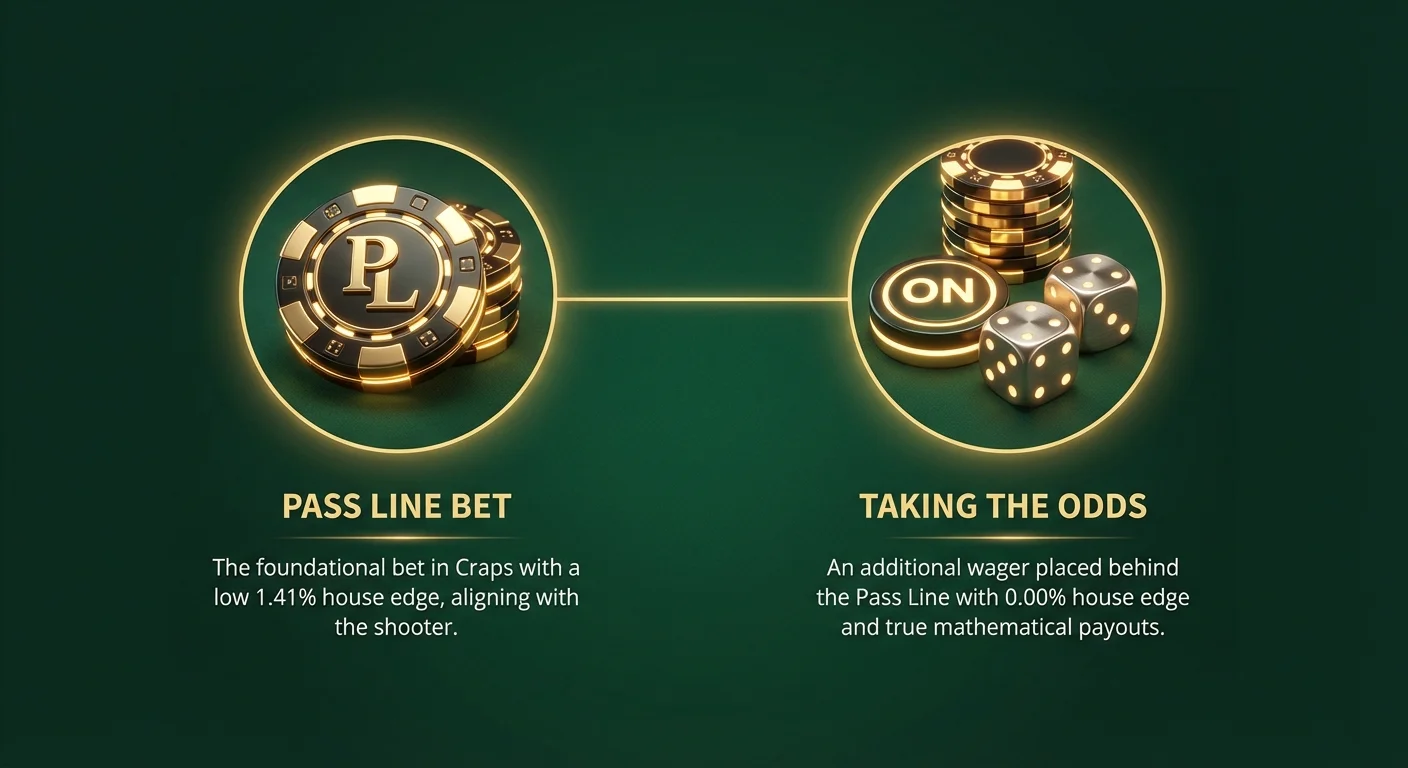
The Pass Line: Your Entry Ticket
Before we can discuss advanced odds, we must understand the engine that drives the game of craps: the Pass Line bet. This is the most common wager on the table, and for good reason. It aligns your interests with the "shooter" (the person rolling the dice, or the algorithm in a crypto game).
The Mechanics of the Pass Line
When you place a bet on the Pass Line, you are betting on the outcome of the shooter's "Come Out" roll (the first roll of a new round).
The House Edge on a standard Pass Line bet is 1.41%. In the world of gambling, this is quite low - much better than American Roulette (5.26%) or most slot machines.
Here is the flow of the Pass Line bet:
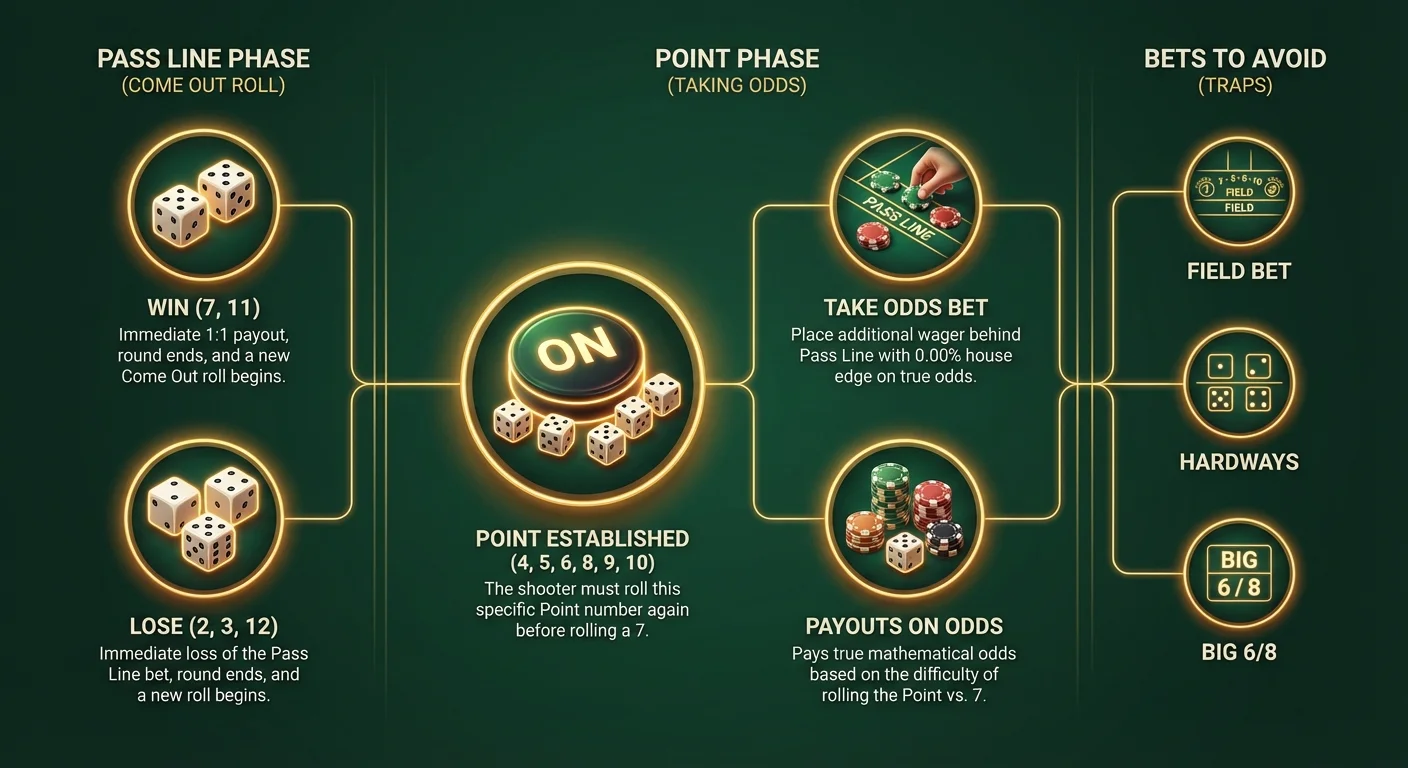
The Come Out Roll: The puck is marked "OFF."
- Instant Win: If the shooter rolls a 7 or 11, you win even money (1:1). The round ends, and a new one begins.
- Instant Loss: If the shooter rolls a 2, 3, or 12 (known as "craps"), you lose your bet immediately.
- The Point is Established: If the shooter rolls a 4, 5, 6, 8, 9, or 10, that number becomes the "Point." The dealer (or UI) marks this number with the "ON" puck.
The Point Phase: Once a point is established, the rules change.
- The Goal: You now need the shooter to roll that specific Point number again.
- The Danger: You need them to roll the Point before they roll a 7.
- The Outcome: If the Point hits, you win even money. If a 7 hits (Seven Out), you lose.
Why It Works
The genius of the Pass Line is its simplicity and its probability distribution. On the Come Out roll, you have a significant advantage (8 ways to win vs. 4 ways to lose). Once the point is established, the math flips slightly in favor of the casino (because a 7 is the most common number to roll), but the combined probability keeps the house edge at a manageable 1.41%.
The Secret Weapon: "Taking the Odds"
If the Pass Line is the foundation, "Taking the Odds" is the skyscraper you build on top of it.
After a Point is established, you are allowed to place an additional bet behind your original Pass Line wager. This is called the Odds Bet.
Here is the most important thing you will read in this guide: The House Edge on the Odds Bet is 0.00%.
It is one of the only bets in a casino - physical or crypto - where the house has absolutely no mathematical advantage. They pay you exactly what the probability dictates. This is why you will never see a dedicated box on the table layout for "Odds." The casino doesn't advertise it because they don't make money on it.
How It Reduces House Edge
Because the Odds bet pays "true odds" (fair value), combining it with your Pass Line bet dilutes the casino's overall advantage. The more you bet on the Odds compared to your Pass Line, the lower the effective house edge becomes.
| Bet Structure | House Edge (Combined) |
|---|---|
| Pass Line Only | 1.41% |
| Pass Line + 1x Odds | 0.85% |
| Pass Line + 2x Odds | 0.61% |
| Pass Line + 3-4-5x Odds | 0.37% |
| Pass Line + 10x Odds | 0.18% |
Strategy Tip: To maximize your potential return, you should bet the minimum allowed on the Pass Line and the maximum allowed on the Odds.
For example, if you have a budget of $20 per hand in Bitcoin:
- Bad Strategy: $20 on the Pass Line, $0 on Odds. (House Edge: 1.41%)
- Winning Strategy: $5 on the Pass Line, $15 on Odds. (House Edge: ~0.6%)
Understanding the Math: Payouts and Probabilities
To truly master the Odds bet, you need to understand the payouts. Unlike the Pass Line, which always pays 1:1, the Odds bet pays based on the difficulty of rolling the Point number versus a 7.
In Craps, the number 7 is the most likely outcome (6 combinations: 1-6, 6-1, 2-5, 5-2, 3-4, 4-3). All other numbers are compared against this.
The 4 and 10
These are the hardest numbers to roll (only 3 combinations each).
- True Odds: 2 to 1 (A 7 is twice as likely to appear as a 4).
- Payout: 2 to 1.
- Example: If you bet 0.01 BTC on the Odds, you win 0.02 BTC.
The 5 and 9
These are moderately difficult (4 combinations each).
- True Odds: 3 to 2.
- Payout: 3 to 2.
- Example: If you bet 0.02 BTC on the Odds, you win 0.03 BTC.
- Note: When betting on 5 or 9, always bet in even numbers (e.g., $10, not $5) to ensure you get the full 3:2 payout without rounding issues, though crypto decimals usually handle this automatically.
The 6 and 8
These are the easiest points to hit (5 combinations each).
- True Odds: 6 to 5.
- Payout: 6 to 5.
- Example: If you bet 0.05 ETH on the Odds, you win 0.06 ETH.
- Note: Bet in multiples of 5 (or 6 depending on the platform) to simplify the math.
Summary Payout Table
| Point Number | Probability vs. 7 | True Odds Payout | Ideal Bet Unit |
|---|---|---|---|
| 4 or 10 | 3 ways vs 6 ways | 2 to 1 | Any amount |
| 5 or 9 | 4 ways vs 6 ways | 3 to 2 | Even numbers |
| 6 or 8 | 5 ways vs 6 ways | 6 to 5 | Multiples of 5 or 6 |
The "Don't Pass" Variation: The Dark Side
While the Pass Line is about camaraderie (betting with the shooter), the "Don't Pass" bar is about cold, hard math. This is often called playing on the "Dark Side."
The Don't Pass bet is essentially the opposite of the Pass Line:
- Come Out: You win on 2 or 3. You lose on 7 or 11. (12 is usually a push/tie).
- Point Phase: You win if the shooter rolls a 7 before repeating the Point.
The Math: The Don't Pass has a House Edge of 1.36%, which is slightly statistically superior to the Pass Line's 1.41%.
Laying the Odds
Just like you can "Take" odds on the Pass Line, you can "Lay" odds on the Don't Pass. However, because you are statistically more likely to win (since a 7 is more common than any point), you must pay a premium.
- 4 or 10: You must bet 2 to win 1.
- 5 or 9: You must bet 3 to win 2.
- 6 or 8: You must bet 6 to win 5.
While the Don't Pass is mathematically better, many beginners find it frustrating to cheer for a "Seven Out," and the payout structure of Laying Odds requires a larger bankroll to win small amounts.
Why You Should Avoid Other Bets
To understand why the Pass Line + Odds strategy is the foundation of winning, you must compare it to the alternatives. Crypto craps tables often highlight bets like the "Field," "Hardways," or the "Big 6/8." These are generally traps.
The Field Bet
The Field is a one-roll bet that the next number will be 2, 3, 4, 9, 10, 11, or 12.
- The Trap: While it looks like you have many winning numbers, the losing numbers (5, 6, 7, 8) are rolled much more frequently.
- House Edge: Typically 2.78% to 5.56% depending on if the casino pays double or triple on the 12. This is significantly worse than the Pass Line.
The Big 6 and Big 8
These bets pay even money (1:1) if a 6 or 8 is rolled before a 7.
- The Trap: A standard Place bet on 6 or 8 pays 7:6. The Big 6/8 only pays 1:1. You are literally getting paid less for the exact same outcome.
- House Edge: A massive 9.09%. Never make this bet.
Hardways
Betting that a 4, 6, 8, or 10 will roll as a "double" (e.g., 2-2 or 5-5) before rolling "easy" or a 7.
- The Trap: The probability of rolling a hardway is low compared to the risk.
- House Edge: Ranges from 9% to 11%. These are high-variance "sucker bets."
Crypto Craps: The Digital Advantage
Playing Craps on a crypto gambling site offers distinct advantages over traditional online or land-based casinos, specifically when employing the Odds strategy.
1. Provably Fair Gaming
In a physical casino, you trust gravity. In a standard online casino, you trust an auditor. In crypto craps, you trust the code. Many crypto craps games utilize "Provably Fair" technology. This allows you to verify that the roll was not manipulated.
- How it works: You are provided a "client seed" and a "server seed" (hashed). After the roll, the seed is revealed, and you can mathematically verify that the outcome was pre-determined by the hash, not changed reactively to your bet size.
2. Micro-Betting and Bankroll Management
Land-based casinos usually have $10, $15, or $25 minimums. To play the "Max Odds" strategy there, you might need $100 on the table per hand.
Crypto sites allow for fractional betting (e.g., 0.00001 BTC). This allows beginners to practice the Pass Line + Odds strategy with mere cents while learning the rhythm of the game without risking their rent money.
3. Instant Payouts
When you hit a hot streak and press your odds on a point of 4, the payout can be substantial. Crypto casinos typically offer instant withdrawals, meaning your winnings are in your wallet in minutes, avoiding the "reverse withdrawal" trap common in fiat casinos where pending times encourage you to gamble winnings back.
Practical Strategy: A Step-by-Step Walkthrough
Ready to play? Follow this exact sequence for the most statistically sound game.
- Check the Limits: Look at the table limit for "Odds." It will usually say "3x, 4x, 5x Odds" or simply "Max Odds."
- Place the Pass Line: Put your minimum unit (e.g., $5 or 0.001 BTC) on the Pass Line bar.
- Roll 1 (Come Out):
- If 7 or 11: You win. Collect. Leave the original bet.
- If 2, 3, 12: You lose. Replace the bet.
- If 4, 5, 6, 8, 9, 10: The Point is marked.
- Take the Odds: Place a multiple of your Pass Line bet (e.g., $10 or $15) behind your Pass Line chips. On digital interfaces, there is usually a small semi-circle or designated area right under the Pass Line bar.
- Wait: Do not make Field bets. Do not bet on Hardways. Just wait.
- Resolution:
- Shooter hits the Point: You win 1:1 on the Pass Line, and you win True Odds (6:5, 3:2, or 2:1) on your Odds bet.
- Shooter Seven-Outs: You lose both bets.
- Repeat: Start over at Step 2.
Common Mistakes to Avoid
- Betting Too Much on the Flat Bet: Do not bet $50 on the Pass Line and take $0 in odds. If your budget is $50, bet $10 on Pass and $40 in odds. This reduces the house edge significantly.
- Hedge Betting: Some players bet the Pass Line and then bet "Any Craps" to protect against a 2, 3, or 12 on the Come Out. This increases the house edge and eats into your long-term bankroll. Trust the math; don't hedge.
- Misunderstanding "Off" Bets: In most games, your Odds bets are "OFF" during a Come Out roll. If you had a lingering bet from a previous roll and a 7 hits on the new Come Out, you usually lose your Pass Line but get your Odds chips back. Check your specific casino's rules (or the "Working" button status).
Summary
Craps is a game of streaks, excitement, and volatility. While you cannot control the dice (unless you believe in dice control, which is impossible in digital crypto craps), you can control how much you pay for the privilege of playing.
By sticking to the Pass Line and Taking the Odds, you are engaging in one of the fairest gambles available in the world. You are accepting a tiny fee (1.41% on the flat bet) for the opportunity to place a large wager with zero house edge.
Key Takeaways:
- Pass Line: The anchor bet. Wins on 7/11, loses on 2/3/12.
- Odds Bet: The best bet in the house. Pays true mathematical odds. Always maximize this relative to your flat bet.
- Avoid the Noise: Ignore the blinking lights of the Field and Hardways. They drain your crypto balance with high house edges.
- Manage Your Bankroll: Use the divisibility of cryptocurrency to play within your means, ensuring you can weather the variance of the game.
Master this foundation, and you will not only understand Craps - you will be playing it smarter than 90% of the people on the floor. Good luck, and may the shooters be hot!