
The allure of controlling the uncontrollable is as old as gambling itself. In the world of craps, this manifests as "Dice Control," "Dice Setting," or "Controlled Shooting." It is the theory that a player can physically manipulate the dice - through grip, set, and toss mechanics - to alter the outcome of a roll.
For the land-based casino veteran, this is a controversial topic that divides the community into believers and skeptics. But for the modern player at CryptoGambling.com, engaging with Bitcoin craps or provably fair table games, the question takes on an entirely different dimension.
Can you really influence dice outcomes? Is it a legitimate skill that tips the house edge, or is it merely superstition wrapped in pseudo-science? Furthermore, does any of this apply when the dice are digital?
This guide examines the physics, statistics, and reality of dice control, specifically analyzing its place in the modern landscape of crypto gambling.
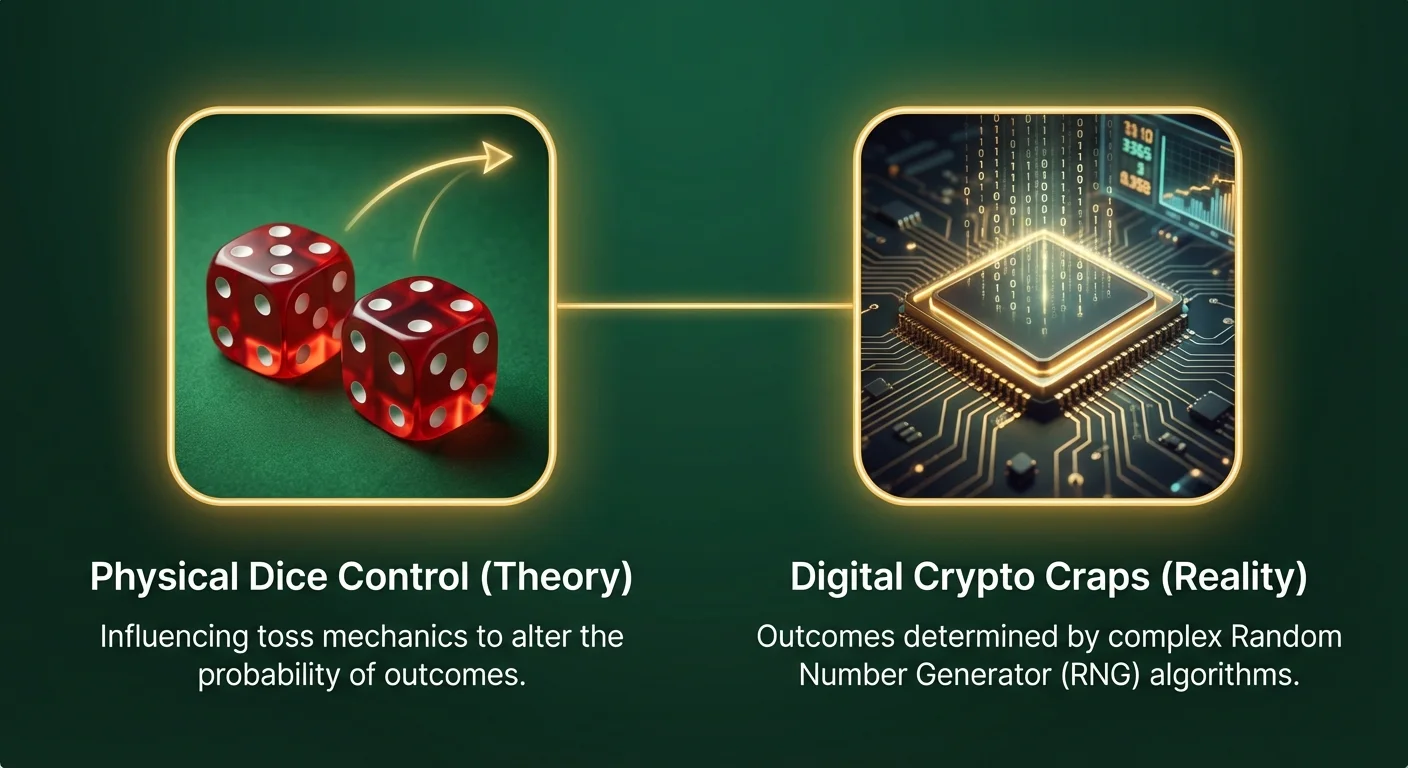
What is Dice Control (Controlled Shooting)?
At its core, dice control is not about forcing a specific number (like a hard 8) to appear on command. That is a Hollywood myth. Instead, legitimate "advantage players" (APs) who practice dice control aim to reduce the frequency of the 7.
In a standard random game, the number 7 appears once every six rolls (a Sevens-to-Rolls Ratio, or SRR, of 6.0). If a shooter can alter their toss mechanics to roll a 7 once every 6.5 or 7 rolls, they flip the mathematical advantage from the casino to the player.
The methodology involves three distinct steps:
- The Set: Arranging the dice in a specific configuration before the throw.
- The Grip: Holding the dice in a way that minimizes friction and keeps them on axis.
- The Toss: Throwing the dice gently to minimize bounce and kinetic energy upon landing.
The Logic of "On-Axis" Rolling
The theory relies on keeping the dice "on axis." Imagine the dice are wheels on an axle. If you spin them perfectly, the numbers on the sides (the axle faces) will never appear on top.
If a shooter can keep the dice rotating together on a horizontal axis, they eliminate certain outcomes. By eliminating outcomes that add up to 7, the shooter statistically increases their chances of winning on Place bets and Pass Line odds.
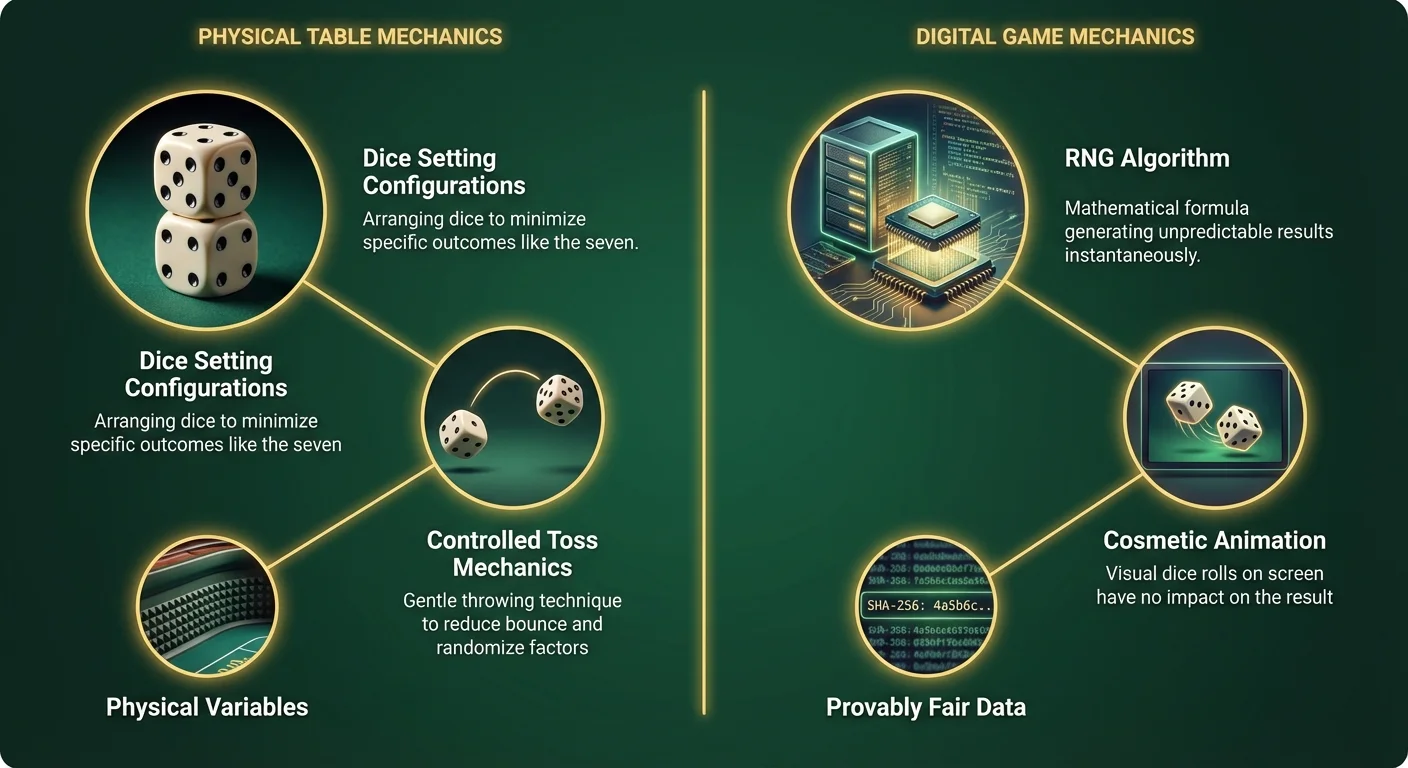
Common Dice Sets Explained
To understand the culture of dice control, you must understand the "sets." Even in online crypto craps games that allow you to "choose your dice set" for cosmetic purposes, these terms appear.
Here is a breakdown of the most popular sets used by controlled shooters:
| Dice Set Name | Configuration | Purpose | Target Numbers |
|---|---|---|---|
| The Hardways Set | Hard 10 (5-5) on top, Hard 4 (2-2) on bottom | The most common set for beginners. It puts four 7s on the axis faces (Left/Right). | Hard 4, 6, 8, 10 |
| The 3-V Set (V-3) | 3s in a "V" shape on top (3-3) | Designed to minimize the appearance of the 7. Often used by intermediate shooters. | 6, 8, and inside numbers |
| The 2-V Set | 2s in a "V" shape on top (2-2) | Similar to the 3-V, aimed at hitting outside numbers. | 4, 10, and outside numbers |
| All-7s Set | 7 showing on all faces | Paradoxically used by "Don't Pass" shooters or on the Come Out roll to create 7s. | 7 (Any Seven) |
The Physics of the "Perfect Roll"
According to dice influence proponents, a perfect toss requires the dice to fly through the air side-by-side, rotating forward at the same speed, hitting the table just inches from the back wall, and "dying" (stopping) upon touching the pyramid rubber.
If the dice bounce erratically, hit the wall hard, or split apart, the "randomness" of the table takes over, and the edge is lost.
The Skeptic's Argument: Physics vs. Randomness
While the theory of dice control is mathematically sound (if you can alter the probabilities, you will win), the practical application is where the debate heats up.
The Back Wall Factor
Casinos are not oblivious to physics. This is why craps tables have "pyramid" alligator rubber on the back wall. The geometry of these diamonds is specifically designed to force the dice to scramble in random directions upon impact.
To influence the dice, a shooter must touch the back wall (a requirement in all regulated casinos) but do so gently enough that the dice do not scramble. This requires a level of motor skill comparable to a professional golfer or baseball pitcher.
Confirmation Bias
Skeptics argue that dice control is largely confirmation bias. A player sets the dice to the "Hardways Set," rolls a Hard 8, and attributes it to skill. They then roll a 7, and attribute it to "bad luck" or a "sticky table." In reality, even a random roller will hit streaks of numbers.
The House Edge Persists
Regardless of the set, the math of the table remains.
- Pass Line: 1.41% House Edge
- Place 6 & 8: 1.52% House Edge
- The Field: 2.78% (or 5.56% depending on payouts)
- Big 6/8: 9.09% House Edge (Avoid this bet!)
Unless a shooter can prove over thousands of rolls that their SRR is significantly higher than 6.0, the house edge will eventually grind their bankroll down.
Dice Control in the Era of Crypto Gambling
This is the critical pivot for our readers. You are likely playing with Bitcoin, Ethereum, or USDT at an online casino. Does dice control apply to you?
The short answer is No.
The long answer involves understanding how online casinos work.
1. RNG (Random Number Generators)
In software-based crypto craps (games that look like video games), there are no physical dice. There is no gravity, no friction, and no back wall.
When you click "Roll," the software calls upon a Random Number Generator - a complex algorithm that spits out a result based on mathematical probability. Even if the game animation allows you to "set" the dice to a V-3 set, it is purely cosmetic. The outcome is determined the millisecond you click the button, based on the RNG seed, not the animation of the dice.
2. Provably Fair Technology
One of the massive advantages of crypto gambling is Provably Fair technology. This allows players to verify that the casino did not cheat.
In a Provably Fair craps game, the outcome is generated using:
- Server Seed: Provided by the casino (hidden until revealed).
- Client Seed: Provided by you (or your browser).
- Nonce: A transaction counter.
These strings of data are hashed together to create the result. Because the result is derived from cryptographic hashes, "skill" in throwing is impossible. You cannot influence a SHA-256 hash by "setting" pixels on a screen.
3. Live Dealer Crypto Craps
What about Live Dealer games (like those from Evolution Gaming) where you watch a real human roll dice via video stream?
Even here, dice control is effectively impossible for two reasons:
- The Shooter is the Dealer: You are not rolling the dice. The presenter is.
- Mechanical Launchers: To prevent dealer fatigue and ensure fairness, many live dealer craps games use a mechanical arm to launch the dice. This machine is designed to be purely random.
If You Can't Control the Dice, Control the Strategy
If dice control is irrelevant in crypto craps, how do you gain an advantage? You shift your focus from physical manipulation to mathematical discipline.
Since you cannot alter the outcome of the roll, you must choose bets where the casino has the smallest possible advantage.
Strategy 1: The Pass Line with Max Odds
This is the gold standard for crypto craps players.
- The Bet: Place a bet on the Pass Line.
- The Edge: The House Edge is 1.41%.
- The Odds: Once a point is established (4, 5, 6, 8, 9, 10), take "Odds."
- True Odds: The casino pays these bets at true mathematical odds (zero house edge).
- Why it works: By combining the Pass Line with a large Odds bet, you can dilute the overall house edge to below 0.5%.
| Point | True Odds Payout |
|---|---|
| 4 or 10 | 2 to 1 |
| 5 or 9 | 3 to 2 |
| 6 or 8 | 6 to 5 |
Strategy 2: Avoiding "Sucker Bets"
Without dice control, high-house-edge bets will destroy your crypto balance.
- Avoid the Field: While it looks tempting with many winning numbers, the House Edge is usually 2.78% or higher.
- Avoid the Big 6 / Big 8: These pay 1:1. Placing the 6 or 8 directly pays 7:6. Never bet the Big 6/8.
- Avoid Hardways: The payouts are high (7:1 or 9:1), but the house edge is massive (often over 9%).
Strategy 3: The Dark Side (Don't Pass)
Mathematically, the "Don't Pass" bar (betting against the shooter) has a slightly better house edge (1.36%) than the Pass Line (1.41%).
- In a physical casino, this makes you unpopular because you win when everyone else loses.
- In crypto craps, you are playing alone against the house. There is no social stigma. It is a strictly mathematical play.
The Psychology of the "Hot Hand"
Even in a Provably Fair crypto environment, you will experience "hot streaks" where the shooter (the algorithm) rolls ten 8s in a row.
Dice control enthusiasts would call this "Rhythmic Rolling." A statistician calls it Variance.
In crypto gambling, variance is high. You might lose 10 Pass Line bets in a row, or you might hit 5 points consecutively. The key to surviving isn't trying to control the algorithm, but managing your bankroll so you can weather the cold streaks and capitalize on the hot ones.
Practical Tip: Never chase losses. If the algorithm seems "cold," it isn't actually cold - the dice have no memory. However, your wallet does. Set a Stop-Loss limit in Bitcoin or USDT before you start playing.
Conclusion: Skill or Superstition?
In the physical world of brick-and-mortar casinos, dice control remains a fascinating "maybe." It requires hundreds of hours of physical practice, a perfect environment, and a lack of casino heat to work. For 99% of players, it is a superstition; for the 1%, it is a difficult athletic skill.
However, on CryptoGambling.com, the verdict is clear: Dice control is a myth.
In the realm of digital craps, physics is replaced by code. The "set" of the dice is a graphic, not a variable. But this shouldn't discourage you. By stripping away the superstition of controlled shooting, you are left with the purity of the game: math, probability, and risk management.
Key Takeaways for the Crypto Craps Player:
- Forget the Set: Don't waste time trying to "set" virtual dice. The RNG decides the outcome instantly.
- Trust the Math: Stick to Pass/Don't Pass and Come bets with full Odds.
- Verify the Fairness: Utilize the Provably Fair tools provided by crypto casinos to ensure your "bad luck" is statistically valid variance, not a rigged game.
- Play the Odds, Not the Toss: Your control lies in where you place your chips, not how the dice land.
The next time you log in to play a session of Bitcoin Craps, leave the rhythmic rolling theories at the door. Bet smart, manage your crypto, and let the algorithm do the rest.