
Roulette is perhaps the most iconic game in the casino ecosystem. Whether it is the clatter of the ball on a physical wooden wheel or the digital animation of a Provably Fair crypto game, the allure remains the same: the potential for a massive payout on a single spin. However, seasoned players know that relying on pure luck is a volatile way to play. This desire for control and structure has given birth to betting systems - mathematical strategies designed to manage your bankroll and, theoretically, optimize your winning potential.
If you have spent any time in crypto casino forums or strategy guides, you have likely heard of the "Big Three" progressive betting systems: the Martingale, the D'Alembert, and the Fibonacci.
These strategies are often sold as guaranteed ways to beat the house. This guide will dismantle that myth while providing a comprehensive, intermediate-level analysis of how these systems work, how to execute them, and the specific risks involved when playing with a cryptocurrency bankroll. We will explore why having a system is better than betting blindly, but why no mathematical progression can truly overcome the house edge.

Understanding the Landscape: The House Edge
Before diving into specific systems, it is crucial to understand the mathematical battlefield. Betting systems manage how much you bet, not where the ball lands. They do not change the probability of the outcome.
According to standard roulette mechanics, the house always maintains an advantage.
- European Roulette (Single Zero): Contains numbers 1-36 and a single 0. The house edge is 2.70%.
- American Roulette (Double Zero): Contains numbers 1-36, 0, and 00. The house edge jumps to 5.26%.
Pro Tip: As a crypto gambler, you likely have access to dozens of providers. Always choose European or French roulette variations. Playing American roulette essentially involves voluntarily giving the casino double the money over the long run.
Most betting systems rely on "Even Money" bets (Red/Black, High/Low, Odd/Even). On a European wheel, you have an 18/37 chance of winning, or roughly 48.6%. You will notice this is not 50/50. That small discrepancy - the green Zero - is where betting systems often fall apart in the long term.
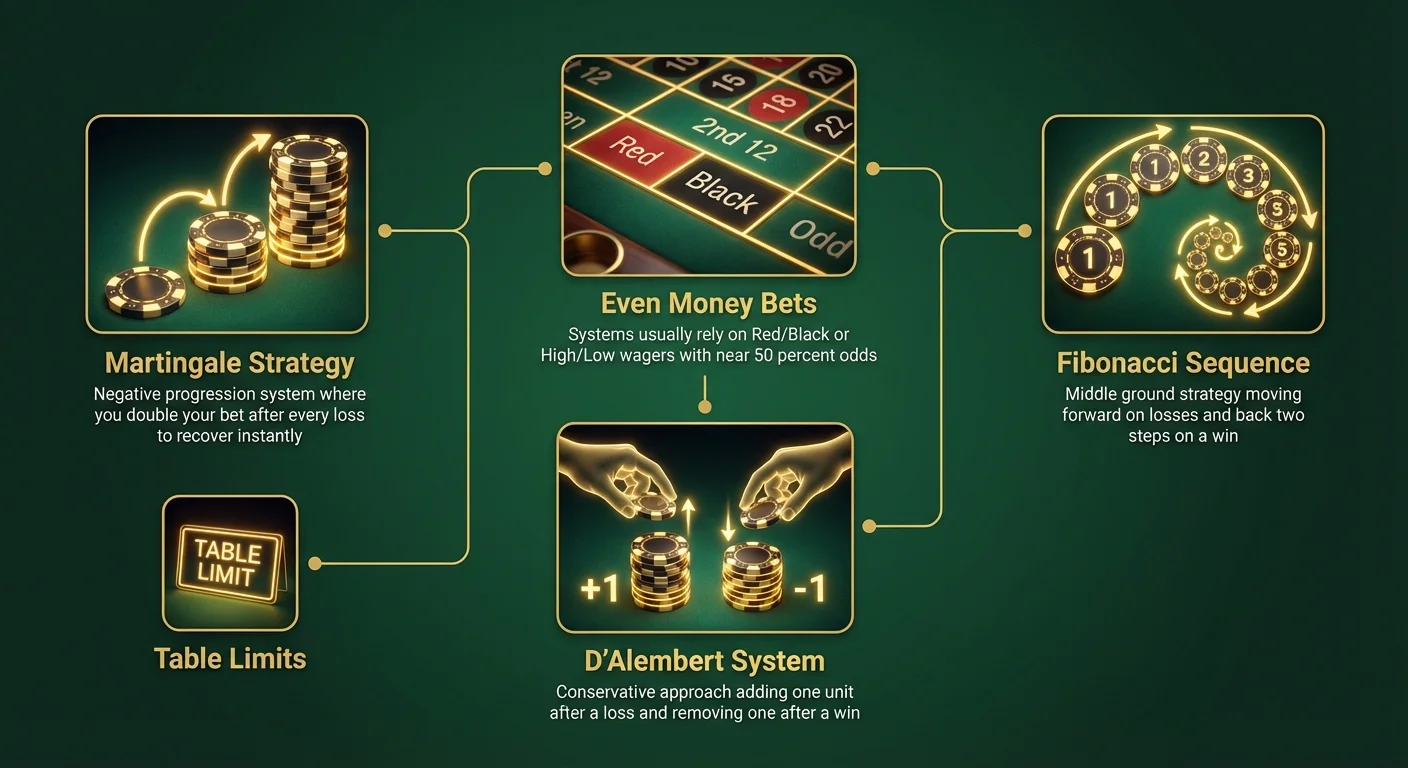
The Martingale Strategy: The Aggressive Recovery
The Martingale is the most famous betting system in history. Dating back to 18th-century France, it is intuitively appealing because it promises that a single win will recover all previous losses plus a small profit.
How It Works
The concept is a negative progression system. You increase your stakes when you lose and reset them when you win.
- Start Small: Place a 1-unit bet on an even-money option (e.g., Red).
- The Loss: If you lose, double your bet for the next spin.
- The Win: If you win, you recover all previous losses and gain a profit equal to your original unit.
- Reset: After a win, go back to the original 1-unit bet.
The Progression in Action
Let's assume you are betting with a base unit of 0.001 BTC.
| Spin # | Bet Amount | Outcome | Total Loss | Net Result if Win |
|---|---|---|---|---|
| 1 | 0.001 BTC | Loss | -0.001 BTC | +0.001 BTC |
| 2 | 0.002 BTC | Loss | -0.003 BTC | +0.001 BTC |
| 3 | 0.004 BTC | Loss | -0.007 BTC | +0.001 BTC |
| 4 | 0.008 BTC | Loss | -0.015 BTC | +0.001 BTC |
| 5 | 0.016 BTC | Loss | -0.031 BTC | +0.001 BTC |
| 6 | 0.032 BTC | Win | +0.001 BTC | Profit Secured |
The Fatal Flaw: Exponential Growth
The Martingale is mathematically sound only if you have an infinite bankroll and the casino has no table limits. Neither of these conditions exists in the real world.
The danger is the exponential growth of the bet. In the table above, by spin 6, you are risking 32 units to win just 1. If you hit a losing streak of 10 spins - which is statistically probable over a long session - you would need to bet 1,024 times your original stake.
In crypto terms, if you started with $5 equivalent, your 10th bet would need to be $5,120. Most tables have a "Maximum Bet" limit. Once the Martingale progression requires a bet higher than the table maximum, the system crashes, and the losses are locked in.
The D'Alembert System: The Balanced Approach
Named after the French mathematician Jean-Baptiste le Rond d'Alembert, this system is based on the theory (often called the Gambler's Fallacy) that nature seeks equilibrium - that red and black outcomes will even out in the short term.
How It Works
Like the Martingale, this is a negative progression, but it is linear rather than geometric. You do not double your bet; you simply add or remove a unit.
- Base Unit: Decide on a unit size (e.g., 10 USDT).
- Loss: If you lose a bet, increase your next wager by one unit.
- Win: If you win a bet, decrease your next wager by one unit.
- Floor: If you win on a 1-unit bet, you simply stay at 1 unit.
D'Alembert in Action
| Spin | Result | Action | Bet Amount | Net Profit/Loss |
|---|---|---|---|---|
| 1 | Loss | Increase +1 | 1 Unit | -1 |
| 2 | Loss | Increase +1 | 2 Units | -3 |
| 3 | Win | Decrease -1 | 3 Units | 0 (Breakeven) |
| 4 | Loss | Increase +1 | 2 Units | -2 |
| 5 | Win | Decrease -1 | 3 Units | +1 |
| 6 | Win | Decrease -1 | 2 Units | +3 |
Analysis
The D'Alembert is safer for your bankroll. A losing streak of 7 or 8 spins won't wipe you out instantly or hit the table limit. However, because the progression is slow, it takes much longer to recover from a deep hole. If you lose 10 times in a row, you need roughly 10 wins (depending on the sequence) to get back to even, whereas the Martingale fixes it in one spin.
The Fibonacci Strategy: Nature's Sequence
The Fibonacci strategy utilizes the famous mathematical sequence found in nature, architecture, and financial trading. It serves as a middle ground between the high-risk Martingale and the slow-grind D'Alembert.
The Sequence
The sequence is generated by adding the two previous numbers to get the next one:
1, 1, 2, 3, 5, 8, 13, 21, 34, 55, 89, 144...
How It Works
- Start: Bet 1 unit.
- Loss: Move one step forward in the sequence.
- Win: Move two steps back in the sequence.
Why Move Back Two Steps?
This is the genius of the Fibonacci system. Unlike the Martingale, which aims to wipe out all losses in one win, Fibonacci assumes you will lose more often than you win. By moving back two steps, you can theoretically end a session with a profit even if you lost more spins than you won.
Fibonacci in Action
Imagine a unit is 1 mBTC.
- Bet 1 (Loss) -> Sequence: 1, 1, 2, 3...
- Bet 1 (Loss) -> Sequence: 1, 1, 2, 3...
- Bet 2 (Loss) -> Sequence: 1, 1, 2, 3...
- Bet 3 (Loss) -> Sequence: 1, 1, 2, 3, 5...
- Bet 5 (Loss) -> Sequence: 1, 1, 2, 3, 5, 8...
- Bet 8 (Win!) -> Move back two steps to number 2.
- Next Bet is 2.
Analysis
The Fibonacci is considered one of the most elegant systems. It allows you to weather losing streaks better than Martingale because the bets ramp up slower. However, like all systems, a significantly long losing streak will still push you toward the table limits, albeit at a slower pace.
Comparing the Systems
Here is a quick reference guide to help you decide which system fits your risk tolerance.
| Feature | Martingale | D'Alembert | Fibonacci |
|---|---|---|---|
| Risk Level | High (Exponential) | Low (Linear) | Medium (Cumulative) |
| Recovery Speed | Instant (1 Win) | Slow | Moderate |
| Bankroll Need | Large | Small/Medium | Medium |
| Complexity | Very Simple | Simple | Intermediate |
| Best For | Short sessions, high limits | Long play, risk aversion | Disciplined, structured play |
The Crypto Factor: Risks and Advantages
Playing these systems at a crypto casino introduces unique variables that traditional brick-and-mortar casinos don't offer.
1. Volatility and Unit Value
In fiat casinos, a $1 chip is always a $1 chip. In crypto, the value of your bankroll fluctuates.
- The Risk: If you are playing a Martingale strategy using Bitcoin, and the price of BTC spikes by 10% during your session, the "value" of your losses is magnified if you hit a bad streak.
- The Strategy: Use "Stablecoins" (USDT, USDC) for system betting if you want to perform strict mathematical calculations without worrying about market volatility.
2. Provably Fair Gaming
One of the biggest advantages of crypto gambling is Provably Fair technology.
- In a land-based casino, you trust the dealer.
- In a crypto casino, you can verify the hash of every spin.
- Why it matters for systems: Gamblers often blame "rigged software" when a system fails. With provably fair roulette, you can verify that that streak of 12 Blacks in a row was a genuine statistical anomaly, not a glitch designed to break your Martingale.
3. Auto-Betting and Speed
Crypto roulette games are fast. Many allow you to set "Auto-Bet" parameters where you can program the software to "Double on Loss" (Martingale) automatically.
- Warning: Speed kills. A Martingale failure that would take an hour at a physical table can happen in 30 seconds online. Monitor your auto-bets closely and always set a "Stop Loss."
Why No System Can Beat the House Edge
It is the harsh reality of gambling: Mathematics has no memory.
The D'Alembert system relies on the idea that if Red hits 5 times, Black is "due." This is false. The roulette wheel has no memory of the previous spin. The odds of hitting Red on spin #6 are exactly the same as they were on spin #1 (48.6%).
Betting systems manipulate the volatility of your experience, but they do not improve your Expected Value (EV).
- Martingale trades small, frequent wins for the risk of one catastrophic loss.
- D'Alembert smooths out the variance but bleeds money slowly against the Zero.
The House Edge acts as a tax on every spin. Whether you bet flat amounts or use a complex Fibonacci sequence, the casino expects to keep 2.70% of all money wagered on a European wheel over infinite time.
Practical Strategy Tips for Crypto Roulette
If you decide to employ these systems, do so with discipline and these "insider" tips:
- Hunt for "La Partage": This is a specific rule found in some French Roulette games. If you bet even-money and the ball lands on Zero, you get half your bet back. This cuts the house edge to 1.35%, making it the statistically best game to use with betting systems.
- Calculate Your Bankroll Depth: Before starting a Martingale, calculate how many losses you can sustain. If you have 0.1 BTC, don't start your bets at 0.01 BTC. Start at 0.0001 BTC to allow yourself room for 8 or 9 doublings.
- Set a "Win Goal": Systems work best in short bursts. If your goal is to win 10% of your bankroll, stop immediately once you hit it. The longer you play, the more likely the house edge will erode your stack.
- Ignore "Hot" and "Cold" Numbers: Crypto roulette interfaces often highlight "Hot" numbers. For independent events like roulette spins, past frequency does not predict future results. Stick to your system's rules, not the dashboard's suggestions.
Conclusion
Betting systems like Martingale, D'Alembert, and Fibonacci add a layer of excitement and structure to roulette. They prevent you from betting erratically and can help manage wins and losses over a short session. The Martingale offers the thrill of high-stakes recovery, the D'Alembert offers a safer, methodical grind, and the Fibonacci provides an interesting mathematical compromise.
However, they are not magic wands. No combination of bets can mathematically eliminate the house edge or the threat of the green Zero.
When playing with crypto, utilizing Provably Fair European or French roulette tables is your best defense. Treat these systems as tools for entertainment and bankroll management, not as investment strategies. The wheel will spin where it wants - your job is to ensure that when luck goes against you, you have a plan to survive the variance.
Disclaimer: Gambling involves risk. No strategy guarantees a win. Only gamble with funds you can afford to lose.