
If you have ever stepped foot in a traditional bingo hall, you likely know the drill: listen for the numbers, mark your card, and wait for a straight line of five. However, the world of online and crypto bingo has evolved far beyond the basic horizontal, vertical, or diagonal line. With the flexibility of digital interfaces and the transparency of blockchain technology, modern bingo offers a staggering array of winning possibilities.
Did you know there are statistically over 32,000 unique winning combinations available in standard 75-ball bingo? While you won't see all of them in a single session, understanding the hierarchy of these patterns - from the simple "Four Corners" to the elusive "Blackout" - is essential for any player looking to maximize their entertainment and their bankroll.
In this guide, we will move beyond the basics. We will analyze high-value bingo patterns, break down the odds of the coveted Blackout, and explain how playing at crypto casinos changes the dynamic of the game through Provably Fair technology and auto-daubing features.
The Anatomy of the Grid: Where Patterns Begin
To understand winning patterns, you must first understand the battlefield. While 90-ball bingo (popular in the UK and Australia) typically relies on a three-stage win system (1 Line, 2 Lines, Full House), the 75-ball variant (dominant in the US and most crypto casinos) is the king of complex patterns, which variant has the best odds.
The 75-Ball Card
The standard card consists of a 5x5 grid containing 25 spaces.
- Columns: Labeled B-I-N-G-O.
- Numbers: 1 through 75 distributed across the columns.
- The Free Space: Located in the dead center. This is the "Joker" in the deck; it is automatically marked as "hit" before the game begins.
Because of that central Free Space and the square nature of the grid, game developers can create geometric shapes, letters, and thematic objects that players must form to win.
Categorizing Patterns by Difficulty and Value
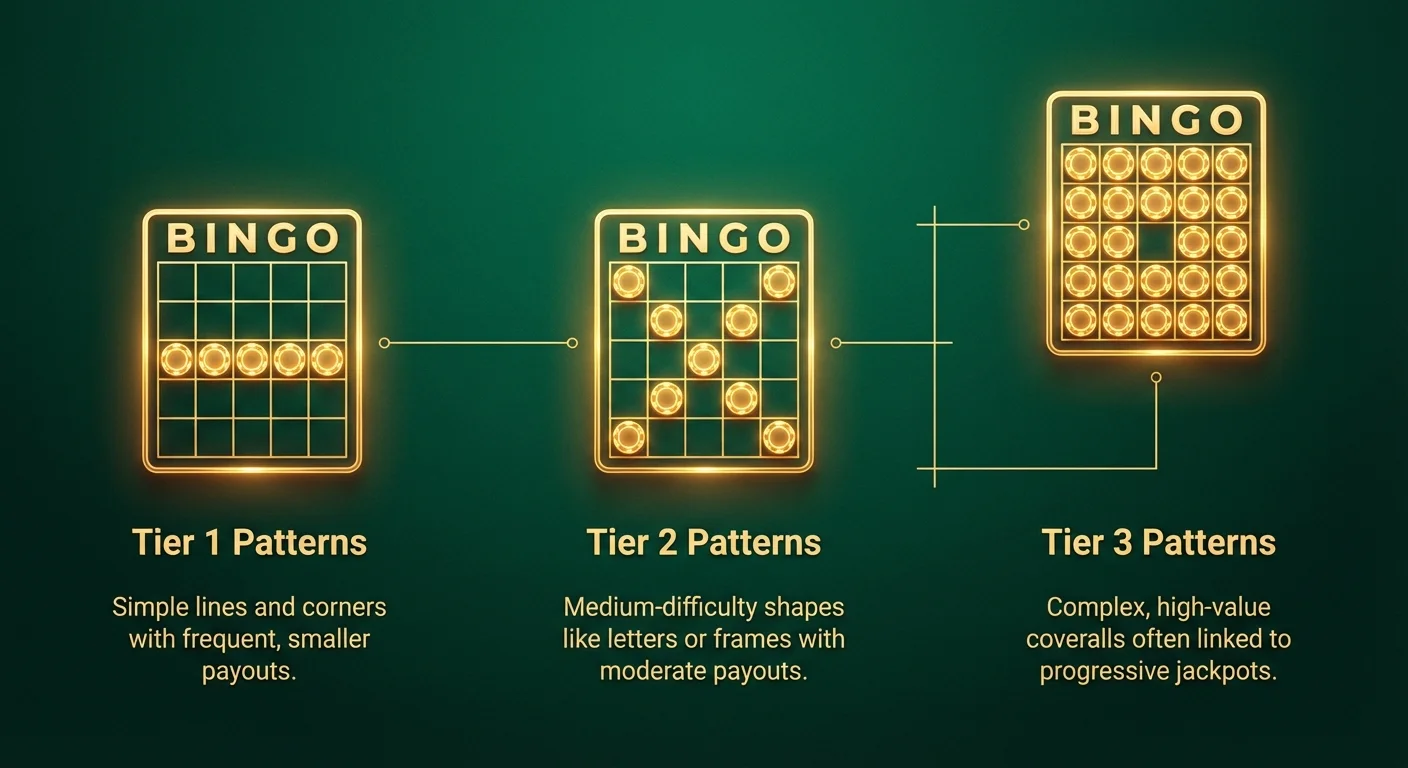
When you log into a crypto casino bingo room, the specific game rules will dictate the winning pattern. Generally, the more complex the pattern, the higher the prize pool or the progressive jackpot attached to it.
Tier 1: The Standard Patterns (Low Variance)
These are the "bread and butter" of bingo. They occur frequently, the games are fast, and the payouts are generally smaller (unless it is a high-stakes room).
- Single Line: The most basic win. You need five numbers in a row horizontally, vertically, or diagonally.
- Note: The diagonal line is slightly easier than horizontal or vertical lines because it utilizes the Free Space, meaning you only need to hit four numbers.
- Two Lines: Any two distinct lines on the same ticket. They usually do not have to intersect, but rules vary by room.
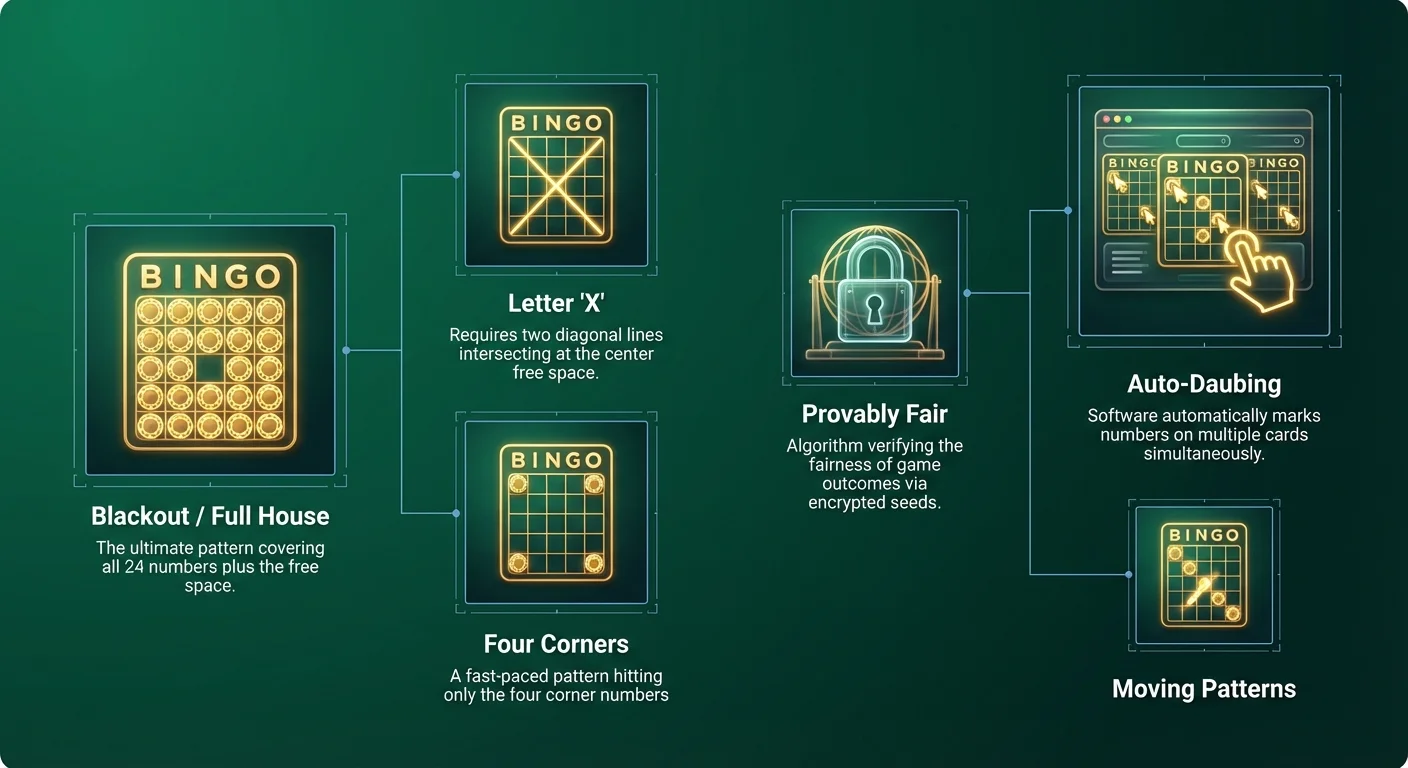
- Four Corners: A fast-paced favorite. You only need to hit the top-left, top-right, bottom-left, and bottom-right numbers. This pattern often keeps players on the edge of their seats because it only requires four calls to potentially win (though statistically, it takes many more).
Tier 2: The Geometric and Letter Patterns (Medium Variance)
This is where online bingo shines. Digital software can instantly recognize complex shapes that would be a nightmare to track manually in a physical hall.
- The Letter 'X': This requires two diagonal lines intersecting at the Free Space. It effectively splits the board into four triangles.
- The Letter 'T' or 'L': Forming specific letters. For an 'L', you typically need the entire 'B' column and the bottom row.
- Postage Stamp: A 2x2 square of four numbers in any of the four corners of the board.
- The Picture Frame: All numbers along the border of the card must be daubed. This leaves the inner 3x3 grid empty.
Tier 3: High-Value Complex Patterns (High Variance)
These patterns take longer to form, meaning more balls must be called. Consequently, these games often feature higher pot prizes.
- The Sputnik/Explosion: A complex pattern involving the center space and specific surrounding clusters.
- The Windmill: Four 2x2 squares in the corners (like four Postage Stamps).
- Coverall / Blackout: The ultimate prize. We will discuss this in depth in the next section.
The Holy Grail: Analyzing Bingo Blackout Odds
The terms "Blackout," "Coverall," and "Full House" are often used interchangeably. In the context of 75-ball bingo, a Blackout means covering all 24 numbers (plus the Free Space) on your card.
This is the pattern usually linked to Progressive Jackpots.
Line vs. Full House: The Probability Gap
Many beginners fail to grasp the mathematical leap between getting a Line and getting a Blackout, especially when comparing them to calculating your true chances.
- The Line: In a standard game, a line might be won within the first 15 to 25 calls.
- The Blackout: To cover every spot on a 75-ball card, the caller usually needs to draw between 50 and 60 numbers.
Why does this matter?
If a crypto casino offers a "Jackpot" for getting a Blackout in under 50 calls, the odds are stacked heavily against you.
- The probability of a Blackout in roughly 50 calls is extremely low.
- As the number of calls increases (55, 60, 65), the probability of someone hitting the Blackout rises exponentially.
If you are playing specifically to chase a Blackout jackpot, ensure you check the "Ball Count Requirement." If the jackpot triggers only if won in under 45 balls, treat it like a lottery ticket - fun to dream about, but statistically unlikely.
Comparative Table: Pattern Difficulty & Payout Potential
| Pattern | Complexity | Approx. Balls to Win (Avg) | Payout Tier |
|---|---|---|---|
| Single Line | Low | 15 - 25 | Low / Standard Pot |
| Four Corners | Low | 10 - 20 | Low / Speed Bingo |
| Double Line | Medium | 20 - 30 | Medium |
| Letter 'X' | Medium | 30 - 40 | Medium - High |
| Outer Frame | High | 45 - 55 | High |
| Blackout / Full House | Very High | 50 - 60+ | Jackpot / Grand Prize |
The Crypto Advantage: Auto-Daubing and Provably Fair
One of the distinct advantages of playing bingo at a cryptocurrency casino is the integration of technology that assists with pattern recognition.
The Problem with Complex Patterns Offline
In a traditional hall, if the game is "The Windmill" or a "Crazy Kite," human error becomes a massive factor. It is very easy to overlook a number that completes a complex geometric shape, causing you to miss a "Bingo" call and forfeit your prize.
The Online Solution: Auto-Daub
Crypto bingo platforms utilize Auto-Daubing. The software automatically marks your numbers as they are called. More importantly, the software instantly validates your card against the required pattern.
- Benefit: You can play 10, 20, or even 50 cards simultaneously without fear of missing a pattern.
- Strategy: This allows you to scale your volume (buying more tickets) to increase your odds, a strategy that is physically impossible with paper and daubers.
Provably Fair Patterns
In the world of crypto gambling, Provably Fair is a buzzword you should know. It refers to an algorithm that allows players to verify the fairness of the game outcome and see how Provably Fair bingo works.
- How it works: Before the bingo game starts, the server generates a "seed" (the sequence of numbers to be drawn). This is hashed (encrypted) and given to you.
- The Verification: After the game, you can reveal the seed and verify that the numbers called were pre-determined and not manipulated based on your card's pattern. This ensures that the casino didn't stop calling numbers just because you were one spot away from a Blackout.
Unique Digital Patterns: Beyond Geometry
Digital bingo platforms are not constrained by physical limitations. This allows for "Crazy" or "Wild" patterns that rotate.
The "Any Way" Rule
Some patterns come with an "Any Way" rule. For example, if the pattern is an "Airplane," the rule might allow the airplane to be pointing up, down, left, or right. As long as the shape exists relative to the card's orientation, it counts.
Moving Patterns
In advanced crypto bingo games, you might encounter moving patterns. This is rare but exciting. For example, a 2x2 square pattern might not be fixed in the corner; it could be valid anywhere on the grid. This drastically improves your odds compared to a fixed-location pattern.
Strategies for High-Value Pattern Play
While bingo is a game of chance governed by RNG (Random Number Generation), how you approach high-value patterns can affect your long-term variance.
1. The Tippett Theory Application
L.H.C. Tippett, a British statistician, proposed a theory specifically for 75-ball bingo. He suggested that:
- In short games (Simple patterns like Lines or 4 Corners), numbers closer to 1 and 75 are more likely to be significant.
- In long games (Complex patterns like Blackout), the numbers drawn tend to gravitate toward the median number (38).
Strategy: If you can choose your cards (or if the casino allows you to swap cards before the game), look for cards with a concentration of numbers near 38 when playing for a Blackout, and numbers near the extremes (1 and 75) when playing speed bingo.
2. The "Buy-In" Balance
For complex patterns like the Blackout, the game lasts longer. This keeps the entertainment value high for a single ticket. However, because the payout is usually a progressive jackpot or a large pool, competition is fierce.
- Tip: Instead of buying expensive tickets for a standard line game, save your bankroll to max out your ticket allowance on "Jackpot Night" or games featuring high-value patterns. The Expected Value (EV) is higher when the prize pool is inflated.
3. Avoid the Crowd
This is a golden rule in bingo. The more cards in play, the lower your chances of winning.
- If a Blackout prize is fixed (e.g., $1,000 guaranteed regardless of player count), play at off-peak hours (early mornings or late nights).
- If the prize is based on ticket sales (pari-mutuel), playing during peak hours is fine because the pot grows with the crowd.
A Note on Slingo: The Slot-Bingo Hybrid
We cannot discuss patterns without mentioning Slingo. Mentioned often in modern gambling guides, Slingo mixes slot mechanics with bingo grids, which requires mastering Slingo.
- The Mechanism: You spin a reel to reveal numbers that mark off spots on your grid.
- The Pattern Focus: Slingo is entirely about patterns. You gain points or cash prizes for every line (Slingo) you complete.
- Ladder System: Usually, completing a Full House in Slingo unlocks the maximum bonus game or cash multiplier.
If you enjoy the pattern-seeking aspect of bingo but prefer the solitary, fast-paced nature of slots, Slingo is an excellent alternative found in most crypto casinos.
Summary: Winning is More Than Just Luck
While you cannot control the numbers drawn, you can control the games you enter and the cards you play.
- Understand the Goal: Don't just look for lines. Check the game rules to see if you are hunting for an 'X', a 'T', or a Blackout.
- Respect the Odds: A Full House is exponentially harder to hit than a Line. Manage your bankroll accordingly.
- Leverage Tech: Use auto-daub features to play multiple cards on complex patterns.
- Verify with Crypto: Use Provably Fair tools to ensure your "near miss" on a big jackpot was bad luck, not bad ethics.
Bingo patterns add depth, strategy, and visual excitement to a classic game. Whether you are chasing the quick thrill of a "Four Corners" win or the life-changing potential of a "Blackout," understanding the mechanics behind the patterns is the first step toward playing like a pro.
Disclaimer: Gambling involves risk. Please gamble responsibly. Strategies mentioned in this guide are for educational purposes and do not guarantee winnings.