
Keno is one of the most accessible and exciting games in the casino world. It moves fast, offers massive payouts for small wagers, and requires zero skill to start playing. Whether you are sitting in a smoky lounge in Las Vegas or playing from your phone on a premier crypto gambling site, the thrill of watching those numbers pop up is universal.
However, Keno is also a game steeped in superstition. Because it is purely a game of chance with a high house edge, players have spent decades inventing systems, patterns, and rituals to try and tame the volatility. While these rituals can be fun, believing in them as mathematical facts is a surefire way to deplete your bankroll.
If you are playing Keno with the expectation that a specific pattern or a "due" number is guaranteed to hit, you are falling victim to common gambling fallacies. In this guide, we will strip away the superstition and look at the cold, hard logic behind the game. We will debunk the five most common Keno myths that are costing you money and replace them with solid, mathematically sound advice to help you play smarter.
Understanding the Beast: How Keno Actually Works
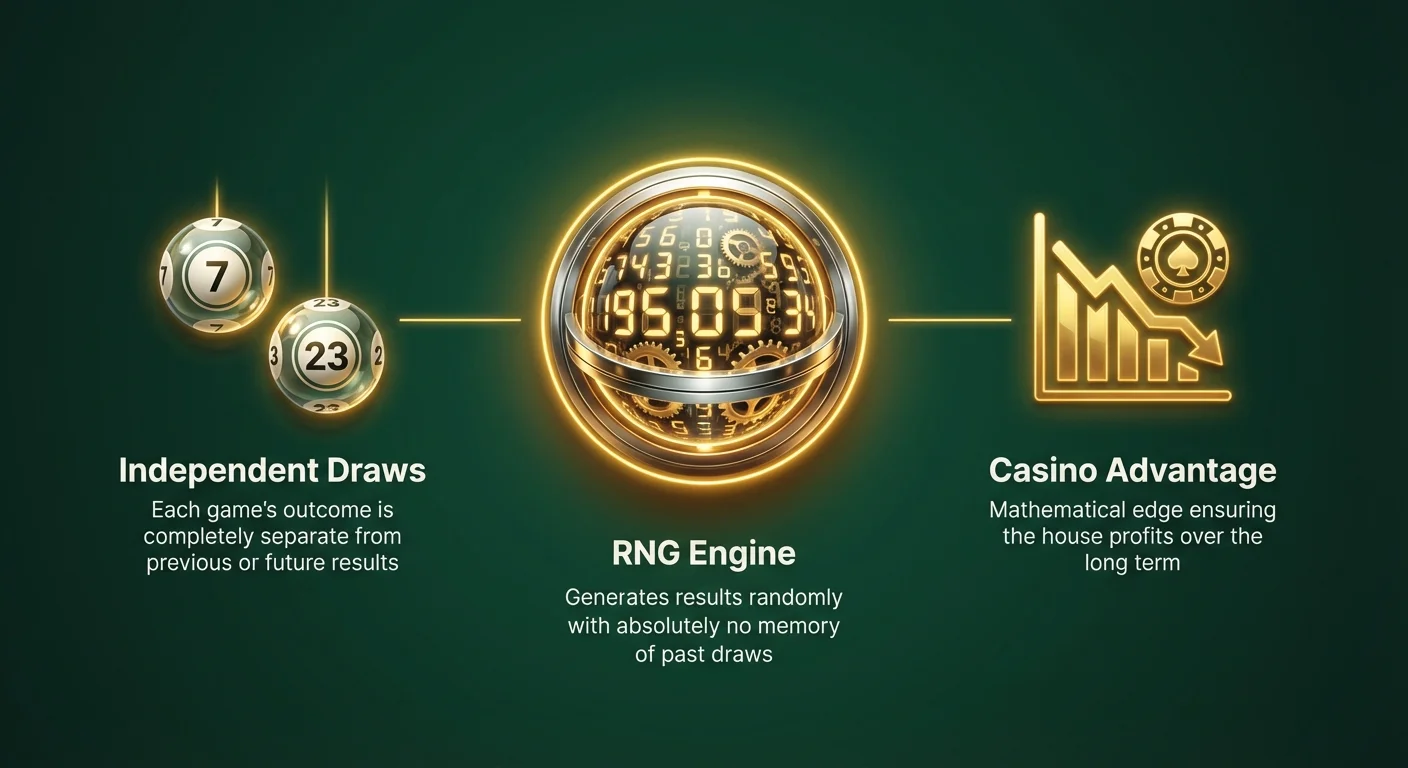
Before we dismantle the myths, it is crucial to understand the engine driving the game. In modern online Keno - and specifically in crypto Keno - the results are determined by a Random Number Generator (RNG).
In a standard game, there are 80 numbers (1 through 80). The game draws 20 numbers. Your goal is to match (or "catch") the numbers you selected.
The defining characteristic of an RNG is independence. This means that the result of the current game has absolutely no connection to the result of the previous game or the next one. The computer does not remember that the number 7 was drawn five times in a row, nor does it care. This concept of independence is the primary weapon we will use to debunk the following myths.
Myth #1: The "Due" Number Fallacy
This is, without a doubt, the most expensive myth in the gambling world. It is known scientifically as the Gambler's Fallacy.
The Myth
You have been watching the Keno board for ten rounds. You notice that the number 45 hasn't appeared a single time. You convince yourself that 45 is "cold," but because the laws of averages exist, it must appear soon to balance things out. You start betting heavily on 45, doubling your bet each time it misses, convinced it is "due" for a win.
The Reality
In the world of probability, numbers are never "due."
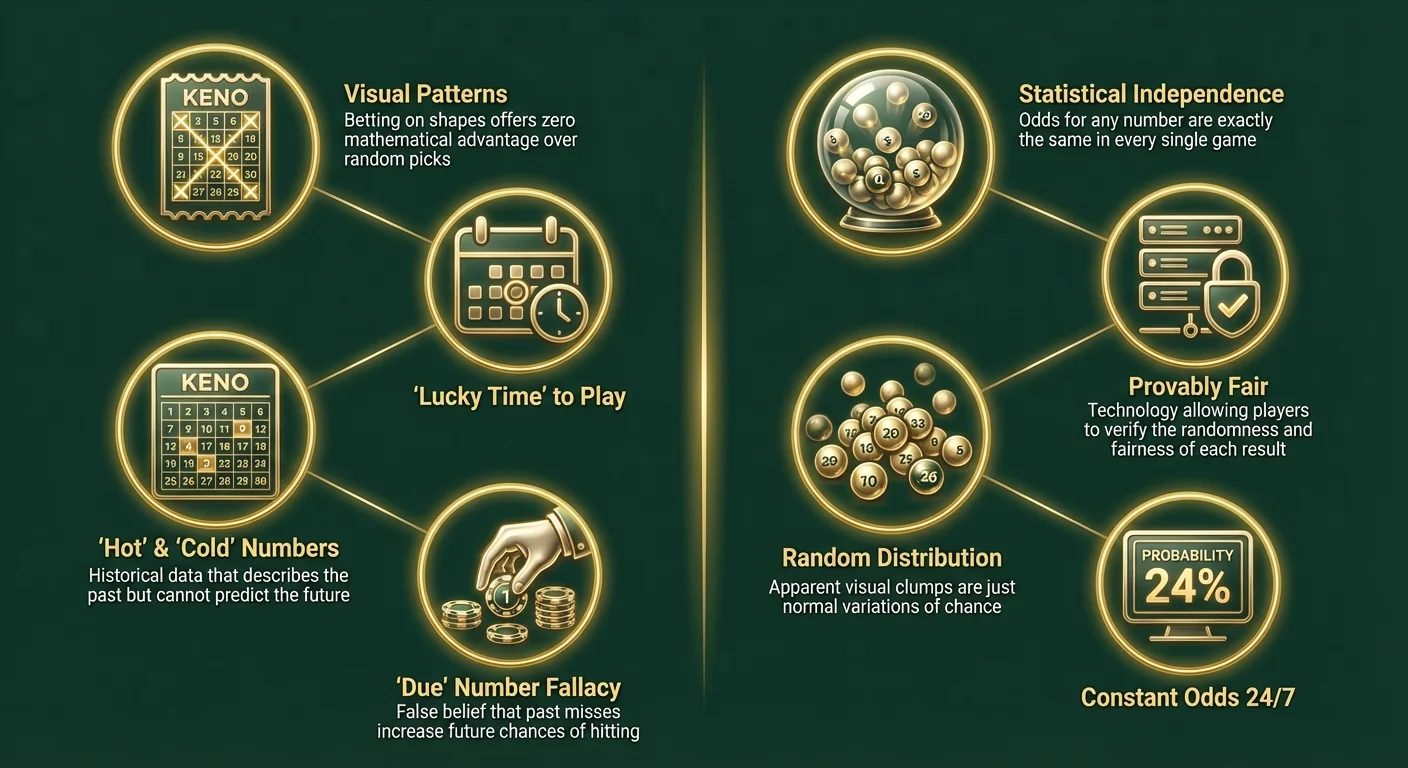
In every single round of Keno, the number 45 has the exact same probability of being drawn as it did in the previous round: roughly 1 in 4 (specifically, there are 20 balls drawn out of 80, so a 25% chance). Even if the number 45 hasn't hit for 100 consecutive games, the odds of it hitting in game 101 are still exactly 25%.
The universe does not have a memory that forces short-term correction. While statistical averages do even out over millions of rounds (the Law of Large Numbers), they do not correct themselves in the short session you are playing. Chasing a "due" number is the quickest way to drain your crypto wallet.
Practical Tip
- Don't Chase: Never increase your bet size just because you feel a number is about to hit.
- Pick and Stick (or Don't): It doesn't matter if you change your numbers every round or keep the same ones for a year; the odds remain constant. Play whichever way makes you happier, but don't expect a mathematical edge from it.
Myth #2: Visual Patterns Increase Winning Odds
Humans are pattern-seeking creatures. We look for order in chaos. This leads to the belief that creating aesthetic patterns on the Keno card will confuse the machine or trigger a payout.
The Myth
Many players believe that playing specific shapes - like "The Cross," "The Corners," or specific lines - increases the likelihood of catching numbers. For example, the 4 x 5 Corners strategy involves picking clusters of numbers in the four corners of the ticket. The logic is that numbers often clump together, so betting on clusters captures these groups.
The Reality
The Random Number Generator does not see a grid. It does not see corners, lines, or crosses. It sees a flat list of integers from 1 to 80.
When the numbers are displayed on your screen, they are arranged in a grid for your visual convenience. To the algorithm, the numbers 1, 2, 11, and 12 (a top-left corner cluster) are just four independent integers. They have the exact same mathematical probability of being drawn as the sequence 4, 28, 56, and 79.
While numbers do often appear to "clump" visually on the board, this is random distribution at work. Betting on a "T" shape or a "Box" shape is fun, but it offers zero statistical advantage over closing your eyes and tapping the screen randomly.
The Problem with Pattern Betting
The danger of pattern betting isn't the pattern itself - it's the rigidity. If you are stuck playing a specific visual pattern, you might be ignoring the distinct rules of the specific Keno variant you are playing. For example, playing a 10-number "X" pattern on a game that offers the best odds for 5-number picks is a strategic error driven by a myth.
Myth #3: "Hot" and "Cold" Numbers Can Predict the Future
If you walk into a land-based casino or look at the interface of many online Keno games, you will often see a dashboard highlighting "Hot" numbers (drawn frequently in the last X rounds) and "Cold" numbers (drawn rarely).
The Myth
Players believe they can use this historical data to predict the next draw.
- Strategy A: Bet on Hot numbers because they are on a streak.
- Strategy B: Bet on Cold numbers because they are due (see Myth #1).
The Reality
Hot and cold numbers are descriptive, not predictive. They tell you what has happened, not what will happen.
In a fair crypto Keno game, the results are generated by a cryptographic seed. The previous draws have no influence on the current seed. If the number 23 has been "Hot" for the last hour, it is purely coincidental variance.
While some sources suggest that numbers like 1, 4, 23, 34, and 72 hit the most historically, this data is usually aggregated from specific sessions or mechanical machines that might have had slight imperfections. In the digital age of Provably Fair gaming, there are no "lucky" numbers. Every number is statistically equal.
The "Provably Fair" Antidote
This is where playing at a reputable crypto casino helps. Provably Fair technology allows you to verify the fairness of every bet. You can check the server seed and client seed to prove that the result was pre-determined by math, not by "hot streaks." This transparency proves that past results do not influence future outcomes.
Myth #4: There is a "Lucky Time" to Play
The Myth
"Don't play Keno on Friday nights; the casino tightens the machine because it's busy."
"Play on Tuesday morning at 4 AM; the game is in 'payout mode' to attract players."
The Reality
This myth is a hangover from the days of mechanical slot machines and conspiratorial thinking.
- RNGs run 24/7: The algorithm does not know what time it is. It operates on millisecond-timing seeds.
- House Edge is Constant: The casino does not need to "tighten" the machine to make money. The mathematical house edge ensures they profit over the long term regardless of when you play.
- Global Player Base: In online crypto gambling, players are connecting from Tokyo, London, and New York simultaneously. "Night" for you is "morning" for someone else.
The odds of hitting a 10-spot jackpot are the same at 3:00 PM on a Tuesday as they are at midnight on New Year's Eve.
Myth #5: All Keno Paytables Are Basically the Same
Of all the myths, this one causes the most direct financial damage.
The Myth
"Keno is Keno. It doesn't matter which version I play; the payouts are standard."
The Reality
Keno has one of the most variable Return to Player (RTP) percentages of any casino game. The difference between a "good" Keno game and a "bad" one can be massive.
- Land-based Keno: Often has an RTP of 60% to 75% (the house keeps 25-40 cents of every dollar). This is terrible value.
- Online/Crypto Keno: Often has an RTP of 90% to 98%.
Furthermore, different versions have different Paytables. One game might pay 3x your bet for hitting 3 numbers, while another version might only pay 2x for the same achievement. Assuming they are all the same stops you from shopping around for the best value.
Comparison: Bad Paytable vs. Good Paytable (Hypothetical)
| Hits (Catches) | "Bad" Keno Payout | "Good" Crypto Keno Payout | Impact |
|---|---|---|---|
| 3 out of 5 | 1x Bet (Push) | 2x Bet | Double the profit on frequent wins |
| 4 out of 5 | 10x Bet | 15x Bet | Significant difference |
| 5 out of 5 | 250x Bet | 500x Bet | Massive difference in jackpot |
Takeaway: Never sit down at a virtual Keno machine without looking at the "Info" or "?" tab to check the payouts. If you don't check, you are gambling blind. Review the paytables and RTP.
Real Strategies: Replacing Myths with Math
Now that we have debunked the myths, how should you actually play? If you can't predict numbers, what can you control?
You can control three things: Volatility, Payout Selection, and Bankroll.
1. The "Middle Ground" Strategy (4 to 8 Spots)
While you can pick anywhere from 1 to 15 (or 20) numbers, the probability math suggests a "sweet spot."
- Too Few (1-3 numbers): The payouts are too small to be exciting, and the house edge is often higher on 1-spot bets.
- Too Many (10+ numbers): Hitting 10 out of 10 is statistically nearly impossible (1 in several million). You will drain your bankroll chasing a miracle.
The Strategy: Most experts recommend picking between 4 and 8 numbers. This range offers reasonable odds of hitting a winning combination while still providing payouts that make the win feel significant. For example, catching 6 out of 6 pays handsomely, but it is far more achievable than catching 10 out of 10.
2. Check the "Catch All" vs. "Catch Some" Rules
In some crypto Keno variants, you are paid only if you catch all your numbers (high volatility). In others, you get smaller payouts for partial matches (low volatility).
- Bankroll Preservation: If you have a small bankroll, play versions that pay for partial catches (e.g., catching 2 out of 4). This keeps your balance alive longer.
- Jackpot Hunting: If you are playing with crypto gains you are willing to lose for a shot at a Lamborghini, play the high-volatility versions.
3. Leverage Crypto Bonuses
Since you cannot beat the house edge mathematically, the best way to improve your overall position is to use money that isn't yours.
- Deposit Bonuses: Many crypto casinos offer 100% matches on deposits. Using these funds for Keno increases your playtime.
- Rakeback: Look for sites that offer rakeback on every bet. Even if you lose a round of Keno, getting a small percentage of crypto back softens the blow.
4. Stop-Loss Limits
The speed of Keno is its danger. In online Keno, you can play a round every 3 seconds.
- Set a Loss Limit: Decide "I am willing to lose 0.005 BTC today." If you hit that number, stop.
- Set a Win Limit: "If I double my money, I cash out."
- Use Auto-Bet Wisely: Most crypto Keno games have an "Auto" feature. Set it to stop on a win or stop after a certain loss amount. Never leave it running unattended.
The Crypto Keno Advantage
Why play Keno with cryptocurrency instead of fiat currency? The answer lies in transparency and speed.
- Provably Fair: As mentioned in Myth #3, this technology allows you to verify that the casino didn't cheat you. It debunks the myth of the "rigged machine."
- Instant Payouts: Keno is a fast game. If you hit a 500x win, you don't want to wait 3 days for a bank transfer. Crypto transactions allow you to move your winnings to your private wallet instantly.
- Anonymity: You can enjoy your gaming without bank statements judging your hobby.
Conclusion: Play for Fun, Not for Rent
Keno is a game of pure chance, similar to the lottery. The myths of patterns, lucky numbers, and due dates are comforting lies that players tell themselves to feel in control of the uncontrollable.
The truth is simple: The balls fall where they may.
By abandoning these myths, you stop chasing losses on "cold" numbers and stop making inefficient bets based on "pretty" patterns. You start focusing on what matters: finding the best paytables, managing your crypto bankroll, and enjoying the adrenaline rush of the draw.
Treat Keno as entertainment, not an investment strategy. If you play with a clear head, a strict budget, and a disregard for superstition, you are already ahead of 90% of the other players.
Key Takeaways
- Numbers are never "due." Past results do not influence future draws.
- Patterns are for aesthetics, not odds. A line has the same odds as a random scatter.
- Check the RTP. Not all Keno games pay the same; find the high-paying crypto versions.
- Play the Middle. Picking 4-8 numbers usually offers the best balance of risk and reward.
- Use Provably Fair. Verify your results to ensure true randomness.