The anticipation of waiting for that final number - the "1 to go" moment - is the heartbeat of bingo. But in the digital age, that excitement is often shadowed by a lingering doubt: Is this game rigged? When you are playing against a computer rather than watching physical balls tumble inside a cage at a local hall, how do you know the software isn't programmed to make you lose?
For decades, online gambling relied on "black box" Random Number Generators (RNGs). You had to trust that the casino's audit certificate was valid and that the software was honest. Enter crypto gambling fairness. With the rise of blockchain technology, a new standard has emerged: Provably Fair Bingo.
This guide moves beyond basic rules to explore the engine room of crypto bingo. We will deconstruct the cryptographic algorithms that power these games, explain how the casino and the player co-create the randomness, and teach you how to verify every ball called to ensure you are getting a fair shake.
The Evolution of Fairness: From Physical Cages to Cryptographic Hashes
To understand why Provably Fair technology is revolutionary, we must look at what it replaced. In a traditional land-based hall, you see the caller, the machine, and the balls. If a ball looks dented or weighted, you can see it.
In standard online Web 2.0 bingo (fiat currency casinos), the "caller" is a line of code. This code uses a Pseudo-Random Number Generator (PRNG). While auditors like eCOGRA verify these algorithms, the player cannot check the result of a specific game in real-time. You are asked to trust the regulatory body.
Provably fair bingo shifts the paradigm from "trust" to "verification." It uses open-source algorithms and cryptographic hashing - the same technology securing the Bitcoin network - to prove that the outcome of the game was predetermined before you even bought your ticket, or that it was generated using inputs that the casino could not manipulate.
The "Glass Box" Concept
Think of Provably Fair as a glass box. You can't reach in and change the numbers, but you can see exactly how they are being mixed. If the casino tries to cheat, the math won't add up, and the fraud becomes mathematically visible on the blockchain.
The Core Components of Provably Fair Technology
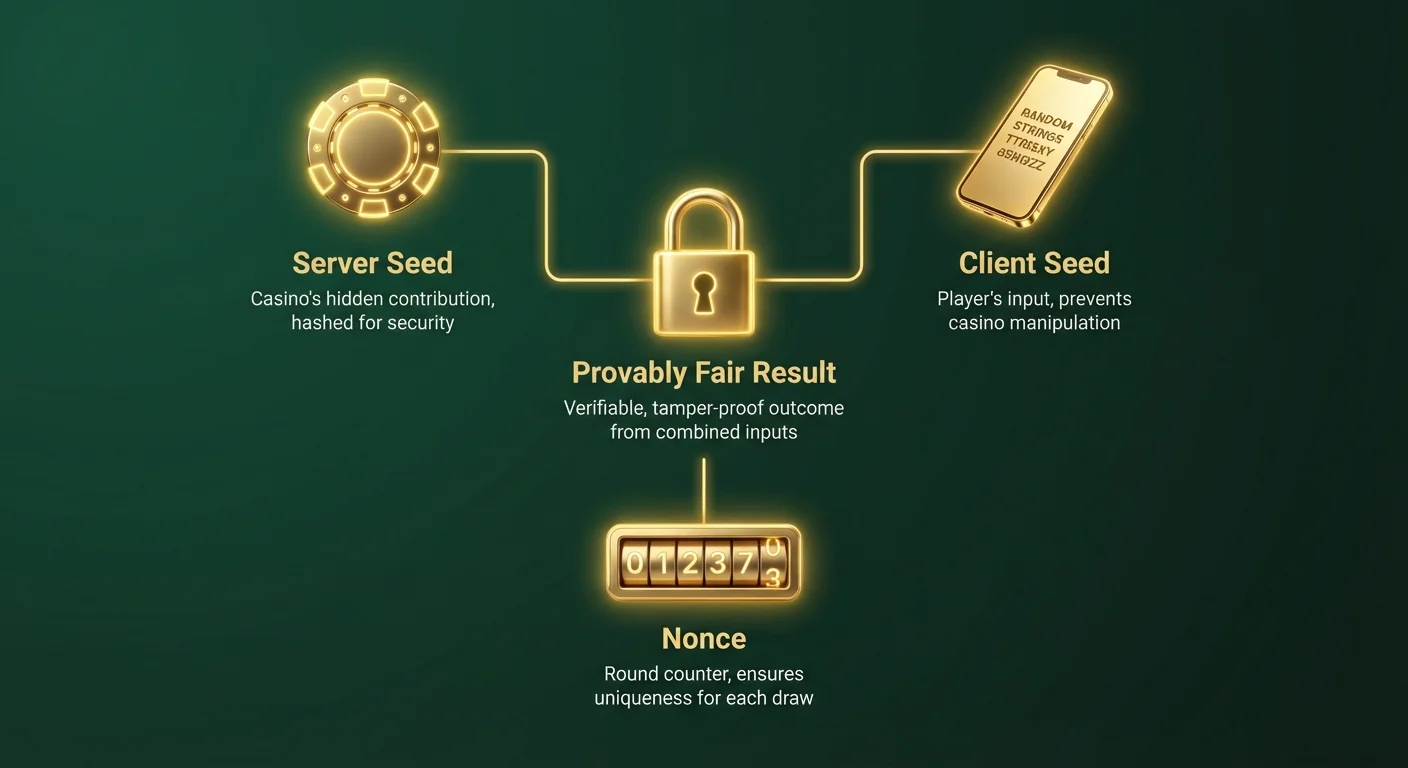
Provably Fair systems rely on three distinct variables. When combined, these variables produce a random result (the bingo call) that neither the player nor the house can predict or manipulate alone.
1. The Server Seed
This is a random string of characters generated by the casino before the round starts. It represents the casino's contribution to the randomness. To prevent the casino from changing this seed after you place a bet, it is hashed (encrypted) and shown to you before the game begins.
2. The Client Seed
This is the game-changer. This is a random string of characters that you (or the browser acting on your behalf) provide. Because the casino doesn't know your Client Seed when they create their Server Seed, they cannot rig the game to counter your inputs. In multiplayer bingo, this is often derived from a public blockchain block hash (like a recent Bitcoin block) to ensure it is neutral for all players.
3. The Nonce
"Nonce" stands for "Number used only once." It is a counter that tracks which turn or round you are on. In a slot machine, the nonce resets every spin. In bingo, the nonce usually increments with every ball drawn.
- Ball 1 = Nonce 0
- Ball 2 = Nonce 1
- Ball 3 = Nonce 2
The Hash Function (SHA-256)
These three elements are fed into a cryptographic hash function, typically SHA-256. This algorithm takes the input data and churns out a long string of hexadecimal characters. This string is then converted into decimal numbers, which become the bingo calls (e.g., B-12, I-28).
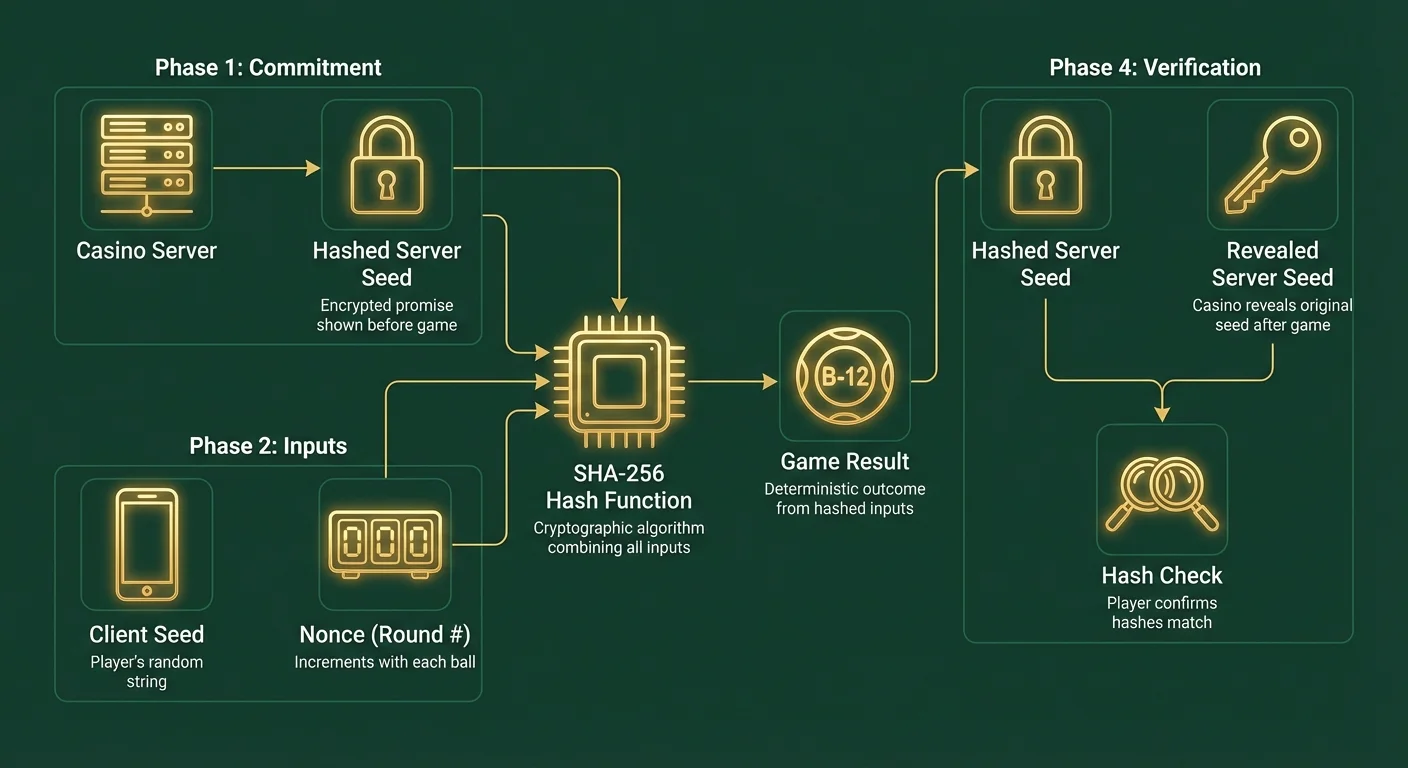
Step-by-Step: How a Provably Fair Bingo Draw Works
Let's break down the technical lifecycle of a single game of crypto bingo to see how these variables interact.
Phase 1: The Commitment (Pre-Game)
Before you buy your cards, the casino generates the Server Seed.
- Example Server Seed:
8b3...9a1 - The casino runs this through a hash function to create a Hashed Server Seed.
- They display this Hashed Seed to you. This is a digital promise. They have committed to the random sequence, and if they change the Server Seed later, it won't match this hash.
Phase 2: The Input (The "Cut")
You provide the Client Seed. On many crypto sites, you can manually type this in or let the browser generate a random one. In multiplayer rooms, the site waits for a specific future block on the blockchain (e.g., Bitcoin block #850,000) to determine the Client Seed. This acts like a player "cutting the deck" of cards. The casino cannot predict the hash of a future Bitcoin block.
Phase 3: The Draw (Game Mechanics)
The game begins. To determine the first number:
- The system combines:
Server Seed+Client Seed+Nonce (0). - It hashes this combination string.
- The first 8 characters of the resulting hash are converted from hexadecimal to a decimal number.
- If the number is between 1 and 75 (for 75-ball bingo), that is the call. If it is higher, it moves to the next set of characters until a valid number is found.
Phase 4: Verification (Post-Game)
Once the game ends, the casino reveals the unencrypted Server Seed. You can now verify that the game was fair.
How to Verify a Bingo Hash
This is the most critical skill for a crypto gambler. You do not need to be a coder to verify bingo hash data; most sites provide built-in tools, or you can use third-party verifiers.
Here is the manual process to understand what is happening:
- Locate the Game Data: Go to your bet history. You should see the Server Seed, Client Seed, and Nonce for that game.
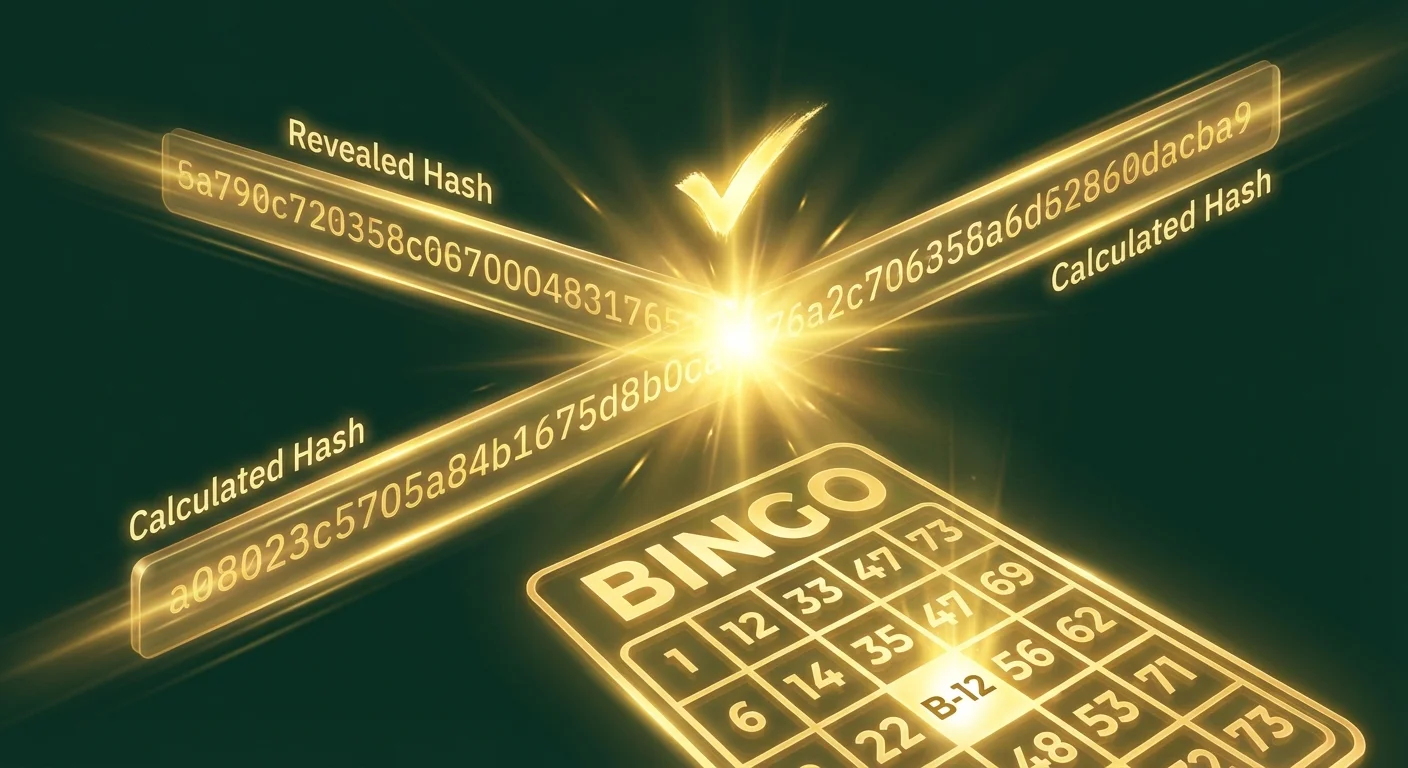
- Unhash the Server Seed: Check the revealed Server Seed against the Hashed Server Seed shown at the start. If you hash the revealed seed using an SHA-256 calculator, it must match the initial hash exactly. If it doesn't, the casino changed the seed during the game (cheating).
- Generate the Result:
- Open an online HMAC SHA-256 tool.
- Paste the Server Seed in the "Key" field.
- Paste the
ClientSeed:Noncein the "Data" field. - The output is a long string of numbers and letters.
- Convert to Decimal:
- Take the first pairs of hex characters.
- Convert them to decimal numbers.
- Apply the specific bingo modulo (e.g., Modulo 75) to get the ball number.
If the number generated by your manual calculation matches the ball that was called in the game, the game was mathematically fair.
Comparison: Provably Fair vs. Traditional RNG
Why should a player switch from a standard bingo site to a crypto platform? The answer lies in transparency.
| Feature | Traditional Online Bingo | Provably Fair Crypto Bingo |
|---|---|---|
| Randomness Source | Internal RNG server | Server Seed + Client Seed + Nonce |
| Verification | Impossible for players; relies on audit | Instant verification for every ball |
| Transparency | "Trust us, we are licensed" | "Don't trust us, verify the math" |
| Outcome Manipulation | Possible (though illegal) | Mathematically impossible without detection |
| Payouts | Standard banking (1-5 days) | Crypto (Instant to 1 hour) |
| Anonymity | Requires strict KYC | often minimal or no KYC |
Fairness Across Different Bingo Variations
Whether you are playing strictly for patterns or standard cover-all games, the randomness engine remains the same. However, the application of the hash differs slightly depending on the bingo variant.
75-Ball Bingo Fairness
In 75-ball bingo, the patterns (like the "Four Corners" or "Blackout" mentioned in general guides) rely on a grid of 5x5. The Provably Fair algorithm must generate numbers between 1 and 75 without repetition.
- The Check: When verifying, the algorithm will skip numbers that have already been drawn in that specific game session (Nonce sequence) to ensure no duplicates appear.
90-Ball Bingo Fairness
Common in the UK and Australia, this version uses numbers 1-90. The probability calculation changes here.
- The Check: The hexadecimal conversion will be modulo 90. The verification process is identical, but the mathematical range is wider.
Single Player (Slingo) vs. Multiplayer
- Single Player (Slingo): You have total control. You set the Client Seed manually. If you feel a seed is "unlucky," you can change it instantly.
- Multiplayer Rooms: Fairness is derived from a public, immutable source. Because 100 people are playing the same game, one player cannot dictate the seed. The casino usually uses the hash of a Bitcoin block that hasn't been mined yet when ticket sales close. This ensures total neutrality.
Practical Tips for the Crypto Bingo Player
Understanding the math is great, but how does this help you win? While Provably Fair technology ensures the house isn't cheating, it doesn't change the odds of the game. However, it does allow you to play with a clear strategy.
1. Verify Your "Near Misses"
One of the biggest psychological triggers in gambling is the "near miss" - waiting for one number that never comes. In rigged software, algorithms are sometimes tweaked to create these near misses to keep you playing.
- Tip: If you have a suspicious streak of 1-to-go losses, perform a hash verification. If the math checks out, you know it's genuine variance, not a predatory algorithm.
2. Rotate Your Client Seed
If you are playing single-player crypto bingo or Slingo, change your Client Seed frequently.
- Tip: While this doesn't mathematically increase your odds (random is random), it prevents you from falling into a psychological rut of blaming a "bad seed."
3. Check the Return to Player (RTP)
Fairness ensures the draws are random, but it doesn't dictate the payout percentage.
- Tip: Always check the Information tab. A Provably Fair game with a 70% RTP is still a "fair" game (it's doing what it says it does), but it's a terrible bet. Look for crypto bingo games with RTPs above 95%.
4. Use the "Verify" Button
Most modern crypto casinos have a simplified "Verify" button in the history tab. You don't always need to do the complex math yourself.
- Tip: Click this periodically. It signals to the casino that players are watching, and it gives you peace of mind.
Common Myths About Crypto Bingo Fairness
Even with transparent tech, misconceptions persist. Let's debunk a few.
Myth: "If I can verify the seed, I can predict the next number."
Reality: No. You can only verify past results. Because you don't know the Server Seed until the game is over, you cannot reverse-engineer the next ball.
Myth: "Provably Fair means I will win more."
Reality: Fairness guarantees randomness, not winnings. It ensures the house edge is exactly what is advertised, not that the edge is removed.
Myth: "The card generation is rigged, even if the balls aren't."
Reality: In top-tier crypto casinos, the generation of your bingo card is also a Provably Fair event. You can often verify the hash that determined which numbers appeared on your ticket.
Conclusion: Trusting the Math, Not the House
The transition from traditional bingo halls to crypto gambling represents a massive leap in player protection. You no longer have to worry if the machine is "cold" or if the software is biased against you. By utilizing Provably Fair bingo technology, you have the power to audit the casino after every single ball is called.
While the rules of Bingo - marking cards, chasing patterns, and shouting for the win - remain timeless, the technology behind them has evolved. By understanding seeds, hashes, and nonces, you transform from a passive participant into an informed player. The numbers don't lie, and now, you have the tools to prove it.
Glossary of Terms
- Hash: A unique string of characters generated by encrypting data. Any change to the input data completely changes the hash.
- Seed: A starting variable used to initialize a random number generator.
- Immutable: Data that cannot be changed once written (a key feature of blockchain).
- RNG: Random Number Generator.
- Algorithm: A set of rules calculations used to solve a problem (in this case, picking a random number).