
The atmosphere shifts when the caller announces a "Coverall" or "Blackout" game. In traditional halls, the chatter dies down; in online crypto bingo rooms, the chat box floods with anticipation. This is the main event. While standard line wins keep the game flowing, the Coverall is where the massive progressive jackpots, life-changing crypto payouts, and serious bragging rights live.
Many casual players treat the Blackout as a pure lottery, throwing a few satoshis at a card and hoping for the best. However, intermediate and advanced players know that while you cannot control the numbers drawn, you can manipulate the probability of success through bankroll allocation, card density mechanics, and game selection.
This guide dives deep into the Coverall strategy, moving beyond basic rules to explore the probability mathematics and tactical approaches required to chase the full card.
Understanding the Beast: What is Coverall Bingo?
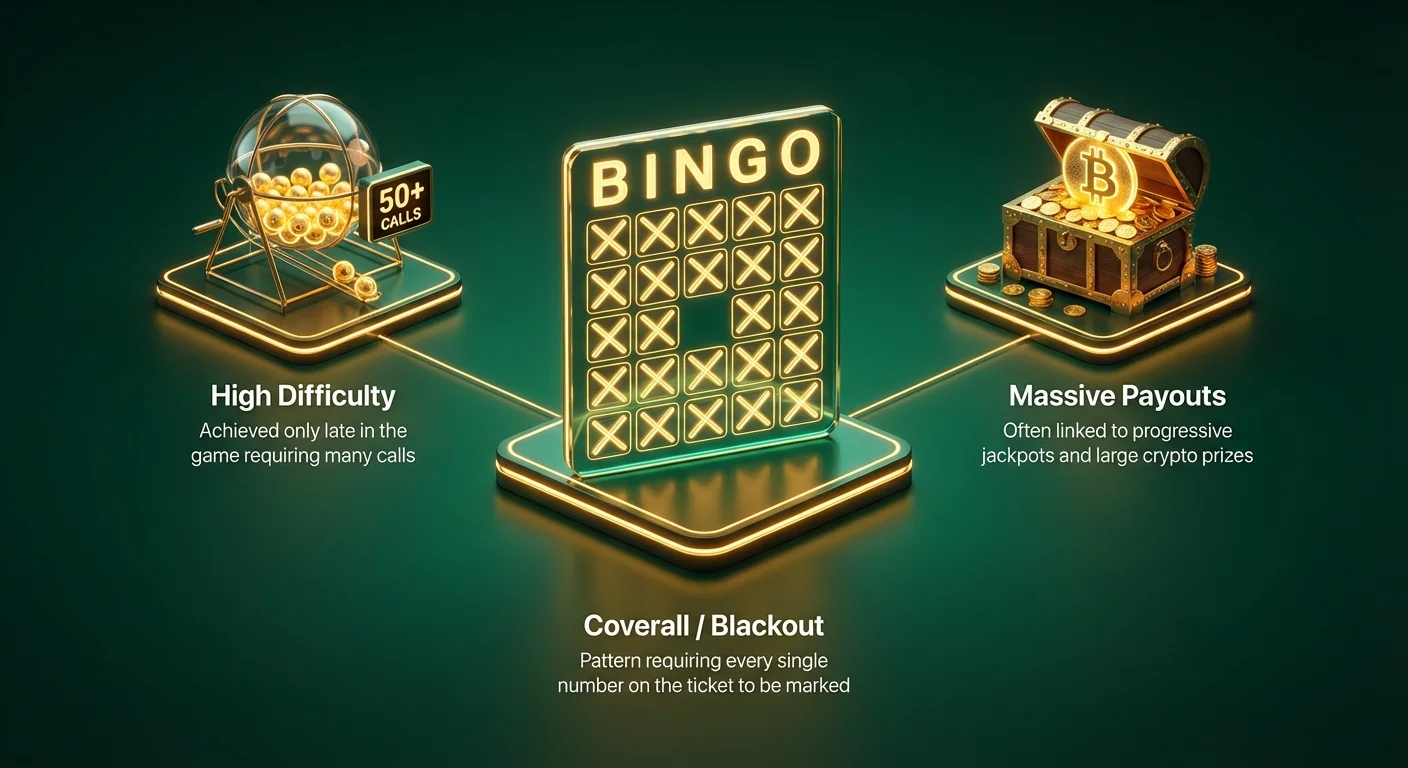
In bingo terminology, a Coverall (often called a Blackout) is a pattern that requires a player to mark off every single number on their ticket to win.
Unlike standard patterns (lines, four corners, or shapes) which might require only 4 to 16 hits, a coverall requires marking:
- 24 Numbers in 75-Ball Bingo (25 squares minus the free space).
- 15 Numbers in 90-Ball Bingo (all numbers on the strip).
Because of the difficulty and time required to hit every number, these games are typically reserved for the end of a session or scheduled as special jackpot events. This high difficulty is directly correlated to the prize pool.
The Crypto Advantage
In the context of CryptoGambling.com, Coverall games take on a new dimension. Traditional online bingo obscures the mechanics, but Provably Fair crypto bingo allows you to verify the randomness of the draw. When you are waiting for that one final number for a 1 BTC jackpot, knowing the algorithm hasn't been tweaked against you is invaluable. Furthermore, the volatility of cryptocurrencies means that a fixed jackpot won months ago might be worth significantly more by the time you hit the Blackout.
The Mathematics of the Blackout
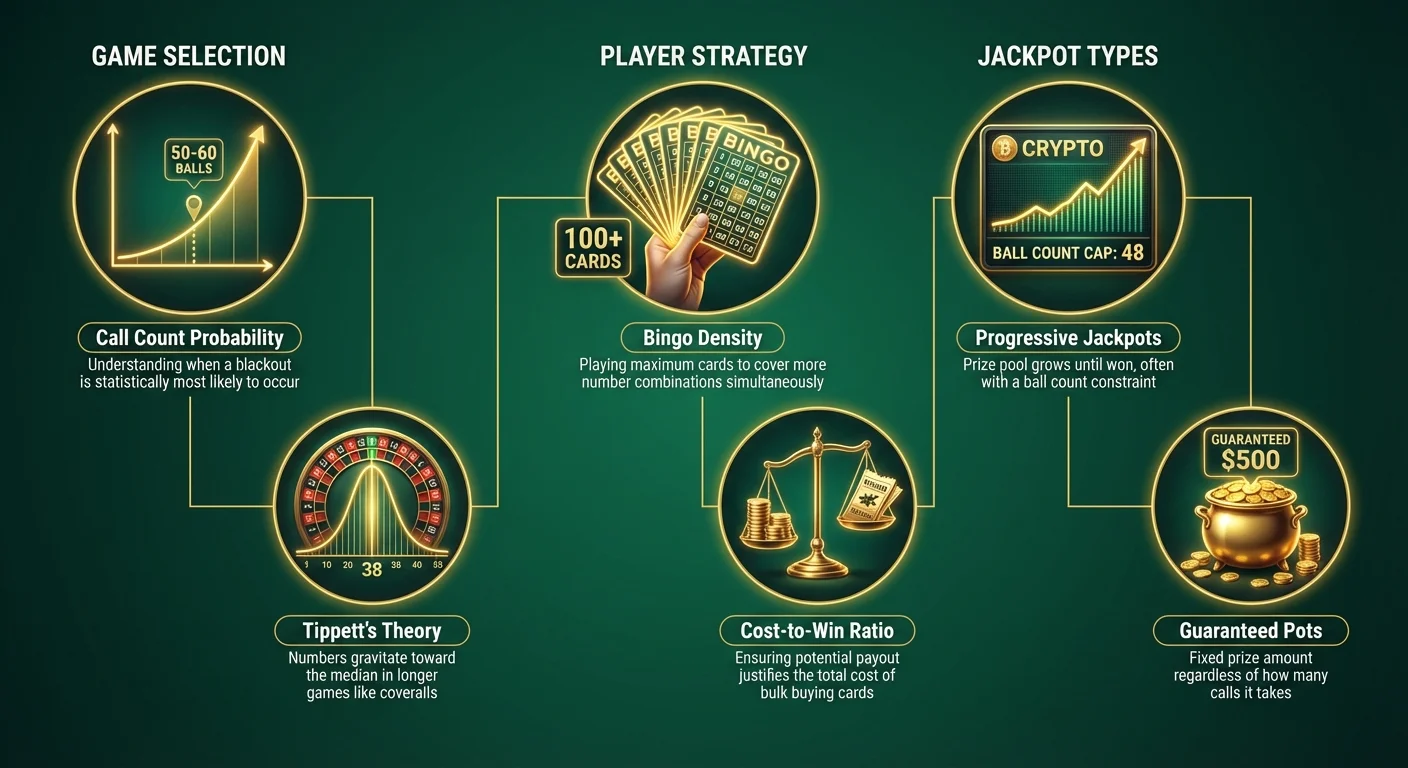
To build a strategy, you must first respect the math. The odds of hitting a blackout in the early calls are astronomically low. Understanding "Call Count Probability" helps you manage expectations and choose the right games.
Call Count Probability (75-Ball)
In a standard 75-ball game, it is mathematically impossible to get a blackout before the 24th call. However, the probability remains near zero until well into the 40s.
- 50 Calls: The probability of a single card achieving a blackout usually hovers around 50 to 60 balls drawn.
- The Tipping Point: Most progressive jackpots require a blackout within a specific number of calls (e.g., "Blackout in 49 calls or fewer"). This is why those jackpots grow so large - they are statistically rare events.
If you are playing a standard guaranteed pot game (where the game continues until someone wins regardless of call count), the strategy shifts from "speed" to "endurance."
Tippett's Theory in Coverall Context
L.H.C. Tippett, a British statistician, proposed that the more numbers called in a 75-ball game, the more the drawn numbers gravitate toward the median (the number 38).
While many players use this to select cards for short games (picking numbers near 1 and 75), Coverall strategy flips this. Because Coverall games inevitably go long (often 55+ calls), cards with a higher concentration of numbers near the median (30-45) theoretically have a higher completion rate in long-duration games.
Note: In modern crypto bingo, you often cannot hand-pick card numbers, but if the interface allows "card swapping," look for cards with a cluster of median numbers for coverall rounds.
Optimal Card Count: The "Bingo Density" Strategy
The single most effective variable you can control is the number of cards you play. This is known as Bingo Density.
In a physical hall, you are limited by how fast you can daub (mark) paper with ink. In online crypto bingo, the Auto-Daub feature removes this physical limit, allowing you to play 50, 100, or even 200 cards simultaneously.
The Probability Shift
Imagine a room with 100 cards in play total.
- Player A buys 1 card. Win chance: 1%.
- Player B buys 20 cards. Win chance: 20%.
This seems obvious, but the strategy lies in the Cost-to-Win Ratio.
If the jackpot is $100 (in crypto equivalent) and cards cost $1, Player B is spending $20 to win $100. If the room is crowded with 1,000 active cards, Player B's 20 cards only give them a 2% chance. Spending $20 for a 2% shot at $100 is negative Expected Value (EV).
The Strategy:
- Analyze Player Count: Before buying, look at the active users in the room.
- Calculate Pot Odds: Ensure the potential payout justifies a bulk buy.
- The " swarm" Approach: For Coverall games, it is mathematically better to play many cheap cards than a few expensive ones. You want to cover as much of the number spread as possible.
Comparative Table: Card Count Strategy
| Scenario | Opponents | Jackpot Size | Recommended Strategy |
|---|---|---|---|
| Low Traffic | < 50 Players | Fixed (Small) | Conservative: Buy 4-6 cards. The competition is low, so you don't need to overspend to have a fair shot. |
| High Traffic | > 500 Players | Fixed (Medium) | Avoid: The dilution of your odds makes this negative EV unless you catch a lucky break. |
| Jackpot Event | High | Progressive (Massive) | Aggressive Swarm: Buy the max allowed cards (within budget). You are paying for a lottery ticket chance at a life-changing sum. |
Progressive Jackpots: The Holy Grail of Coveralls
The primary reason to specialize in Coverall strategy is the Progressive Jackpot. In crypto casinos, these are often denominated in Bitcoin or Ethereum, meaning the prize pool fluctuates with the market.
A Progressive Coverall usually has a "Ball Count Cap."
- Example: Win 5 BTC if you hit Blackout in 48 calls or less.
- If nobody wins in 48 calls, the game continues for a smaller, fixed consolidation prize, and the 5 BTC rolls over to the next game.
Strategies for Progressives:
- Timing is Everything: Monitor the jackpot. As the pot grows, more players will join, diluting your odds. However, you should only enter "Max Bet" mode when the jackpot is statistically "overdue" or has reached a break-even point regarding your investment.
- Verify the Cap: Always check the ball count requirement. A 48-ball cap is significantly harder to hit than a 52-ball cap. Be wary of games offering huge prizes but requiring a blackout in under 45 calls - the odds are similar to winning a national lottery.
75-Ball vs. 90-Ball Coveralls
Your strategy must adapt to the variant you are playing.
75-Ball (US Style)
- Grid: 5x5 with a free center space.
- Total Numbers: 24 to mark.
- Strategy: The free space is your best friend. In a coverall, it is already "hit." This variation favors "Four Corners" and "X" patterns along the way, often offering sub-prizes before the blackout. Look for games that pay out for these intermediate patterns to fund your hunt for the coverall.
90-Ball (UK/Aus Style)
- Grid: 3 rows of 5 numbers (9 columns).
- Total Numbers: 15 to mark.
- Strategy: 90-ball bingo is played in three stages: 1 Line, 2 Lines, and Full House (Coverall). This is often better for bankroll management. Even if you miss the Coverall, holding a high volume of cards increases your chances of securing the 1-Line or 2-Line prizes, which can offset the cost of your tickets.
Practical Tips for the Full Card Hunter
Transitioning from a casual player to a strategist requires discipline. Here are actionable tips to improve your Coverall results:
1. Leverage the "Off-Peak" Hours
In crypto gambling, "global" means someone is always awake. However, fewer players are online during the gap between US West Coast nights and European mornings.
- Why? Coverall games often have a "Minimum Guaranteed Pot." If the guaranteed prize is $500, and only 10 players buy in for $5 each, the pot has an overlay (extra value provided by the house). Playing during quiet hours increases your % win rate significantly.
2. Maximize Deposit Bonuses
Coverall games are high variance - you will lose many times before you win big. You need a deep bankroll to sustain this.
- Use crypto welcome bonuses or reload bonuses to fund your card purchases.
- Caveat: Ensure the wagering requirements allow bingo to contribute 100%.
3. Use Provably Fair Verification
If a Coverall game goes to 65+ calls without a winner, players often get suspicious. In a Provably Fair crypto casino, you can check the "client seed" and "server seed" hashes. Doing this occasionally confirms the site is legitimate and prevents you from tilting (playing emotionally) due to suspected foul play.
4. The "Stay Alive" Budget Rule
Never spend more than 5% of your total bankroll on a single Coverall game, no matter how big the jackpot is.
- If you have 10 mBTC, your max buy-in for a session is 0.5 mBTC.
- This ensures you can survive a losing streak and be present for the next jackpot opportunity.
Conclusion: Playing the Long Game
Winning a Coverall game is the pinnacle of the bingo experience. It requires more than just luck; it requires patience, understanding of probability, and smart bankroll management.
While you cannot force the virtual caller to pick B-12, you can ensure you are playing in the right rooms, at the right times, with the optimal number of cards. The "Full Card" strategy is not about winning every game - it's about positioning yourself so that when luck does strike, you have the maximum exposure to capture that massive crypto payout.
Remember, in the world of blackout bingo, endurance is your greatest asset. Keep your auto-daub on, watch the player count, and wait for that perfect run of numbers to fill the card.