
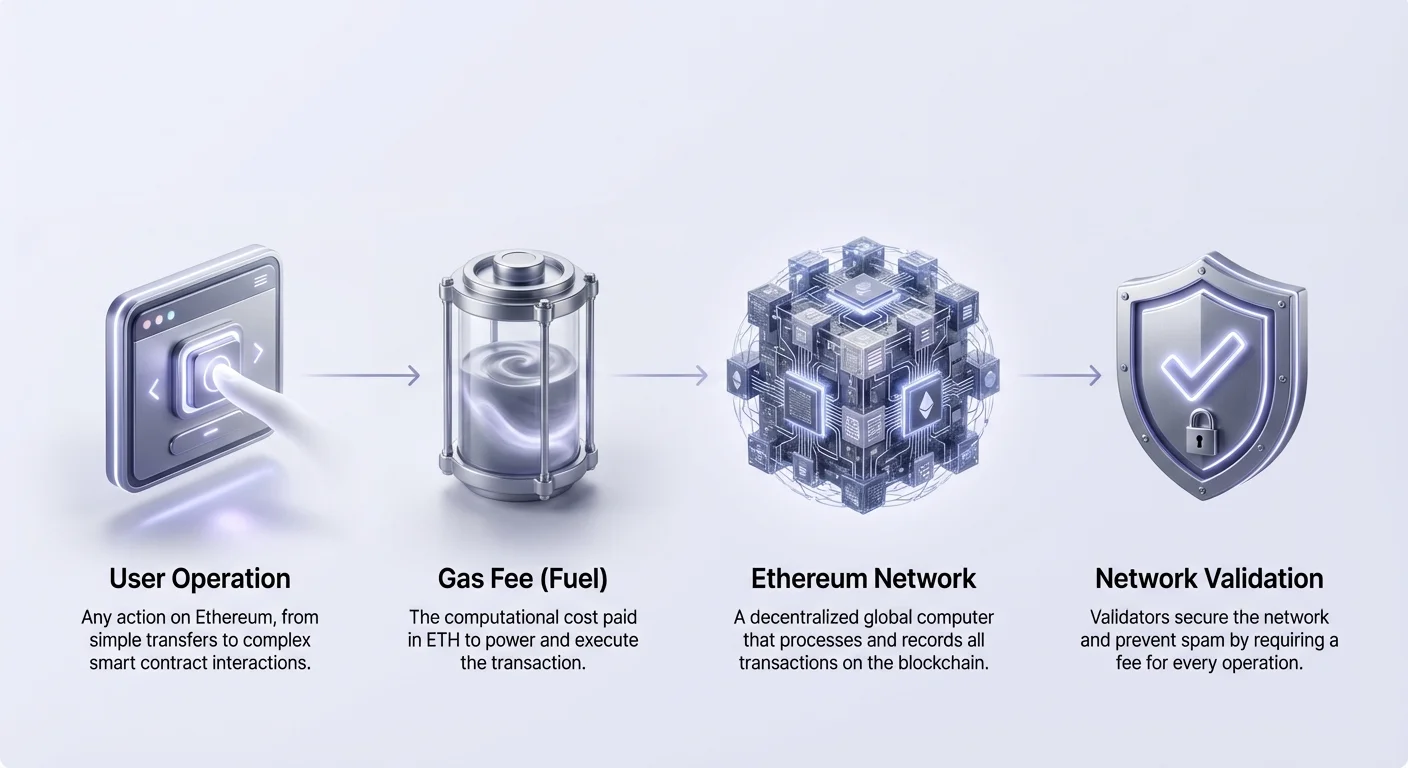
Every interaction on the Ethereum network requires a specific amount of computing power to execute. Whether you are sending funds to a friend, buying a digital collectible, or engaging with decentralized finance applications, you must pay a fee for the service. This fee acts as the fuel that powers the decentralized global computer that is Ethereum. Without this mechanism, the network would be vulnerable to spam attacks and infinite loops that could clog the system.
Understanding these costs is essential for anyone looking to navigate the crypto ecosystem efficiently. New users often feel confused when they see the cost of a transaction fluctuate wildly from one minute to the next. Sometimes a simple transfer costs a few dollars, while at other times, it might cost significantly more. This variability is not random but is driven by specific technical and economic factors inherent to the blockchain's design.
To use Ethereum effectively, you must grasp the underlying concepts of gas, how fees are calculated, and the tools available to manage them. By mastering these mechanics, you can avoid overpaying for simple transfers and ensure your urgent transactions are processed without delay. This guide breaks down the components of Ethereum transaction costs and explains how you can take control of your expenses.
The Fundamentals of Ethereum Gas
Defining Gas and Gwei
In the context of Ethereum, "gas" refers to the unit of computation that measures the amount of computational effort required to execute specific operations on the network. It is comparable to the liters of fuel needed to run a car engine. Just as a car requires more fuel to drive uphill than on a flat road, complex blockchain transactions require more gas than simple ones. Every operation, from a basic payment to a complex smart contract interaction, has a fixed gas cost determined by the protocol.
While gas measures the "work" done, the price you pay for that work is denominated in ether (ETH). However, because the amounts are typically very small fractions of ETH, the community uses a smaller unit called "gwei" to denote gas prices. One gwei is equal to 0.000000001 ETH. Using gwei makes it much easier to discuss and read prices. It is far simpler to say a transaction costs "50 gwei" than to say it costs "0.00000005 ETH."
The Necessity of Network Fees
Fees serve two primary functions within the Ethereum ecosystem. First, they compensate the entities that maintain the network. Validators are responsible for processing transactions and securing the blockchain. The fees provide a financial incentive for these participants to dedicate their hardware and energy to the network. Without this compensation, there would be little reason for anyone to maintain the infrastructure that keeps Ethereum running.
Second, and perhaps more importantly, gas fees act as a security mechanism against spam. If transactions were free, a malicious actor could flood the network with millions of useless requests, effectively halting legitimate activity. By attaching a financial cost to every operation, the network makes spam attacks prohibitively expensive. This ensures that valuable block space is reserved for genuine economic activity and prevents resources from being wasted on trivial or malicious computations.
How Transaction Costs Are Determined
The Fee Market Structure
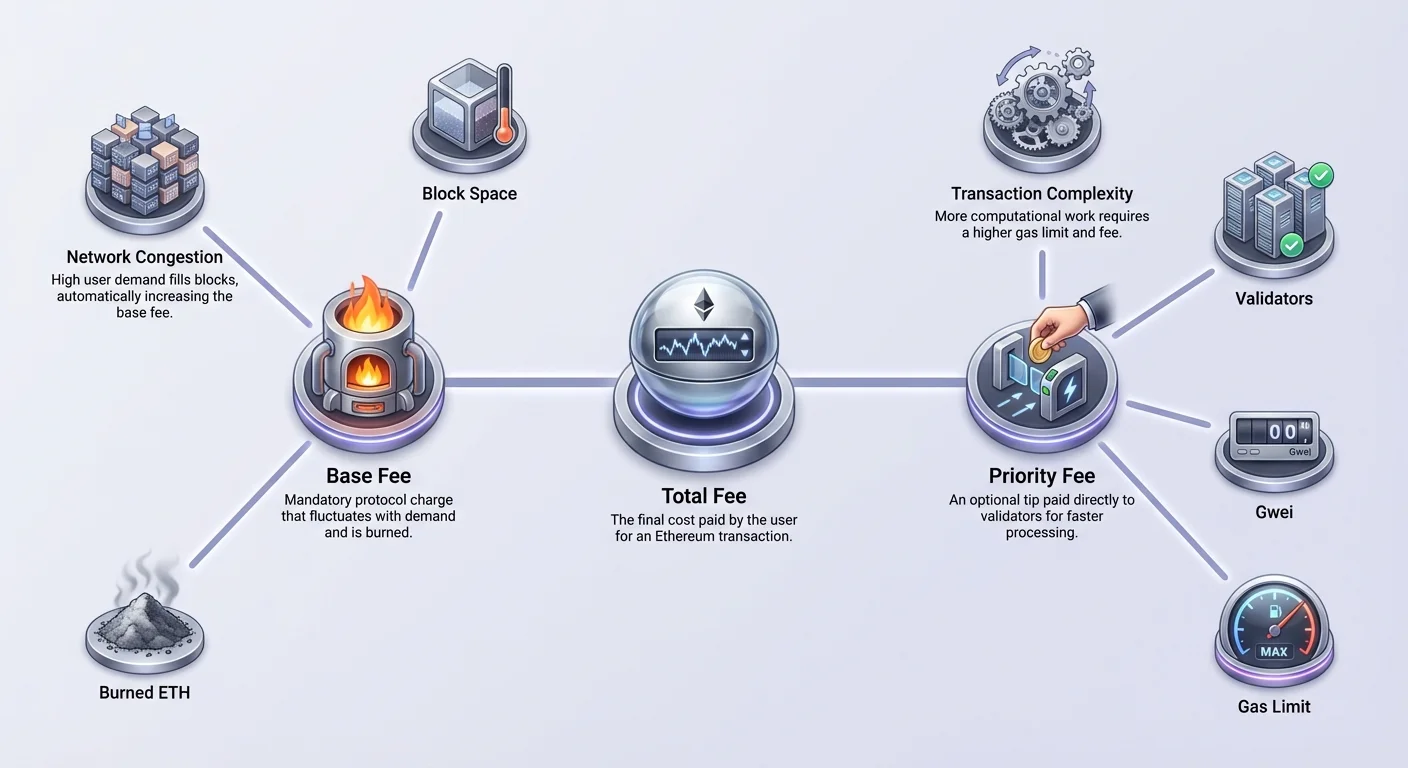
The Ethereum fee market underwent a significant overhaul with the implementation of EIP-1559. Before this update, fees were less predictable. Now, the total fee you pay is split into two distinct parts: the base fee and the priority fee. Understanding the difference between these two components is key to managing your transaction costs effectively.
The base fee is a mandatory charge set by the protocol itself. It fluctuates automatically based on the demand for block space. If the previous block was full, the base fee increases for the next block. If the previous block was empty, the base fee decreases. Crucially, this portion of the fee is "burned," meaning it is permanently removed from the circulating supply of ETH. This burning mechanism creates a deflationary pressure on the Ethereum supply when network usage is high.
Priority Fees and Tips
The second component is the priority fee, often referred to as a "tip." This extra amount is paid directly to the network validators. While the base fee ensures your transaction is eligible to be included in a block, the priority fee incentivizes validators to choose your transaction over others. When the network is not congested, a small tip is usually sufficient to get your transaction processed quickly.
However, during periods of high demand, users effectively enter a bidding war. Those who offer higher priority fees are more likely to have their transactions processed first. Validators naturally select the transactions that offer the highest rewards. If you need a transaction to confirm immediately during a busy period, you will need to attach a higher priority fee. If your transaction is not urgent, you can offer a lower tip and wait for demand to subside.
| Fee Component | Recipient | Function |
|---|---|---|
| Base Fee | Burned (Destroyed) | Regulates network traffic |
| Priority Fee | Validator | Accelerates confirmation |
The Impact of Network Congestion
Market forces heavily influence the total cost of a transaction. Because the size of each block on the blockchain is limited, the network can only process a certain number of transactions per second. When the number of users trying to send transactions exceeds this limit, congestion occurs. During these times, the base fee rises automatically to dampen demand, and the priority fees rise as users compete for speed.
This dynamic pricing model explains why fees can spike suddenly. If a popular decentralized application launches a new product or a highly anticipated NFT collection drops, thousands of users may flood the network simultaneously. This surge in demand forces prices up. Conversely, during weekends or late nights in primary time zones, the network may be quieter, resulting in significantly lower costs for the same actions.
Complexity and Data Costs
Simple vs. Complex Transactions
Not all transactions are created equal. The complexity of the action you are performing directly dictates the amount of gas required. A standard transfer of ETH from one wallet to another is the simplest type of transaction. It requires the minimum amount of data and computational work, making it the cheapest operation you can perform.
In contrast, interacting with smart contracts involves much more computational overhead. Smart contracts are pieces of code that run on the blockchain. When you use a decentralized finance protocol or play a blockchain-based game, you are often triggering complex logic. The network must verify every step of this logic, which consumes more gas. Therefore, swapping tokens or depositing funds into a lending protocol will always cost more than a simple payment.
Data Storage Implications
The amount of data involved in a transaction is a major factor in its cost. Writing new data to the blockchain is one of the most expensive operations in Ethereum. For example, minting a Non-Fungible Token (NFT) involves creating a new digital asset and recording its unique attributes on the ledger. This requires significantly more block space than simply updating a ledger balance.
Since EIP-1559, transactions that carry more data incur a higher base fee total because they consume a larger portion of the block's gas limit. This is why "minting" or creating on-chain assets is often the most expensive activity for a user. If you are planning to execute a complex transaction involving large amounts of data, it is financially wise to wait for a period of low network congestion to minimize the base fee multiplier.
| Action Type | Data Required | Cost Level |
|---|---|---|
| Sending ETH | Minimal | Low |
| Token Swap | Moderate | Medium |
| NFT Minting | High | High |
Managing Fees with Wallets
Custodial Exchange Limitations
Many beginners purchase their first Ethereum on centralized cryptocurrency exchanges. While these platforms are convenient for buying and selling, they often act as intermediaries for your funds. When you hold ETH on an exchange, you are using a custodial wallet. This means the exchange controls the private keys and manages the technical details of transactions on your behalf, exposing you to the spectrum of custody risks.
One major downside of custodial wallets is the lack of control over transaction fees. Exchanges typically charge a flat withdrawal fee that is set higher than the actual network cost. This allows the exchange to profit from your withdrawals. You usually cannot customize the fee to pay less when the network is empty, nor can you bump the fee to speed up a transaction. You are bound by the platform's predetermined rates and policies.
Self-Custodial Customization
To gain full control over transaction costs, you must use a self-custodial wallet. These wallets give you direct access to the Ethereum network without a middleman. Because you are interacting directly with the blockchain, you have the power to set your own parameters for every transaction. This flexibility allows you to optimize your spending based on your specific needs at that moment.
Most modern self-custodial wallets provide user-friendly interfaces for fee management. They often present three preset options: Low, Medium, and High. A "Low" setting will set a smaller tip, saving you money but potentially delaying the transaction. A "High" setting ensures rapid confirmation but costs more. For advanced users, these wallets also allow the manual entry of gas limits and gwei prices, offering precise control over the transaction budget.
The Risks of Underpayment
While customizing fees offers great flexibility, it comes with risks that users must understand. If you set your fee too low—specifically, if your combined base fee and priority fee is lower than what the market currently demands—your transaction will not be picked up by validators. It will remain in a "pending" state in the memory pool, waiting for gas prices to drop.
If the network remains busy, a transaction with a low fee can remain stuck for hours or even days. In some cases, it may eventually be dropped from the pool entirely. While you do not lose your ETH if a transaction fails or is dropped, the funds involved in the transfer are effectively frozen until the issue is resolved. Self-custodial wallets often provide a "speed up" feature to solve this, allowing you to replace the stuck transaction with a new one that carries a higher fee.
Practical Tips for Fee Optimization
Using Gas Trackers
Before initiating any transaction, it is highly recommended to check the current state of the network. Various tools known as "gas trackers" are available online, such as Etherscan's Gas Tracker. These services monitor pending transactions in the memory pool and provide real-time estimates for low, average, and high priority fees.
By glancing at a gas tracker, you can immediately see if the network is congested. If the average gas price is 100 gwei, you know it is an expensive time to transact. If it is 15 gwei, it is a prime opportunity to move funds or execute complex contracts. Using these tools prevents you from blindly overpaying or setting a fee that is too low to be processed.
Timing Your Transactions
Since fees are driven by supply and demand, they follow recognizable patterns. Network activity often mirrors the waking hours of major global markets, particularly the United States and Europe. Consequently, fees tend to be higher during business hours in these regions. Conversely, late nights or weekends often see a dip in activity, resulting in lower gas prices.
If your transaction is not time-sensitive, simply waiting a few hours can result in significant savings. For example, if you plan to deploy a smart contract or bridge assets to another network, waiting for a Sunday morning (UTC) can reduce the cost by half or more compared to a Tuesday afternoon. Patience is one of the most effective tools for reducing Ethereum costs.
Batching and Planning
Another strategy for reducing costs is to consolidate your activity. Every unique transaction incurs a base cost of 21,000 gas just for the transfer itself. If you need to send ETH to three different people, sending three separate transactions requires paying that base cost three times. While Ethereum does not natively support "batching" for simple transfers in the same way Bitcoin does, planning ahead can still save money.
For instance, if you are moving funds from an exchange to your self-custodial wallet, try to move the total amount you need for the month in one go rather than in small, frequent chunks. This minimizes the number of times you have to pay the exchange's withdrawal fee and the network's base fee. Being strategic about when and how you move funds is essential for preserving your capital.
Conclusion
Mastering Ethereum transaction costs requires a shift in perspective from traditional banking. In the conventional financial world, fees are often opaque or hidden in the exchange rate. On the blockchain, costs are transparent, dynamic, and directly related to the demand for the network's resources. By understanding the roles of the base fee and the priority fee, users can demystify why costs fluctuate and how to predict them.
The transition from custodial exchanges to self-custodial wallets represents a significant step in managing these costs. While exchanges offer simplicity, they strip the user of agency regarding fees. Taking custody of your assets empowers you to participate in the fee market directly, choosing to pay for speed when necessary or saving money when time permits. This control is a fundamental aspect of the financial freedom that cryptocurrency offers.
Ultimately, gas fees are the price of security and decentralization. They ensure the network remains robust, spam-free, and operational without a central authority. By utilizing gas trackers, timing transactions wisely, and understanding the complexity of your on-chain actions, you can navigate the Ethereum network confidently and cost-effectively.
Always check a gas tracker before sending a transaction to ensure you are not overpaying for network fees.