
Baseball is often described as a "moneyline sport." Unlike football or basketball, where the point spread is the great equalizer, baseball bettors traditionally focus on simply picking the winner. However, any seasoned handicapper knows the frustration of seeing a heavy favorite listed at -250 or -300. The risk-to-reward ratio on the moneyline often makes betting on elite teams mathematically unviable over the long haul.
Enter Run Line betting.
The run line is baseball's version of the point spread. It is the great equalizer that allows you to extract value from heavy favorites or find extra security with scrappy underdogs. For the intermediate bettor, mastering the run line is essential for portfolio management. It turns unbettable games into profitable opportunities and allows for nuanced strategies that go beyond "who will win."
This guide breaks down the mechanics of the 1.5 run line, explores the mathematics of value, and details advanced strategies for using alternate lines on top-tier crypto sportsbooks.
What is Run Line Betting?
In its simplest form, the run line is a handicap applied to the final score of a baseball game. While NFL spreads fluctuate wildly based on team strength (from -3 to -14), the standard baseball run line is almost static at 1.5 runs.
Because baseball is a low-scoring sport where one-run games are statistically common, the oddsmakers set the line at 1.5 to force a decision:
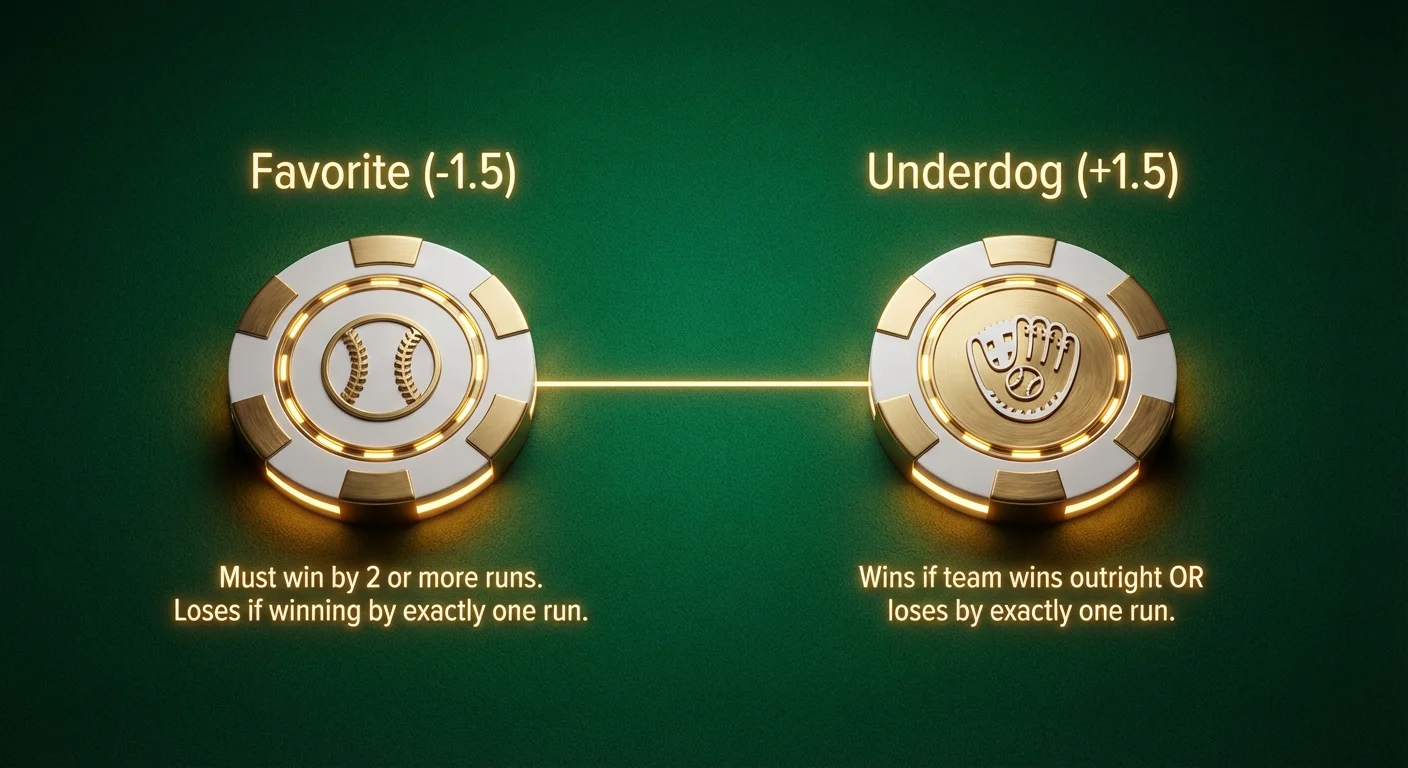
- The Favorite (-1.5): To win this bet, the favorite must win the game by 2 runs or more. If they win by exactly one run, the bet loses.
- The Underdog (+1.5): To win this bet, the underdog must either win the game outright OR lose by exactly one run.
The Trade-Off: Risk vs. Reward
The primary reason bettors utilize the run line is to manipulate the "juice" (the odds payout).
When you bet a favorite on the Moneyline, you pay a premium (e.g., -200) for the safety of just needing a win. When you bet that same favorite on the Run Line (-1.5), you are accepting a harder condition (winning by 2+), and in exchange, the sportsbook offers you much better odds - often flipping the juice from negative to positive.
Example: Los Angeles Dodgers (Favorite) vs. Colorado Rockies (Underdog)
| Bet Type | Selection | Odds | Implied Probability | Outcome Needed |
|---|---|---|---|---|
| Moneyline | Dodgers | -240 | 70.6% | Dodgers win (any score) |
| Run Line | Dodgers (-1.5) | -110 | 52.4% | Dodgers win by 2+ runs |
| Moneyline | Rockies | +200 | 33.3% | Rockies win |
| Run Line | Rockies (+1.5) | -110 | 52.4% | Rockies win OR lose by 1 |
In this scenario, a bettor backing the Dodgers on the Moneyline has to risk $240 to win $100. By shifting to the Run Line, they only risk $110 to win $100. However, they lose the safety net of a one-run victory.
The Mathematics of the 1.5 Split
To effectively bet the run line, you must understand the frequency of one-run games. In Major League Baseball (MLB), approximately 28% to 30% of all games finish with a margin of victory of exactly one run.
This statistic is the "vig" of the run line. When you take a favorite at -1.5, you are essentially betting that the game will not fall into that 30% statistical bucket of one-run finishes.
When to Bet the Favorite (-1.5)
You are looking for specific conditions where a blowout or a comfortable win is highly probable.
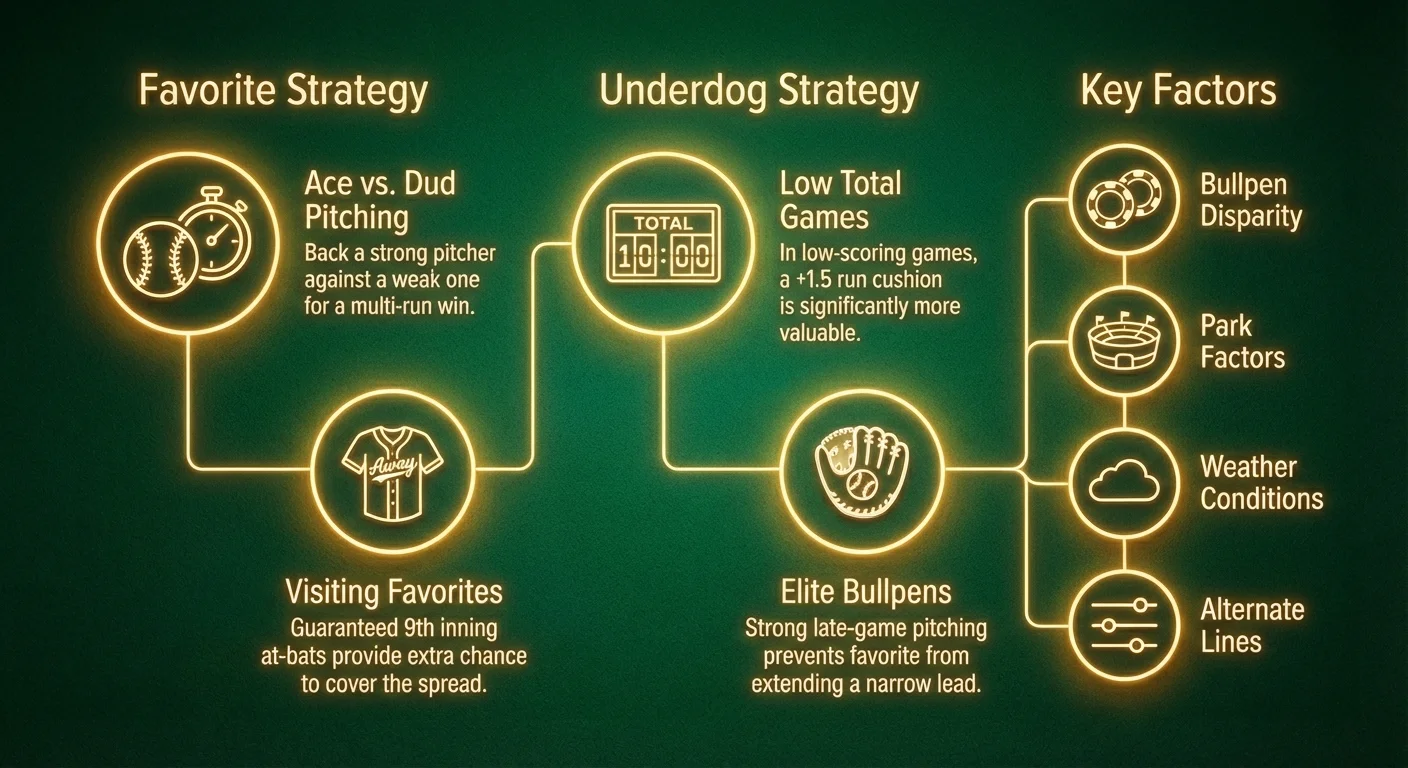
- Ace vs. Dud: When a top-tier pitcher (low WHIP, high strikeout rate) faces a back-of-the-rotation starter or a bullpen game.
- High Totals: Games with high Over/Under totals (e.g., 10.5 or 11 runs) are less likely to end in a one-run differential than games with a total of 7. More runs usually lead to wider variance in the final score.
- Visiting Favorites: This is a crucial, often overlooked strategy. When the favorite is the Away team, they are guaranteed to bat in the top of the 9th inning. If they are winning by 1 run, they keep hitting, potentially extending the lead to 2 or 3.
- Contrast: A Home favorite winning by 1 run in the bottom of the 9th does not bat. The game ends immediately. You lose your -1.5 bet despite the team winning.
When to Bet the Underdog (+1.5)
Taking the +1.5 runs is often referred to as "insurance." You are paying a premium (worse odds than the moneyline) to survive a close loss.
- Low Totals: In a game with an Over/Under of 6.5 or 7, runs are premium currency. If the final score is projected to be 3-2, getting +1.5 runs is massive leverage.
- Home Underdogs: As mentioned above, home teams don't bat if leading in the 9th. However, if a Home Underdog is losing by 1 in the 9th, they get to bat. This gives them a chance to tie (winning your bet) or walk it off.
- Elite Bullpens: If the underdog has a "lockdown" bullpen, they are likely to keep the game close in the late innings, preventing the favorite from extending a 1-run lead to a 2-run lead.
Alternative Run Lines: Beyond 1.5
While 1.5 is the standard, modern crypto sportsbooks offer "Alternate Run Lines". This is where intermediate bettors can find massive value by customizing their risk profile.
The -2.5 and -3.5 Lines
If you believe a team will absolutely crush their opponent (e.g., the Yankees playing the worst team in the league at Yankee Stadium), you can "sell" more runs.
- Bet: Yankees -2.5
- Odds: +160 (instead of -130 on the -1.5 line)
- Strategy: Use this in "mismatches" where the favorite has a potent offense and the underdog has a depleted bullpen.
The Reverse Run Line (Favorites to +1.5)
Sometimes, a favorite is shaky, but you don't trust the underdog enough to bet them outright. You can bet the Favorite at +1.5.
- Scenario: You think the Astros will win, but their pitcher is struggling. You take Astros +1.5.
- Trade-off: You will pay massive juice (e.g., -300 or worse). This is generally considered "negative value" and should be avoided unless part of a parlay.
The Reverse Run Line (Underdogs to -1.5)
This is a high-risk, high-reward aggressive play. You are betting the Underdog not just to win, but to dominate.
- Odds: Often ranges from +250 to +400.
- Use Case: You have identified a distinct edge (e.g., an injured superstar on the favorite's team or a pitcher tipping pitches) that the market hasn't reacted to yet.
The Crypto Advantage in Run Line Betting
Using cryptocurrency for baseball betting offers distinct advantages, particularly for intermediate and high-volume bettors focusing on spreads and run lines.
1. Reduced Juice and Better Lines
Crypto-first sportsbooks often operate with lower overhead than traditional fiat books. This frequently results in "reduced juice." While a standard book might offer a Run Line at -115, a crypto book might offer the same line at -108. Over a 162-game season, saving 7 cents on the dollar adds up to significant profit retention.
2. Instant Bankroll Management
Baseball is a daily grind. Games happen every day, often with doubleheaders. In fiat betting, withdrawing winnings can take days, tying up your capital.
- The Crypto Edge: With Bitcoin, Litecoin, or USDT, withdrawals are often processed in minutes. This allows you to win a day game, withdraw, and re-deposit or re-allocate those funds for the night slate immediately.
3. Higher Limits for Alternate Lines
Many traditional books limit the amount you can wager on "exotic" bets like Alternate Run Lines (-2.5). Crypto sportsbooks, known for catering to high rollers and utilizing Provably Fair algorithms for backend security, generally offer much higher ceilings on these specific wager types.
Strategic Framework: How to Handicap the Run Line
To move from a beginner to an intermediate level, you must stop looking at "Team A vs. Team B" and start looking at specific variables that influence the margin of victory.
1. The Bullpen Disparity
In modern baseball, starting pitchers rarely go complete games. They usually go 5 or 6 innings. This means 30-40% of the game is in the hands of the bullpen.
- Strategy: Check the "Bullpen ERA" and "Bullpen WHIP" (Walks plus Hits per Inning Pitched) for the last 14 days.
- The Trap: A favorite might have a great starter, but a terrible bullpen. If they are up 4-1 in the 7th inning, a bad bullpen might give up 2 runs. The score becomes 4-3. The favorite wins, but the Run Line (-1.5) loses. Avoid laying -1.5 with teams that have volatile closers.
2. The Weather and Park Factors
The environment dictates run production.
- Coors Field (Colorado) / Great American Ball Park (Cincinnati): These are "launching pads." High altitude or small dimensions lead to more runs. High-scoring games (e.g., 9-7) make it easier to cover -1.5 because run variance is higher.
- T-Mobile Park (Seattle) / Citi Field (New York): Pitcher-friendly parks. Games are often 2-1 or 3-2. Betting the -1.5 here is risky; betting the +1.5 on the underdog is highly valuable.
3. Home vs. Away Splits
As touched upon earlier, the "Home Team Disadvantage" on the run line is mathematically significant.
- Away Teams: Get 27 outs guaranteed.
- Home Teams: Get 24 outs if winning.
- The Data: Historically, Away favorites cover the -1.5 run line at a higher percentage than Home favorites simply because they have an extra inning to score insurance runs. If you are debating between two favorites, always lean toward the road team for the run line.
4. Correlated Parlays
A popular strategy for intermediate bettors is the "Run Line + Total" correlation.
- If you like a Favorite to cover -1.5, it usually implies they will score runs.
- Correlation: Parlaying [Favorite -1.5] AND [Team Total Over] can boost odds significantly.
- Note: Some books restrict correlated parlays, but many crypto books allow them.
Practical Examples: Evaluating Value
Let's look at how to evaluate if the Run Line is a "sucker bet" or a value play in a specific game.
Scenario A: The "Trap"
- Matchup: Yankees (Home) vs. Royals
- Moneyline: Yankees -280
- Run Line: Yankees -1.5 (-130)
- Context: It's a Sunday day game. The Yankees played a double-header yesterday and their bullpen is exhausted. The wind is blowing in.
- Verdict: Avoid. The -130 is tempting compared to -280, but the exhausted bullpen and the fact that the Yankees are at home (loss of 9th inning at-bats) increase the likelihood of a 1-run win or a late bullpen collapse.
Scenario B: The "Value"
- Matchup: Braves (Away) vs. Marlins
- Moneyline: Braves -190
- Run Line: Braves -1.5 (+105)
- Context: The Braves are starting their ace. The Marlins are starting a rookie. The Marlins have the worst offense in the league against right-handed pitching.
- Verdict: Bet the Run Line. You are getting plus money (+105) on a superior team. Being the road team, the Braves will keep batting in the 9th even if they are up 4-0, potentially tacking on more runs. The likelihood of the Marlins keeping this within 1 run is low.
Common Mistakes to Avoid
Even smart bettors fall into traps with the spread. Here are the most common errors:
- Chasing Odds: Just because a Run Line pays +150 doesn't mean it has value. If the implied probability of winning by 2 runs is lower than the odds suggest, you will lose money long-term.
- Ignoring Line Movement: If a Run Line moves from -110 to -130, ask why. Did a star player get scratched from the lineup? Did the wind direction change? Don't bet a "stale" line.
- Betting Run Lines on "Ace vs. Ace": When two Cy Young candidates face off (e.g., Gerrit Cole vs. Jacob deGrom), the final score is likely to be 1-0 or 2-1. These are terrible games for -1.5 bets. Stick to the Moneyline or the Under in pitching duels.
Summary: Key Takeaways
Run line betting is the bridge between low-value moneyline wagers and high-risk prop bets. It requires a deeper understanding of game flow than simply picking a winner.
- Standard Line: The run line is almost always 1.5.
- The Hook: That 0.5 is vital - it prevents pushes.
- Road Warriors: Prefer betting road favorites on the run line to guarantee 9 innings of at-bats.
- Bullpen Management: Always check bullpen rest days before laying the 1.5 runs.
- Crypto Speed: Utilize crypto sportsbooks for better liquidity and faster turnarounds on daily baseball slates.
By identifying the right pitching matchups and understanding the nuances of stadium factors and home/away advantages, you can use the run line to significantly boost your baseball betting ROI. Remember, in run line betting, you aren't just predicting who wins; you're predicting how they win.