
For sports bettors transitioning from high-scoring sports like basketball or football to the ice, hockey presents a unique mathematical challenge. In the NFL, a point spread can range from 3 to 14 points. In the NBA, double-digit spreads are common. However, hockey is a sport of razor-thin margins, where a single goal often decides the outcome, and "blowouts" are statistically rare.
Because of this low-scoring nature, traditional point spreads don't work in the NHL. Instead, oddsmakers utilize the Puck Line.
If you have ever looked at NHL odds and felt that the Moneyline on a heavy favorite (like -250) offered too little reward for the risk, the Puck Line is the alternative you need. This guide will take you through the mechanics of puck line betting, the strategic implications of the standard 1.5 goal spread, and how to leverage crypto sportsbooks to maximize your returns on the ice.
What is Puck Line Betting?
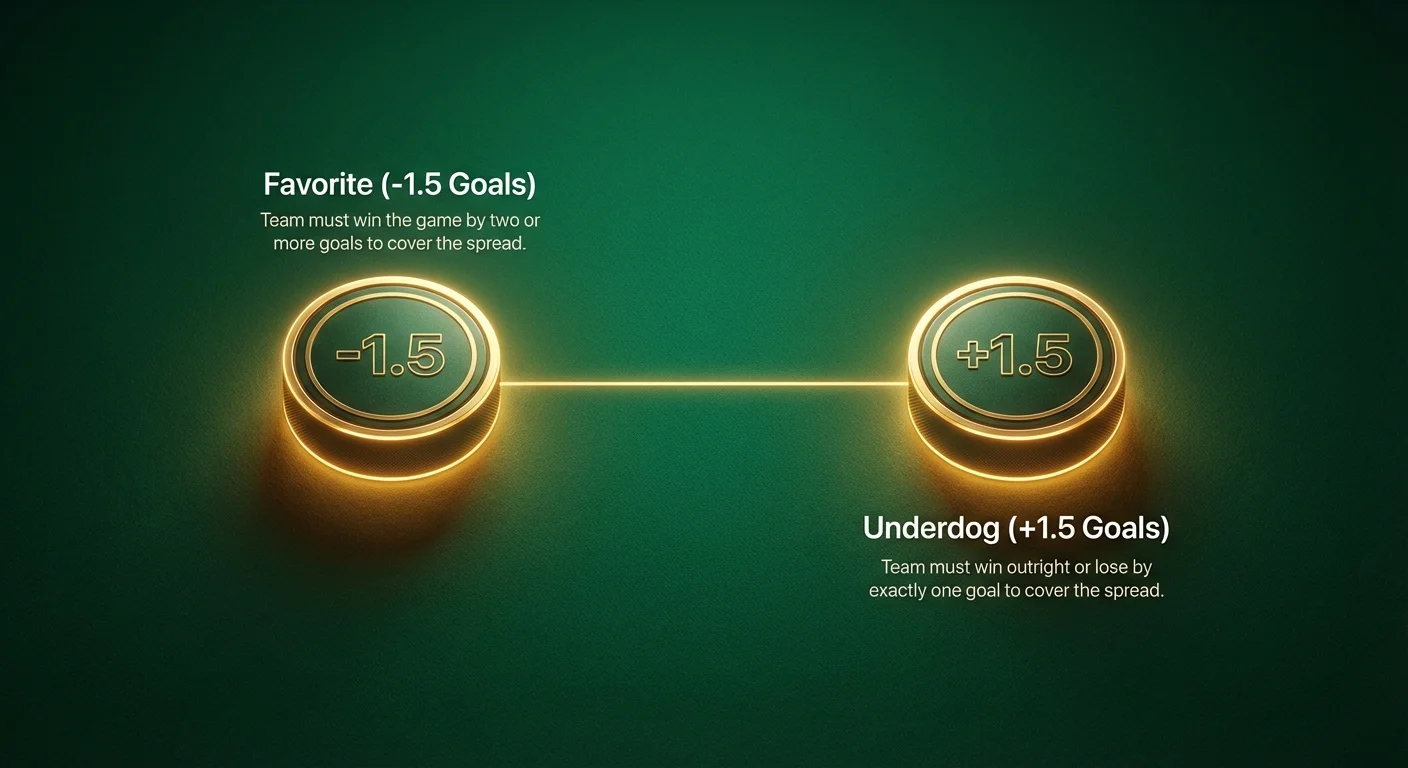
In simplest terms, the Puck Line is hockey's version of the point spread. However, unlike football or basketball where the spread number moves based on team strength (e.g., -6.5, -7, -7.5), the hockey spread is almost always fixed at 1.5 goals.
Because goals are so scarce in hockey, oddsmakers rarely adjust the goal number itself. Instead, they adjust the price (the odds) associated with that number.
The Mechanics of the 1.5 Spread
Every NHL game features a favorite and an underdog on the Puck Line:
- ** The Favorite (-1.5):** To win this bet, the team must win the game by 2 or more goals.
- The Underdog (+1.5): To win this bet, the team must either win the game outright OR lose by exactly 1 goal.
The Payout Structure
This is where the Puck Line differs significantly from the Moneyline.
- Moneyline Scenario: The Boston Bruins are heavy favorites against the San Jose Sharks. The Moneyline might be -280. You would have to bet $280 just to win $100.
- Puck Line Scenario: Because it is difficult to win by multiple goals in the NHL, the Bruins' Puck Line (-1.5) might flip the odds to +130. Now, a $100 bet yields $130 in profit.
Conversely, betting the underdog on the Puck Line (+1.5) offers "insurance" against a close loss, but you will pay a premium for it (often -150 to -170).
Puck Line vs. Moneyline: A Strategic Comparison
Understanding when to stick to the Moneyline and when to take the risk on the goal spread is the hallmark of an intermediate-to-advanced bettor.
The following table breaks down the risk/reward profiles of both options using a hypothetical matchup: Colorado Avalanche (Favorite) vs. Arizona Coyotes (Underdog).
| Bet Type | Selection | Odds | Result Needed | Risk Profile | Strategy |
|---|---|---|---|---|---|
| Moneyline | Avalanche | -220 | Win by any amount (OT/SO included) | Low Risk / Low Reward. You pay a heavy "tax" (juice) for safety. | Best for parlays or when you suspect a 1-goal game. |
| Puck Line | Avalanche | +125 | Win by 2+ goals | High Risk / High Reward. A 3-2 win kills your bet. | Use when the favorite has a potent offense and the opponent has weak goaltending. |
| Moneyline | Coyotes | +180 | Win by any amount | High Risk / High Reward. Pure upset pick. | Use when you believe the underdog will win outright. |
| Puck Line | Coyotes | -150 | Win OR Lose by 1 | Low Risk / Low Reward. You pay juice for insurance. | Best when backing a defensive underdog or a hot goalie who keeps games close. |
The Impact of the Empty Net Goal
If you are going to engage in puck line betting, you must understand the most volatile variable in hockey: The Empty Net.
In the final 1:30 to 2:00 of a game, a team trailing by one or two goals will pull their goaltender for an extra attacker. This creates a 6-on-5 advantage for the losing team but leaves their net completely unguarded.
For Puck Line bettors, this is known as "Sweating the Empty Net."
- The Favorite Bettor (-1.5): If your team is winning 3-2, you are currently losing your bet. However, if the opponent pulls their goalie and your team scores on the empty net to make it 4-2, you experience a "backdoor cover" and win your bet in the final seconds.
- The Underdog Bettor (+1.5): If you bet the underdog +1.5 and they are losing 3-2, you are winning your bet. However, if they pull their goalie to try to tie it, and concede an empty netter to go down 4-2, your winning ticket instantly turns into a loser.
Strategy Tip: Teams are pulling goalies earlier than ever before thanks to modern analytics. It is not uncommon to see a goalie pulled with 3 minutes remaining. Factor this volatility into your bankroll management.
Overtime and the Puck Line
It is vital to understand how Overtime (OT) affects your goal spread wagers.
- Regulation Ties: If a game is tied 2-2 at the end of regulation, it goes to OT.
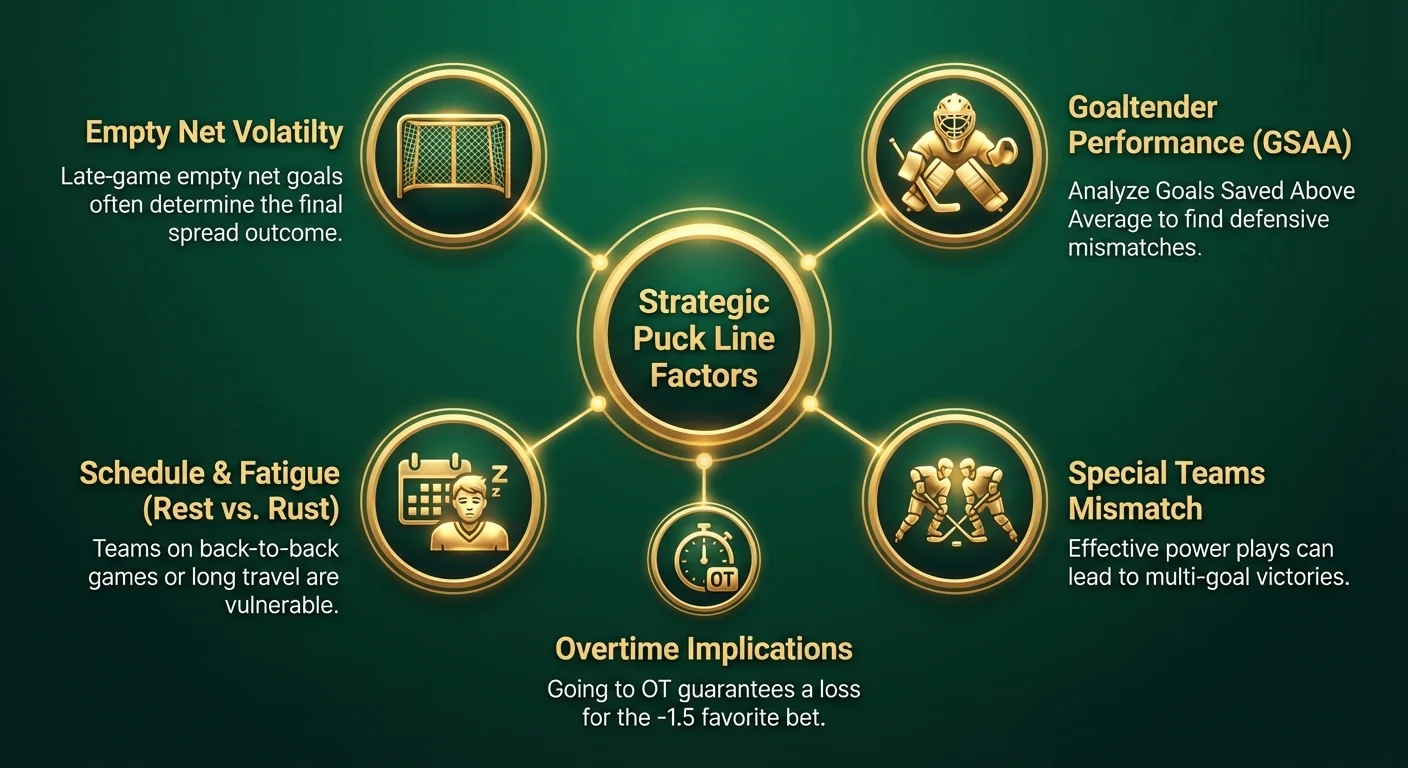
- The -1.5 Bettor: You have effectively lost. Even if your team scores in OT, they win 3-2. That is a margin of 1 goal. You needed 2. Therefore, a game going to OT is an automatic loss for -1.5 favorites.
- The +1.5 Bettor: You have effectively won. Since the game is tied, the worst-case scenario for your team is losing by 1 goal in OT. Since +1.5 covers a 1-goal loss, your bet cashes the moment the buzzer sounds for the end of the third period.
The Crypto Advantage in Hockey Betting
When betting on niche markets like the Puck Line, using a crypto-focused sportsbook offers distinct advantages over traditional fiat bookmakers.
1. Line Shopping and Micro-Movements
Crypto sportsbooks often operate with lower margins. While a fiat book might offer the Favorite -1.5 at +120, a Bitcoin sportsbook might offer +130 or +135. Over the course of an NHL season, that 10-15 cent difference in the price adds up to significant units of profit.
2. Instant Settlement
Hockey games often end late at night. If you win a West Coast game on the Puck Line at 1:00 AM EST, traditional banks force you to wait days for withdrawals. With crypto (USDT, BTC, ETH), your winnings can be in your wallet within minutes of the final horn, ready for the next day's slate.
3. High Limits and Anonymity
If you find a massive edge on a hockey spread - for example, a star goalie is announced as injured last minute - you may want to bet heavy. Crypto books generally offer higher betting limits and do not limit winning players as aggressively as soft fiat sportsbooks.
Advanced Strategies for Puck Line Betting
Moving beyond the basics, how do you actually identify value on the Puck Line? You cannot simply blindly bet every favorite at -1.5. Here are four specific strategies to improve your ROI.
1. The "Rest vs. Rust" Discrepancy
Schedule analysis is more critical in hockey than perhaps any other sport.
- Fade the Tired Team: Look for a favorite playing a rested team, but be careful. The best spot for a Puck Line bet is when a Top Tier Team (rested) plays a Bottom Tier Team that is on the second night of a "back-to-back."
- Travel Factors: Teams playing their 3rd game in 4 nights, especially with travel involved (e.g., flying from New York to Florida), often possess "heavy legs" in the 3rd period. This is when the favorite pulls away, scoring late goals to cover the -1.5 spread.
2. Goaltending Metrics (GSAA)
Do not look at "Wins" or "Goals Against Average" (GAA). These are team stats. When betting the spread, look at Goals Saved Above Expected (GSAx) or Goals Saved Above Average (GSAA).
- Strategy: If an elite team (High Scoring) faces a team starting a backup goalie with a negative GSAA, bet the Puck Line.
- Why? A bad goalie is more likely to give up "soft" goals, turning a tight 2-1 game into a 4-1 blowout.
3. The Reverse Puck Line
Did you know you can flip the script? Most sportsbooks allow you to bet "Alternate Puck Lines."
- Taking the Favorite at -2.5: If you expect a massive blowout, you can bet the favorite to win by 3 goals. The payout will often be massive (+300 or higher).
- Taking the Underdog at -1.5: If you believe the underdog is actually the better team and will win handily, you can bet them at -1.5. This offers immense value compared to the Moneyline.
4. Special Teams Mismatch
The easiest way for a team to cover the -1.5 spread is via the Power Play.
- Analyze the matchup between Team A's Power Play % and Team B's Penalty Kill %.
- If a Top 5 Power Play faces a Bottom 5 Penalty Kill, the likelihood of a multi-goal win increases drastically. Power play goals often come in bunches, allowing teams to extend leads without relying on 5-on-5 play.
When to AVOID the Puck Line
Knowing when not to bet is just as important as knowing when to bet.
- Playoff Hockey: In the NHL playoffs, scoring drops, defenses tighten, and referees swallow their whistles (fewer penalties). Games are tighter. The value of +1.5 increases, while the -1.5 favorite bet becomes extremely risky.
- The "Hot Goalie" Underdog: If the underdog has a goaltender performing at a Vezina-trophy level (even if the team is bad), avoid betting against them on the Puck Line. A hot goalie can single-handedly keep a game 1-0 or 2-1.
- Rivalry Games: Divisional rivalry games tend to be more physical and closer in score, regardless of the standings. The "variance" in these games makes the -1.5 spread a dangerous proposition.
Alternative Markets: The 3-Way Regulation Line
There is a cousin to the Puck Line that often confuses bettors: the 3-Way Line (or 3-Way Regulation).
- Puck Line: Includes Overtime/Shootouts.
- 3-Way Line: Bets are settled after 60 minutes.
In the 3-Way market, you can bet:
- Home Team to win in Regulation (-0.5 goals)
- Away Team to win in Regulation (-0.5 goals)
- Draw (Tie after 60 mins)
Pro Tip: If you like a Favorite to win (-1.5 on Puck Line) but the odds are too risky, check the 3-Way Regulation Moneyline. This essentially asks the team to win by any margin (1 or more), but they must do it in 60 minutes. It offers better odds than the standard Moneyline but is safer than the -1.5 Puck Line because a 1-goal win still cashes the ticket (provided it doesn't go to OT).
Summary: Key Takeaways for Hockey Spread Betting
To summarize, mastering the Puck Line is about understanding that hockey is a game of low probabilities and high variance. The move from the Moneyline to the Puck Line is a move from "Who will win?" to "How dominant will the win be?"
- The Standard: The Puck Line is almost always set at 1.5 goals.
- The Favorite (-1.5): Needs to win by 2+. Offers plus-money payouts (higher reward).
- The Underdog (+1.5): Can lose by 1 or win outright. Requires paying juice (higher risk).
- The Empty Net: The most critical factor in late-game covering.
- Crypto Edge: Utilize crypto books for faster payouts and better odds on these specific markets.
- OT Rule: If the game hits Overtime, the -1.5 bet loses immediately; the +1.5 bet wins immediately.
By analyzing goaltending matchups, scheduling fatigue, and special teams efficiency, you can stop viewing the hockey spread as a gamble and start treating it as a calculated investment. The next time you see a heavy favorite with unplayable Moneyline odds, check the Puck Line - the value might just be waiting for you there.