
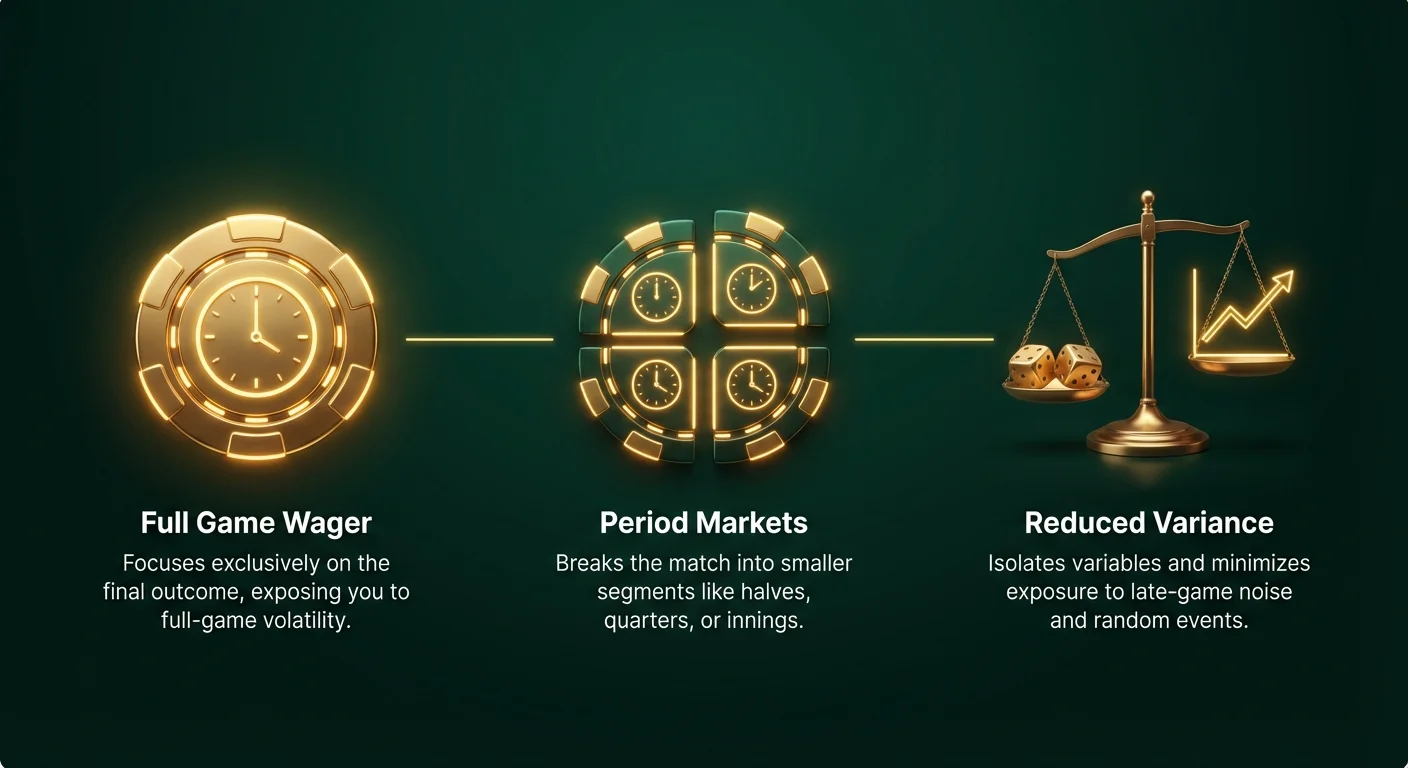
For the casual sports fan, the final score is the only number that matters. Did the team win? Did they cover the spread? But for the intermediate to sharp bettor, a game is not a singular event; it is a story told in chapters. By focusing exclusively on the full-game outcome, you expose yourself to 60 or 90 minutes of variance, injuries, garbage time shenanigans, and coaching decisions that have nothing to do with winning and everything to do with clock management.
Enter period betting. This strategy involves breaking a match down into its constituent parts - First Half, Second Half, Quarters, or Innings - and finding value in those specific segments. Whether you are betting on the NBA, NFL, Soccer, or MLB, focusing on period markets allows you to isolate variables (like starting pitchers or specific rotation patterns) and remove the noise that often ruins full-game wagers.
This guide will move beyond the basics of "what is a spread" and dive into the intermediate strategies required to beat the books in the derivative markets. We will explore why the first half often offers a "purer" handicap than the full game, how to leverage crypto sportsbooks for rapid turnover of capital, and the mathematics behind quarter lines.
Understanding Period Markets: The "Derivative" Board
In sports betting terminology, period bets are often referred to as "derivatives." They are derived from the full-game line but are not simply mathematical divisions of that line.
If the Kansas City Chiefs are -7 favorites over the Buffalo Bills for the full game, a novice might assume the First Half spread is -3.5. While this is sometimes true, it is rarely that simple. Oddsmakers adjust period lines based on:
- Pacing: Some teams start slow and finish strong.
- Depth: A team with a weak bench is vulnerable in the 2nd Quarter but strong in the 1st and 3rd.
- Strategy: In sports like Baseball, the first half (First 5 Innings) is entirely dependent on starting pitching, while the full game relies on the bullpen.
Full Game vs. Period Betting Comparison
To understand the trade-offs, review the comparison below.
| Feature | Full Game Betting | First Half (1H) Betting | Quarter/Period Betting |
|---|---|---|---|
| Duration | 2-4 Hours | 45-90 Minutes | 12-20 Minutes |
| Primary Variable | Complete Team Depth & Stamina | Starters & Game Planning | Immediate Momentum & Rotations |
| Garbage Time Risk | High (Backdoor covers common) | Low (Teams rarely rest starters in 1H) | Medium (4th Quarter is high risk) |
| Limit Size | Highest Limits | Medium Limits | Lower Limits |
| Variance | Smoothed out over time | Moderate | High (One play can swing the result) |
Strategy: First Half Betting (1H)
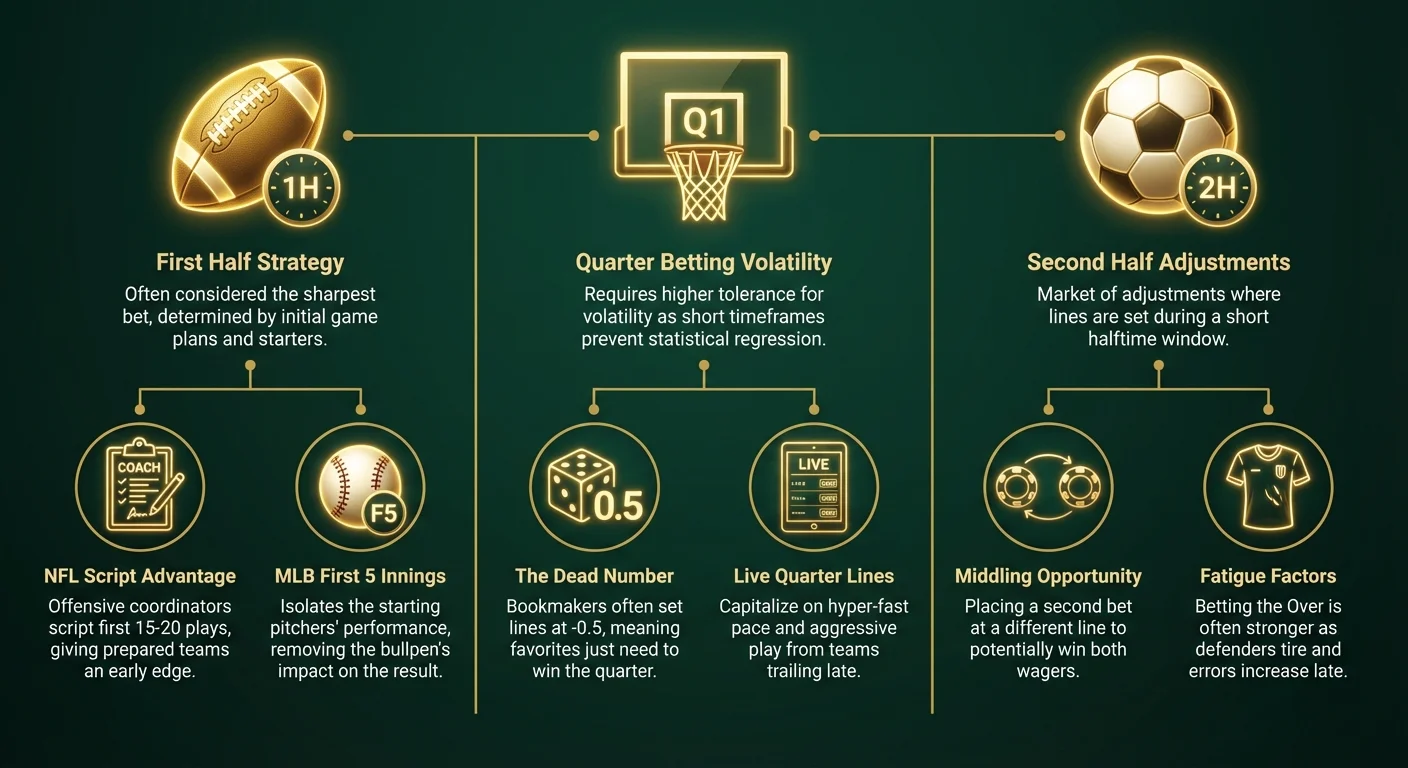
First half betting is widely considered the sharpest way to bet on sports like American Football and Basketball. The logic is sound: early in the game, the result is determined by the preparation of the coaches and the talent of the starting rosters, unpolluted by fatigue or "prevent defense" strategies.
The NFL "Script" Advantage
In the NFL, most offensive coordinators script their first 15 to 20 plays of the game. These plays are practiced extensively throughout the week to exploit specific weaknesses seen on film.
- The Strategy: Look for teams with highly rated offensive coaches (play callers) facing defenses with poor communication. The offense usually has the advantage in the first 30 minutes because the defense has not yet adjusted to the game plan.
- The Fade: Conversely, some teams are notorious for slow starts but excellent halftime adjustments. Betting the 1H Under or the underdog on the 1H spread can be profitable against "second-half teams."
NBA Rotations and the "Fresh Legs" Theory
In the NBA, the First Half line is often a test of the starting five. However, you must understand the rotation patterns.
- The 1st Quarter vs. 2nd Quarter: Starters usually play the majority of the 1st Quarter. The 2nd Quarter is often dominated by bench units. If a team has a superstar starting lineup but a terrible bench, the 1st Quarter spread is a better bet than the 1st Half spread. By betting the full 1H, you risk the bench giving up the lead in Q2.
The "First 5 Innings" (F5) in Baseball
Perhaps the most famous period bet is the MLB "First 5 Innings" wager.
- Why it exists: In modern baseball, bullpens (relief pitchers) throw 30-40% of the innings. If you handicap a game based on a dominant starting pitcher (e.g., Gerrit Cole), but the bullpen blows the lead in the 8th inning, your handicap was correct, but your bet lost.
- The Fix: Betting the F5 line isolates the starting pitchers. If your starter is better than theirs, you cash the ticket after the 5th inning, regardless of what the bullpen does later.
Strategy: Quarter Betting
Quarter betting requires a higher tolerance for volatility. While a half allows time for regression to the mean (a team shooting 20% will likely improve), a quarter is too short for luck to even out. However, this volatility creates value.
The "Dead Number" Concept
In the NFL, key numbers are 3 and 7. In quarter betting, the key numbers are 0.5, 3, and 7.Bookmakers hate giving "hooks" (the .5) on quarter lines. You will often see a heavy favorite priced at -0.5 or -3.5 for the first quarter.
- The Tip: If a heavy favorite is -0.5 in the first quarter, they essentially just need to win the quarter. If they are -7.5 for the game, betting the Q1 at -0.5 is often safer than laying the points for the full game, as favorites tend to try hardest to establish a lead early.
Live Quarter Betting
This is where period bets merge with live betting. If a favorite is down by 10 points entering the 4th Quarter, the "live line" for the 4th Quarter specifically (not the game total) becomes interesting. Teams trailing late tend to play at a hyper-fast pace, fouling to stop the clock or throwing deep passes.
- Strategy: Look for 4th Quarter Overs in blowouts where the losing team is aggressive, or "Garbage Time" covers where the winning team puts in 3rd string defenders.
The Crypto Advantage: Velocity of Money
One of the often-overlooked aspects of period betting is the ability to reuse your capital. This is where using a high-end crypto sportsbook becomes a strategic tool rather than just a payment preference.
In traditional fiat sportsbooks, if you win a First Half bet, the funds might not settle until the game is officially over, or withdrawals/transfers take days. In the crypto ecosystem (especially with Bitcoin, USDT, or Litecoin), settlement is automated and near-instant upon the conclusion of the market.
The "Snowball" Effect:
- 1:00 PM: You bet 0.005 BTC on Team A to win the First Half.
- 2:30 PM: The first half ends. Team A wins. The smart contract or provably fair system settles the bet immediately.
- 2:35 PM: You now have your principal plus profit available to bet on the Second Half of the same game, or the First Half of a game starting at 4:00 PM.
This increased velocity of money allows you to turn over your bankroll multiple times in a single Sunday, maximizing ROI on a smaller starting deposit.
Second Half Betting: The Market of Adjustments
Betting the second half (2H) is fundamentally different from the first. The 2H line is not posted until halftime, giving you only 10-15 minutes to analyze the data.
The "Middle" Opportunity
Period betting opens the door for "Middling."
- Scenario: You bet the Lakers -4 for the Full Game before tip-off.
- Halftime Reality: The Lakers are up by 20 points.
- The 2H Line: The books post the Lakers as -2 for the Second Half.
- The Strategy: You might bet against the Lakers in the 2H (or bet the 2H Under), knowing they will likely coast. However, the most common "Middle" involves totals.
- Pre-game: You bet Over 210.
- Halftime: The score is very high (120 points). The new Live Total is 240.
- The Adjustment: You bet the Under 240.
- The Win: If the final score falls between 210 and 240, you win both bets.
Fatigue Factors
In sports like Soccer and Basketball, fatigue sets in during the second half.
- Soccer: Most goals are scored in the second half, specifically in the last 15 minutes (75'-90'). Defenders get tired, mental errors increase, and substitutes game-chase. Betting the 2nd Half Over in soccer is a statistically stronger play than the 1st Half Over.
Finding Value: Calculating Period Odds
Don't assume the period line should be exactly half of the game line. Here is a general guide on how bookmakers derive these lines, so you can spot mistakes.
NFL / College Football
- 1st Half Spread: Usually roughly 50-55% of the full game spread. (e.g., -7 full game is usually -4 1H).
- Reasoning: The favorite is expected to exert dominance, but "garbage time" in the 4th quarter often suppresses the full game margin.
NBA
- 1st Quarter Line: Usually 25-28% of the full game spread.
- 1st Half Line: Roughly 50-52% of the full game spread.
- Value Spot: If a team is -10 full game, the Q1 line might be -3. If you know the team starts fast, -3 is a bargain compared to covering double digits later.
Hockey (NHL)
- 1st Period Total: Almost always set at 1.5 goals.
- Strategy: Because the number (1.5) rarely changes, the juice (odds) moves drastically. If two defensive teams are playing, the Under 1.5 1st Period might be -140.
- The Derivative Hack: If you like the Under for the full game, the 1st Period Under is often safer because goalies are fresh and the game tightens up early.
Practical Tips for Period Bettors
When incorporating quarters and halves into your routine, follow these protocols to minimize risk.
- Check the Depth Charts: For 1st Quarter bets, look at the starters. For 2nd Quarter bets, look at the bench. If a team has a "Sixth Man of the Year" candidate, they often dominate the Q2 lines.
- Weather Watch (NFL/Outdoor): Heavy wind affects the game immediately. It often takes kickers and quarterbacks a quarter to adjust to wind/rain. 1st Quarter Unders are profitable in bad weather.
- Goalkeeper/Pitcher Analysis: In hockey and baseball, the starting pitcher/goalie is the period bet. Do not bet a First Period/F5 line without confirming the starter.
- Ignore the "Due" Factor: Just because a team lost the first 3 quarters doesn't mean they are "due" to win the 4th. In fact, if they are losing badly, they may have given up.
- Shop for Lines: Since period markets have lower liquidity than full game markets, odds vary wildly between sportsbooks. One crypto book might have -3 while another has -2.5. That half-point is crucial.
Common Mistakes to Avoid
- Chasing Losses: Losing a 1st Half bet and immediately doubling your stake on the 2nd Half just to "get even" is the fastest way to drain a crypto wallet. Treat the 2nd Half as an entirely new event.
- Blindly Splitting Totals: If the full game total is 50, don't assume the 1st Half total is 25. It is usually higher (e.g., 26 or 26.5) because teams are fresher and scoring is higher early on. Betting the Under 25 would be a bad bet if the market value is 26.
- Overexposure: Do not bet the Full Game, the 1st Half, and the 1st Quarter on the same team. If the team simply has a bad day, you lose three bets instantly. Pick the specific period where you think your edge lies.
Summary
Period betting is not just about impatience; it is about precision. It allows you to target specific narratives - the fast-starting NBA team, the script-heavy NFL offense, or the dominant MLB starting pitcher - without worrying about the chaos of the final whistle.
By utilizing first half betting and quarter strategies, you are effectively reducing the timeframe in which things can go wrong. Combined with the efficiency of crypto betting platforms, which allow for instant payouts and rapid capital recycling, period betting offers a sophisticated way to grow a bankroll.
Remember, the goal isn't to predict who wins the war; it's to predict who wins the opening battle. Analyze the starters, understand the rotations, and capitalize on the derivatives.