For the modern gambler, the thrill of the casino often lives in the digital realm - high-speed hands, instant Bitcoin deposits, and the solitude of the screen. But there is a distinct, visceral magic to the snap of physical cards and the clatter of clay chips that online play can simulates but never fully replicate.
Hosting a home blackjack game elevates the standard "poker night" concept. It transforms a casual gathering into a high-stakes, sophisticated affair. However, the logistical headache of cash - making change, handling dirty bills, and the security risk of having thousands of dollars on a dining table - often dampens the mood.
This guide bridges that gap. We will explore how to host a professional-grade blackjack game where the cards are physical, the procedures are Las Vegas standard, but the financial settlement is entirely handled via cryptocurrency. From setting the house rules to mastering the mechanics of dealing cards, here is how to take your game from screen to felt.
The Setup: Digital Ledger, Analog Table
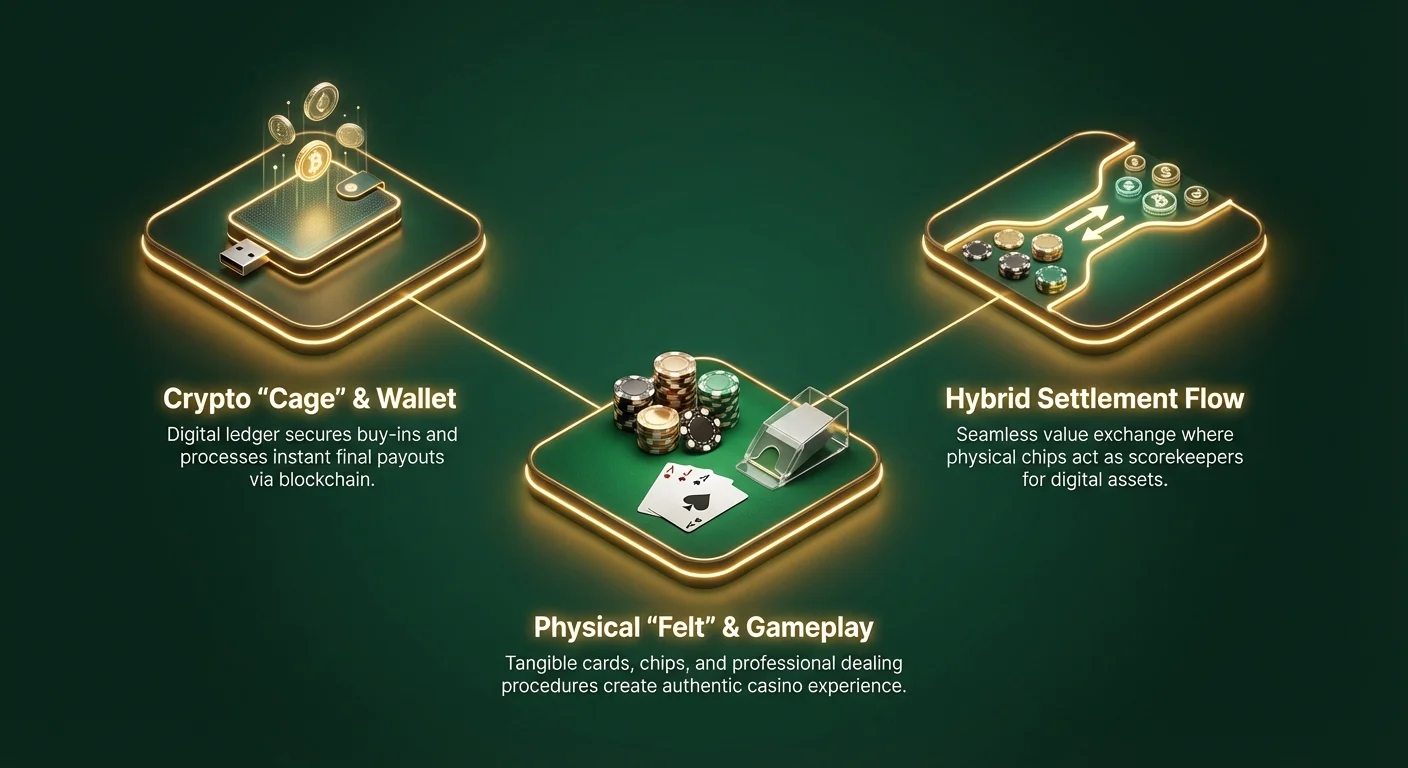
Before you shuffle the first deck, you must establish the infrastructure. In a crypto-powered game, the "Cage" is a digital wallet, and the "Chips" are merely scorekeepers until the final settlement.
The Crypto Cage
Designate a specific hardware wallet or a fresh hot wallet address as the "House Bank."
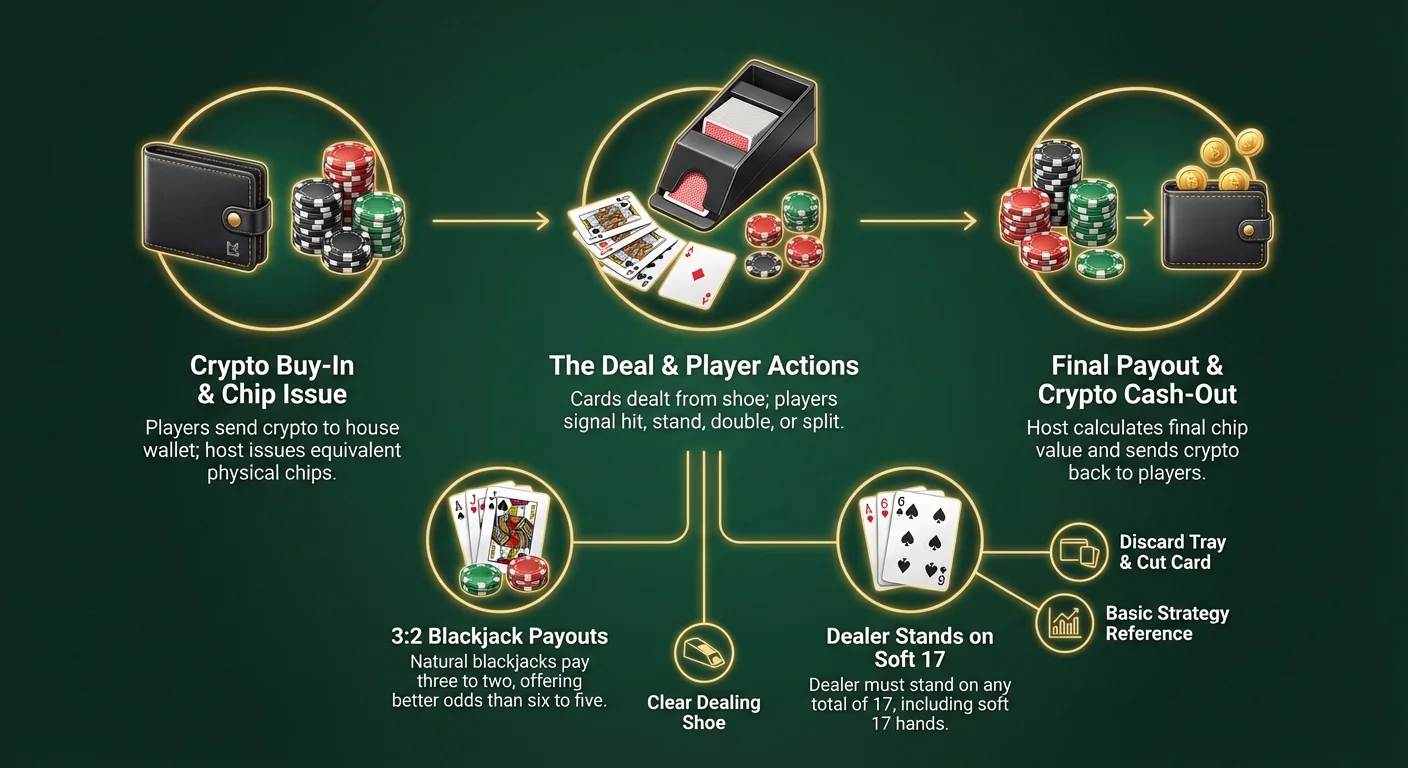
- Buy-ins: Players transfer their buy-in (e.g., $500 in USDT, USDC, or BTC) to the House Bank address before the first hand is dealt.
- Chip Issuance: Once the transaction is confirmed on the blockchain, the host issues physical chips equivalent to the USD value of the crypto sent.
- Cash-out: At the end of the night, players count their chips. The host calculates the value and sends the crypto back to the player's wallet immediately.
Pro Tip: Use stablecoins (USDT/USDC) for the game duration to avoid volatility. If you play with Bitcoin, agree on a fixed exchange rate at the start of the night, or embrace the chaos and let the market price dictate the final value. This volatile aspect means players should always incorporate crypto bankroll management given the market's swings.
Essential Equipment
To replicate the casino feel, you need more than a deck of cards from the drugstore.
- The Shoe: A clear acrylic dealing shoe (4 to 6 decks). This prevents card counting manipulation and speeds up the game.
- Discard Tray: Essential for keeping used cards organized.
- Cut Card: A solid colored plastic card used to cut the deck and protect the bottom card.
- Chips: Heavyweight clay composite chips (11.5g or 13.5g).
- Felt: A green blackjack layout. This helps cards slide and clearly defines betting circles.
Defining the House Rules: Be Better Than the Casino
One of the primary reasons to host a home game is to offer better odds than the watered-down games found on the Las Vegas Strip. According to industry data, many casinos have shifted to 6:5 payouts, which drastically hurts the player. Your home game should be a sanctuary for fair play.
The Golden Rule: 3 to 2 Payouts
Never run a 6:5 game at home. It increases the house edge by roughly 1.39%, turning a skill game into a money pit. At a home game, you want action and fun, not to fleece your friends.
| Bet Amount | 6:5 Payout (Avoid) | 3:2 Payout (Standard) | Difference |
|---|---|---|---|
| $10 | $12 | $15 | +$3 |
| $20 | $24 | $30 | +$6 |
| $50 | $60 | $75 | +$15 |
| $100 | $120 | $150 | +$30 |
Dealer Procedures: European vs. American
You must decide how the dealer (you) receives cards.
- American Style: The dealer takes two cards initially - one face up, one face down (the hole card). If the up-card is an Ace or Ten, the dealer "peeks" for Blackjack immediately.
- European Style: As noted in standard rulebooks, the dealer receives only one card face up. The second card is drawn only after all players have finished their hands.
Recommendation: Stick to American Style for home games. It saves time. If the dealer has Blackjack, the hand ends immediately, saving players from doubling down or splitting on a doomed hand.
The "House" Rules Checklist
Before the first deal, announce these parametersDecks: 6 Decks is standard, but understanding how deck count changes everything is key to calculating true odds. 6 Decks is standard.
The Mechanics of Dealing Cards
Dealing cards is a physical skill that requires practice. Clumsy dealing ruins the immersion. Follow this step-by-step procedure to look like a pro.
1. The Shuffle and Cut
Using a 6-deck shoe requires a thorough shuffle.
- The Wash: Spread all cards face down on the felt and scramble them in a circular motion. This is the only way to truly randomize a new deck.
- The Stack: Gather them and square the deck.
- The Cut: Offer the cut card to a player. They insert it into the deck. You cut the deck at that point, moving the back half to the front.
- The Burn: Place the cut card roughly one deck from the bottom of the stack (the "penetration"). When you reach this card during play, the shoe ends.
- Burn Card: Before the very first hand, slide the top card out and place it in the discard tray face down. This is called "burning" a card and is a traditional anti-cheating measure.
2. The Deal Sequence
Hold the shoe with your left hand. Remove cards with your left thumb, grasping them with your right thumb and index finger to flip and sail them to players.
- Deal one card face up to each player, moving clockwise (left to right).
- Deal one card face up to yourself (the dealer).
- Deal a second card face up to each player.
- Deal a second card face down to yourself (slide it underneath your up-card).
3. Managing the Action
Start with the player to your left (First Base). Ask for their signal.
- Hit: Player taps the table. You deal a card face up.
- Stand: Player waves their hand horizontally over the chips. Move to the next player.
- Double Down: Player places a matching stack of chips next to their original bet. You deal one card, usually placed perpendicular to the original two, indicating no more cards.
- Split: Player separates their pair and matches the bet. You separate the cards and deal a second card to the first hand immediately.
4. The Dealer's Turn
Once all players have acted, reveal your hole card.
- If your total is 16 or less, you must hit.
- If your total is 17 or more (and you are playing "Stand on Soft 17"), you stop.
- Pay winning bets even money (1:1).
- Pay Blackjacks 3:2.
- Collect losing bets immediately into the tray.
Managing Payouts and "Poker Night Crypto" Settlement
The complexity of blackjack lies in the math of the payouts, especially when dealing with physical chips that represent digital assets.
Calculating 3:2 Quickly
When a player hits a "natural" (an Ace and a 10-value card on the first two cards), you pay 3:2.
- The Trick: Divide the bet by 2, then multiply by 3.
- Example: Bet is $25. Half is $12.50. Times three is $37.50.
- Alternative: Pay the bet (1:1), then pay half the bet. ($25 + $12.50 = $37.50).
Handling Insurance
If your up-card is an Ace, ask "Insurance?" This is a side bet that you have aStrategy Tip: As per expert strategy guides, insurance is statistically a bad bet for the player unless they are counting cards. As a host, you can remind them of this, or reference our guide on analyzing the insurance trap.he donation to the house bankroll.
The Crypto Cash-Out
At the end of the session, the "Cage" closes.
- Players "color up" (exchange small denomination chips for large ones).
- The host counts the final stacks.
- Open the blockchain wallet.
- Send the exact equivalent of the chips held to the player's wallet address.
- Transparency: Share the transaction hash (TXID) in the group chat. This serves as the receipt.
Advanced Dealing: Game Protection
Even among friends, mistakes happen. Professional procedures exist to prevent errors and ensure fairness.
"Clearing" Your Hands
Whenever you finish a payout or collect losing bets, show your hands to the "eye in the sky" (or just the room) by turning your palms up and open. This subtly signals you aren't palming chips or cards.
Handling "Pushes"
A push (tie) means money stays on the table. Do not touch the player's chips. Tap the table in front of their bet to signal the push, then move on.
The "Work" Area
Keep the layout clean.
- Players: Chips for the bet go in the circle. Reserve chips stay behind the line.
- Dealer: The deck/shoe is on your left. The discard tray is on your right. Cash/Chips tray is directly in front of you.
Strategy for the Host: Teaching the Game
As the dealer, you are the master of ceremonies. If you have novice players, having a Basic Strategy Chart printed out (or tablet-displayed) is a great touch.
Basic Strategy Quick-Reference
According to mathematical consensus, following basic strategy reduces the house edge to roughly 0.5%. Encourage your players to:
- Always Split: Aces and 8s.
- Never Split: 10s and 5s.
- Double Down: Always double 11. Double 10 against anything except a dealer Ace or 10.
- Hard 12-16: These are the "stiff" hands. The general rule is to stand if the dealer shows a "bust card" (2 through 6), and hit if the dealer shows a 7 or higher.
Why Crypto and Cards are the Perfect Match
Integrating cryptocurrency into a physical home game solves the oldest problem in gambling: Trust and Logistics.
- Provably Fair Finance: While the cards are physical, the money trail is immutable. There are no "IOU" notes scribbled on napkins. The blockchain doesn't forget.
- Instant Settlement: No one has to drive to an ATM. No one has to wait for a bank transfer to clear.
- Security: You aren't keeping $10,000 in cash in a shoebox in the closet. The funds are secured by private keys.
Conclusion
Hosting a crypto-powered home blackjack game requires more effort than opening a laptop, but the reward is a social experience that combines the tactile satisfaction of the casino with the seamless efficiency of Web3.
By adhering to professional dealing cards procedures, offering fair 3:2 payouts, and managing the bankroll on the blockchain, you create an environment that is sophisticated, secure, and incredibly fun. So, shuffle up, cut the deck, and let the blocks - and the cards - fall where they may.