
Standard blackjack is the undisputed king of the casino floor. It offers some of the best odds in the house, requires a blend of luck and skill, and provides a rhythm that has captivated gamblers for centuries. However, for the seasoned player or the curious newcomer at a crypto casino, the standard game can sometimes feel a bit... routine.
Enter the variants. Games like Spanish 21, Blackjack Switch, and Double Exposure take the core mechanics of 21 and twist them. They introduce rule changes that seem too good to be true - like seeing both of the dealer's cards or swapping cards between hands - but they balance these superpowers with subtle mathematical costs.
In the world of crypto gambling, these variants are incredibly popular. Digital platforms allow for seamless gameplay of these complex rule sets, often accompanied by Provably Fair algorithms that ensure the unique mechanics aren't rigged against you.
This guide will dissect these three major variants. We will explore how they differ from the standard American or European games, the specific strategies you need to employ to win, and which game offers the best mathematical edge for your specific playing style.
Why Play Variants? The Risk vs. Reward
Before diving into the specific games, it is crucial to understand why these variants exist. In standard blackjack, the House Edge is derived from the fact that the player acts first; if you bust, you lose, even if the dealer subsequently busts.
Variants alter this ecosystem. To entice players, casinos introduce "favorable rules" (like winning on 21 automatically). To protect their profit margin, they introduce "unfavorable rules" (like 1:1 payouts on Blackjacks).
For the smart crypto gambler, the goal is to find the variants where the favorable rules outweigh the costs, provided you play with the correct strategy. If you apply standard Basic Strategy to these games, you will likely lose your bankroll quickly. These games require adaptation.
Spanish 21: The "No 10s" Powerhouse
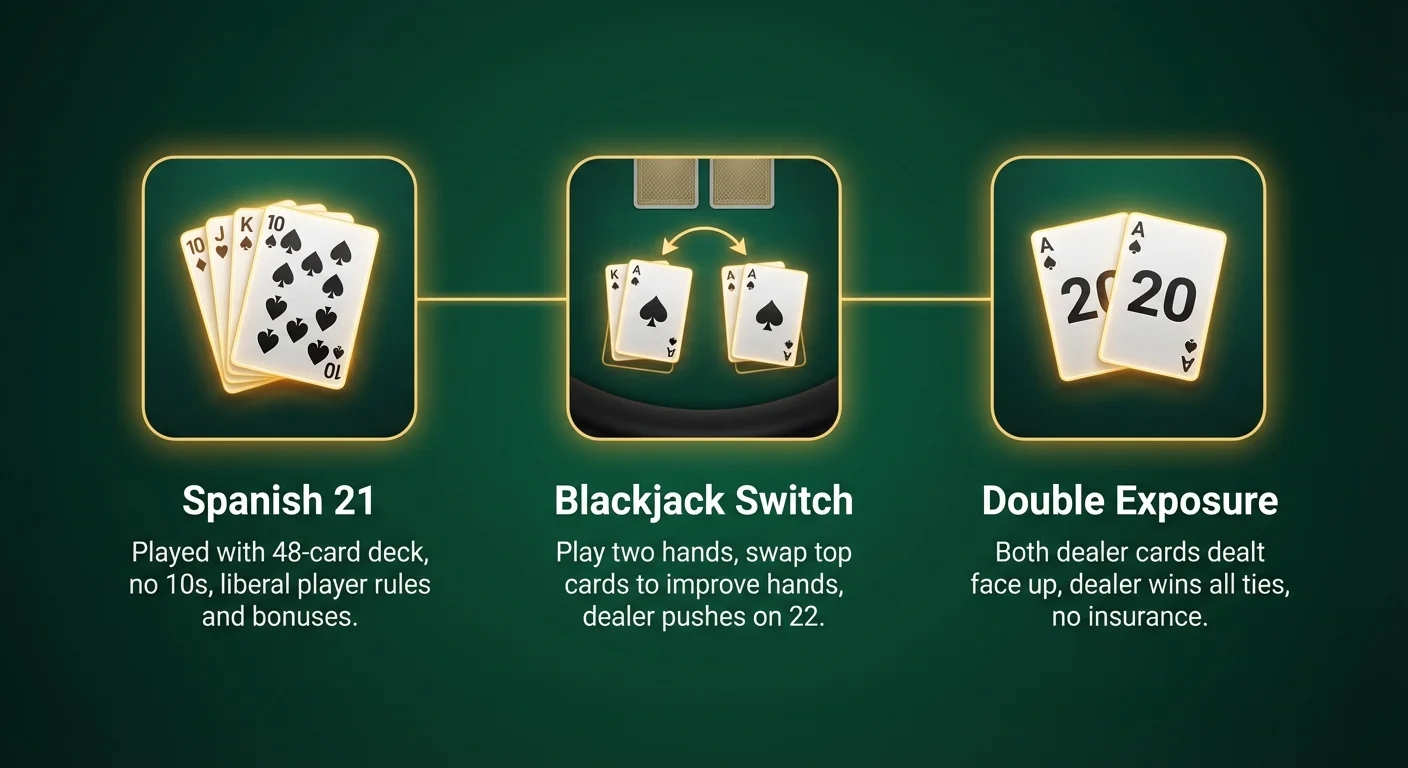
Spanish 21 (often known as "Spanish Blackjack" or simply "Pontoon" in some online software suites) is arguably the most action-packed variant. It offers the player more freedom and options than any other version of the game.
The Major Twist: The Missing 10s
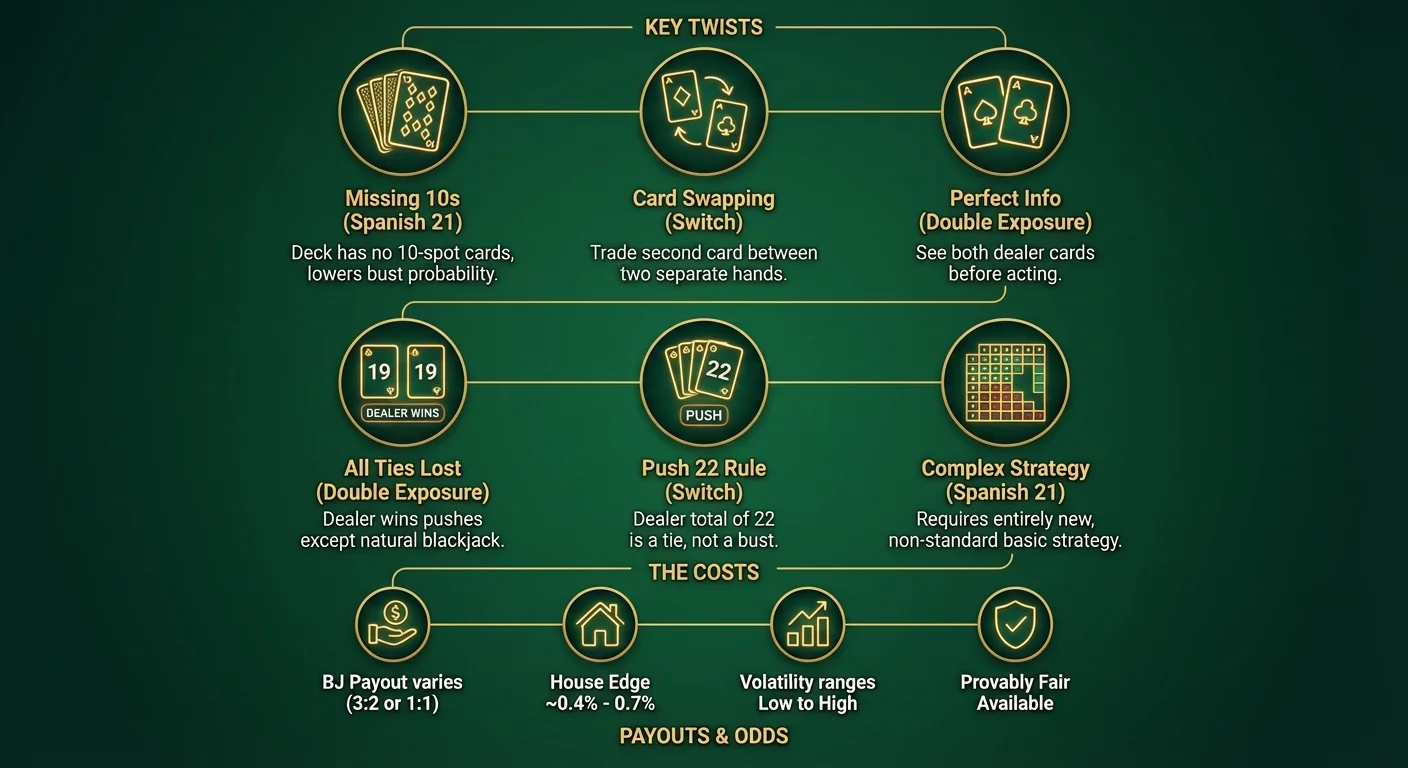
The defining characteristic of Spanish 21 is the deck. It is played with 6 to 8 decks, but all the 10s are removed. The face cards (J, Q, K) remain, but the spot cards of 10 are gone. This leaves a 48-card deck.
At first glance, this is disastrous for the player. 10-value cards are essential for getting Blackjacks and for causing the dealer to bust. Removing them shifts the House Edge significantly in the casino's favor.
The Player's Compensation
To make up for the missing 10s, the rules of Spanish 21 are incredibly liberal. If you know how to use them, this game can actually offer better odds than standard blackjack.
- Player 21 Always Wins: If you have a total of 21, you win immediately. You do not push against a dealer 21.
- Player Blackjack Beats Dealer Blackjack: A natural 21 always wins.
- Double Down on Any Number of Cards: Unlike standard blackjack where you usually double on the first two cards, here you can hit three times, get to a soft 17, and then double down.
- Surrender After Doubling: This is known as "Double Down Rescue." If you double your bet and get a terrible card, you can surrender and take back the doubled portion of your bet, losing only the original wager.
- Bonus Payouts: You get paid extra for specific hands (e.g., a 5-card 21 pays 3:2, a 6-card 21 pays 2:1, and a 7-card 21 pays 3:1). Combinations like 6-7-8 or 7-7-7 also pay bonuses.
Strategy Adjustments for Spanish 21
Because the deck lacks 10s, the probability of busting is lower. This means you should be more aggressive when hitting.
- Hit Stiff Hands: In standard blackjack, you might stand on a 12 or 13 against a dealer 3 or 4. In Spanish 21, you almost always hit these because the chance of drawing a 10 and busting is eliminated.
- Chase the Bonuses: While you shouldn't ruin a good hand to chase a bonus, the 5, 6, and 7-card Charlie rules mean you should hit low totals more aggressively.
- Always Rescue: If you double down and receive a card that makes your total a hard 12 through 16, and the dealer shows a strong card (8, 9, 10, A), use the "Double Down Rescue" (Surrender) option.
Blackjack Switch: The Strategist's Dream
Invented in the early 2000s, Blackjack Switch fulfills a fantasy every gambler has had: "I wish I could just swap these cards around." In this game, you must play two hands of equal value, and you are allowed to switch the second card dealt to each hand.
The Major Twist: The Switch
You place two equal bets. You are dealt two hands.
- Hand 1: Ace, 6 (Soft 17)
- Hand 2: 10, 5 (Hard 15)
In a standard game, you have a mediocre hand and a terrible hand. In Blackjack Switch, you can swap the top cards (the 6 and the 5).
- New Hand 1: Ace, 10 (Blackjack!)
- New Hand 2: 10, 6 (Hard 16)
You turned a difficult situation into an instant winner and a manageable hand.
The Cost: The "Push 22"
This switching ability gives the player a massive advantage. To counter this, the house introduces the "Push 22" rule.
- If the dealer busts with a total of 22, all player hands that have not busted are considered a Push (tie), rather than a Win.
- Blackjacks pay 1:1 instead of 3:2.
Strategy Adjustments for Blackjack Switch
The strategy here is twofold: the switching strategy and the playing strategy.
- Switching Logic: The goal is not just to make one super hand. The math suggests you should switch to balance your hands or to turn a losing hand into a push. However, always switch if it creates a Blackjack.
- Playing the Push 22: Because the dealer doesn't bust on 22, you have to be more aggressive on your own hands. You cannot rely on the dealer busting as often.
- Hit Soft 17: In most Switch variations, the dealer hits Soft 17. Combined with the 1:1 payout, you should rarely double down on 10 or 11 against a dealer 10 or Ace, unlike in standard European rules.
Double Exposure: The Game with No Secrets
Double Exposure (sometimes called "Face Up 21") removes the mystery of the dealer's hole card. Both of the dealer's initial cards are dealt face up.
The Major Twist: Perfect Information
Seeing the dealer's total of 19 or 20 before you make a decision changes everything. There is no guesswork. If the dealer has a hard 20, you know exactly what you have to beat. You will never stand on a 19 against a dealer 20 hoping they will bust - you know they won't.
The Cost: Losing Ties
To pay for this information, the casino implements harsh tie-breaking rules:
- Dealer Wins All Ties: If you have 19 and the dealer has 19, you lose. (The exception is usually a natural Blackjack, which pushes or wins depending on the casino).
- Blackjack Pays 1:1: The standard 3:2 payout is gone.
- Restricted Splits/Doubles: Many Double Exposure games only allow doubling on 9, 10, and 11, and restrict doubling after splits.
Strategy Adjustments for Double Exposure
The strategy for Double Exposure is radically different from standard blackjack.
- Hit on 17-19: If the dealer shows a 20, you must hit your 19. It feels unnatural, but standing guarantees a loss (since the dealer wins ties or beats you). You have to take the risk to get 20 or 21.
- No Insurance: Since you can see both dealer cards, insurance doesn't exist. You already know if they have Blackjack.
- Splitting Decisions: You should be much more aggressive splitting pairs when you can see the dealer has a weak stiff hand (like a hard 12-16).
Comparison: Odds, Payouts, and Volatility
To help you decide which variant suits your crypto bankroll, let's compare the key metrics. Note that "House Edge" figures assume you are playing with perfect strategy for that specific variant.
| Feature | Standard Blackjack | Spanish 21 | Blackjack Switch | Double Exposure |
|---|---|---|---|---|
| Blackjack Payout | 3:2 (usually) | 3:2 | 1:1 | 1:1 |
| Dealer Busts | Normal | Less frequent (no 10s) | Push on 22 | Normal |
| House Edge | ~0.50% | ~0.40% (Rule dependent) | ~0.58% | ~0.69% |
| Volatility | Medium | High | Low | Medium |
| Complexity | Medium | High | Very High | Low |
| Best For | Traditionalists | Risk-takers & Bonus hunters | Mathematical thinkers | Cautious players |
A Note on House Edge
Surprisingly, Spanish 21 often has the lowest house edge of the bunch if the specific casino allows redoubling and hitting split Aces. However, it requires the most complex strategy memorization. Blackjack Switch has very low variance because you can "fix" bad hands, making your bankroll last longer, even if big wins are harder to come by due to the 1:1 BJ payout.
Crypto Casino Specifics: Playing Variants Online
Playing these variants at a crypto casino offers distinct advantages over land-based venues.
Provably Fair & Trust
In games like Double Exposure or Switch, players are often suspicious. "If I switch my cards, how do I know the next card dealt wasn't rigged to make me bust?"
Crypto casinos utilizing Provably Fair technology allow you to verify the seed generation of the shuffle before the hand begins. This cryptographic proof ensures that the deck order was determined before you made your decision to switch or hit, guaranteeing the game isn't reacting to your moves.
Instant Payouts & Table Limits
Crypto casinos typically offer much wider table limits. You might find Spanish 21 tables accepting micro-bets (e.g., 0.0001 BTC) up to high-roller limits, which is rare in brick-and-mortar casinos where floor space is premium. Furthermore, when you hit that massive "Super Bonus" in Spanish 21 (like three suited 7s against a dealer 7), payouts in crypto are often instant, avoiding the cashier cage wait.
Bonuses and Wagering
Be careful with casino bonuses. Because variants like Spanish 21 and Switch have such high Return to Player (RTP) percentages, many crypto casinos exclude them from wagering requirements or count them at a reduced rate (e.g., 5% contribution). Always check the Terms & Conditions before grinding a bonus on these tables.
Practical Strategy Tips for All Variants
Regardless of which variant you choose, there are universal rules for managing your crypto bankroll and maximizing your session.
1. Avoid the 6:5 Trap
As noted in our guide on 6 to 5 Blackjack, payouts are the biggest killer of player profit. While Switch and Double Exposure legitimately pay 1:1 due to their unique mechanics, never play a "Standard" or "Spanish 21" game that pays 6:5 on Blackjack. The house edge triples on these tables. In crypto casinos, check the game "Help" file to confirm the payout structure before placing a single Satoshi.
2. Use the Correct Chart
This is the most common mistake. You cannot use a standard Blackjack Basic Strategy card for Spanish 21 or Switch.
- In Spanish 21, you hit 12 against a dealer 2 (because there are no 10s to bust you). Standard strategy says Stand.
- In Double Exposure, you hit 19 against a dealer 20. Standard strategy says Stand.
- Tip: Open a separate browser tab with the specific strategy chart for the variant you are playing.
3. Consider Positive Progressions
Because variants like Blackjack Switch result in many "pushes," negative progression systems like the Martingale (doubling after a loss) can be dangerous and confusing. Instead, consider the Paroli System (Reverse Martingale). This involves increasing your bet only after a win.
- Why it works here: In Spanish 21, you are often chasing "streaks" or bonuses. The Paroli allows you to capitalize on a hot run without risking your entire bankroll on a single hand during a cold deck.
4. Master the "Surrender"
Surrender is underutilized. In Spanish 21, "Double Down Rescue" is a form of surrender that saves your bankroll. If you double and get a 2 for a total of 12, and the dealer shows a King, surrender immediately. You forfeit the potential loss of the double and live to fight another hand.
Conclusion: Which Variant is For You?
Choosing a blackjack variant is about understanding your own psychology as a gambler.
- Choose Spanish 21 if: You love action, side bets, and the thrill of hitting big bonuses. You don't mind learning a complex strategy chart for the best possible odds.
- Choose Blackjack Switch if: You hate the feeling of getting dealt "stiff" hands (12-16). You want more control over your destiny and prefer a game that extends your playtime through frequent pushes.
- Choose Double Exposure if: You dislike uncertainty. You want to know exactly what you are up against on every hand, even if it means sacrificing the big 3:2 payouts.
The beauty of crypto gambling is accessibility. You can try all three in "demo mode" at most major crypto casinos. Test the mechanics, practice the strategy charts, and find the twist that turns the odds in your favor.