Welcome to the tables. If you are stepping into a digital casino for the first time, or specifically looking to transition from traditional fiat gambling to cryptocurrency betting, Blackjack is arguably the best starting point. It offers the perfect blend of simplicity, strategy, and - crucially - one of the lowest house edges in the casino world.
Unlike slots, where you simply press a button and hope for the best, Blackjack requires you to make decisions. Your choices directly impact the outcome of the hand. When you combine this with the transparency and speed of blockchain technology, you get a gaming experience that is both fair and thrilling.
This guide covers everything you need to know to sit down at a crypto blackjack table with confidence. We will break down the objective, the interface, the rules, and the specific mechanics of betting with Bitcoin, Ethereum, or USDT.
The Objective: It's Not Just About 21
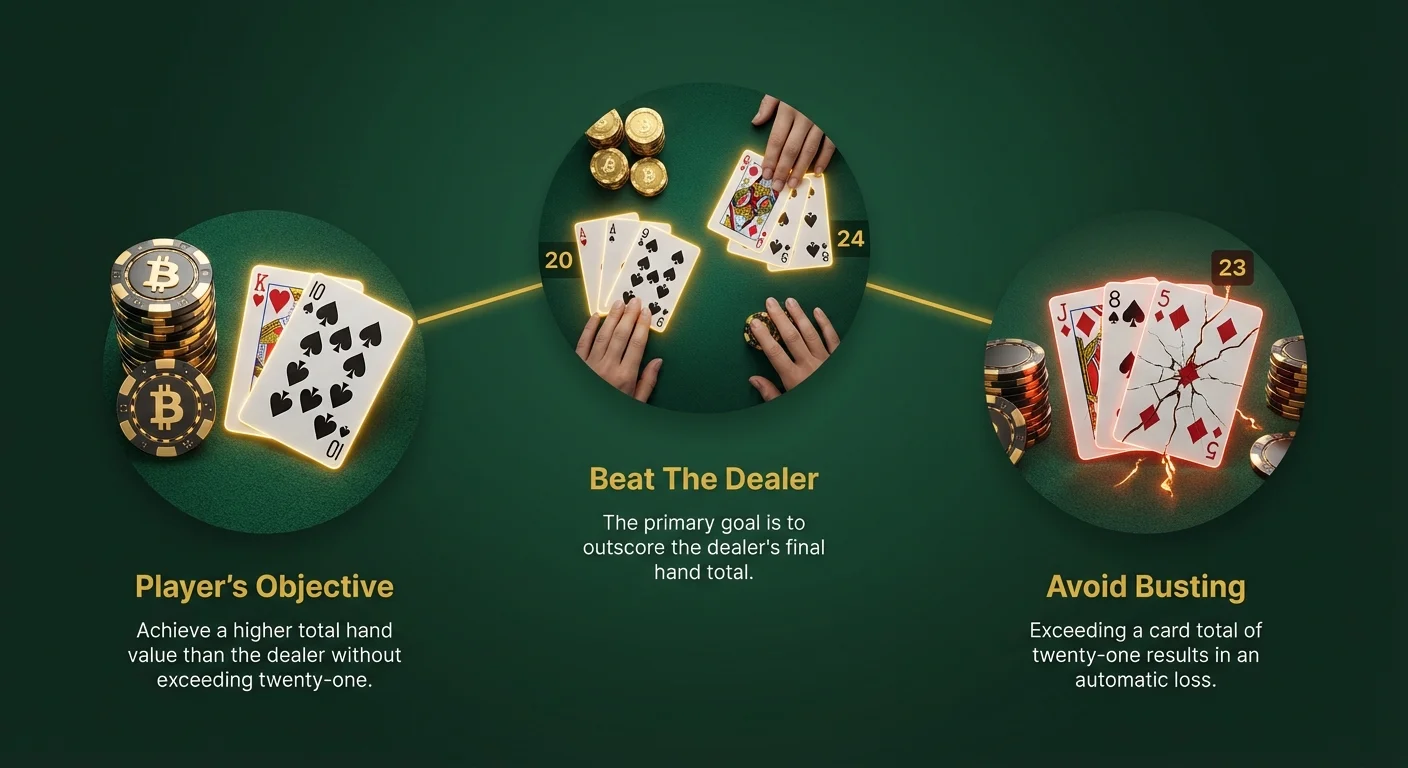
There is a common misconception among beginners that the goal of Blackjack is to get your card count as close to 21 as possible. While hitting 21 is great, it is not the primary objective.
The true objective is to beat the dealer.
You can achieve this in two ways:
- Having a hand value higher than the dealer's hand without going over 21.
- Remaining under 21 while the dealer "busts" (goes over 21).
If you focus solely on hitting 21, you will likely take unnecessary risks and "bust" yourself. In a house-banked game like Blackjack, you are playing strictly against the casino (the dealer), not against other players sitting at the virtual table.
Card Values
Before you place a Satoshi on the table, you must understand what the cards are worth. The suits (hearts, diamonds, spades, clubs) do not matter in standard Blackjack.
| Card | Value | Note |
|---|---|---|
| 2 through 9 | Face Value | A "5" is worth 5, a "9" is worth 9. |
| 10, Jack, Queen, King | 10 | These are often referred to as "10-value cards." |
| Ace | 1 or 11 | Counts as 11 unless that would make you bust, in which case it counts as 1. |
What is a Blackjack?
A "Blackjack" (or "Natural") is when your initial two cards are an Ace and a 10-value card. This totals 21 immediately. This is the best hand in the game and typically pays out at higher odds (usually 3:2).
The Crypto Casino Interface
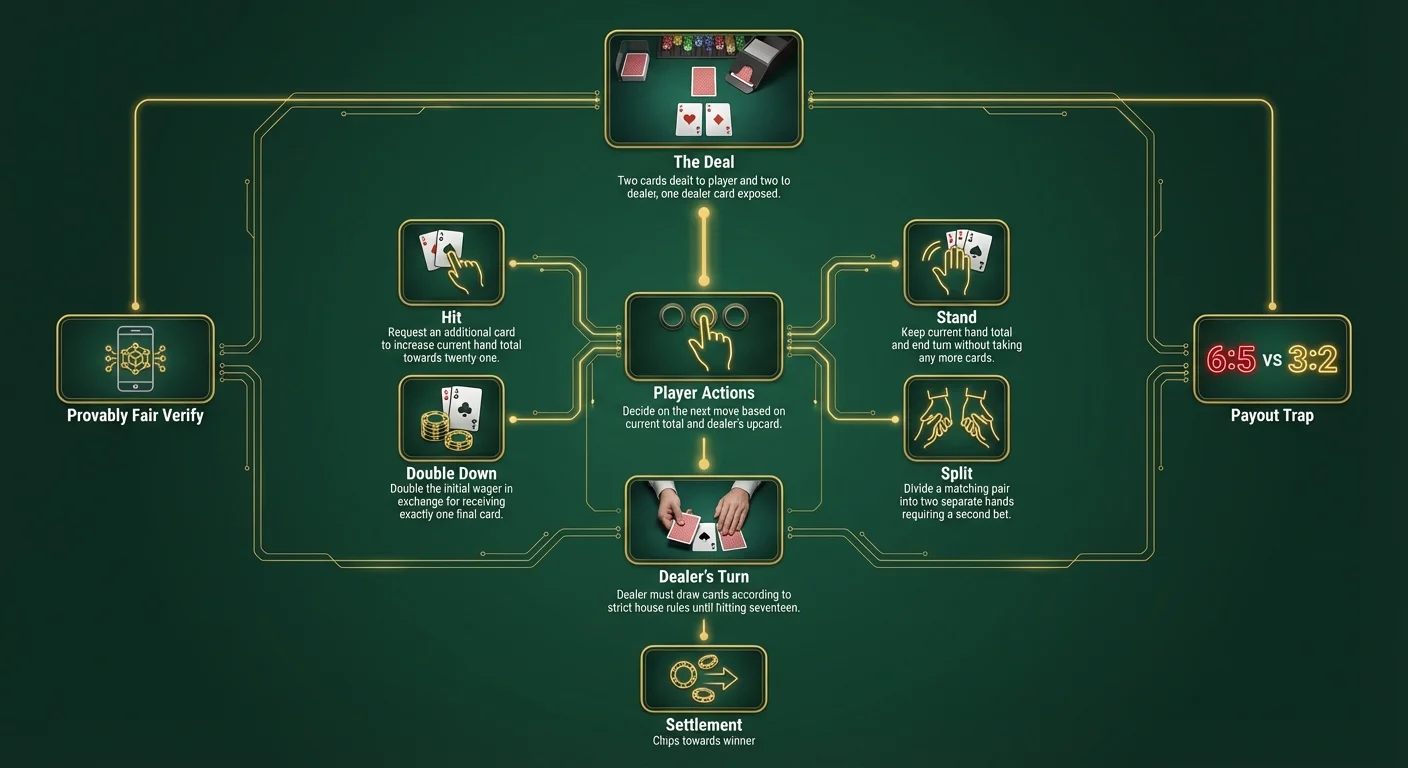
When you load a Blackjack game at a crypto casino, the interface is designed to mimic a physical table but with added digital conveniences. Here is a walkthrough of the layout you will encounter.
1. The Betting Area
At the bottom center of the screen, you will see the betting circle or square. This is where you place your chips. In a crypto casino, your balance will be displayed either in the native currency (e.g., BTC, ETH, LTC) or a fiat equivalent (USD/EUR) depending on your settings.
- Chip Selector: You will see digital chips with different values (e.g., 0.1 mBTC, 1 mBTC). Click the chip value you want, then click the betting circle to place it.
- Crypto Denominations: Be careful with decimal places. A 0.01 BTC bet is significantly larger than a 0.01 USD bet. Always double-check if the game is denominated in "mBTC" (millibitcoin) or "uBTC" (microbitcoin).
2. The Dealer
At the top of the screen sits the dealer. In "Live Dealer" crypto games, this is a video feed of a real human. For a deeper look into the differences, read about RNG software vs. live dealer games. In RNG (Random Number Generator) games, this is computer graphics. The dealer's shoe (the box holding the decks of cards) is usually to their left or right.
3. Action Buttons
Once cards are dealt, buttons will appear on the screen allowing you to make your moves. Common buttons include:
- Hit: Green button (usually).
- Stand: Red button.
- Double: x2 symbol.
- Split: Arrows diverging.
- Rebet: A circular arrow (allows you to repeat the previous bet instantly).
4. Provably Fair Verification
This is exclusive to crypto gambling. Somewhere on the interface (often in the settings or history tab), you will find a "Provably Fair" widget. This allows you to check the "seed" and "hash" of the hand to verify that the shuffle was truly random and the casino did not manipulate the outcome after you placed your bet.
How to Play: A Step-by-Step Round
Let's walk through a single hand of Blackjack to see how the mechanics flow.
Step 1: Placing Your Bet
You select your chip size and place it in the betting circle. In crypto blackjack, the transaction is internal to the casino platform (off-chain) for speed, so the deduction from your balance is instant. You hit the "Deal" button to lock in the bet.
Step 2: The Deal
The dealer distributes the cards.
- You get two cards: Usually both face up.
- The Dealer gets two cards: One face up (the "Upcard") and one face down (the "Hole Card").
Note: In European Blackjack, the dealer deals themselves only one card face up initially. They do not take the second card until after you have finished your turn. This slight rule variation affects strategy regarding dealer Blackjacks.
Step 3: The Player's Turn
You look at your total and the dealer's Upcard. You must now make a decision. The game will wait until you click an action.
- Hit: You ask for another card to increase your total. You can hit as many times as you like, provided you do not go over 21.
- Stand: You are satisfied with your total and end your turn. You take no more cards.
- Double Down: You double your initial wager in exchange for receiving exactly one more card. Your turn ends immediately after that card is dealt. This is a power move used when you have a mathematical advantage.
- Split: If your first two cards are a pair (e.g., two 8s), you can split them into two separate hands. You must place a second bet equal to the first. Each card becomes the start of a new hand.
- Surrender: Not available at all tables. If you think you will lose, you can "surrender" your hand before taking action. You forfeit the hand but get 50% of your bet back.
Step 4: The Dealer's Turn
Once you Stand or Bust, the dealer plays. The dealer has no free will; they must follow strict house rules.
- Usually, the dealer must Hit until they have a total of 17 or higher.
- Soft 17 Rule: You will see "Dealer Stands on Soft 17" or "Dealer Hits Soft 17" written on the table felt. A "Soft 17" is an Ace and a 6 (valued at 7 or 17). If the dealer hits Soft 17, the house edge is slightly higher.
Step 5: Settlement
- If you bust, you lose immediately (even if the dealer also busts later).
- If the dealer busts and you remain standing, you win.
- If neither busts, the higher total wins.
- If totals are equal, it is a Push (tie), and your bet is returned to your crypto wallet.
American vs. European Blackjack: Know the Difference
Before you load a table, check if it is "American" or "European" Blackjack, as this changes the rules significantly.
American Blackjack:
The dealer takes a "Hole Card" immediately. If the dealer's face-up card is an Ace or a 10, they will "peek" at the hole card to see if they have a Blackjack. If they do, the hand ends immediately, and you lose (unless you also have a Blackjack). This saves you from doubling down or splitting against an unbeatable hand.
European Blackjack:
As noted in comparisons of regional rules, the dealer receives no hole card initially. They only get their second card after all players have finished their turns.
- The Risk: If you Double Down or Split, and the dealer ends up drawing a Blackjack at the end of the round, you lose your total bet (including the double/split money). In American Blackjack, you would only lose your original bet.
- Identification: If you see the dealer has only one card on the felt, you are likely playing European rules.
Payouts and Odds
Understanding what you win is just as important as how you play, so familiarize yourself with the odds and house edge.
| Result | Typical Payout | Explanation |
|---|---|---|
| Winning Hand | 1:1 | Bet 10 mBTC, win 10 mBTC (Total return: 20 mBTC). |
| Blackjack | 3:2 | Bet 10 mBTC, win 15 mBTC. Warning: Avoid tables paying 6:5. |
| Insurance | 2:1 | A side bet that the dealer has Blackjack. |
| Push (Tie) | N/A | Your original bet is returned. |
The 6:5 Payout Trap
Many modern casinos (both physical and crypto) are introducing "6 to 5" payouts for Blackjack.
- 3:2 Payout: A $10 bet wins $15.
- 6:5 Payout: A $10 bet wins $12.
This might look minor, but it increases the House Edge by roughly 1.39% - a massive jump in the casino's favor. Always check the table felt. If it says "Blackjack pays 6 to 5," find a different table.
Insurance: The Sucker Bet
If the dealer's upcard is an Ace, the game will offer you "Insurance." This is a side bet equal to half your original wager. If the dealer has a 10 in the hole (Blackjack), the insurance bet pays 2:1, effectively helping you break even.
Expert Advice: Do not take insurance. The math dictates that over time, you will lose money on this bet. The dealer has If you are interested in gaining an edge through advanced play, you may want to investigate the feasibility of being able to count cards in crypto casinos.a Blackjack less than one-third of the time.
Strategic Moves for Beginners
Blackjack is a solved game. Mathematicians have calculated the optimal move for every single card combination. This is called Basic Strategy. While you don't need to memorize the chart immediately, here are the absolute essentials to keep your bankroll safe.
When to Hit or Stand
- Hard 11 or lower: Always Hit. You cannot bust.
- Hard 12 - 16: This is the "danger zone." Only Hit if the dealer is showing a strong card (7, 8, 9, 10, Ace). If the dealer is weak (2, 3, 4, 5, 6), Stand and hope they bust.
- Hard 17+: Always Stand.
When to Split
Splitting allows you to turn a bad hand into two potentially winning hands, or to maximize profit on strong hands.
- Always Split Aces: A pair of Aces totals 2 or 12 - terrible hands. Split them, and they become two 11s - powerful starting points. Note that when splitting Aces, you usually only get one card per Ace.
- Always Split 8s: Two 8s total 16, statistically the worst hand in Blackjack. Splitting them gives you two chances to hit an 18.
- Never Split 10s: A pair of 10s equals 20. This is a winning hand. Don't ruin a winning hand to chase two good ones.
When to Double Down
Doubling is your way to attack the casino when they are weak.
- Double on 11: Always double down on 11 (unless the dealer has an Ace).
- Double on 10: Double if the dealer shows 2 through 9.
- Double on 9: Double if the dealer shows 3 through 6.
Crypto Betting: Tips and Mechanics
Since you are playing on a crypto gambling site, there are specific nuances to managing your bankroll.
1. Understanding Units and Volatility
Because crypto prices fluctuate, a 0.01 BTC bet today might be worth more or less dollar-value tomorrow. This volatility requires careful bankroll management for volatile assets.
- Tip: Many crypto casinos allow you to display your balance in USD/EUR even if you are betting in crypto. Use this feature to keep your betting sizing consistent with your real-world budget.
2. Transaction Speed
When you deposit to play Blackjack, you generally need to wait for blockchain confirmations (1 for Bitcoin, various for others). However, once the funds are in the casino wallet, betting is instant. When you cash out your winnings, crypto casinos typically process withdrawals significantly faster than fiat casinos - often in minutes.
3. Bonuses and Wagering Requirements
Crypto casinos are famous for massive deposit bonuses (e.g., "100% up to 1 BTC"). Be careful: Blackjack often contributes less to the "wagering requirement" than slots.
- Example: If a casino requires 40x rollover, slots might count 100%, but Blackjack might only count 5% or 10% because the house edge is so low. Always read the Terms & Conditions before playing with bonus funds.
4. Betting Systems
You may hear about systems like the Martingale (doubling your bet after For a detailed analysis of their efficacy and risk, review our guide on Martingale, Paroli, and Fibonacci systems. every loss) or the Paroli (doubling after every win).
- Martingale Warning: This is risky. If you hit a losing streak, you will hit the table maximum limit or run out of funds very quickly.
- Paroli Recommendation: Positive progression (betting more when you are winning with the house's money) is generally safer for beginners than chasing losses.
Summary Checklist
Ready to play? Run through this checklist before your first hand:
- Check the Variant: Is it American (hole card) or European (no hole card)?
- Check the Payout: Is Blackjack 3:2 (Good) or 6:5 (Bad)?
- Check the Limits: Is the minimum bet appropriate for your crypto bankroll?
- No Side Bets: Ignore Insurance and "Perfect Pairs" side bets until you are an expert - they drain money.
- Use a Chart: Keep a Basic Strategy tab open. There is no shame in looking at a "cheat sheet" while playing online; it's the smart way to play.
Blackjack offers the best odds in the house, but only if you play smart. By understanding the rules, utilizing the correct strategy, and managing your crypto bankroll effectively, you can reduce the house edge to less than 1% and enjoy one of the most strategic games in the gambling world. Good luck!