
Walking into a casino - whether it's the plush carpets of Las Vegas or the digital lobby of a high-end crypto gambling site - can feel like entering a foreign country. Everyone seems to speak a different language. You hear calls of "monkey," "paint," "shoe," and "surrender," while digital players in the chat discuss "hashes," "seeds," and "provably fair" verification.
If you don't speak the language, you can't play the game effectively. In Blackjack, terminology isn't just about sounding cool; it is about understanding the rules, the odds, and the flow of the game. Misunderstanding a term like "6 to 5 payout" could cost you a significant percentage of your bankroll, while failing to understand "Provably Fair" means missing out on the primary security benefit of crypto gambling.
This guide is designed to take you from a novice to a knowledgeable player. We have compiled a complete glossary ranging from the felt-table classics to the modern blockchain lexicon. Whether you are holding Bitcoin or physical chips, this is your dictionary for dominance at the 21 table.
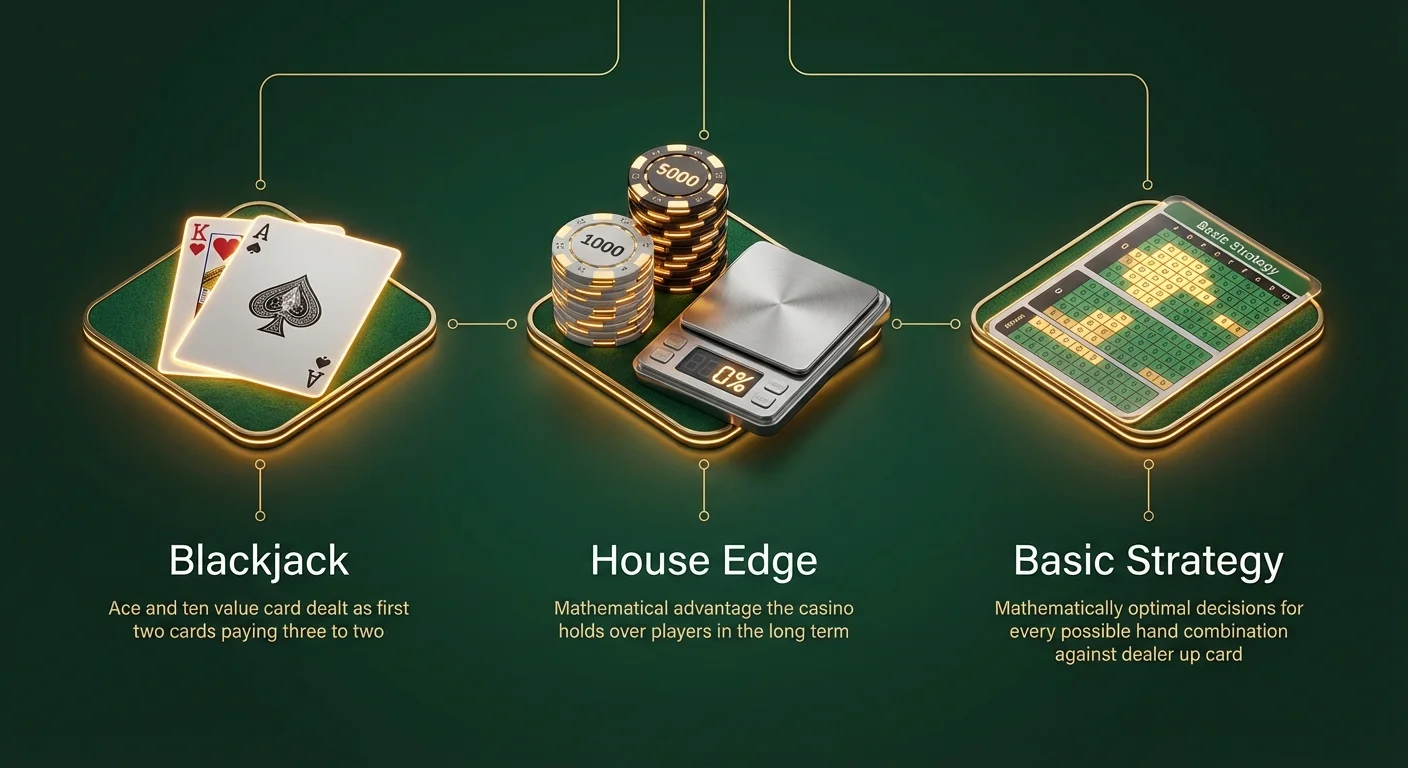
The Essentials: Core Gameplay Terminology
Before you can worry about advanced strategies or blockchain verification, you must master the fundamental language of the game. These are the terms you will use in almost every hand.
Blackjack (The Natural)
This is the holy grail. A "Blackjack" (or a Natural) consists of an Ace and any 10-value card (10, Jack, Queen, King) dealt as your first two cards.
- Why it matters: A standard win pays 1:1, but a Blackjack typically pays 3:2. This bonus payout is essential for lowering the House Edge.
Bust
The dreaded outcome. If your hand total exceeds 21, you bust. You lose your bet immediately, even if the dealer subsequently busts as well.
Hit
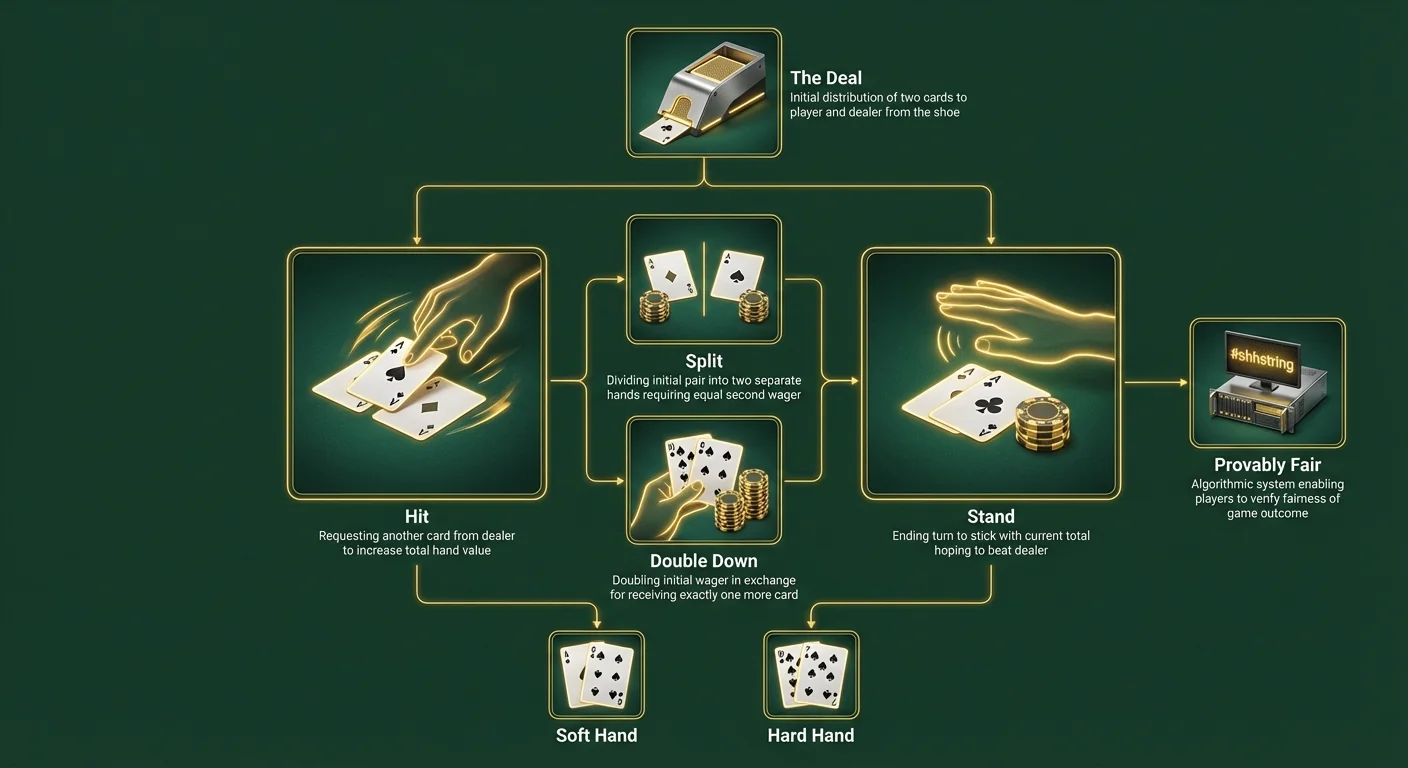
The action of requesting another card from the dealer to increase your hand total.
- Signal: In a physical casino, you tap the table. Online, you click the green "Hit" button.
Stand (or Stay)
The decision to end your turn and stick with your current total. You are hoping your total is high enough to beat the dealer or that the dealer will bust.
- Signal: In a physical casino, you wave your hand horizontally over your cards.
Push
A tie between the player and the dealer. If you have 18 and the dealer has 18, the hand is a Push.
- Outcome: Your original bet is returned to you. You neither win nor lose. Note: In some aggressive variants like "Double Exposure," the dealer may win on ties, which is terrible for the player.
Hole Card
This is a critical distinction between American and European Blackjack. The "Hole Card" is the dealer's face-down card.
- American Rules: The dealer receives one card face up and one face down (the hole card). They check for Blackjack immediately if their up-card is an Ace or Ten.
- European Rules: The dealer receives only one card face up. They do not take a second card until all players have finished their hands. This changes the strategy regarding splitting and doubling against potential dealer Blackjacks.
Up Card
The card the dealer holds that is visible to all players. Your entire strategy (Basic Strategy charts) is based on the relationship between your hand and this specific card.
Soft Hand vs. Hard Hand
- Soft Hand: Any hand containing an Ace that counts as 11. For example, an Ace and a 6 is a "Soft 17." It is "soft" because you cannot bust by taking one more card (the Ace will simply revert to a 1).
- Hard Hand: A hand without an Ace, or a hand where the Ace must count as 1 to avoid busting. A 10 and a 7 is a "Hard 17." You are stuck; hitting risks a bust.
The Crypto Dictionary: Blockchain-Specific Terms
Playing Blackjack with cryptocurrency introduces a new layer of technology. Unlike traditional online casinos that run on opaque servers, crypto casinos often offer transparency tools. Here is the slang you need to know to verify your games.
Provably Fair
This is the gold standard of crypto gambling. It is an algorithmic system that allows the player to verify that the outcome of a hand was determined before the bet was placed and was not manipulated by the casino.
- How it works: It uses cryptographic hashes to prove the deck wasn't "shuffled" in the casino's favor after you hit "Deal."
Seed (Server Seed & Client Seed)
These are the two random variables that determine the shuffle of the deck.
- Server Seed: Provided by the casino. You usually see a "hashed" (encrypted) version of this before the hand starts.
- Client Seed: Provided by you (the player). You can usually customize this in the settings.
- The Magic: The casino combines their seed with your seed to generate the random outcome. Because you control half the data (the Client Seed), the casino cannot cheat the result.
Hash
A long string of alphanumeric characters. In Provably Fair gaming, the casino shows you the "Hash" of the Server Seed before the hand. After the hand, they reveal the unencrypted seed. You can check if the two match. If they do, the game was fair.
Sats (Satoshis)
The smallest unit of Bitcoin (0.00000001 BTC). Because one Bitcoin is worth a lot of money, blackjack bets are often denominated in "Sats" or "mBTC" (millibitcoin).
- Tip: Always double-check your decimal places. Betting 10 mBTC is very different from betting 10 BTC!
Smart Contract
Used mostly in decentralized casinos (dApps). This is code on the blockchain that automatically executes the payout when you win. It removes the need for a cashier to approve your withdrawal manually - the money is sent to your wallet instantly.
Gas Fees
The transaction fee paid to the blockchain network (like Ethereum or Bitcoin) to process your deposit or withdrawal. This is separate from the casino's fees.
Player Actions: The Strategic Glossary
Beyond hitting and standing, you have weapons in your arsenal to maximize profits or minimize losses. These terms usually appear on the buttons of your crypto blackjack interface.
Split
If your first two cards are of equal value (e.g., two 8s), you can "Split" them.
- The Cost: You must place a second bet equal to your first.
- The Result: You now play two separate hands.
- Pro Tip: Always split Aces and 8s. Never split 10s. Splitting 10s breaks up a winning 20 for two mediocre hands.
Double Down
This is the power move. You double your initial wager in exchange for receiving exactly one more card.
- When to use: Use this when you have a mathematical advantage (like a total of 11) and the dealer is weak (showing a 5 or 6). You are capitalizing on the likelihood that one high card will land you a strong total while the dealer busts.
Surrender
Often called the "Casino's Best Kept Secret." This allows you to forfeit your hand before playing it out.
- The Cost: You lose 50% of your bet, but you get to keep the other 50%.
- Late Surrender: You can surrender only after the dealer checks for Blackjack.
- Early Surrender: You can surrender before the dealer checks (very rare and very favorable to the player).
- Why use it? If you have a Hard 16 and the dealer has a 10, your odds of winning are terrible. Saving half your bet is statistically better than playing the hand.
Insurance
A side bet offered when the dealer's up-card is an Ace. You are betting that the dealer has a 10 in the hole (a Blackjack).
- The Payout: Pays 2:1.
- The Reality: Experts agree this is a "sucker bet." The house edge on insurance is roughly 6-7%. Unless you are counting cards in crypto casinos, never take insurance.
Table Rules & Equipment Terms
Whether you are clicking buttons or sitting on a stool, the mechanics of how the cards are delivered affect your odds.
Shoe
The box thSingle Deck vs Multi-Deck: The dealer holds the cards in their hand.holds the cards in their hand.
Penetration
A term used by card counters. It refers to how deep into the shoe the dealer deals before shuffling.
- Example: If a dealer uses 4.5 decks out of a 6-deck shoe, the penetration is 75%. Better penetration makes card counting more effective.
Continuous Shuffling Machine (CSM)
A machine that shuffles cards after every hand.
- The Trap: This makes card counting impossible because the "count" resets every hand. It also speeds up the game, exposing your bankroll to the house edge more frequently per hour.
Discard Tray
Where the played cards go. In a Provably Fair crypto game, the "discard tray" is essentially the history of the generated hash - once the seed is used, it is retired.
Burn Card
The first card taken from the top of the deck after a shuffle, which is placed in the discard tray without being played. This is a tradition to prevent players from spotting the top card, though in digital crypto blackjack, this is merely a visual animation.
The Numbers Game: Odds and Payouts
You will see these numbers splashed across banners on gambling sites. Understanding the difference between them is the difference between a profitable session and a slow drain of funds.
3 to 2 vs. 6 to 5
This is the single most important distinction in modern blackjack. It refers to how much you get paid when you hit a natural Blackjack.
| Payout Ratio | Bet Amount | Winnings | ROI | Verdict |
|---|---|---|---|---|
| 3 to 2 | $10 | $15 | 150% | Standard. Always play this. |
| 6 to 5 | $10 | $12 | 120% | Avoid. Increases House Edge. |
Playing a 6:5 game increases the house edge by roughly 1.39%. In the long run, this makes the game virtually unwinnable. Always check the felt or the "Info" tab on your crypto game to ensure it pays 3:2.
House Edge
The mathematical advantage the casino holds over the player, expressed as a percentage.
- Standard Blackjack: ~0.5% (if playing Basic Strategy).
- Bad Rules (6:5 payout, no doubling allowed): Can jump to 2% or higher.
- Crypto Advantage: Some crypto blackjack variants offer "reduced juice" or specific rules that can lower the edge to 0.4% or less.
Return to Player (RTP)
The flip side of House Edge. If the House Edge is 0.5%, the RTP is 99.5%. This means for every $100 wagered, the machine is programmed to return $99.50 over the long term (millions of hands).
Variance (Volatility)
This measures the "swing" of the game. For advice on surviving long periods of bad luck, read about Understanding Variance in Betting.
- Low Variance: You win small amounts frequently. Your bankroll stays steady.
- High Variance: You endure long losing streaks followed by massive wins.
- Blackjack Context: Blackjack is generally a low-variance game compared to Slots. However, if you play aggressive betting strategies (like Martingale), you artificially create high variance.
Advanced Slang: Speaking Like a Pit Boss
Want to sound like you've been living in a casino for years? Here are the colloquialisms used by pros and pit bosses.
Monkey
A slang term for any 10-value card (10, Jack, Queen, King). You will often hear players chanting "Monkey!" when they double down on an 11 and need a 10 to make 21.
Paint
Refers specifically to face cards (Jack, Queen, King) because they have pictures painted on them.
Stiff Hand
A hand total between 12 and 16. These are the hardest hands to play because you are likely to bust if you hit, but likely to lose if you stand.
- Strategy: You usually stand on a stiff hand if the dealer shows a stiff card (2 through 6).
Snapper
Old-school slang for a Blackjack (natural).
Toke
A tip for the dealer. In live dealer crypto games, you can often "toke" the dealer using your casino balance.
Whale
A high-roller. In crypto gambling, whales are players betting massive amounts of BTC or ETH per hand. They often get special VIP hosts and rakeback deals.
Rakeback
A common perk in crypto casinos. The house gives you back a small percentage of every bet you place, regardless of whether you win or lose. It effectively lowers the house edge.
Betting Systems Glossary
When you read guides on "how to win," you will encounter names of famous mathematicians and strategies. While no system can overcome the house edge mathematically, these manage your bankroll through systems.
Flat Betting
Betting the exact same amount on every hand. This is the safest way to play and ensures you don't lose your bankroll quickly due to variance.
Martingale
A negative progression system.
- The Rule: Double your bet after every loss.
- The Theory: When you eventually win, you recover all previous losses plus a profit of one unit.
- The Danger: Table limits. If you lose 8 hands in a row, you might hit the maximum bet limit of the table and be unable to double, locking in a massive loss.
Paroli (Reverse Martingale)
A positive progression system.
- The Rule: Double your bet after a win.
- The Theory: You are playing with the "house's money" during a hot streak.
- The Safety: If you lose, you drop back to your base bet, limiting damage to your own bankroll.
Oscar's Grind
A conservative system where you aim to win exactly one unit at a time. You only increase your bet after a win, but you never let a bet size exceed what is needed to recoup previous losses for the current cycle. It is designed for long, slow sessions.
Variant-Specific Terms
Not all Blackjack is created equal. You will find these variations in the lobby of CryptoGambling.com recommended sites.
Double Exposure
A variant where both of the dealer's cards are face up.
- The Trade-off: Ties usually lose (except natural Blackjack), and Blackjacks pay even money (1:1). It looks easier, but the rules are tightened to keep the house edge.
European Blackjack
As mentioned in the "Hole Card" section, this variant restricts when the dealer checks for Blackjack. It often restricts splitting and doubling rules (e.g., you can only double on 9, 10, or 11).
Spanish 21
A variant played without the 10s in the deck (the face cards remain). This sounds terrible for the player, but the game offers super-liberal rules (like surrendering late, re-splitting Aces, and special payouts for 21) to compensate.
Switch (Blackjack Switch)
You play two hands at once and are allowed to switch the top cards of each hand to create better starting totals.
- The Catch: Natural Blackjacks pay 1:1, and a dealer 22 results in a Push rather than a bust.
Practical Application: How to Use This Glossary
Knowing these terms changes how you approach the game. Here is a quick checklist for the next time you log in to play:
- Check the "Shoe": Is it a single deck or 6-deck?
- Verify the "Payout": Is it 3:2 or 6:5? If it's 6:5, close the window.
- Look for "Surrender": Does the game offer it? If so, keep your Surrender strategy chart handy.
- Inspect the "Hash": If you are on a crypto site, locate the Provably Fair tab. Even if you don't verify every hand, knowing it's there ensures the casino is operating honestly.
- Watch your "Hard" and "Soft" totals: Adjust your Basic Strategy based on whether you have an Ace.
Summary
Blackjack is unique among casino games because it blends luck with tangible skill. By mastering the vocabulary, you are doing more than learning slang; you are learning the mechanics of the game.
When you understand that "Insurance" is a bad bet mathematically, or that a "Soft 17" dealer rule hurts your odds, you stop gambling blindly and start playing strategically. Whether you are betting Satoshis or dollars, speak like a pro, and you'll start playing like one. When wagering crypto, it is critical to use effective bankroll management techniques to account for market volatility.
Ready to test your vocabulary? Head over to our recommended crypto blackjack tables and see if you can spot the difference between a Soft 17 and a Hard 17 in real-time.