
Keno is one of the oldest lottery-style games in existence, tracing its roots back to ancient China. Today, it has found a new, high-tech home on the blockchain. For modern players, Crypto Keno offers a distinct upgrade over the slow-paced versions found in land-based casinos or state lotteries. It is faster, more transparent, and often offers significantly higher Return-to-Player (RTP) percentages.
However, moving from traditional gambling to the world of Bitcoin and Ethereum casinos can be intimidating for a beginner. The interfaces look different, the betting mechanics are faster, and terms like "Provably Fair" and "Client Seeds" replace the standard casino jargon.
This guide is your comprehensive introduction to the world of blockchain Keno. We will break down crypto keno rules, explain how to play keno using digital assets, and provide you with a bitcoin keno guide to managing your bankroll and maximizing your potential for profit.
What is Crypto Keno?
At its core, Keno is a game of pure chance that functions like a mash-up of Bingo and a standard Lottery. In a traditional game, there is a board (or "grid") numbered 1 through 80. Players select a specific amount of numbers (usually between 1 and 15), and then a machine draws 20 numbers at random. You win based on how many of your selected numbers match the drawn numbers.
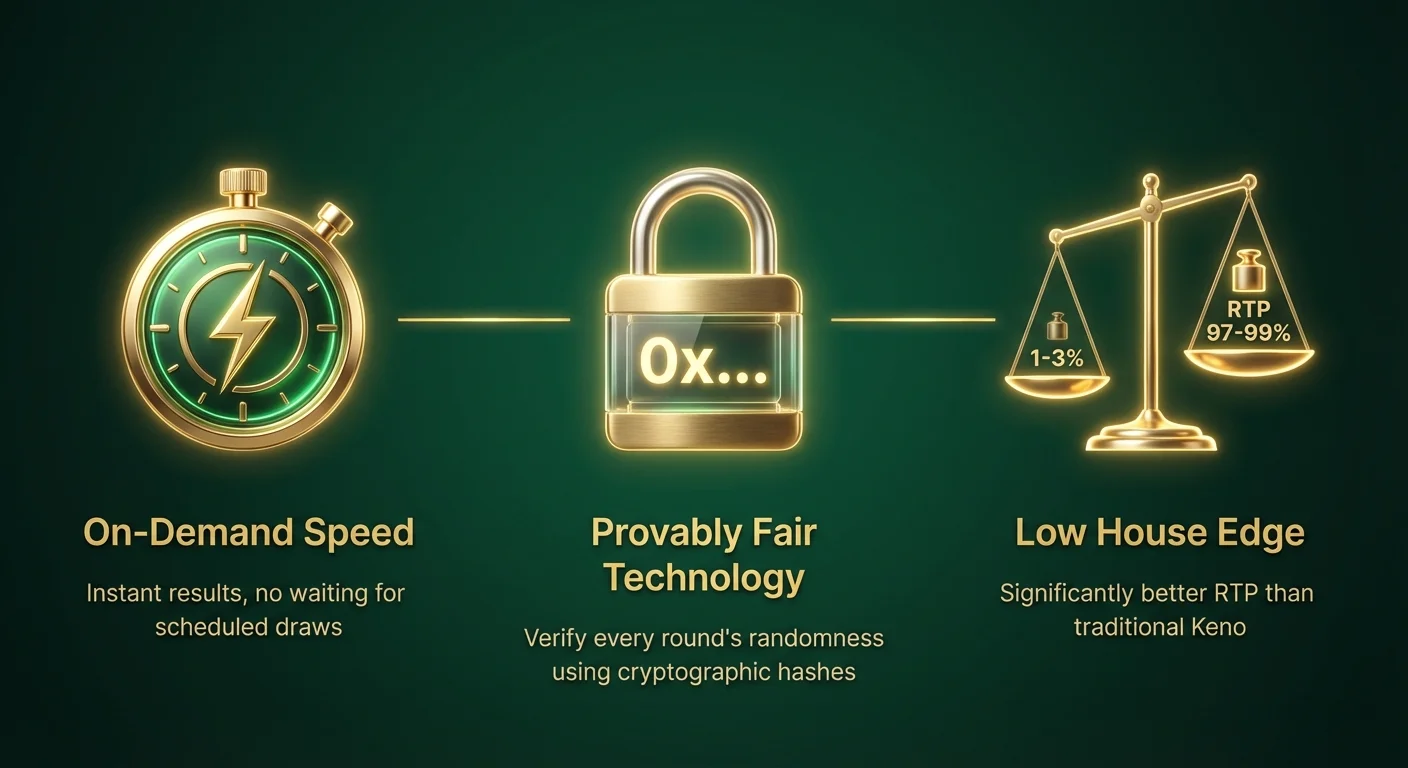
Crypto Keno follows these same fundamental rules but introduces several blockchain-specific advantages:
- Speed: Unlike land-based Keno, where draws might happen every 5 minutes, Crypto Keno is "on-demand." You press a button, and the result is instant.
- Provably Fair: This is a cryptographic technology that allows you to verify that the outcome of every round was truly random and not manipulated by the casino.
- Low House Edge: Physical casinos often have a house edge of 20-30% on Keno. Crypto platforms, due to lower overheads, often reduce this to 1-3% (meaning an RTP of 97-99%).
- Micro-betting: With cryptocurrencies like Satoshi (fractions of Bitcoin) or USDT, you can play thousands of rounds with very small bets, which is perfect for testing strategies.
Getting Started: How to Play Keno with Crypto
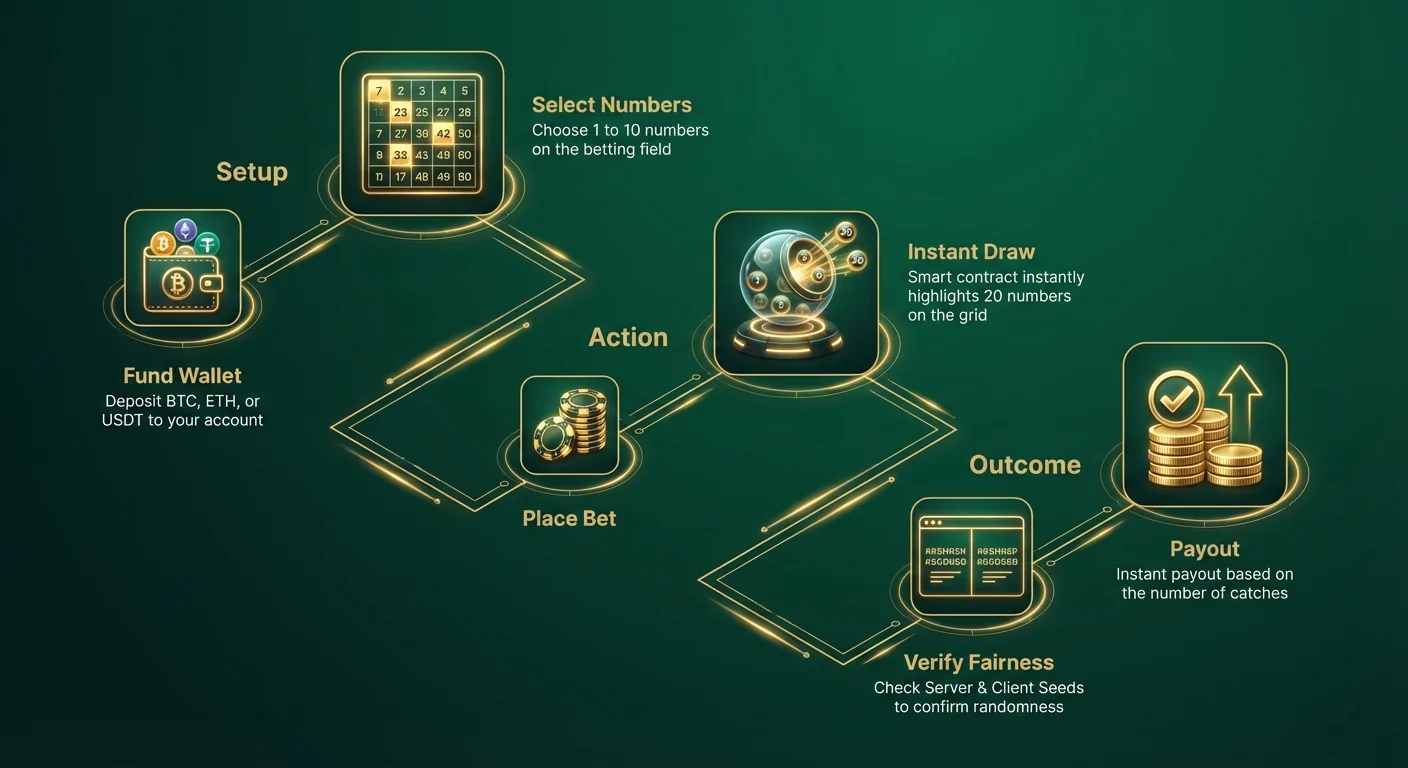
Before you can start picking your lucky numbers, you need to navigate the setup process. If you are new to crypto gambling, here is a step-by-step workflow to get you into the game.
Step 1: Fund Your Account
To play, you need a funded wallet. Most crypto casinos accept major coins like Bitcoin (BTC), Ethereum (ETH), Litecoin (LTC), and Tether (USDT).
- Transfer: Send your chosen crypto from your private wallet (like MetaMask or Exodus) to the unique deposit address provided by the casino.
- Wait for Confirmation: Blockchain transactions usually take a few minutes to confirm. Once the funds appear in your casino balance, you are ready.
Step 2: The Interface
When you load a Crypto Keno game, you will see a grid of numbers from 1 to 80.
- The Betting Field: This is where you enter your wager amount.
- The Risk Level: Many crypto Keno games (unlike traditional ones) allow you to choose "Classic," "Low," "Medium," or "High" risk. This changes the payout multipliers. High risk means you win less often, but the payouts are massive. Low risk offers frequent, smaller wins.
- Auto-Pick: If you don't want to choose numbers manually, use the "Auto-Pick" button to have the computer generate random spots for you.
Step 3: Selecting Your Spots
You must choose how many numbers (spots) to play. In most crypto versions, you can pick anywhere from 1 to 10 numbers, though some allow up to 20.
- Click on the numbers you want to bet on. They will highlight to indicate selection.
- Observe the Paytable: As you select more numbers, you will see the potential payouts change dynamically on the screen.
Step 4: The Draw
Once your bet is placed and numbers are picked, hit the "Bet" or "Play" button. The smart contract or Random Number Generator (RNG) will instantly highlight 20 numbers on the grid.
- Catches: If a drawn number lands on one of your selected spots, it is called a "Catch."
- Payout: You are paid instantly based on how many catches you secured relative to how many spots you picked.
Understanding Keno Odds and Payouts
One of the most critical aspects of learning how to play keno is understanding that more spots do not always equal better odds.
In a standard game where 20 numbers are drawn from 80:
- Total Numbers: 80
- Numbers Drawn: 20
- Probability: Every single number has a 1 in 4 (25%) chance of being drawn.
However, the odds change drastically depending on how many numbers you group together. Hitting 1 out of 1 number is relatively easy. Hitting 10 out of 10 is mathematically astronomical (roughly 1 in 8.9 million).
The "Spots" vs. "Catches" Dynamic
The payout is determined by the percentage of your picks that hit.
| Number of Picks | Minimum Matches to Win | Volatility | Max Payout Potential |
|---|---|---|---|
| 1 Spot | 1 | Low | Low (usually 3x-3.8x) |
| 4 Spots | 2 | Medium | Moderate |
| 8 Spots | 4 | High | High |
| 10 Spots | 5 | Very High | Jackpot Levels |
Pro Tip: In Crypto Keno, pay attention to the "Base Payout." Some games pay you back a small amount even if you catch zero numbers (usually only applicable when you pick a high amount of spots, like 10 or more), because statistically, missing every single number on a 10-pick ticket is actually quite difficult!
Proven Strategies for Beginners
While Keno is a game of chance and no strategy can alter the RNG, how you bet can significantly impact your longevity and enjoyment. Here are strategies tailored for the crypto environment.
1. The "Sweet Spot" Strategy (4 to 8 Numbers)
Mathematically, the best odds for a decent return usually lie in the middle range.
- Picking 1-3 numbers: The payouts are low, and the volatility is low. It's safe but boring.
- Picking 9-15 numbers: The odds of hitting a "solid" win (like 9 out of 10) are incredibly slim. You will likely bleed your bankroll waiting for a big hit.
- The Sweet Spot: Selecting 4, 5, or 6 numbers offers the best balance. The odds of hitting 4 out of 5 are reasonable, and the payouts are substantial enough to boost your crypto balance.
2. The Budget Split (Bankroll Management)
Because Crypto Keno is so fast, you can burn through a budget in minutes if you aren't careful. Implementing strict bankroll management is non-negotiable for serious players.
- Rule of Thumb: Your bet size should be no more than 1% of your total session bankroll. If you have $100 worth of Bitcoin to play with, your bets should not exceed $1.
- Stop-Loss: Many auto-betting features on crypto sites allow you to set a "Stop on Loss" limit. Use this. Set it to stop if your balance drops by 20%.
3. Playing the "Cold" Numbers
A common myth in gambling is that of "Hot" and "Cold" numbers.
- Hot Numbers: Numbers that have appeared frequently in the last few draws.
- Cold Numbers: Numbers that haven't been drawn in a while.
Some players believe that if a number hasn't appeared recently, it is "due" to hit. While the RNG ensures every draw is independent, playing cold numbers is a popular strategy to diversify your picks. - Note: In crypto gambling, you can often see a live feed of stats showing which numbers are currently hot or cold.
4. Cluster Betting
This involves selecting numbers that are physically close to each other on the grid (e.g., creating a box shape or a line).
- The Theory: Randomness sometimes creates "clumping." You will often see numbers like 23, 24, and 33, 34 hit together.
- How to play: Instead of picking numbers scattered all over the board, pick a "zone" (like the top left corner) and bet on a cluster of 5 numbers there.
The "Provably Fair" Advantage
If you are writing a bitcoin keno guide, you cannot ignore the concept of Provably Fair. This is the biggest differentiator between traditional online casinos and blockchain casinos.
In a traditional casino, you have to trust that the software isn't rigged. In a crypto casino, you can verify it.
How it Works:
- Server Seed: Before the round starts, the casino generates a random number (seed) and hashes it (encrypts it). They show you this hash before you bet.
- Client Seed: Your browser (or you manually) provides a random seed on your end.
- The Result: The game combines the Server Seed and the Client Seed to generate the Keno numbers.
- Verification: After the round, the casino reveals the unencrypted Server Seed. You can plug the Server Seed and Client Seed into a third-party verifier. If the resulting numbers match the game outcome, you know 100% that the casino did not cheat or change the numbers after you placed your bet.
Crypto Keno vs. Traditional Keno: Key Differences
| Feature | Traditional Keno (Land-Based/Web 2.0) | Crypto Keno (Blockchain) |
|---|---|---|
| Speed | Slow (Draws every few minutes) | Instant (On-demand) |
| RTP (Return to Player) | 70% - 85% | 96% - 99% |
| Fairness | Audited occasionally by third parties | Provably Fair (Verifiable per hand) |
| Betting Limits | Usually fixed minimums ($1+) | Flexible (Micro-bets allowed) |
| Anonymity | Requires KYC / ID | Often no KYC required |
Common Mistakes to Avoid
Even with the best crypto keno rules at your disposal, beginners often fall into specific traps.
1. The Gambler's Fallacy
This is the belief that past results influence future outcomes. Just because the number 7 has been drawn five times in a row does not mean it is less likely to appear next time. And just because number 80 hasn't appeared in 50 turns does not mean it is "due." In crypto Keno, every millisecond generates a new, independent hash.
2. Over-Betting to Recover Losses (Martingale)
The Martingale strategy involves doubling your bet after every loss to win back your money.
- Why it fails in Keno: Keno has high volatility. You can go many rounds without a win. Doubling your bet repeatedly will hit the table limit or drain your wallet very quickly. Stick to flat betting (betting the same amount) or very conservative progression.
3. Ignoring the Risk Settings
If you are playing a crypto Keno version that allows you to set the risk to "High," understand what that means. You will see long streaks of losing rounds. If you have a small bankroll, "High Risk" settings will wipe you out before you hit a big multiplier. Stick to "Classic" or "Medium" risk until you build a profit buffer.
Expert Tips for Improving Your Odds
To wrap up this bitcoin keno guide, here are three expert tips to take to the tables:
- Look for Bonuses: Crypto casinos are famous for "faucets" (free crypto drops), rakeback (getting a % of your wager back), and deposit bonuses. Using these funds to play Keno effectively increases your RTP because you are risking less of your own money.
- Consistency is Key: If you pick a set of numbers (e.g., 5, 12, 45, 60), stick with them for a set number of rounds. Constantly changing numbers increases the frustration factor when your previous numbers inevitably hit.
- Check the Max Payout: Before playing, look at the max win cap of the casino. If you are betting big on a 10-number selection, ensure the casino's liquidity is high enough to pay out the jackpot if you hit 10/10.
Summary
Crypto Keno is a thrilling, fast-paced game that offers better odds and more transparency than its traditional counterparts. By understanding the balance between spots and catches, utilizing provably fair tools to ensure trust, and managing your crypto bankroll wisely, you can turn this game of chance into a fun and potentially rewarding part of your portfolio.
Remember, while patterns and strategies make the game more engaging, the blockchain ensures that every draw is random. Play for fun, bet responsibly, and enjoy the speed of blockchain gaming.