
For centuries, horse racing has been known as the "Sport of Kings." It is the original organized betting sport, pre-dating modern football leagues and basketball associations by generations. However, the dusty image of the racetrack is undergoing a radical transformation. Today, the thundering hooves of the track meet the lightning-fast transactions of the blockchain.
For the modern crypto user, horse racing betting offers a unique thrill that differs significantly from wagering on team sports. It is fast-paced (a race is over in two minutes), data-rich, and offers payout potentials that can turn a small wager into a massive windfall.
Whether you are depositing Bitcoin, Ethereum, or USDT, the fundamentals of the track remain the same. This guide will walk you through the essential terminology, the mechanics of the betting pool, and how to master everything from simple Show bets to complex exacta trifecta strategies.

The Crypto Advantage in Horse Racing
Before diving into the mechanics of the race, it is important to understand why betting on horses with cryptocurrency is superior to traditional fiat methods.
- Global Access: Horse racing is a global sport, with major events in the UK, USA, Dubai, Australia, and Hong Kong. Traditional banking often blocks cross-border gambling transactions. Crypto bypasses these geographical restrictions.
- Instant Settlements: In traditional off-track betting (OTB), waiting for a withdrawal can take days. With crypto horse racing platforms, your winnings are often in your wallet within minutes of the race going official.
- Anonymity: Many crypto sportsbooks require less invasive KYC (Know Your Customer) protocols than traditional bookmakers, allowing you to keep your hobby private.
- Provably Fair Virtuals: While this guide focuses on live racing, many crypto sites offer virtual horse racing. These are RNG-based games where the "Provably Fair" algorithm allows you to verify the randomness of the result - a feature unique to blockchain gambling.
How Horse Racing Differs from Team Sports
If you are coming from a background of betting on the NFL or Premier League, you need to adjust your mindset. The biggest difference lies in how the odds are determined.
Parimutuel Betting vs. Fixed Odds
In sports betting, you usually lock in "Fixed Odds." If you bet on a team at 2.0 (+100) on Tuesday, you get those odds even if they drop by Sunday.
North American horse racing uses Parimutuel Betting (Pool Betting).
- All money bet on a specific market (e.g., Win) goes into a central pool.
- The "track take" (taxes and house edge) is removed.
- The remaining money is divided among the holders of the winning tickets.
Key Takeaway: The odds you see on the screen (the "Morning Line" or current odds) are estimates. Your actual payout is determined by the final odds at the moment the gates open. If a flood of money comes in on your horse at the last second, your payout will decrease.
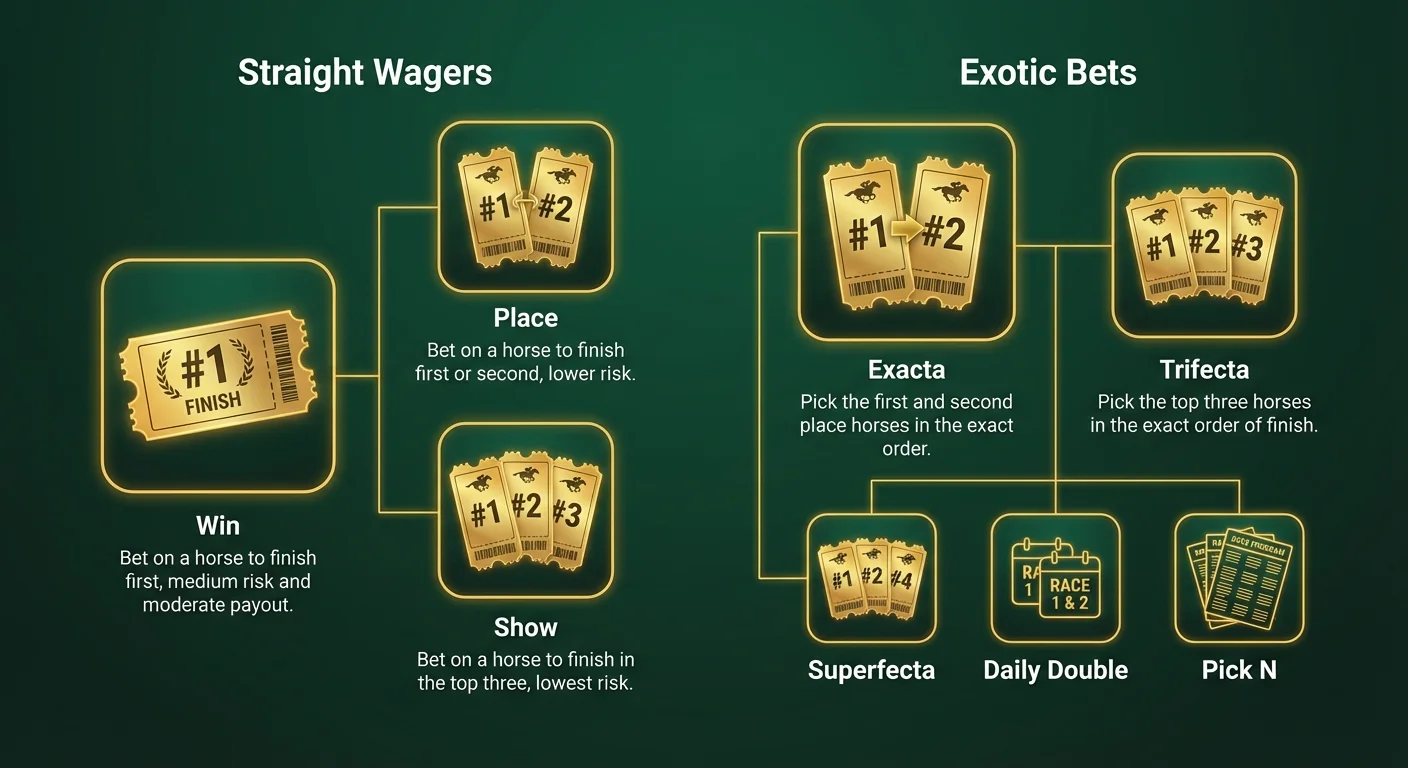
Straight Wagers: The Bread and Butter
For beginners, straight wagers are the best place to start. They are simple to understand, have a higher hit rate, and help you get a feel for handicapping without risking your entire bankroll.
Win
The most straightforward bet in racing. You bet on a horse to finish First.
- Condition: The horse must win outright.
- Risk: Medium.
- Payout: Determined by final odds.
Place
You bet on a horse to finish First or Second.
- Condition: Your horse can win the race or come in as the runner-up. You collect the same amount regardless of whether they are 1st or 2nd.
- Risk: Low.
- Payout: Lower than a Win bet, as the pool is split between two sets of winners.
Show
You bet on a horse to finish First, Second, or Third.
- Condition: As long as the horse hits the board (top 3), you cash your ticket.
- Risk: Very Low.
- Payout: Generally small, often used by conservative bettors or to salvage a bet on a longshot.
Across the Board
This is a combination bet. If you say "$2 Across the Board on Horse #5," you are actually making three separate bets:
- $2 to Win
- $2 to Place
- $2 to Show
- Total Cost: $6.
- Scenario A (Horse wins): You collect on all three bets (Win, Place, and Show).
- Scenario B (Horse runs 2nd): You collect Place and Show money.
- Scenario C (Horse runs 3rd): You collect only the Show money.
Comparison of Straight Wagers
| Bet Type | Finish Required | Difficulty | Average Payout | Best For... |
|---|---|---|---|---|
| Win | 1st | Medium | Moderate | Bettors confident in a specific horse. |
| Place | 1st or 2nd | Low | Low-Mod | Backing a strong contender who might get nipped at the wire. |
| Show | 1st, 2nd, or 3rd | Very Low | Low | Beginners or safer bankroll building. |
Exotic Bets: Chasing the Big Score
"Exotics" are wagers that involve multiple horses or multiple races. This is where the life-changing money is found in horse racing betting. While a Win bet might pay 5:1, an exotic bet can easily pay 500:1 or more. However, they are much harder to hit.
Exotics are divided into two categories: Vertical (single race) and Horizontal (multiple races).
Vertical Exotics (Single Race)
These bets require you to predict the exact order of finish within one specific race.
1. Exacta
You must pick the First and Second place horses in the exact order.
- Example: You bet an Exacta 4-7. Horse #4 must win, and Horse #7 must come second. If #7 wins and #4 is second, you lose.
2. Trifecta
You must pick the First, Second, and Third place horses in the exact order.
- Difficulty: High.
- Payout: High. This is one of the most popular bets for value hunters.
3. Superfecta
You must pick the Top Four horses in the exact order.
- Difficulty: Extreme.
- Payout: Massive. At major events like the Kentucky Derby, a $1 Superfecta can pay tens of thousands of dollars.
The Strategy of "Boxing"
Because getting the exact order is difficult, smart bettors use a Box.
- Exacta Box: You pick two horses, and they can finish 1st and 2nd in any order. This effectively places two bets (4-7 and 7-4).
- Trifecta Box: You pick three horses to finish top 3 in any order. A 3-horse Trifecta box costs $12 (assuming a $2 base wager) because it covers all 6 possible combinations.
Horizontal Exotics (Multiple Races)
These bets test your ability to pick winners over a sequence of races.
- Daily Double: Pick the winner of two consecutive races (usually the first two or last two of the day).
- Pick 3 / Pick 4 / Pick 5 / Pick 6: Pick the winner of 3, 4, 5, or 6 consecutive races.
- The Jackpot: The Pick 6 is often the "Jackpot" bet of the track. If no one hits it, the pool carries over to the next day, sometimes swelling to millions of dollars.
How to Read the Odds and Calculate Payouts
In crypto horse racing, understanding the math is vital. In North America, odds are usually fractional (e.g., 5/1, 9/2).
The Math
Odds represent profit relative to the stake.
- 5/1: For every $1 you bet, you get $5 in profit. A $2 bet returns $12 total ($10 profit + $2 stake).
- 9/2: This equals 4.5/1. A $2 bet returns $11 total ($9 profit + $2 stake).
- 1/5: This is a heavy favorite. You must bet $5 to make $1 in profit.
Minimum Payouts
Tracks are legally required to pay a minimum amount, usually $2.10 or $2.20 on a $2 bet, even if a horse is an overwhelming favorite.
Handicapping 101: How to Pick a Winner
"Handicapping" is the art of analyzing the race data to determine which horse has the best chance of winning. You don't need to be a mathematician, but you should look at these four core factors:
1. Form (Past Performances)
Look at the horse's recent races.
- Finishing Position: Did they finish 1st, 2nd, or 3rd recently?
- Comments: Look for notes like "stumbled start," "blocked," or "wide trip." A horse that finished 4th but had a terrible trip might be a better bet than a horse that won against weaker competition.
2. Class
Horse racing is tiered.
- Maiden: Horses that have never won.
- Claiming: Low-level races where horses can be bought.
- Allowance: Higher quality.
- Stakes/Graded Stakes: The elite level (e.g., The Kentucky Derby).
Tip: Look for a horse "dropping in class." If a horse was racing in Allowance races and is now in a Claiming race, they are facing easier competition and are likely to perform well.
3. Speed Figures
Most race cards provide a "Speed Figure" (like a Beyer Speed Figure). This is a single number representing how fast the horse ran, adjusted for track conditions.
- Compare the last 3 speed figures of the field. The horse with the consistently highest numbers is the theoretical favorite.
4. Connections (Jockey and Trainer)
In horse racing, the human element matters.
- Top Jockeys: Elite jockeys get the best mounts. If a top jockey switches to ride a specific horse, it's a sign of confidence.
- Trainer %: Look for trainers with a high win percentage (20%+ is excellent).
Practical Betting Strategies for Crypto Users
Now that you know the rules, here is how to apply them to your game.
The "Ladder" Strategy
This is a conservative method to protect your bankroll.
- Identify a horse you like at decent odds (e.g., 8/1).
- Bet $10 to Win.
- Bet $10 to Place.
- Bet $10 to Show.
- Logic: If the horse runs 2nd, the Place and Show payouts cover the loss of the Win bet. If it wins, you maximize profit.
The "Key" Strategy for Trifectas
If you are certain Horse #5 will win, but you aren't sure who will come 2nd or 3rd, use a Key.
- Bet: $1 Trifecta Key: 5 / 2,6,7 / 2,6,7.
- Cost: This costs $6 (6 combinations).
- Logic: You win if #5 comes 1st, and any combination of horses 2, 6, and 7 finish 2nd and 3rd. This is cheaper than boxing all four horses ($24).
Bankroll Management for Racing
Horse racing is high variance. Losing streaks are common, especially when chasing Exotics.
- Set a Daily Limit: Decide how much crypto you are willing to lose before the first race starts.
- Percentage Staking: Bet 2% to 5% of your daily bankroll per race.
- Don't Bet Every Race: There is no rule saying you must bet Race 1 through Race 10. Pass on races where you don't have a strong opinion.
Crypto Specifics: Wallets and Withdrawals
When using a crypto sportsbook for racing, keep these technical tips in mind:
- Network Fees: If you are betting small amounts (e.g., $5 bets), avoid using Ethereum (ERC-20) for deposits due to gas fees. Litecoin (LTC), Ripple (XRP), or Tron (TRX) are better for high-frequency, low-cost transfers.
- Stablecoins: To avoid volatility in your bankroll (e.g., Bitcoin dropping 5% while you are watching the race), consider keeping your betting balance in USDT or USDC.
- Bonuses: Many crypto sites offer "Rebates" on horse racing losses. This is unique to racing. You might get 3% to 8% of your daily betting volume returned to you, win or lose. Always check the promotions page.
Summary: Key Takeaways
Horse racing betting is a sophisticated puzzle that rewards research and strategy. By combining the traditional knowledge of the track with the modern advantages of cryptocurrency, you are positioning yourself for a superior betting experience.
- Start Small: Master Win, Place, and Show bets before attacking the exacta trifecta pools.
- Understand the Pool: Remember that in parimutuel betting, you are playing against other bettors, not the house.
- Box Your Exotics: Don't try to be a hero and guess the exact order every time. Pay the extra cost to "box" your picks.
- Read the Form: Don't just bet on names or colors. Look for class drops and speed figures.
- Use Crypto Advantages: Leverage instant payouts and racing rebates to maximize your edge.
The gates are open. Do your research, manage your bankroll, and may your selections always cross the wire first.