
The intersection of the NHL and cryptocurrency offers one of the most adrenaline-pumping experiences in the sports betting world. Hockey is known as the "fastest game on earth," characterized by breakneck speeds, physical intensity, and momentum swings that can change the outcome of a wager in mere seconds. For the crypto bettor, this aligns perfectly with the nature of digital assets: fast transactions, high volatility, and a global marketplace that never sleeps.
While the NFL and NBA often dominate the headlines, the NHL offers unique value for sharp bettors. The season is long, the parity is high, and the markets are often softer than those of football or basketball. However, stepping onto the ice without a strategy is a quick way to freeze your bankroll. This guide covers the NHL betting basics, explains how to leverage crypto hockey platforms, and breaks down the strategies required to turn a profit on the rink.
Why Bet on Hockey with Crypto?
Before diving into the mechanics of the sport, it is essential to understand why you should be using Bitcoin, Ethereum, or stablecoins like USDT for your NHL stablecoin strategies and risks.
- Speed of Settlement: Hockey games often end late at night. Traditional banking methods can take days to process withdrawals. Crypto betting sites typically process payouts instantly or within minutes, allowing you to access your winnings immediately after the final horn.
- Privacy and Anonymity: Crypto sportsbooks generally require less invasive KYC (Know Your Customer) procedures than traditional fiat books, allowing you to maintain privacy.
- Higher Limits: Because crypto transactions carry no chargeback risk for the operator, high-volume bettors often enjoy significantly higher wagering limits.
- Global Access: Hockey is a global sport with massive followings in Canada, the US, Scandinavia, and Russia. Crypto creates a borderless payment system, allowing you to bet from almost anywhere.

Understanding the NHL Season Structure
To bet successfully, you must understand the rhythm of the season. The NHL schedule is a grind, and betting trends change as the year progresses.
1. The Regular Season (October - April)
Each of the 32 teams plays 82 games. This is a war of attrition.
- Early Season: High variance as teams figure out their chemistry. Goal scoring is often higher as defenses haven't tightened up.
- Mid-Season: The "dog days" of winter. Fatigue sets in. This is where betting against teams on "back-to-back" nights becomes a profitable strategy.
- Late Season: Teams out of playoff contention may tank (lose intentionally for draft picks) or play "spoilers" with no pressure. Motivated teams fighting for wild card spots are often good bets.
2. The Stanley Cup Playoffs (April - June)
The intensity skyrockets. The game slows down, checking becomes tighter, and referees tend to swallow their whistles (call fewer penalties).
- Betting Impact: Unders (fewer goals) become more common. Underdogs have a higher success rate in the NHL playoffs compared to the NBA, thanks to the impact of a "hot goalie."
The "Big Three" Hockey Markets
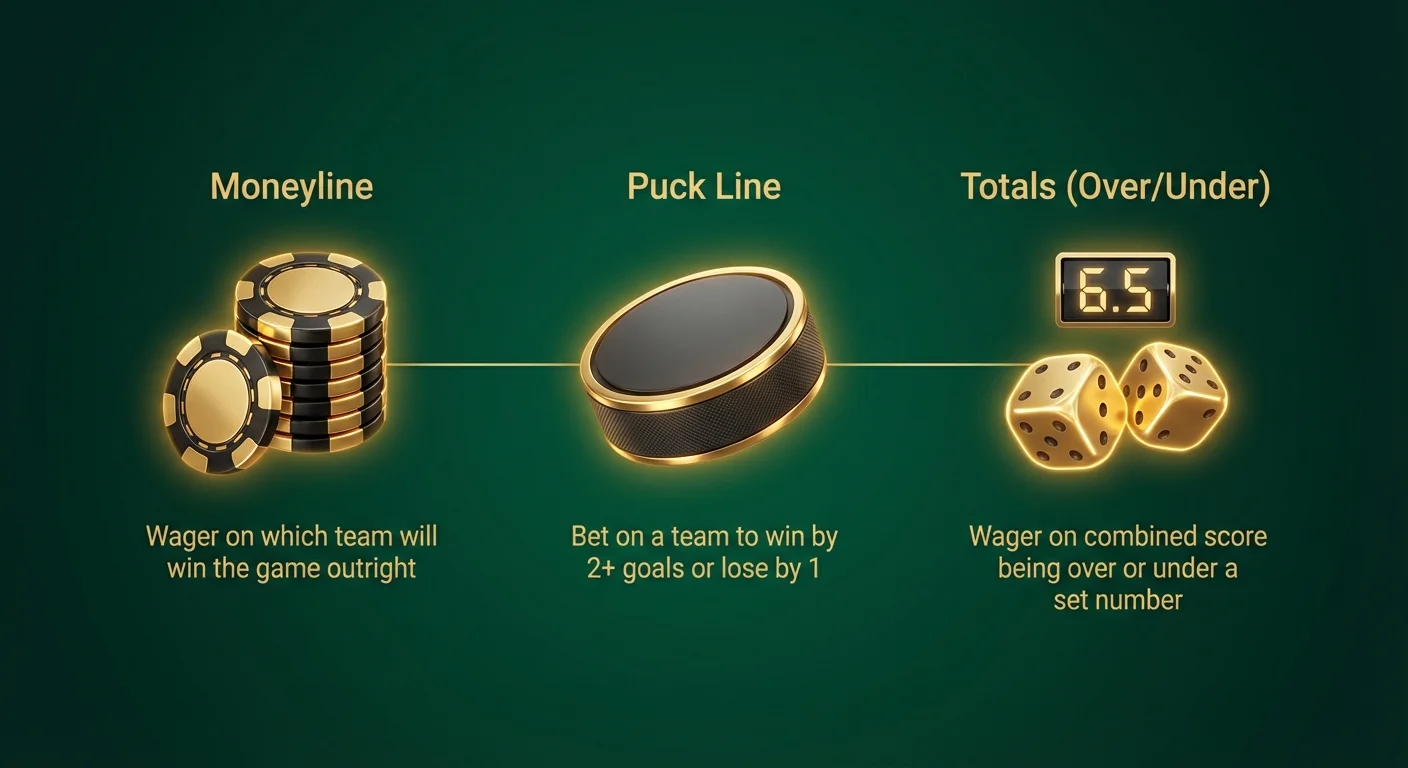
Unlike football where the point spread is king, hockey betting revolves around the Moneyline, the Puck Line, and the Total.
1. The Moneyline (Who Wins?)
This is the simplest bet: picking the winner. However, in hockey, you must distinguish between 2-Way and 3-Way markets.
| Market Type | What it Means | Risk Profile |
|---|---|---|
| 2-Way Moneyline | Includes Overtime (OT) and Shootouts. If your team wins in OT, you win. | Lower Risk, Lower Payout (on favorites) |
| 3-Way Moneyline (60 Min) | Regulation only. You can bet Team A, Team B, or Draw. If the game goes to OT, Team A/B bets lose. | Higher Risk, Better Odds |
Crypto Tip: Always double-check your bet slip. If you see a "Draw" option with high odds (usually around +300 or 4.00), you are betting on the 60-minute line. If the game is tied after 3 periods, your bet on a team loses even if they win in overtime.
2. The Puck Line ( The Spread)
Hockey's version of the point spread is almost always set at 1.5 goals.
- The Favorite (-1.5): The team must win by 2 or more goals. This offers better odds (usually plus money, e.g., +140) than the moneyline.
- The Underdog (+1.5): The team can lose by exactly one goal, or win the game outright. This usually comes with expensive juice (e.g., -160).
The Empty Net Factor: The Puck Line is unique because of the empty net. If a team is leading 3-2 in the final minute, the losing team will pull their goalie for an extra attacker. If the leading team scores on the empty net, the score becomes 4-2. This "meaningless" goal covers the -1.5 spread.
3. Totals (Over/Under)
You are betting on the combined score of both teams. Standard NHL totals are 5.5, 6.0, or 6.5.
- Over 6.5: You need 7 or more goals.
- Under 6.5: You need 6 or fewer goals.
- Push: If the total is a whole number (e.g., 6.0) and the final score is 4-2, the bet is a push, and your crypto is returned.
Advanced Crypto Hockey Markets
Once you master the basics, you can explore markets that offer higher variance and potential for larger crypto returns.
The Grand Salami
This is a hockey-exclusive wager. You bet on the total goals scored in every NHL game played that day.
- Strategy: If top-tier goalies are starting across the league, bet the Under. If it's a slate full of high-offense teams (like Edmonton or Toronto) facing weak defenses, bet the Over.
Period Betting
You can bet on who will win the 1st Period specifically.
- Strategy: Look for "slow starter" teams who tend to fall behind early, or teams coming off a back-to-back who might have "heavy legs" in the first 20 minutes.
Player Props
- Anytime Goal Scorer: Will Player X score a goal?
- Shots on Goal (SOG): Will Player X have Over/Under 3.5 shots?
- Points: Goals + Assists.
Crypto Specific Tip: Proposition markets can vary wildly between crypto sportsbooks. One site might have Connor McDavid at -120 to score, while another has him at +100. Because crypto deposits are fast, you can keep balances on multiple sites to "line shop" for the best price.
Strategic Fundamentals: How to Win on the Ice
Hockey is a sport of high variance. The worst team in the league beats the best team much more often in the NHL than in the NBA. To gain an edge, you must look beyond the team names.
1. The Goalie is Everything
The starting goaltender is the most critical variable in hockey betting guides.
- Confirmed vs. Probable: Never place a large wager until the starting goalie is confirmed (usually after the morning skate).
- The Backup Drop-off: There is a massive difference between a team's elite starter (e.g., Igor Shesterkin) and their backup. Odds makers adjust for this, but often not enough. Betting against a tired team starting a backup goalie is a classic strategy.
2. Schedule and Fatigue (The Spot Bet)
Hockey is physically draining. The schedule creates "schedule losses."
- Back-to-Backs: Teams playing the second night of a back-to-back (0 days rest) historically have a lower winning percentage and concede more goals.
- 3-in-4: Teams playing their 3rd game in 4 nights are fade material.
- First Game Back Home: After a long road trip (5+ games), teams often play sluggishly in their first game back home. This is a psychological letdown spot.
3. Special Teams (Power Play vs. Penalty Kill)
5-on-5 play is important, but games are won and lost on special teams.
- If Team A has a Top-5 Power Play and Team B has a Bottom-5 Penalty Kill, the advantage heavily swings toward Team A, even if they are evenly matched at even strength.
- Tip: Check if a team takes a lot of penalties. A disciplined team neutralizes a good Power Play by simply staying out of the box.
4. Advanced Stats (The "Fancy Stats")
You don't need a math degree, but you should know two terms:
- Corsi (CF%): A proxy for puck possession. It measures all shot attempts (goals, saves, misses, blocks). If a team has a Corsi over 50%, they are controlling the puck more often than not.
- PDO: A "luck" metric combining shooting percentage and save percentage. If a team has an exceptionally high PDO (over 103.0), they are likely "lucky" and due for regression (a losing streak). If their PDO is very low (under 98.0), they are unlucky and due to bounce back.
Live Betting with Crypto
Hockey is arguably the best sport for in-play (live) betting because the momentum shifts are visible.
- The "Trailing Favorite" Strategy: If a heavy favorite like the Colorado Avalanche goes down 0-1 early on a fluke goal, their live moneyline odds will improve significantly (e.g., from -200 to -110). If they are dominating possession but just got unlucky, this is a prime value bet.
- The Empty Net Hedge: If you bet the Under 6.5 and the score is 3-2 with 2 minutes left, you are in danger of an empty net goal ruining your bet. You can place a small live bet on "Next Goal" or the Over to hedge your position.
Crypto Advantage: In live betting, seconds count. The streamlined interfaces of crypto-first sportsbooks often lag less than legacy fiat sites, allowing you to lock in the line before it changes.
Bankroll Management for the Crypto Bettor
Betting with cryptocurrency adds a layer of volatility to your bankroll management. If you hold your bankroll in Bitcoin, the value of your funds fluctuates with the market, independent of your betting results.
Managing "Double Volatility"
- Stablecoins: If you want to avoid the fluctuation of crypto prices, bet using USDT or USDC. This ensures that a $100 win remains $100, regardless of what the crypto market does.
- Unit Sizing: Stick to betting 1% to 3% of your bankroll per game. In hockey, where underdogs win frequently, betting huge amounts on heavy favorites (-250 or higher) is a recipe for disaster.
- The "Juice" Calculation: Crypto books often offer reduced juice (lower margins). A standard line is -110 / -110. Some crypto books offer -105 / -105. Over a full season, saving that 5 cents on every dollar wagered makes a massive difference to your ROI.
Common Mistakes to Avoid
- Betting on Brand Names: Just because the Montreal Canadiens or Chicago Blackhawks are famous doesn't mean they are good this year. Betting on reputation rather than current form is a rookie mistake.
- Ignoring Injuries: Losing a top center affects a team's ability to win faceoffs and control possession. Losing a top defenseman exposes the goalie. Always check the injury report.
- Chasing Losses: If you lose the 7:00 PM games, do not blindly bet double on the 10:00 PM West Coast games just to "get even."
Summary: Your Checklist for NHL Success
To summarize this NHL betting basics guide, here is your pre-game checklist before locking in that crypto wager:
- Confirm Goalies: Is the starter confirmed? Is it a backup?
- Check the Schedule: Is the team on a back-to-back or ending a long road trip?
- Analyze the Odds: Are you betting the 3-Way (Regulation) or 2-Way (OT included) Moneyline?
- Review Special Teams: Does a strong Power Play meet a weak Penalty Kill?
- Manage the Bankroll: Is this bet within your 1-3% unit size?
Hockey offers a perfect blend of statistical analysis and pure chaos. By utilizing the speed and flexibility of cryptocurrency, and adhering to the strategies outlined above, you can elevate your viewing experience and potentially grow your digital asset portfolio. Keep your stick on the ice, shop for the best lines, and bet responsibly.