
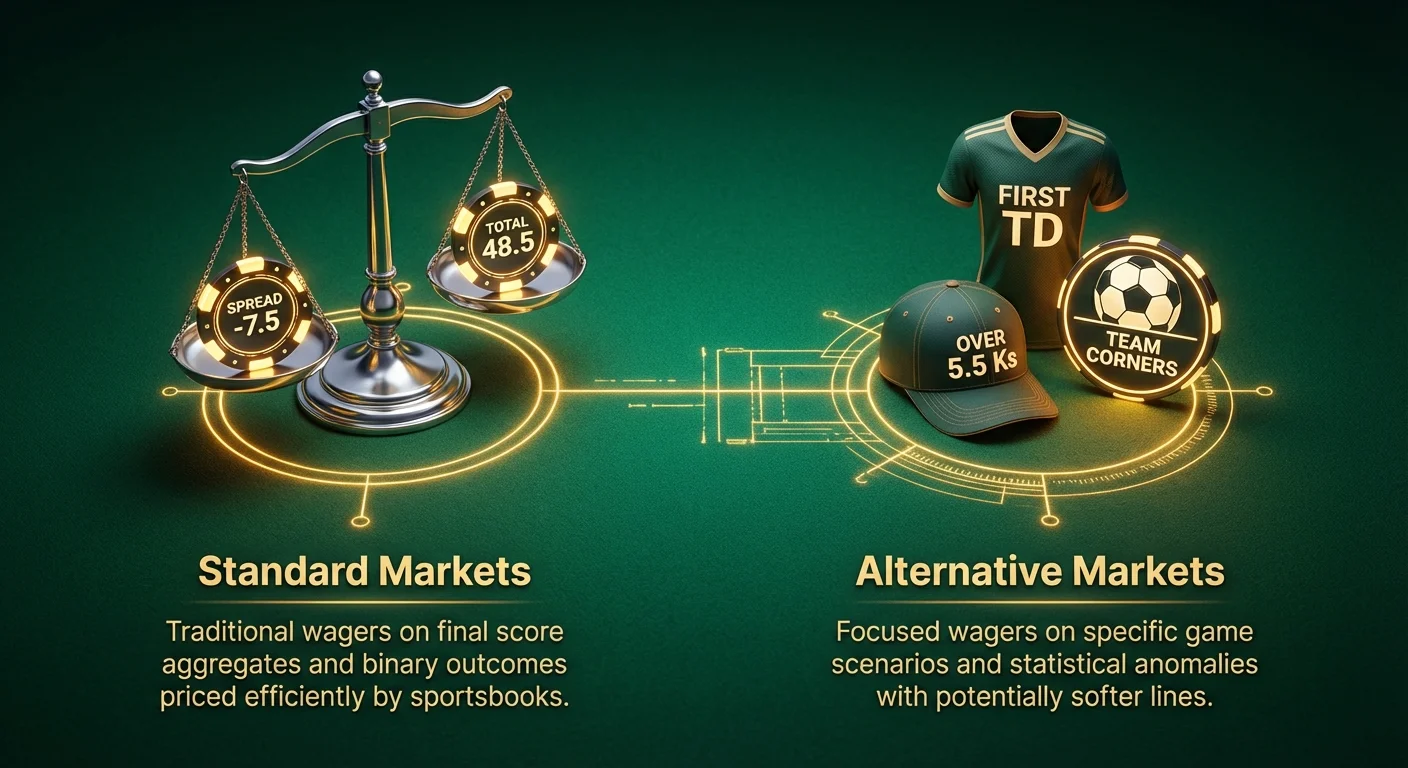
For the vast majority of sports bettors, the gambling universe is confined to three main planets: the spread, the moneyline, and the total (over/under). While these are the most liquid markets, they are also the most efficient. The sharpest minds in the world and the most advanced algorithms are constantly hammering these lines into a state of near-perfect accuracy. If you are strictly betting NFL spreads or NBA totals, you are fighting a war against the sportsbook's strongest fortifications.
However, there is a way to flank these defenses. Game props and team props represent alternative betting markets where the oddsmakers' pricing models are often less rigid, and where your specific knowledge of a team's tendencies can yield a significant edge. Unlike player props, which focus on individual athletes, game and team props focus on specific scenarios, milestones, and statistical anomalies that occur within the contest.
This guide is designed for the intermediate bettor ready to move beyond the final score. We will explore how to isolate variables using team totals, how to leverage game scripts for winning margin bets, and how to utilize the flexibility of crypto sportsbooks to maximize your returns in these specialized markets.
The Anatomy of the Prop Market
To find value, you must first understand the distinction between the market types. In standard betting, you are generally predicting who will win or how many points will be scored in aggregate. In the prop market, you are betting on the narrative of the game.
Game Props vs. Team Props
While often grouped together, they require different analytical approaches:
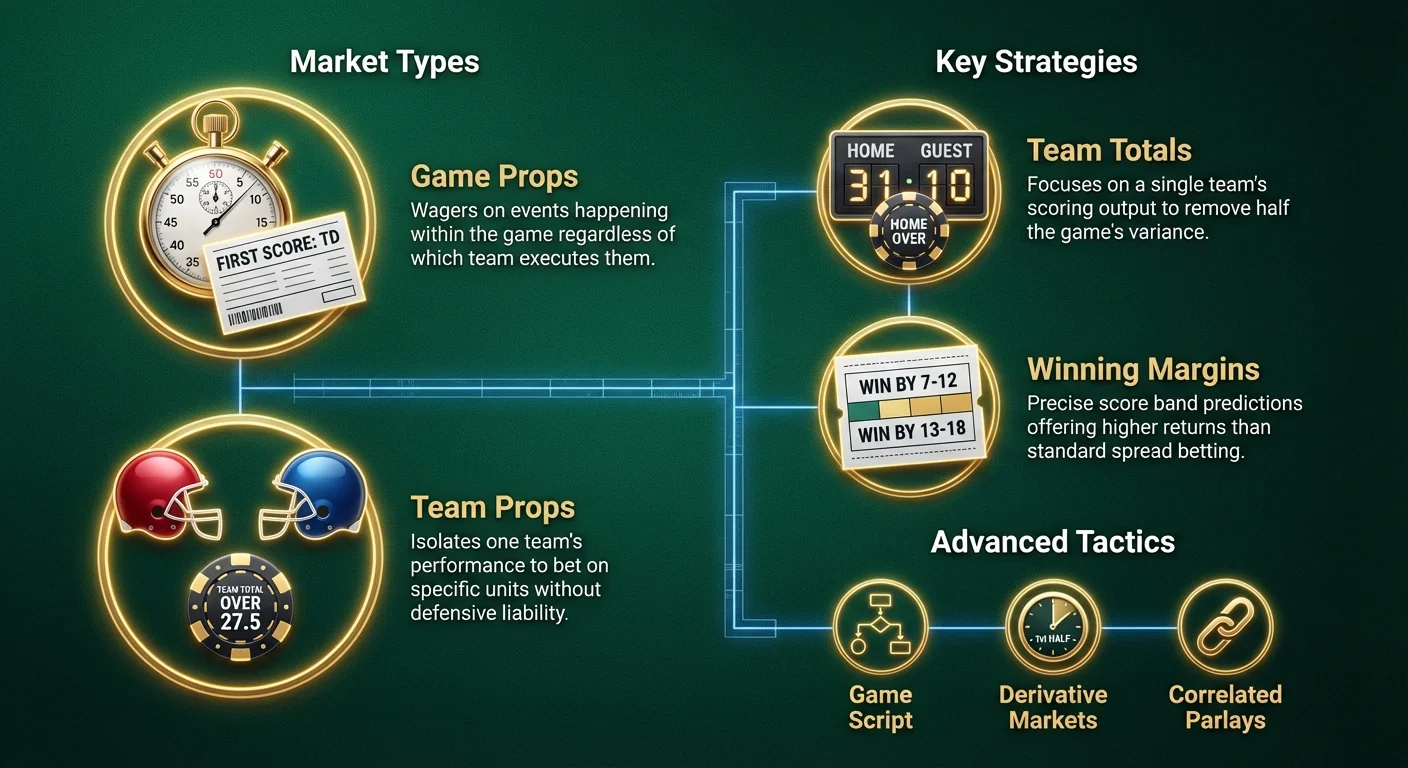
- Game Props: These are wagers on events that happen within the game, regardless of which team executes them.
- Examples: Will the game go to overtime? Will the total score be odd or even? What will be the first scoring play (Touchdown/Field Goal/Safety)? Will there be a run scored in the first inning (NRFI/YRFI)?
- Team Props: These isolate one team's performance from the other. This allows you to bet on a team's offense without sweating their defense, or vice versa.
- Examples: Team Total Points (Over/Under), Team to Score First, Team to Win Both Halves, Team Total Corners (Soccer).
Why "Sharps" Love Alternative Markets
The main lines (spread/total) attract the most volume. Because of this, sportsbooks adjust them rapidly. If a sharp bettor puts 5 BTC on the Chiefs -3, the line moves to -3.5 instantly.
However, prop markets are "softer." Bookmakers cannot devote the same computational resources to pricing the "Race to 10 Points" prop as they do the final spread. Consequently, you will often find lines that are stale or simply mispriced based on recent news or tactical matchups. The trade-off is that limits are generally lower, but for most bettors building a bankroll, the limits on crypto sites are more than sufficient.
Strategy 1: Mastering Team Totals
The Team Total is arguably the most valuable tool in the intermediate bettor's arsenal. It allows you to remove half of the variance from a standard Over/Under bet.
The Problem with Full Game Totals
Imagine you are betting on an NFL game between the Buffalo Bills (high offense) and the New England Patriots (defensive struggles, poor offense). The Total is set at 48.5. You like the Over because you think Buffalo will score at will. However, if New England's offense is completely incompetent and scores only 7 points, Buffalo could score 35 and the game still lands on 42 (Under). You correctly predicted Buffalo's dominance but lost the bet because of New England's failure.
The Team Total Solution
In this scenario, betting Buffalo Bills Team Total Over 27.5 is the superior play.
- Scenario A: Buffalo wins 31-10.
- Full Game Over 48.5: LOSS (Total 41)
- Buffalo Team Total Over 27.5: WIN (31 points)
- Scenario B: Buffalo wins in a shootout 34-31.
- Full Game Over 48.5: WIN
- Buffalo Team Total Over 27.5: WIN
By isolating the team total, you are betting strictly on the specific mismatch you identified (Buffalo offense vs. NE defense) rather than relying on the opponent to contribute to the score.
When to Bet Team Totals
- Garbage Time Protection: When betting a heavy favorite's team total over, you benefit from them scoring late to run up the score, even if the defense allows a backdoor cover on the spread.
- Fading the Public: Often, public perception inflates the full game total. If two good defenses play, the public might still bet the Over because they like the quarterbacks. The "Under" on specific team totals is often safer than the full game Under, specifically if one team has a banged-up offensive line.
Strategy 2: Winning Margins and Bands
Betting the spread is a binary outcome. Betting Winning Margins allows you to increase your odds significantly by being more precise with your prediction. This is a high-value strategy in alternative betting markets.
The "Ladder" Approach
Instead of betting a favorite at -7.5 (standard odds -110 or 1.91), look at the Winning Margin props.
| Market | Selection | Approx. Odds | Analysis |
|---|---|---|---|
| Spread | Favorites -7.5 | -110 (1.91) | Needs a win by 8+. Safe, standard. |
| Winning Margin | Win by 7-12 | +450 (5.50) | High risk, but captures the key number of 7 and 10. |
| Winning Margin | Win by 13-18 | +600 (7.00) | Captures key numbers 14 and 17. |
| Alternative Spread | Favorites -13.5 | +220 (3.20) | Aggressive spread betting. |
If you believe a team will dominate, but not by 40 points, splitting your unit between the "Win by 7-12" and "Win by 13-18" bands can yield a much higher return than a simple spread bet.
Soccer and "To Win to Nil"
In soccer, the "Win to Nil" (Team to win and keep a clean sheet) is a massive value prop compared to the standard Moneyline.
- Scenario: Manchester City vs. a bottom-tier team.
- Moneyline: -500 (1.20). Unbettable due to low value.
- Win to Nil: -120 (1.83).
If you believe the underdog cannot score, you turn a heavy favorite into a near-even money bet.
Strategy 3: Game Script and Correlation
The "Game Script" is the narrative of how a match unfolds. Successful prop betting relies on visualizing the game flow.
The "Race to X" Prop
A popular game prop is "Race to 10 Points" or "Race to 20 Points." This is distinct from who wins the game.
- The Fast Starter: Some teams are historically excellent in the first quarter but fade in the second half due to lack of depth or coaching adjustments.
- Strategy: If an underdog has a scripted opening drive (common in NFL) or a high-pace starting five (NBA), you can bet them to win the "Race to 10" at plus-odds, even if you think they will lose the game eventually.
Correlated Parlays (Same Game Parlays)
Crypto sportsbooks are increasingly offering Same Game Parlays (SGP). The key here is correlation. You want to bet on outcomes that support each other.
- Bad Correlation (Do Not Do This):
- Team A to Win AND Total Points Under (If Team A is a high-flying offense).
- Good Correlation:
- The Blowout Script: Team A -6.5 Spread + Team A Team Total Over + Team B Team Total Under.
- If Team A covers the spread comfortably, it is highly likely they scored a lot and the opponent scored a little. You are essentially making one prediction (a blowout) but getting paid on three different market legs.
Strategy 4: Derivative Markets (Halves and Quarters)
Derivatives are props that focus on a specific segment of the game.
First Half vs. Full Game
In the NBA and NFL, motivation varies by quarter.
- The "Back-to-Back" Fade (NBA): If a team is playing the second night of a back-to-back, they often have "heavy legs" in the second half. However, adrenaline carries them through the first half.
- The Strategy: Instead of betting the opponent on the full game spread (where the tired team might rally), bet the opponent on the 2nd Half Spread. You are isolating the specific time frame where fatigue sets in.
First 5 Innings (MLB)
In baseball, starting pitchers usually go 5 or 6 innings. The bullpen handles the rest.
- The Ace Advantage: If a team has a Cy Young contender pitching against a mediocre pitcher, but has a terrible bullpen, betting the Full Game Moneyline is risky. The bullpen could blow the lead in the 8th inning.
- The Strategy: Bet the First 5 Innings Moneyline. You are betting strictly on the starting pitching matchup, neutralizing the risk of a bullpen collapse.
The Crypto Edge in Prop Betting
Using cryptocurrency for sports betting offers distinct advantages specifically tailored to the prop market.
1. Market Variety and Exotic Props
Crypto-native sportsbooks often run on more agile technology stacks than legacy fiat bookmakers. This allows them to offer a wider array of "exotic" props, such as:
- eSports map-specific props (Baron kills, Pistol round winners).
- Political props.
- Entertainment props.
2. High Limits and Instant Liquidity
Prop markets usually have lower betting limits than spreads because they are vulnerable to sharp bettors. However, major crypto sportsbooks often maintain higher ceilings for these markets or allow for "re-betting" (placing the max bet multiple times) more freely than regulated fiat books. Furthermore, if you hit a massive "Correct Score" prop at +5000 odds, getting your payout instantly via Bitcoin or USDT is preferable to waiting days for a bank transfer.
3. Micro-Betting (Live Props)
Crypto sites excel at live betting due to the automated nature of deposits. "Micro-betting" involves betting on the outcome of the next play (e.g., Next Drive Result: Punt/TD/Turnover). This requires instant execution. The friction-less nature of crypto wallets connected to Web3 betting sites allows for high-frequency interaction with these rapid-fire markets.
Risk Management for Props
While game props offer high value, they also carry higher variance (swings in bankroll).
The "Pizza Money" Rule
Unless you have modeled the prop mathematically, your standard unit size for props should generally be smaller than your unit size for main markets. If your standard bet is 1 unit on a Spread, consider risking 0.5 units or 0.25 units on high-odds props like "First Touchdown Scorer."
Line Shopping is Mandatory
The price discrepancy in alternative markets is massive.
- Book A: Team Total Over 24.5 is priced at -110.
- Book B: Team Total Over 24.5 is priced at -130.
- Book C: Team Total Over 23.5 is priced at -115.
In the example above, Book C offers a massive advantage by lowering the total by a full point. In the NFL, 24 is a key number. If the team scores 24, you win at Book C but push or lose (depending on the hook) at Book A/B. Always hold balances at multiple crypto sportsbooks to snag the best number.
Beware of "Sucker Props"
Not all props are created equal.
- Coin Toss: A purely 50/50 event often priced at -110 on both sides. This is a mathematical guarantee of losing money over time due to the juice (vig). Never bet props where there is zero skill edge.
- Odd/Even Totals: Similar to the coin toss, this is randomness disguised as a bet. Avoid these unless you are simply gambling for entertainment.
Summary: Elevating Your Game
Moving beyond the spread and total requires a shift in mindset. You are no longer asking "Who will win?"; you are asking "How will they win?"
To recap your path to profitability in alternative betting markets:
- Isolate Variables: Use Team Totals to bet on an offense without relying on their defense.
- Seek Precision: Use Winning Margins to get better odds on heavy favorites.
- Use Derivatives: Bet 1st Halves or First 5 Innings to avoid garbage time variance or bullpen failures.
- Correlate: Build parlays where one winning leg makes the second leg more likely to happen.
- Leverage Crypto: Use the speed and variety of crypto books to shop for lines and access live micro-markets.
The main markets are where the public plays. The prop markets are where the prepared bettor finds the inefficiencies. Start analyzing the game scripts, find the mismatch, and place your wagers beyond the final score.