
If you have ever stepped into a digital bingo room on a crypto gambling site, you've likely been bombarded with choices. You see rooms labeled "US Style," "UK Style," "Speed Room," or simply by their ball count: 75, 90, or 30.
For the casual player, the difference might seem purely aesthetic - a different grid shape or a different announcer's voice. However, for the intermediate gambler looking to maximize their Return to Player (RTP) and manage their bankroll effectively, these differences are mathematical pillars that determine your volatility and probability of winning.
Does the 5x5 grid of 75-ball bingo offer better winning chances than the 9x3 strip of 90-ball? Does Speed Bingo burn through your crypto balance too fast, or is it the best way to grind out a wagering requirement?
In this guide, we strip away the superstition and look at the cold, hard math behind bingo variants. We will analyze card structures, game velocity, and odds to help you select the room that aligns with your winning strategy.
The Golden Rule of Bingo Mathematics
Before dissecting the specific variants, you need to understand the fundamental equation that governs all bingo games, whether you are playing with Bitcoin, Ethereum, or fiat currency.
Unlike Blackjack or Poker, where skill can alter the house edge, bingo is a game of probability based on participation.
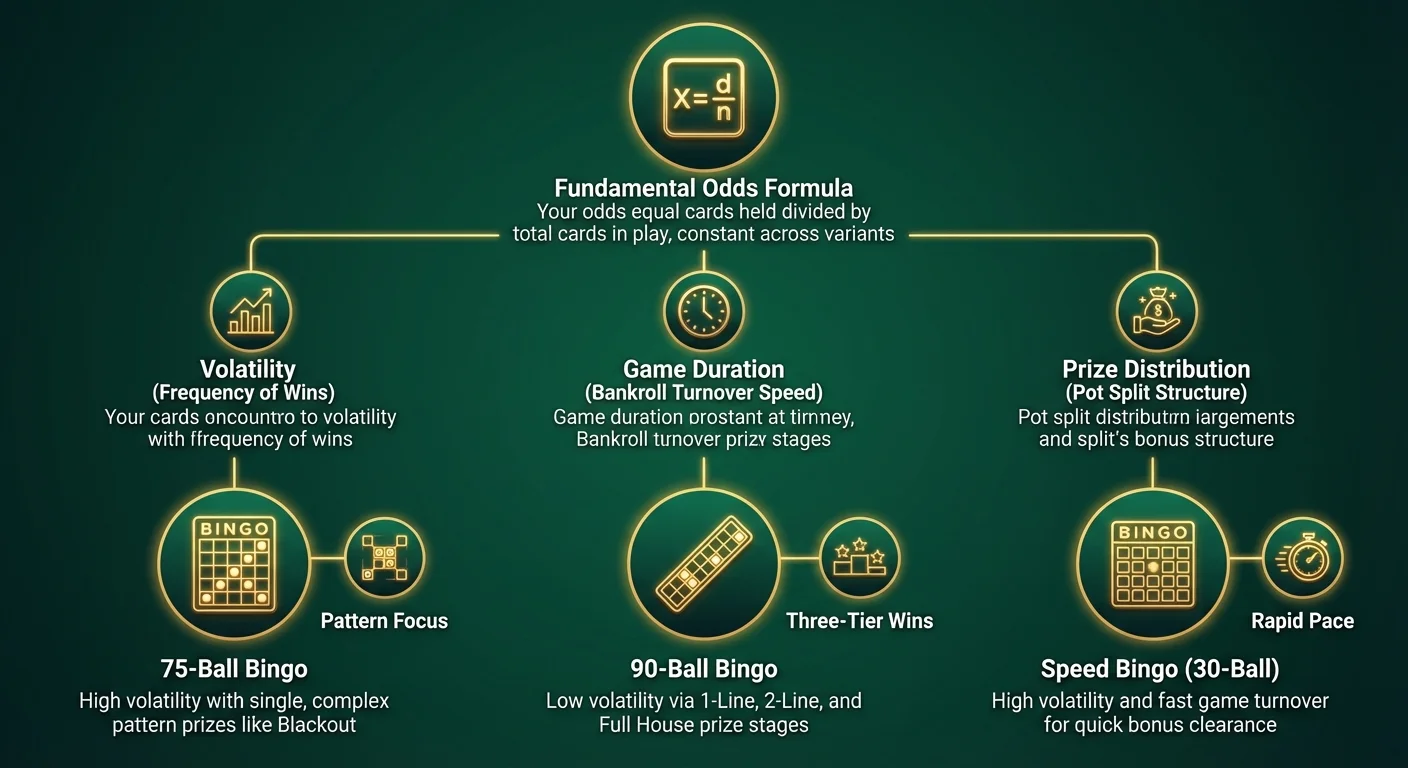
The Fundamental Odds Formula:
If you buy 10 cards in a game where 100 cards have been sold, your chance of winning that specific game is 10%. This rule remains constant regardless of whether you are playing 75-ball or 90-ball.
However, the Variant determines three critical factors:
- Volatility: How often wins occur.
- Game Duration: How quickly your bankroll turns over.
- Prize Distribution: Whether the pot is split or winner-takes-all.
75-Ball Bingo: The American Standard
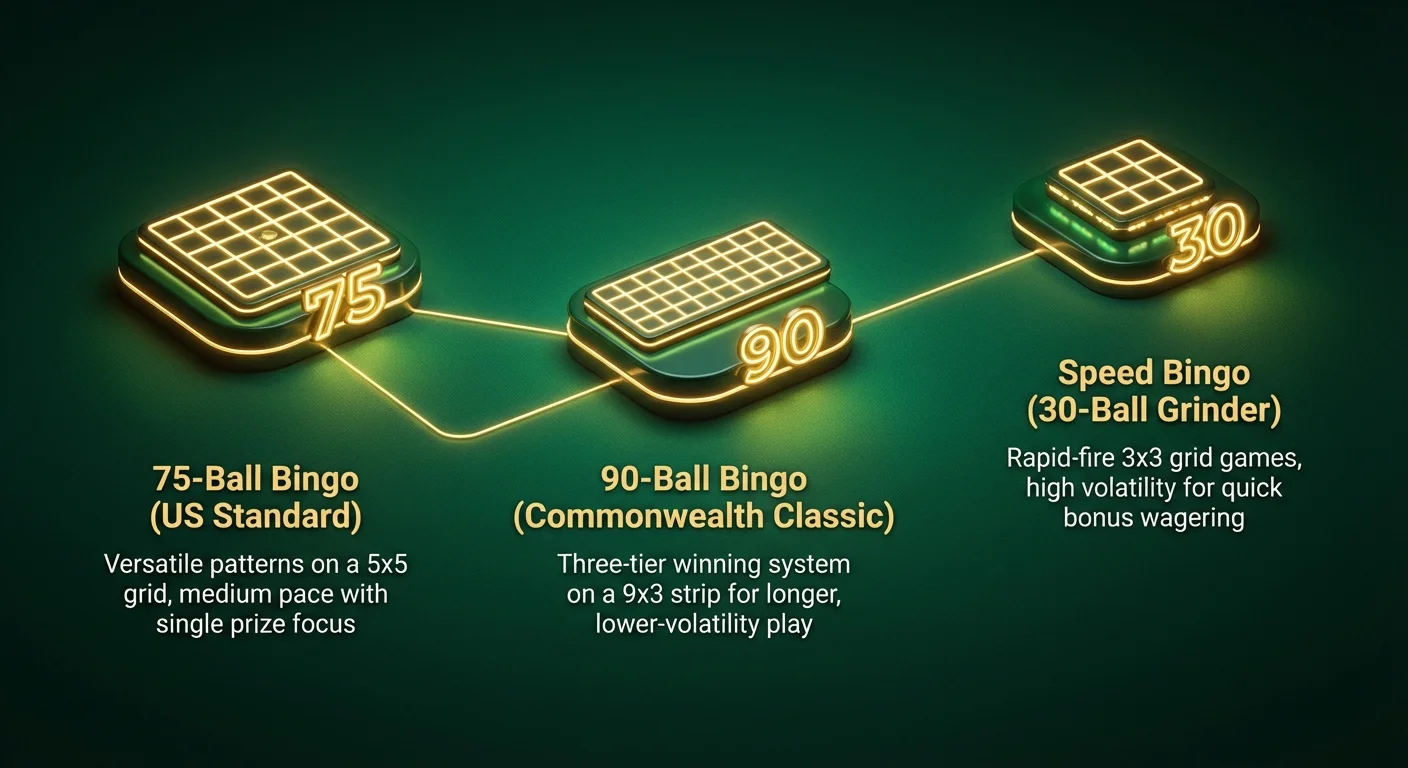
75-ball bingo is the dominant format in North America and a staple on most crypto gambling sites. It is known for its versatility regarding winning patterns.
The Structure
- The Grid: A 5x5 square featuring 25 spaces.
- The Numbers: 1 through 75.
- The Free Space: The center square is automatically marked, meaning you only need to match 4 numbers to clear a line through the center.
- The Letters: Columns are labeled B-I-N-G-O (B: 1-15, I: 16-30, N: 31-45, G: 46-60, O: 61-75).
The Odds and Strategy
The defining characteristic of 75-ball bingo is the Pattern. In 90-ball, you are almost always playing for lines. In 75-ball, you might be playing for a "Blackout" (cover all), an "X," a "Kite," or "Four Corners."
Mathematical Implication:
The complexity of the pattern dictates the length of the game and the variance.
- Simple Patterns (Lines/Corners): These games end quickly. The randomness of the RNG (Random Number Generator) means the distribution of numbers is wide, so simple patterns often result in split pots (multiple players getting Bingo on the same ball).
- Complex Patterns (Blackout): These take much longer. As more numbers are called to achieve a blackout, the probability of a player hitting the pattern increases exponentially toward the end of the call stack.
Strategy Tip: If you are playing 75-ball on a crypto site, look for "Pattern" games rather than simple "Line" games if you want to reduce the chance of splitting the pot. A Blackout game usually results in a single winner, maximizing the payout for that lucky hit.
90-Ball Bingo: The Commonwealth Classic
Popular in the UK, Europe, and Australia, 90-ball bingo offers a distinct structural difference that changes the "payout flow."
The Structure
- The Grid: A 9x3 grid (9 columns, 3 rows).
- The Numbers: 1 through 90.
- The Layout: Each row has 5 numbers and 4 blank spaces. A strip of 6 tickets contains every number from 1 to 90 exactly once.
The Three-Tier Win System
This is where 90-ball mathematically diverges from 75-ball. Almost every game of 90-ball is played in three stages, meaning there are three winners per round:
- 1 Line: Covering all numbers on any single horizontal row.
- 2 Lines: Covering all numbers on any two horizontal rows.
- Full House: Covering all 15 numbers on the ticket.
The Odds and Strategy
Because there are three prizes per game, 90-ball bingo has lower volatility than 75-ball.
Even if you don't win the grand prize (Full House), you have statistical opportunities to win smaller amounts (1 Line or 2 Lines) along the way. This makes 90-ball superior for bankroll preservation. You are getting more playtime and more frequent "return" events, even if the 1-Line prize is essentially just winning your stake back.
The "Strip" Strategy:
In 90-ball, you can often buy a "strip" of 6 cards. Because this strip contains every number from 1-90, you are mathematically guaranteed to mark off a number on every single call. While this doesn't change your odds of winning the pot (which is based on total cards in play), it dramatically reduces the psychological variance of "dead games" where you don't mark anything for ten calls.
Speed Bingo (30-Ball): The Crypto Grinder
Speed Bingo (often called "Zoom" or "30-Ball") is a modern invention perfect for the crypto gambler. It is designed for mobile play and short attention spans.
The Structure
- The Grid: A tight 3x3 grid (9 numbers total).
- The Numbers: 1 through 30.
- The Pace: Numbers are called rapidly, and games often finish in less than 90 seconds.
The Odds and Strategy
Speed bingo is high-octane gambling. The House Edge applies faster here because you are playing more games per hour.
- Pros: If you are trying to clear a deposit bonus or rakeback requirement on a crypto casino, Speed Bingo offers the highest Volume per Hour.
- Cons: High volatility. Because there are only 30 numbers, the gap between winning and losing is razor-thin. A game can end in as few as 9 calls.
Mathematical Implication:
In Speed Bingo, the saturation of cards is usually lower (fewer people can keep up manually, though auto-daub solves this). However, the churn rate is high. If the house holds a 5% edge, playing 60 games an hour in Speed Bingo will drain a bankroll faster than playing 10 games an hour in 75-ball, unless you are hitting wins.
Comparative Breakdown: 75 vs. 90 vs. Speed
To help you choose, here is a breakdown of how these variants stack up against each other regarding odds and gameplay mechanics.
| Feature | 75-Ball | 90-Ball | Speed (30-Ball) |
|---|---|---|---|
| Grid Size | 5x5 (24 numbers + free space) | 9x3 (15 numbers) | 3x3 (9 numbers) |
| Total Numbers | 75 | 90 | 30 |
| Winning Chances | Usually 1 per game (sometimes more for specific patterns) | 3 per game (1L, 2L, Full House) | 1 per game (Full House) |
| Game Duration | Medium (4-6 minutes) | Long (6-10 minutes) | Fast (< 2 minutes) |
| Volatility | Medium | Low (Multiple prizes flatten variance) | High |
| Best For | Pattern lovers & variety | Bankroll preservation & long sessions | Bonus wagering & quick action |
Strategic Analysis: Which Variant Has the "Best" Odds?
If we define "Best Odds" as the highest probability of walking away with profit, the answer depends on your playstyle and the specific room metrics.
1. For the Conservative Player: 90-Ball
If you have a limited amount of Bitcoin or USDT and want to play for an hour, 90-Ball is statistically your best option.
- Why: The split pot (1 Line, 2 Lines, Full House) spreads the RTP (Return to Player) across three winners. This reduces the "all or nothing" nature of the game.
- The Math: In a room with 100 cards, you have three distinct events to beat the 1:100 odds, whereas in Speed Bingo, you only have one.
2. For the Jackpot Hunter: 75-Ball
If you are looking for a significant ROI on a single ticket, 75-Ball Pattern games are superior.
- Why: These games typically have a "Winner Takes All" pot structure. Specific patterns (like the Coverall) often carry progressive jackpots in crypto casinos.
- The Math: While the odds of hitting a specific pattern are harder, the payout ratios are generally higher because the pot isn't diluted by "Line" wins.
3. For the Bonus Hunter: Speed Bingo
If you have claimed a "100% Deposit Match" and need to wager 30x the amount, Speed Bingo is the mathematical choice.
- Why: You need turnover. You need to bet $1000 worth of tickets as fast as possible. 90-ball is too slow for this.
- Warning: Speed bingo requires strict stop-loss limits. The speed of the game means you can spiral quickly.
Advanced Strategies for Crypto Bingo
Now that you understand the variants, here is how to apply intermediate strategies to tilt the odds slightly in your favor.
The "Room Count" Ratio
This is the single most important strategy in online bingo.
- The Concept: Your odds are inversely proportional to the number of cards in play.
- The Move: Avoid peak hours (Friday nights). Play early mornings or late nights.
- The Sweet Spot: Look for rooms where the jackpot is fixed (guaranteed prize pool) but the player count is low. If a room guarantees $100 but only 10 players buy $1 tickets, the room has a Positive Expected Value (+EV) because the casino is subsidizing the overlay.
Granvilles Strategy (Applied to Crypto RNG)
Joseph Granville was a financial writer who applied stock market math to bingo. He argued that in a truly random game (which Provably Fair crypto bingo is), numbers will balance out in the long run.
A winning card should ideally have:
- An equal mix of high and low numbers.
- An equal mix of even and odd numbers.
- An equal mix of numbers ending in 1, 2, 3, 4, 5, 6, 7, 8, 9, and 0.
How to use this: In 75-ball bingo, many crypto sites allow you to "swap" cards before the game starts. If you see a card that is heavy on numbers ending in "5" or heavy on single digits, swap it. Look for the most balanced spread possible.
Tippett's Theory (75-Ball Specific)
L.H.C. Tippett, a statistician, proposed that the longer a 75-ball game lasts, the more the called numbers will gravitate toward the "median" number (38).
- Short Games (Lines/Corners): Choose cards with numbers closer to 1 and 75.
- Long Games (Blackouts): Choose cards with numbers clustered around 38.
The Crypto Advantage: Provably Fair & Instant Payouts
One major advantage of playing these variants on crypto-exclusive sites is the Provably Fair mechanism.
In traditional online bingo, you simply trust the software. In Crypto Bingo, a cryptographic hash is generated before the first ball is called.
- The Seed: You are provided with a hashed server seed.
- The Reveal: After the game, the seed is revealed.
- The Verification: You can plug these numbers into a third-party verifier to prove that the 75, 90, or 30 balls called were predetermined and not manipulated to ensure a specific player (or the house) won.
Plus, winning a Full House in 90-ball on a fiat site might mean waiting 3 days for a withdrawal. On crypto sites, that win hits your wallet instantly, allowing you to re-invest or cash out immediately.
Conclusion: Which Room Should You Join?
There is no single "best" variant, but there is a best variant for you.
- Choose 90-Ball if: You enjoy a social atmosphere, want your bankroll to last longer, and prefer games with multiple chances to win small amounts.
- Choose 75-Ball if: You enjoy variety in patterns and are chasing a single, larger prize pot.
- Choose Speed Bingo if: You are short on time, looking to clear a bonus, or enjoy the adrenaline of rapid-fire gambling.
Ultimately, bingo remains a game of chance. The best strategy is to manage your bankroll, verify the room counts to ensure you aren't playing against thousands of tickets, and take advantage of the transparency that crypto gambling offers.
Good luck, and may the caller pull your numbers!