
If you have ever stood at a bustling craps table in Las Vegas or Atlantic City, you know the unwritten rule: Don't bet against the shooter.
The energy of the table relies on everyone rallying together, screaming for a 7 to stay away, and high-fiving when the point is hit. In this environment, the player betting the "Don't Pass" line - betting that the shooter will fail - is the villain. You are the person profiting from the table's misery. It is socially awkward, often frowned upon, and sometimes actively discouraged by other players.
But here is the secret that professional gamblers have known for decades: The "Dark Side" is mathematically superior.
When you move to the realm of online crypto gambling, the social stigma vanishes. There are no angry glares, no superstitions about "cooling the table," and no peer pressure. It is just you, the algorithm, and the cold, hard probability that favors the house. By betting the "Dark Side," you align yourself with the house mathematics rather than hoping for a lucky streak.
This guide explores the intermediate mechanics of Dark Side Craps, specifically for the online player using Bitcoin or other cryptocurrencies. We will dismantle the "Don't Pass" strategy, explain how to "Lay Odds" effectively, and show you why playing the villain is the smartest move you can make.
The Mathematics of the Dark Side
To understand why the Dark Side is superior, you have to look at the House Edge (HE). In gambling, the House Edge is the mathematical advantage the casino holds over you over an infinite number of bets.
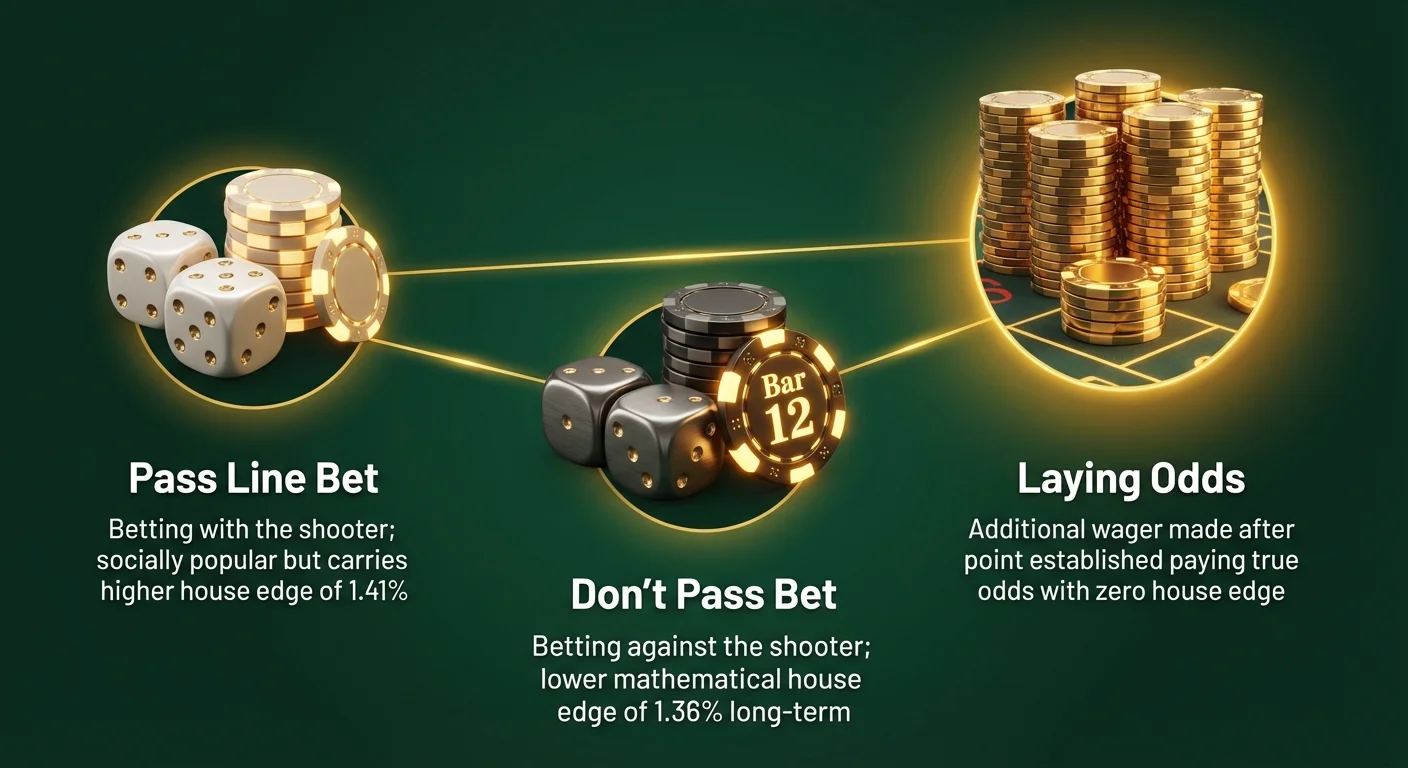
- The Pass Line (The "Light Side"): You bet the shooter will win. The House Edge is 1.41%.
- The Don't Pass Line (The "Dark Side"): You bet the shooter will lose. The House Edge is 1.36%.
While a difference of 0.05% seems negligible to a casual player, to a volume bettor or a crypto grinder using a strategic bankroll, this is significant. It makes the Don't Pass bet one of the absolute best wagers in the entire casino ecosystem, second only to Blackjack played with perfect basic strategy (or Video Poker variations), compared against the entire casino ecosystem.
The "Bar 12" Rule
If betting against the shooter is so good, why doesn't everyone do it? Aside from the social stigma, the casino introduces a mechanic to prevent the player from having a true edge over the house. This is the "Bar 12" rule.
When you bet the Don't Pass:
- Come Out Roll: You win on 2 or 3. You lose on 7 or 11.
- The Push: If the Come Out roll is a 12 (or in some casinos, a 2), it is a Push. You don't win, and you don't lose. This single tie is what preserves the casino's 1.36% edge. Without it, the player would actually have a mathematical advantage over the house.
Why Online Crypto Craps is the Perfect Venue
Physical tables are governed by physics and psychology. Online tables are governed by Random Number Generators (RNG) and Provably Fair algorithms. This distinction is crucial for the Dark Side player.
1. Removing the "Hot Shooter" Fallacy
In live casinos, players fear the "Hot Shooter" - the guy who holds the dice for 45 minutes, hitting point after point. While "Dice Control" is a controversial topic (and largely impossible for the average player), the fear of a controlled throw keeps many away from the Dark Side.
In a crypto casino, every roll is an independent event generated by a SHA-256 hash or similar algorithm. There is no muscle memory, no sticky dice, and no rhythm. The probability of rolling a 7 remains constant at 1 in 6 (16.67%). This purity of probability makes contrarian betting much safer and more predictable online.
2. Speed and Anonymity
Betting the Dark Side requires patience. You are waiting for the inevitable 7 to wipe the board. Online, you control the pace. You can resolve hands instantly. Furthermore, your anonymity is preserved. You aren't "that guy" cheering for a 7; you are simply a wallet address executing a high-RTP (Return to Player) strategy.
3. High Limits for Laying Odds
Crypto casinos often boast higher betting ceilings than traditional online casinos. This is vital for the Dark Side because, as we will discuss next, maximizing your profit requires "Laying Odds," a move that requires a larger bankroll to execute effectively.
The Strategy: Don't Pass and Laying Odds
If you simply bet the Don't Pass flat bet, you are playing a good game, but you aren't playing a great game. To turn this into a powerhouse strategy, you must Lay Odds.
How "Laying Odds" Works
When a shooter establishes a Point (4, 5, 6, 8, 9, or 10), the odds swing in your favor. Why? Because 7 is the most common number with two dice. Once a point is established, it is statistically more likely that a 7 will roll before the point number repeats.
Because you are now the statistical favorite to win, the casino allows you to back up your original bet with an additional wager called "Laying Odds." However, because you are likely to win, you must bet more to win less. This is the opposite of taking odds on the Pass Line.
The Math of Laying Odds
This table breaks down the cost and payout of laying odds against specific points.
| Point Number | True Odds (Lose:Win) | To Win $20, You Must Lay | Payout Ratio |
|---|---|---|---|
| 4 or 10 | 1 : 2 | $40 | Pay 1 to 2 |
| 5 or 9 | 2 : 3 | $30 | Pay 2 to 3 |
| 6 or 8 | 5 : 6 | $24 | Pay 5 to 6 |
The Golden Rule: The House Edge on the "Odds" portion of your bet is 0.00%. The casino pays you exactly the true probability of the roll. By maximizing your Odds bet, you dilute the overall House Edge of your total wager (Flat bet + Odds) down significantly.
- Don't Pass + 1x Odds: Reduces HE to ~0.68%
- Don't Pass + Maximum Odds: Can reduce effective HE to under 0.1% depending on table limits.
Step-by-Step Execution
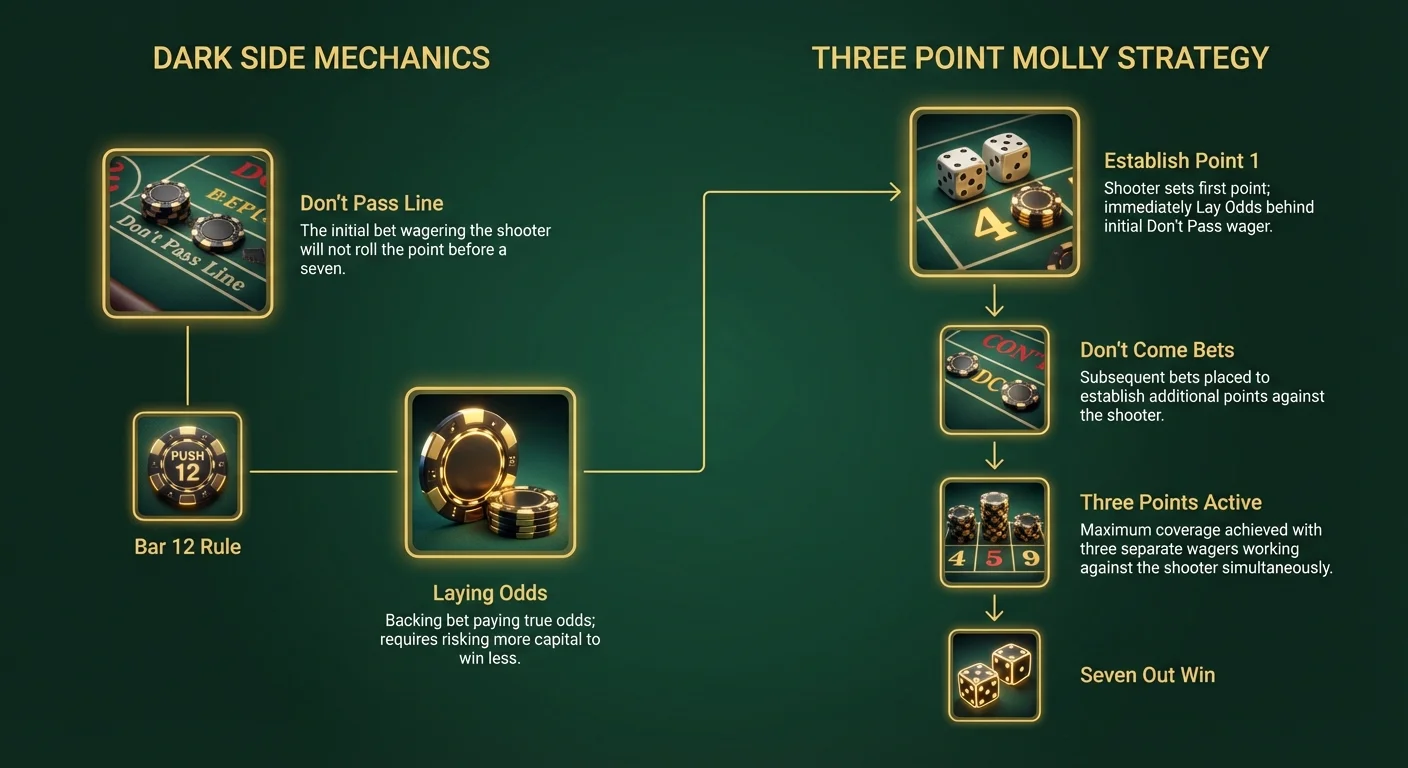
- The Come Out: Place a bet on the Don't Pass bar.
- Win: Roll is 2 or 3.
- Lose: Roll is 7 or 11.
- Push: Roll is 12.
- Point: Any other number becomes the Point.
- The Point Phase: Once the puck switches to "ON," place your chips behind or next to your Don't Pass wager to "Lay Odds."
- Pro Tip: In crypto casinos, ensure you have enough balance in your wallet. If the Point is 4 or 10, you need double your desired win amount to lay odds.
- The Resolution: You wait. You want a 7. If a 7 rolls, your Flat bet wins 1:1, and your Odds bet wins based on the table above. If the Point rolls, you lose both.
The Dark Side "Three Point Molly"
The "Three Point Molly" is a famous aggressive strategy for Pass Line bettors. However, it works exceptionally well in reverse for Dark Side players who want to hedge their volatility and spread their action across multiple numbers. This tactic is part of several advanced betting strategies.
The goal here is to have three separate bets working against the shooter, maximizing your coverage of the board.
How to Execute the Dark Side Molly:
- Bet 1: Place a Don't Pass bet.
- Establish Point 1: Let the shooter establish a point. immediately Lay Odds on this point.
- Bet 2: Place a Don't Come bet.
- The "Don't Come" is mechanically identical to the "Don't Pass," but it is played after the first point is established.
- If the next roll is a 2 or 3, your Don't Come wins immediately. If it's 7 or 11, it loses. If it's a number, that number becomes your personal "Don't Come Point."
- Establish Point 2: Once your Don't Come moves to a number (e.g., the shooter rolls a 5), Lay Odds on that Don't Come bet.
- Bet 3: Place another Don't Come bet.
- Establish Point 3: When this moves to a number, Lay Odds.
- Stop Betting: You now have three numbers working against the shooter (e.g., against the 4, 5, and 9).
The Payoff
You are now waiting for the Seven.
- If the shooter rolls a 7 (the "Seven Out"), ALL THREE of your bets win, and ALL THREE of your Odds bets win. It is a massive payday.
- If the shooter hits one of your numbers (a "Sniper" shot), you only lose that specific bet and its odds. The other two bets remain alive.
This strategy reduces variance compared to betting everything on a single number. You need a decent bankroll to sustain three active bets plus odds, but the "Seven Out" payoff is one of the most satisfying moments in crypto gambling.
What to Avoid: The "Hedge" Trap
Intermediate players often try to outsmart the math by "hedging." The most common error is combining Dark Side betting with Place Bets or Field Bets.
The Field Bet Fallacy
Some guides suggest betting the Don't Pass and then betting the Field (2, 3, 4, 9, 10, 11, 12) to cover yourself.
- The Logic: You win the Don't Pass on 2/3. You win the Field on 2/3/4/9/10/11/12. It feels like you can't lose.
- The Reality: The House Edge on the Field is typically 2.78% (or worse, 5.56% if 2 and 12 only pay double). By mixing a low-edge bet (Don't Pass) with a high-edge bet (Field), you are simply increasing the amount of money you are paying the casino in the long run.
Expert Advice: Do not hedge the Dark Side. Embrace the variance. The math is already in your favor; adding bad bets to "protect" good bets only dilutes your advantage.
Managing Your Bankroll for Contrarian Betting
Playing the Dark Side online requires specific bankroll management (BRM) because you are "Laying" bets.
When you Lay Odds, you are putting up more money than you stand to win. For example, to win $100 on the 4, you must risk $200. This means a streak of "Hot Shooting" (points being hit) can drain a wallet faster than Pass Line betting, requiring strict bankroll management.
Recommended BRM Guidelines:
- Session Bankroll: Should be at least 20x your base bet unit.
- Lay Odds Buffer: If you plan to lay Max Odds, your bankroll needs to be significantly higher (50x base unit).
- Stop Loss: If you lose three consecutive Don't Pass bets (the shooter hits three points in a row), walk away or switch tables. Even in a fair crypto environment, standard deviation creates anomalies. Don't chase losses against a streak of variance.
Summary: The Dark Side Checklist
If you are ready to switch from being a cheerleader to a cold, calculating operator, follow this checklist for your next crypto craps session:
- Check the Rules: Ensure the "Don't Pass" pays 1:1 and pushing on 12 (standard rules).
- Verify Odds Limits: Look for tables that allow "3x, 4x, 5x" odds. The higher the allowance, the better for the Dark Side player.
- Ignore the Chat: Close the player chat. You don't need to explain why you are betting against the table.
- Start with Don't Pass: Bet flat.
- Always Lay Odds: This is where the house edge disappears.
- Expand with Don't Come: If your bankroll allows, use the Dark Side Molly to cover up to 3 numbers.
- Never Hedge: Avoid the Field, Big 6/8, and Hardways. They are mathematically inferior props that eat your profit.
Playing the Dark Side isn't about being negative; it's about being smart. In the physical world, peer pressure forces players into suboptimal bets. In the digital world of crypto gambling, you have the freedom to play the game the way the math intended: Betting on the Seven.