
For the uninitiated, the allure of a slot machine lies in the flashing lights and the dopamine rush of a winning spin. But for the veteran crypto gambler, the eyes are fixed on a different prize: the ticking counter at the top of the screen. This is the progressive jackpot, the "Moon" of the casino world. In the realm of cryptocurrency gambling, where volatility is a lifestyle and Bitcoin values can skyrocket overnight, hitting a progressive jackpot represents the ultimate convergence of luck and timing.
However, treating progressive slots like standard video slots is a rookie mistake that can drain your wallet faster than a market crash. To truly understand how to chase these life-changing sums, you must look under the hood. You need to understand the networks, the contribution rates, the seed values, and the mathematical variance that governs these digital beasts.
This guide moves beyond the basics of "spin and hope." We will dissect the mechanics of progressive networks across crypto casinos, analyze the cost of playing them, and explore whether advantage play is possible in the world of Bitcoin jackpots.
The Engine Room: How Progressive Jackpots Function
At its core, a progressive jackpot is a collective accumulation of capital. Unlike a standard slot machine with a fixed payout table (where 5 Wilds might always equal 500x your bet), a progressive jackpot has no fixed ceiling. It grows with every single bet placed by every single player engaging with the game.
To understand the probability of winning, you must first understand where the money comes from and how it is stored.
The Three Pillars of the Pot
Every progressive jackpot operates using three specific financial mechanisms:
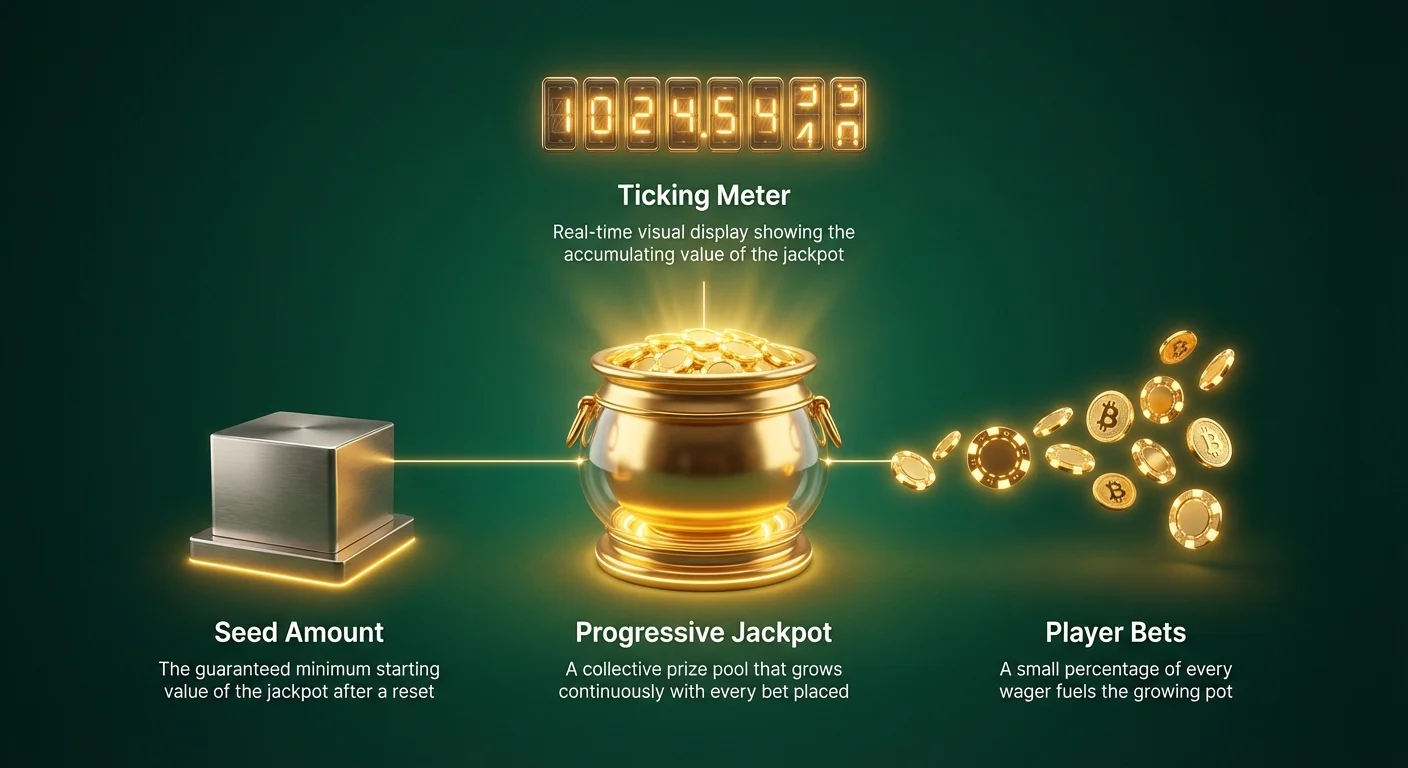
- The Seed Amount: This is the floor, not the ceiling. The seed is the guaranteed minimum amount the casino (or software provider) will pay out if the jackpot is hit immediately after a reset. For example, the legendary Mega Moolah network seeds at 1 million (currency units). In crypto terms, a game might seed at 1 BTC. This ensures that even if you win the jackpot 10 seconds after someone else, it is still a significant prize.
- The Contribution Rate: This is the "tax" you pay for the chance to win big. On a standard slot, perhaps 96% of money wagered is returned to players (RTP). On a progressive slot, a percentage of every wager is shaved off to fund the jackpot. This is usually between 1% and 5% of the total bet.
- The Meter: This is the visual representation of the jackpot size. In modern crypto slots, this meter updates in real-time, often ticking up by fractions of a Bitcoin or USDT every second as bets flow in from around the world.
The Probability of the Trigger
How does the game actually decide you are the winner? It is not simply about lining up cherries. In the world of crypto progressive jackpots, there are three main trigger mechanisms:
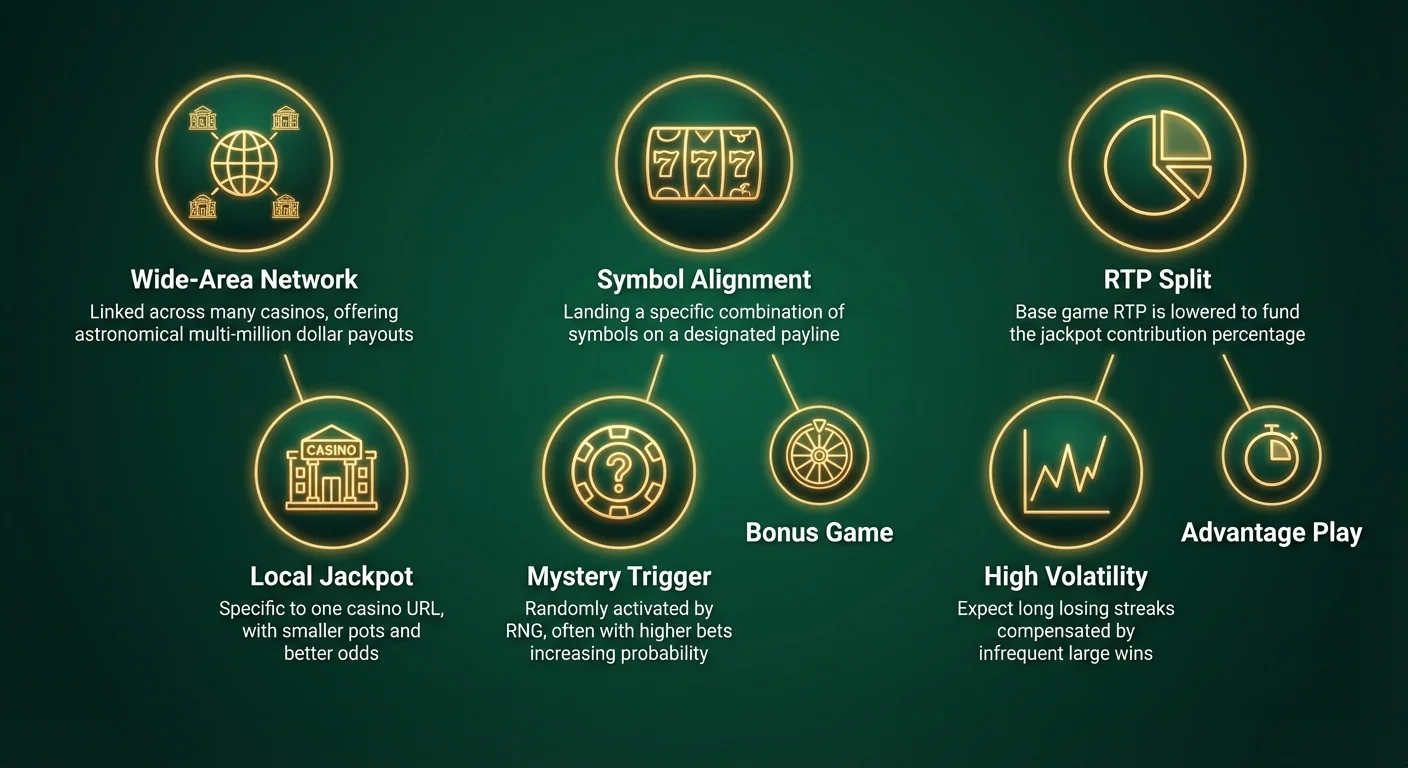
- Symbol Alignment: The traditional method. You must land a specific combination of symbols (e.g., five "Mega Jackpot" symbols) on the 5th payline while betting the maximum coins.
- The Mystery Trigger: Driven entirely by a Random Number Generator (RNG). The jackpot can trigger on any spin, regardless of the symbols on the screen. However, in many of these algorithms, the probability of triggering the jackpot increases proportionally with the size of your bet.
- The Bonus Game: The base game triggers a mini-game (like a wheel spin or a "pick-em" screen). The outcome of this mini-game determines if you win the Mini, Minor, Major, or Mega jackpot.
Network Architecture: Local vs. Wide-Area
When you log into your favorite crypto casino, it is vital to know who you are competing against. The scope of the network significantly impacts the frequency of wins and the size of the pot.
Local (In-House) Jackpots
These are specific to the single crypto casino you are playing at.
- The Pool: Only bets placed by players at that specific URL contribute to the pot.
- The Pros: The competition is lower. Your odds of winning are statistically better because you aren't competing with millions of global players.
- The Cons: The jackpots grow slowly and rarely reach "retirement" levels. They usually cap out in the thousands or tens of thousands of dollars range.
Wide-Area (Network) Jackpots
These are hosted by the software providers (e.g., Microgaming, NetEnt, Playtech, or Pragmatic Play) and linked across hundreds of different crypto and fiat casinos.
- The Pool: A player spinning in Tokyo, a player in London, and you spinning in your living room are all feeding the same pot.
- The Pros: The jackpots are astronomical. These are the games that deliver multi-million dollar payouts.
- The Cons: The odds are akin to a national lottery. You are competing against the entire global gambling population.
Crypto-Native Progressive Networks
A newer phenomenon is the "Provably Fair" jackpot network found on strictly blockchain-based casinos. These often utilize a proprietary system where the jackpot is held in a transparent smart contract.
- Transparency: You can view the pot address on the blockchain.
- Payouts: Instant and automated. Unlike traditional networks that may pay widely networked jackpots in monthly installments, crypto-native jackpots often settle instantly to your wallet.
The Mathematical Cost: RTP and Variance
Intermediate players often make the mistake of looking at a game's RTP (Return to Player) without adjusting for the jackpot contribution. This is critical for bankroll management.
If a slot advertises an RTP of 95%, but it features a progressive jackpot, the base game RTP is significantly lower.
The RTP Split Explained
Let's assume a popular Bitcoin slot has an RTP of 94% and a jackpot contribution of 5%.
- Base Game RTP: 89%
- Jackpot Contribution: 5%
- Total RTP: 94%
What this means for you: You are playing a slot with an 89% return rate during regular play. This is a very "tight" machine. Your bankroll will deplete much faster than on a non-progressive slot with a 96% RTP. You are essentially paying a premium subscription fee on every spin for the lottery ticket attached to the game.
Volatility and The "Long Tail"
Progressive slots are almost exclusively High Volatility (or High Variance). The game is designed to pay out small amounts infrequently to compensate for the massive liability of the jackpot.
- Short Term: Expect long streaks of dead spins or wins that do not cover your bet size.
- Long Term: The statistical return is heavily weighted toward the jackpot winner. If you don't win the jackpot, your personal RTP for the session could be as low as 60-70%.
Strategy: Is Advantage Play Possible?
In the world of standard slots, the house always has the edge. However, progressive jackpots present a unique mathematical anomaly where, under specific conditions, the game can offer a Positive Expected Value (+EV). This is known as Advantage Play.
The Break-Even Point
Every progressive jackpot has a mathematical "break-even" point. This occurs when the jackpot grows so large that the potential payout outweighs the cost of playing.
Example:
Imagine a lottery where tickets cost $1, and the odds are 1 in 1 million.
- If the jackpot is $500,000, every ticket you buy has a value of -$0.50.
- If the jackpot hits $2,000,000, every ticket you buy has a positive expected value (statistically worth $2).
While you cannot calculate the exact odds of a slot machine (as they are proprietary), seasoned advantage players monitor "Must Drop" jackpots.
"Must Drop" and "Daily Drop" Jackpots
Many modern crypto slots (especially from providers like Red Tiger Gaming) feature guaranteed jackpots.
- Daily Drop: Must pay out before a specific time (e.g., 23:59 UTC).
- Must Drop By: Must trigger before the pot reaches a certain amount (e.g., 5 BTC).
The Strategy:
If a "Must Drop by 5 BTC" jackpot is currently sitting at 4.9 BTC, the probability of it triggering in the next few spins skyrockets. The machine must force a win. Playing strictly during these windows is the only way to mathematically flip the edge in your favor.
The Hot and Cold Fallacy
Contrary to advantage play, many gamblers fall for the "Hot/Cold" fallacy on standard network jackpots.
- The Myth: "This jackpot hasn't paid out in 6 months; it is due."
- The Reality: Unless it is a "Must Drop" game, a random number generator has no memory. The odds of winning on the day after a reset are exactly the same as the odds of winning when the pot is at an all-time high. The only difference is the value you get for your risk, not the likelihood of winning.
Practical Guide: Maximizing Your Chances
If you decide to allocate a portion of your bankroll to chasing the moon, follow these tactical rules to ensure you are eligible for the win and protecting your assets.
1. Check the Qualifying Bet Requirements
This is the most heartbreaking mistake in gambling. Many older progressive slots require you to play the Max Bet or active all Paylines to qualify for the jackpot.
- Scenario: You bet 1 coin and line up the 5 Jackpot symbols.
- Result: You win a fixed prize (e.g., 2,000 coins) instead of the multi-million dollar progressive pot because you didn't bet the required 3 or 5 coins.
- Action: Always read the "Info" or "Paytable" tab before spinning. If your bankroll cannot sustain Max Bet spins, move to a cheaper machine (lower denomination) where you can afford the max bet.
2. Choose Your Variance Tier
Not all jackpots are created equal. Choose the tier that matches your goal.
| Jackpot Type | Seed Value | Hit Frequency | Volatility | Recommended For |
|---|---|---|---|---|
| Hourly/Daily Drop | Low ($100 - $1k) | Very High (Multiple/Day) | Medium | Casual players wanting fun wins |
| Local Progressive | Medium ($10k - $50k) | Medium (Weekly/Monthly) | High | Players seeking a new car, not a new life |
| Network Mega | Huge ($1M+) | Very Low (Yearly) | Extreme | Dreamers chasing "Retirement Money" |
3. Leverage Crypto Bonuses (With Caution)
Crypto casinos often offer massive deposit matches (e.g., 100% up to 1 BTC). Using bonus funds to play progressives seems smart, but you must check the Terms and Conditions.
- Restricted Games: Many casinos exclude progressive slots from bonus wagering. Playing them with bonus funds could void your winnings.
- Max Win Caps: Some bonuses limit your withdrawal to 10x your deposit. Imagine winning a $5 million jackpot but only being allowed to withdraw $1,000 because you used a bonus.
- Rule: Always play progressive jackpots with Real Money (Cash Balance), never bonus funds, unless the T&Cs explicitly state otherwise.
4. Understand Currency Conversion
In crypto gambling, visual display matters.
- Some games display the jackpot in fiat (USD/EUR) even if you bet in BTC. The conversion happens at the moment of the win.
- Other games display in mBTC or uBTC.
- Ensure you understand the denomination. Betting 0.1 BTC is vastly different from betting 0.1 mBTC.
Summary: The Smart Way to Chase
Progressive jackpots are the lottery tickets of the crypto casino world. They offer the highest potential returns but come with the steepest costs in terms of RTP and variance. To survive the chase, you must respect the math.
- Acknowledge the Cost: Accept that you are paying a premium for the chance to win big. The base game will drain your balance faster than usual.
- Verify Eligibility: Never play a progressive unless you meet the Max Bet or Payline requirements.
- Hunt for Value: Look for "Must Drop" jackpots nearing their limits for a mathematically superior opportunity.
- Bankroll Partitioning: Keep your "Jackpot Budget" separate from your regular gameplay budget. Treat it as money spent on entertainment, not an investment.
Chasing the moon is thrilling, and in the world of crypto, where payouts are instant and provably fair, the experience is cleaner than ever. Just remember to keep your feet on the ground while your eyes are on the prize.