
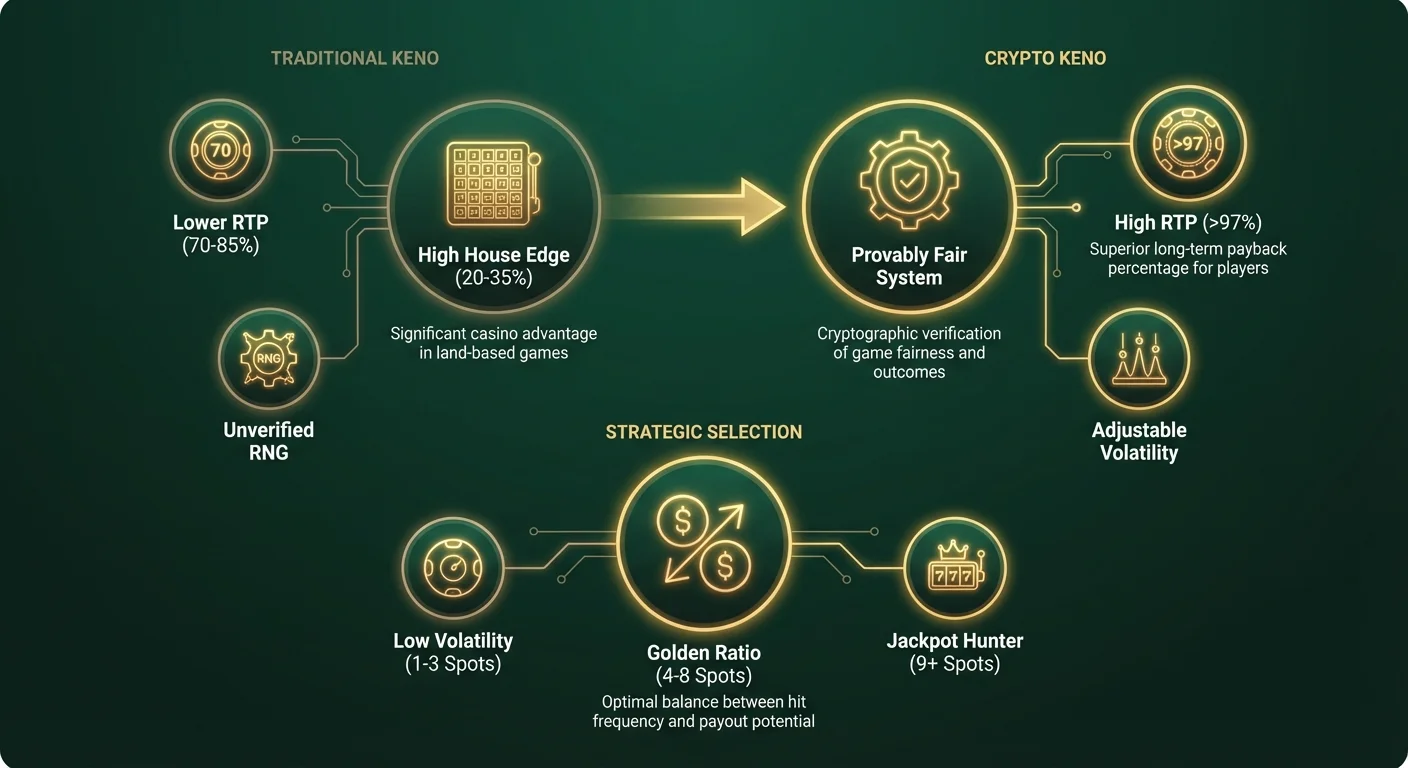
Keno is often dismissed by "serious" gamblers as a game of pure luck with a punishing house edge. In the traditional land-based casino world, this reputation is well-earned; state lotteries and brick-and-mortar casinos often run Keno games with a House Edge ranging from 20% to 35%. However, the landscape of crypto gambling has fundamentally altered the mathematics of this ancient game.
By leveraging the efficiency of blockchain technology, crypto Keno variants often boast Return-to-Player (RTP) rates exceeding 97% - rivaling slots and even some table games. But a high RTP doesn't mean you will win automatically. To navigate the board effectively, you must understand the probability curves, the variance of different "pick" amounts, and the immutable laws of combinatorics.
This guide moves beyond superstition and "lucky patterns." We are analyzing the hard data, the hypergeometric distributions, and the specific advantages of crypto Keno house edge mechanics to help you make mathematically sound decisions.
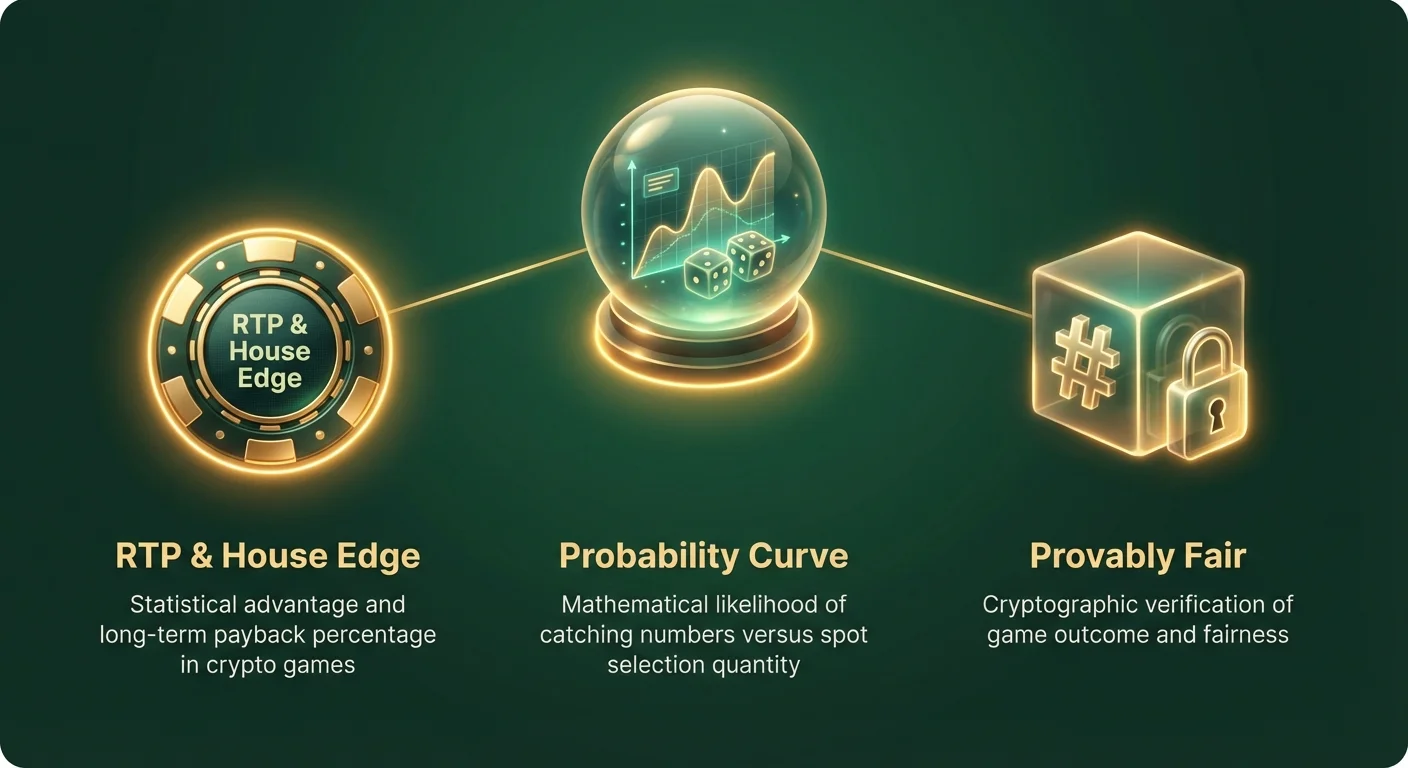
Understanding the Engine: RTP and House Edge
Before selecting numbers, every player must understand the cost of doing business. In gambling mathematics, the House Edge is the statistical advantage the casino holds over the player, while RTP is the percentage of wagered money a machine will pay back to players over an infinite number of spins.
In traditional Keno, if you bet $100 and the RTP is 70%, you are statistically expected to lose $30. In the crypto landscape, competition and lower overheads have driven the Keno RTP up significantly.
Land-Based vs. Crypto Keno: The Gap
The difference is staggering. Here is a comparison of typical margins:
| Venue Type | Typical RTP | House Edge | Volatility |
|---|---|---|---|
| State Lottery Keno | 50% - 60% | 40% - 50% | Very High |
| Vegas Casino (Lounge) | 70% - 80% | 20% - 30% | High |
| Video Keno Machine | 85% - 92% | 8% - 15% | Medium |
| Crypto/Blockchain Keno | 96% - 99% | 1% - 4% | Adjustable |
Mathematical Takeaway: Never play Keno unless you have verified the RTP is above 96%. In crypto casinos, this information is usually available in the "Game Info" or Provably Fair tab. Playing a 70% RTP game is mathematically indefensible when 99% options exist.
The Mathematics of the Draw
Standard Keno involves 80 balls, with 20 drawn by the Random Number Generator (RNG). The number of possible outcomes is astronomical. The total number of ways to draw 20 numbers from a pool of 80 is calculated using combinatorics:
That is roughly 3.5 quintillion combinations. Because the pool is so massive, predicting the exact 20 numbers is impossible. However, we don't need to predict all 20. We only need to predict the "Spots" we select.
The Probability Curve
The most common mistake new players make is assuming that picking more numbers equates to better odds of winning. This is false. Picking more numbers increases your ceiling (maximum payout), but it often increases the volatility (frequency of losing rounds).
We use Hypergeometric Distribution to calculate the probability of hitting $k$ spots when you pick $n$ numbers.
Keno Odds Chart: Analyzing the "Middle Ground"
To make an informed decision, you must look at the probability of catching your numbers versus the payout offered. Below is a Keno odds chart breaking down the probability of hitting a specific number of catches based on how many spots you picked.
The "Pick 1" to "Pick 5" Probability Matrix
| Numbers Picked | Catch 1 | Catch 2 | Catch 3 | Catch 4 | Catch 5 |
|---|---|---|---|---|---|
| Pick 1 | 25.00% | - | - | - | - |
| Pick 2 | 38.00% | 6.00% | - | - | - |
| Pick 3 | 43.10% | 13.90% | 1.40% | - | - |
| Pick 4 | 43.30% | 21.30% | 4.30% | 0.30% | - |
| Pick 5 | 40.50% | 27.00% | 8.40% | 1.00% | 0.10% |
Analysis:
- The 25% Rule: If you pick 1 number, you have exactly a 1 in 4 chance of hitting it. This is the lowest variance bet in Keno.
- The "Pick 5" Sweet Spot: Notice that in a Pick 5 game, you have a 27% chance of hitting 2 numbers and an 8.4% chance of hitting 3. Many crypto paytables start paying out at 2 or 3 catches.
The "Pick 10" Probability Matrix (High Variance)
When you move to picking 10 numbers, the math becomes counter-intuitive. You might expect that hitting 5 out of 10 is a 50/50 shot. It is not.
| Catches (out of 10) | Probability | Approximate Odds |
|---|---|---|
| 0 | 4.6% | 1 in 22 |
| 1 | 14.7% | 1 in 7 |
| 2 | 29.5% | 1 in 3.4 |
| 3 | 26.7% | 1 in 3.7 |
| 4 | 14.7% | 1 in 6.8 |
| 5 | 5.1% | 1 in 19 |
| 6 | 1.6% | 1 in 63 |
| 7 | 0.3% | 1 in 341 |
| 8 | 0.07% | 1 in 1,354 |
| 9 | 0.006% | 1 in 16,000 |
| 10 | 0.00001% | 1 in 8.9 Million |
Crucial Insight: The most likely outcome when picking 10 numbers is hitting 2, 3, or 4 numbers.
- Most paytables do not pay for 0, 1, 2, 3, or 4 catches on a 10-spot ticket.
- This creates a "Dead Zone." You will hit 2, 3, or 4 numbers roughly 70% of the time, and usually lose your wager.
- To play 10 spots effectively, you need a bankroll capable of withstanding long losing streaks while chasing the 5+ catch payouts.
Strategic Selection: The Optimal Spot Count
Based on the math above, we can categorize Keno strategies into three tiers of risk. Your choice should depend on your bankroll and goals.
1. Low Volatility: The "Grinder" (1 to 3 Spots)
If your goal is to play for a long time and clear a wagering requirement (for a crypto bonus), stick to 1, 2, or 3 spots.
- Pick 2: You have a 6% chance of the top prize (hitting 2/2).
- Math: The hit frequency is high enough that your balance won't drain quickly.
2. The Golden Ratio (4 to 8 Spots)
Statistical analysis suggests that picking between 4 and 8 numbers offers the best balance between hit frequency and payout potential.
- Pick 6: This is often cited as the optimal number. The probability of hitting 3, 4, or 5 numbers is reasonable, and the payouts for hitting 6 are substantial.
- Avoid the Dead Zone: With fewer than 8 spots, the gap between "losing catches" and "winning catches" is smaller than in 9+ spot games.
3. The Jackpot Hunter (9 to 15+ Spots)
This is lottery-style play. The odds of hitting 10 out of 10 are nearly 1 in 9 million. In crypto Keno, hitting 10/10 often yields huge multipliers (e.g., 500x to 1000x), but the house edge is realized through the thousands of small losing bets in the "Dead Zone."
The Myth of Patterns vs. The Reality of RNG
Many guides suggest playing patterns like "corners," "clusters," or "lines." While these make the game more visually engaging, they have zero impact on the mathematical odds.
The Independence of Events
Every Keno draw is an independent event. The RNG does not remember that number 42 was drawn in the last round.
- Hot Numbers: Numbers that have appeared frequently in recent draws.
- Cold Numbers: Numbers that haven't appeared in a while.
The Gambler's Fallacy: Believing that a "cold" number is "due" to hit. In a truly random system (like the SHA-256 algorithm used in crypto casinos), a number can theoretically sleep for thousands of rounds.
- Strategy Tip: If your crypto casino offers an "Auto-Pick" or "Random" button, use it. It prevents you from developing emotional attachments to specific patterns (like birthdates) that limit your coverage of the board.
The Crypto Advantage: Provably Fair Gaming
The most significant mathematical advancement in Keno isn't in the odds themselves, but in the verification of those odds. Traditional video Keno requires you to trust the casino's "black box" software. Crypto Keno utilizes Provably Fair technology.
How It Works Mathematically
- Server Seed: The casino generates a random string of text and hashes it (encrypts it) before the round starts. You get the hash.
- Client Seed: Your browser (or you manually) generates a random seed.
- Nonce: A counter that increases with every bet.
- The Result: The game combines the Server Seed + Client Seed + Nonce to calculate the result.
Because you have the hashed Server Seed before the round plays, the casino cannot retroactively change the numbers to make you lose. After the round, you can "unhash" the seed and mathematically verify that the result was predetermined fairly. This eliminates the fear of "rigged" software, ensuring the advertised Keno RTP is accurate.
Payout Charts and Volatility Management
Payouts in Keno are not standardized. Two crypto casinos might both offer 98% RTP but distribute it differently.
Example: High vs. Low Variance Paytables (Pick 4)
Casino A (Low Variance):
- 2 Catches: 1x Bet (Push)
- 3 Catches: 5x Bet
- 4 Catches: 50x Bet
Casino B (High Variance):
- 2 Catches: 0x Bet (Loss)
- 3 Catches: 3x Bet
- 4 Catches: 120x Bet
Analysis:
- Casino A allows you to play longer because getting 2 numbers (21.3% chance) returns your money.
- Casino B is "all or nothing." You lose your money on 2 catches, but the jackpot for 4 catches is massive.
- Tip: Always check the paytable before betting. If you have a small bankroll, choose Casino A. If you are chasing a big win, choose Casino B.
Advanced Tips for Crypto Keno Players
1. The "Catch Zero" Strategy
Some crypto Keno variants offer a payout if you catch zero numbers. This usually applies when picking 10 or more spots.
- Math: The probability of catching 0 numbers on a Pick 10 ticket is roughly 4.6% (1 in 22).
- Strategy: If a casino offers a high payout for "0 hits," this can be a viable strategy to hedge against the "Dead Zone."
2. Martingale System (With Caution)
Because crypto Keno allows for instant, automated betting, many players use the Martingale strategy (doubling the bet after a loss) on low-risk picks (like Pick 1).
- The Risk: While Pick 1 has a 25% win rate, losing streaks of 10+ rounds happen. Doubling your bet 10 times turns a $1 bet into a $1,024 bet.
- Better Alternative: Use "Percentage Betting." Bet 1% or 0.5% of your total bankroll per round. This allows you to survive variance without hitting table limits.
3. Bonus Hunting
Crypto casinos often offer deposit bonuses or rakeback.
- RTP Boost: If a game has a 1% house edge (99% RTP) and you are earning 0.5% rakeback, you have effectively cut the house edge in half to 0.5%.
- Keno is excellent for wagering requirements because of its high speed.
Summary: Playing Smart
Keno is no longer just a game for people waiting for a table at a buffet. In the crypto world, it is a high-RTP, provably fair game that offers flexibility in risk management.
To play with a mathematical edge:
- Check the Stats: Ensure the Keno RTP is above 97%.
- Mind the Spots: Stick to 4-8 spots for the best balance of win frequency and payout.
- Know the Odds: Use the Keno odds chart to understand that hitting 5 out of 10 is difficult and often unrewarding.
- Verify: Utilize Provably Fair tools to ensure the crypto Keno house edge is legitimate.
By understanding the probability matrix and ignoring the myths of lucky patterns, you transform Keno from a blind gamble into a calculated risk.