The flashing lights, the crescendo of triumphant music, the anticipation of the spinning reels - walking into a casino or logging into a crypto gambling site is a sensory experience designed to be thrilling. But have you ever paused to consider why it feels so thrilling? It isn't just luck; it is a masterpiece of behavioral psychology and engineering.
Slot machines are not merely games of chance; they are complex systems built on the principles of operant conditioning, designed to maximize "time on device." For the modern player using Bitcoin or Ethereum, understanding the machinery under the hood - not just the RTP and RNG, but the psychological triggers - is the ultimate form of advantage play. By understanding how developers design games to hook you, you can maintain better control over your session, manage your crypto bankroll effectively, and play responsibly.
The Skinner Box: Why We Spin
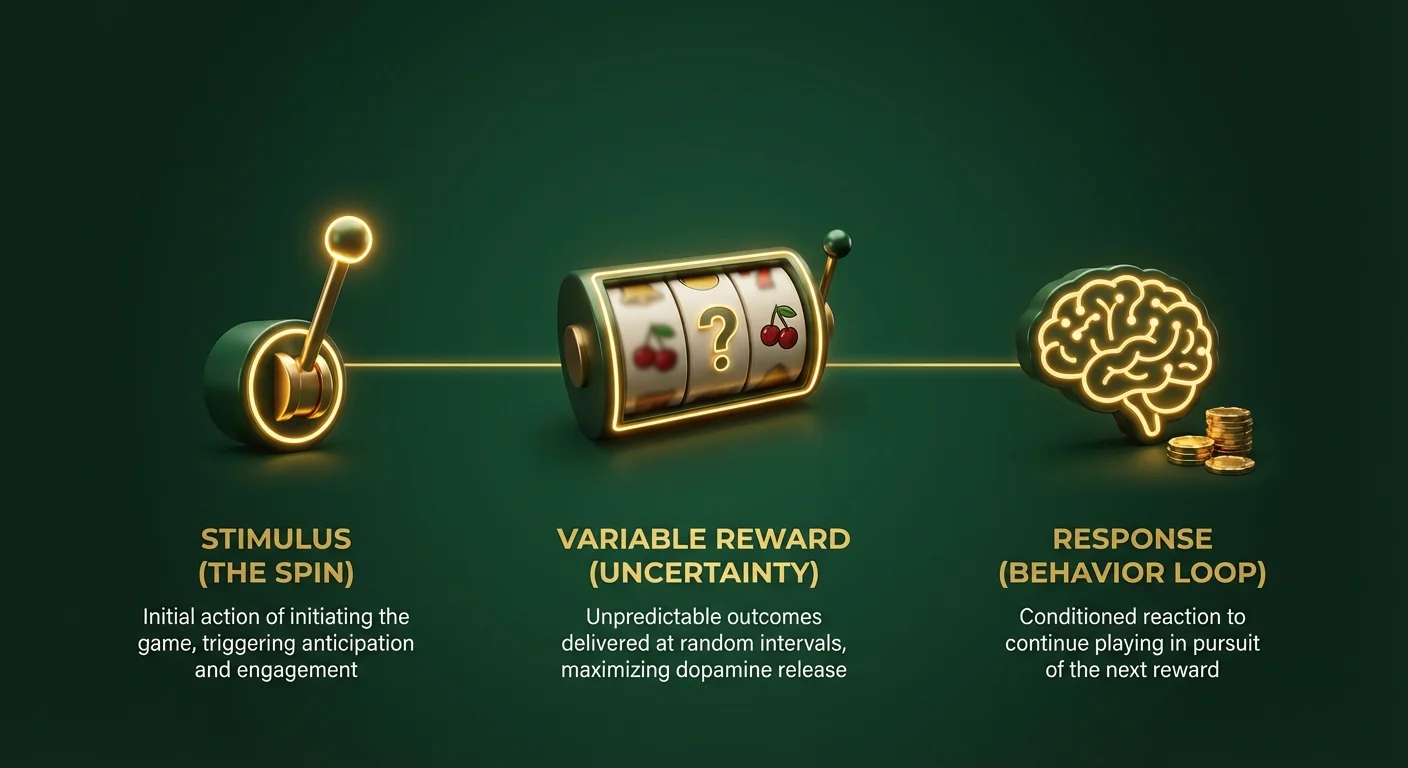
To understand slots, we must look at the work of B.F. Skinner, a behavioral psychologist who discovered "operant conditioning." He placed pigeons in a box where pecking a button resulted in a food pellet.
If the bird got a pellet every time it pecked, it pecked only when hungry. However, when Skinner introduced a Variable Ratio Schedule of Reinforcement - meaning the bird got a reward at random intervals (sometimes after one peck, sometimes after twenty) - the behavior changed drastically. The birds pecked compulsively, continuously, hoping the next peck would be the one.
This is the heartbeat of every slot machine. The Random Number Generator (RNG) ensures that you never know when the win is coming. This uncertainty floods the brain with dopamine, a neurotransmitter associated with reward and pleasure. Interestingly, the dopamine spike occurs before the reward is given - during the anticipation phase (the spin).
The Role of RNG in Psychology
While Source 3 confirms that RNG ensures outcomes are random, it is the pattern of that randomness that matters. If you won every time, you would get bored. If you lost every time, you would quit. The algorithm is tuned to provide wins frequently enough to keep the dopamine flowing, a state known as "maintenance."
The Near-Miss Effect: Almost Winning is Winning
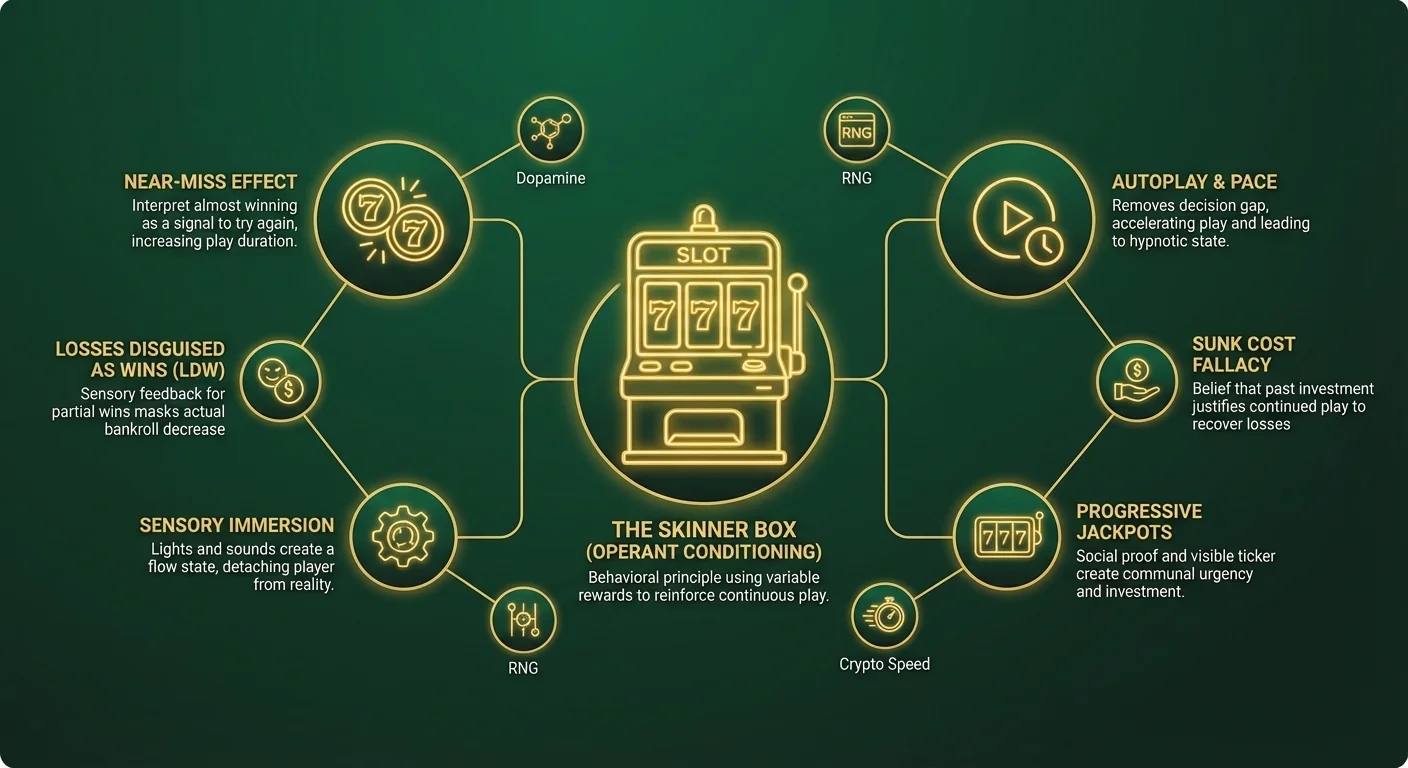
One of the most potent psychological tools in a slot developer's arsenal is the "near-miss." This occurs when two jackpot symbols line up on the payline, and the third symbol stops just above or below the line.
To the logical observer, this is a loss. Mathematically, landing a "near-miss" is the same as losing by a mile. However, to the human brain, a near-miss is interpreted as a "partial win." It signals that you are close to the target, encouraging you to try "just one more time."
Virtual Reels vs. Physical Reels
In the era of mechanical slots, the odds were limited by the physical number of stops on a reel. Today, as noted in the reference material regarding 5-reel and video slots, the physical reels are merely a visual representation of a digital process.
- The Reality: The RNG determines the outcome the nanosecond you press "Spin."
- The Illusion: The spinning animation is a dramatization. Developers can program the game to display near-misses more frequently than they would occur by random chance, specifically to trigger that "so close!" feeling.
Sensory Immersion and "Losses Disguised as Wins"
Modern video slots are multimedia experiences. High-definition graphics, immersive soundtracks, and tactile feedback (on mobile devices) create a "flow state" where the outside world disappears. A critical component of this is a phenomenon researchers call Losses Disguised as Wins (LDW).
Decoding LDW
Imagine you bet $5.00 in Bitcoin on a single spin. The reels spin, lights flash, and bells ring. You have won $2.50.
Your brain registers the lights and sounds as a victory. The machine celebrates the event. However, your bankroll has decreased by $2.50. You have technically lost money, but the sensory cues convince your brain you are on a winning streak. This disconnect keeps morale high even while the balance drains, extending the session longer than the player might have intended.
The Sensory Checklist
When playing, pay attention to these design choices:
- Audio cues: Upbeat music usually plays in a major key (associated with happiness) during spins.
- Animation speed: Wins are often counted up slowly to maximize the feeling of reward.
- Color psychology: bright reds, golds, and greens are used to stimulate excitement and suggest wealth.
The Pace of Play: Frictionless Gambling
Speed is a defining factor in slot psychology. Unlike Poker or Blackjack, where there is a natural pause for dealing cards or making decisions, slots are continuous.
The Danger of Autoplay
As mentioned in our source material, most modern slots feature an "Autospin" function. While convenient, Autospin removes the "decision gap" - the brief moment between spins where a player actively decides to bet again.
When you manually press spin, you make a conscious choice to spend money. With Autospin, the choice is made once for 50 or 100 spins. This leads to a hypnotic state where players may lose track of how much crypto they have wagered.
The Crypto Factor: Speed and Abstraction
Crypto gambling accelerates this pace even further.
- Instant Deposits: There is no waiting for bank clearance; you can top up a wallet in seconds.
- Abstraction of Value: Betting 0.0005 BTC doesn't trigger the same "pain of paying" as handing over a $20 bill. The volatility and decimalization of crypto can make money feel like mere "game credits," detaching the player from the financial reality of the bet.
Gamification and the Sunk Cost Fallacy
Video slots have evolved beyond simple "fruit machines" into complex games with narratives and progression systems. These features utilize the Sunk Cost Fallacy - the belief that because you have invested time or money, you must keep going to get a return.
Persistent State Slots (Advantage Play)
Some slots, as noted in the "Advantage Play" reference, have counters or meters that fill up as you play (e.g., collecting 10 scarabs to turn them Wild).
- The Hook: If you have collected 8 out of 10 symbols, it is incredibly difficult to walk away. You feel you have "paid" for the feature and leaving now would be leaving money on the table.
- The Trap: You may spend far more chasing the final two symbols than the eventual bonus payout is worth.
The Allure of the Jackpot
Progressive jackpots utilize social proof and the lottery dream. Seeing a ticker rise in real-time creates a sense of communal urgency. The fact that a small percentage of your wager contributes to the pot (as detailed in Source 4) makes you feel "invested" in the outcome.
Comparison: The Conscious Player vs. The Conditioned Player
To play responsibly, you must move from being a "Conditioned Player" (reacting to the machine) to a "Conscious Player" (acting with intent).
| Feature | The Conditioned Player | The Conscious Player |
|---|---|---|
| Near-Miss | "I almost won! The machine is due to pay out." | "That was a loss. The animation means nothing." |
| LDW (Win < Bet) | "Nice, a win! The lights are flashing." | "I bet $2 and got $1. My balance went down." |
| Autoplay | Sets 100 spins and zones out. | Plays manually or watches every spin of a set limit. |
| Bonus Meters | "I can't leave, the meter is 80% full." | "Is the cost to fill the meter worth the average payout?" |
| Crypto Value | "It's just 0.01 ETH, that's small numbers." | "That is $XX.XX of real money." |
Strategies for Regaining Control
Now that you understand the machinery of the hook, you can implement strategies to keep your gambling fun and safe.
1. Break the Flow State
The slot is designed to put you in a trance. You need to create friction.
- Turn off the Sound: Without the auditory positive reinforcement, the brain releases less dopamine during "Losses Disguised as Wins."
- Slow Down: Don't hammer the spin button the moment the reels stop. Take a breath.
- Avoid Turbo Mode: While faster spins are exciting, they dramatically increase the "cost per hour" of your session.
2. Reality Checks and Limits
Set hard boundaries before you open the game.
- Time Alarms: Set a timer on your phone for 30 minutes. When it rings, cash out or take a mandatory break.
- Volatility Awareness: Understand the game you are playing. As per Source 7, high RTP doesn't mean frequent wins. If you are playing a high-volatility slot, expect long dry spells and don't chase losses thinking a win is "owed" to you.
3. Master Your Bankroll
Effective bankroll management is the only true defense against the house edge.
- The "Entertainment Budget": Treat your deposit like the cost of a concert ticket. The money is paid for entertainment, not an investment.
- The Stop-Loss: Determine the exact amount you are willing to lose. If your balance hits that number, the session ends. No exceptions.
- The "Winner's Tax": If you hit a big win (e.g., doubling your bankroll), withdraw the original deposit amount immediately. Play only with the house's money.
4. The Provably Fair Advantage
One advantage of crypto gambling is Provably Fair technology. While this doesn't change the psychology of the slot, it allows you to verify that the outcome was indeed random and not manipulated to force a near-miss at a critical moment. Use this transparency to reassure yourself that the math is governing the game, not a "streak" or "luck."
Conclusion
Slot machines are a form of entertainment that costs money. The developers are brilliant at creating an engaging, adrenaline-pumping experience that mimics the neurology of winning, even when you are losing.
There is nothing wrong with enjoying the thrill of the spin, the flash of the lights, or the chase for a progressive jackpot. However, the difference between a fun hobby and a problem lies in understanding the game. By recognizing the near-misses, the sensory tricks, and the sunk cost traps, you strip the machine of its psychological power. You become the master of your own session, ensuring that when the fun stops, you do too.