
Stepping up to a poker table has always felt like entering a foreign country. The regulars speak a rapid-fire dialect of "donk bets," "gutshots," and "reverse implied odds," leaving the uninitiated scrambling to keep up. But in 2024, the landscape has shifted again. Now, you aren't just sitting at a felt table in Vegas; you might be seated at a virtual table in the metaverse, funding your stack with Bitcoin, and verifying the shuffle via a blockchain hash.
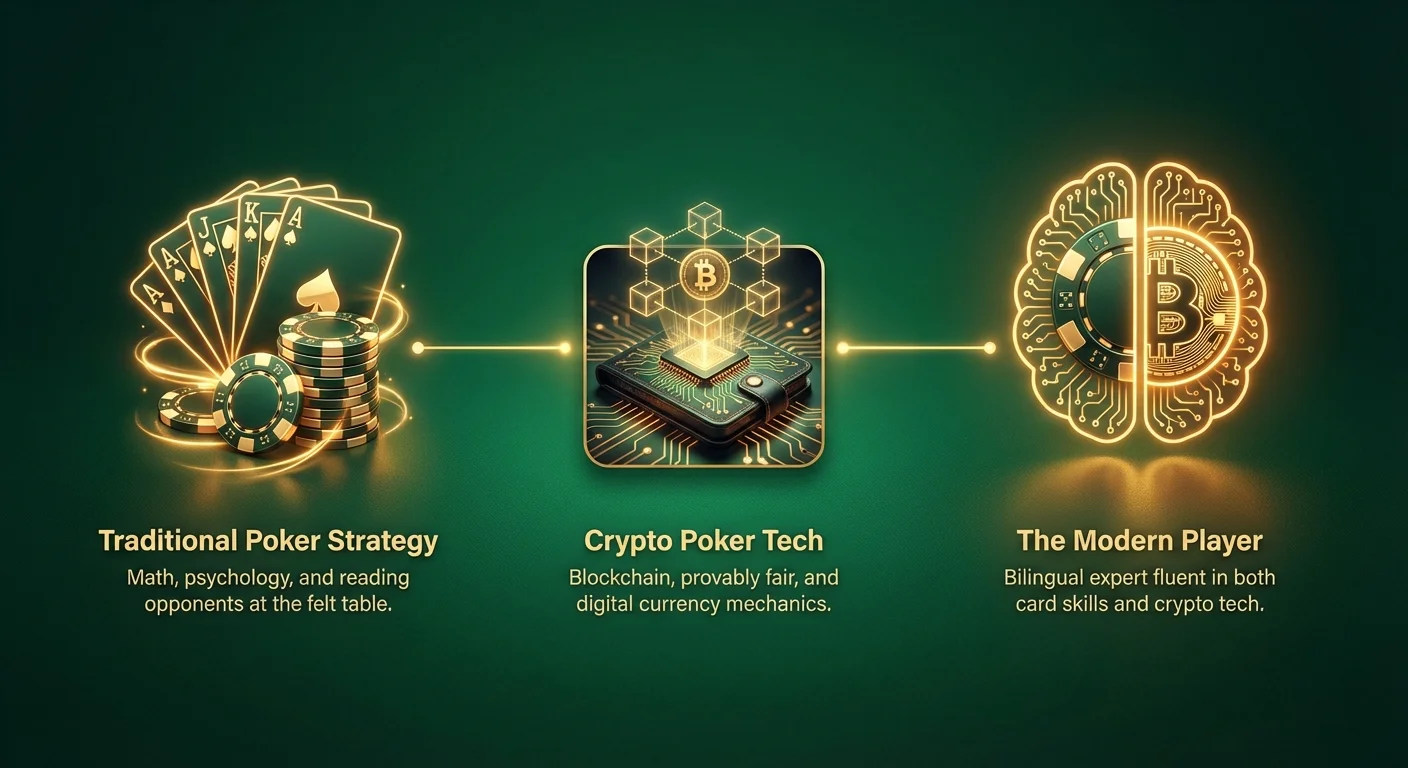
To thrive in the modern era of gambling, you need to be bilingual. You must speak the language of the old-school card shark and the new-school crypto trader. Whether you are grinding micro-stakes on a decentralized app (dApp) or playing high-stakes Texas Hold'em on a major crypto casino, misunderstanding a term can cost you your stack.
This comprehensive guide bridges the gap. We have compiled the essential dictionary for the modern player, blending traditional poker strategy with the technical vernacular of crypto gambling.
The Essentials: Table Mechanics & Setup
Before cards are in the air, you need to understand the financial structure of the game. In crypto poker, this often involves more than just tossing chips into the middle.
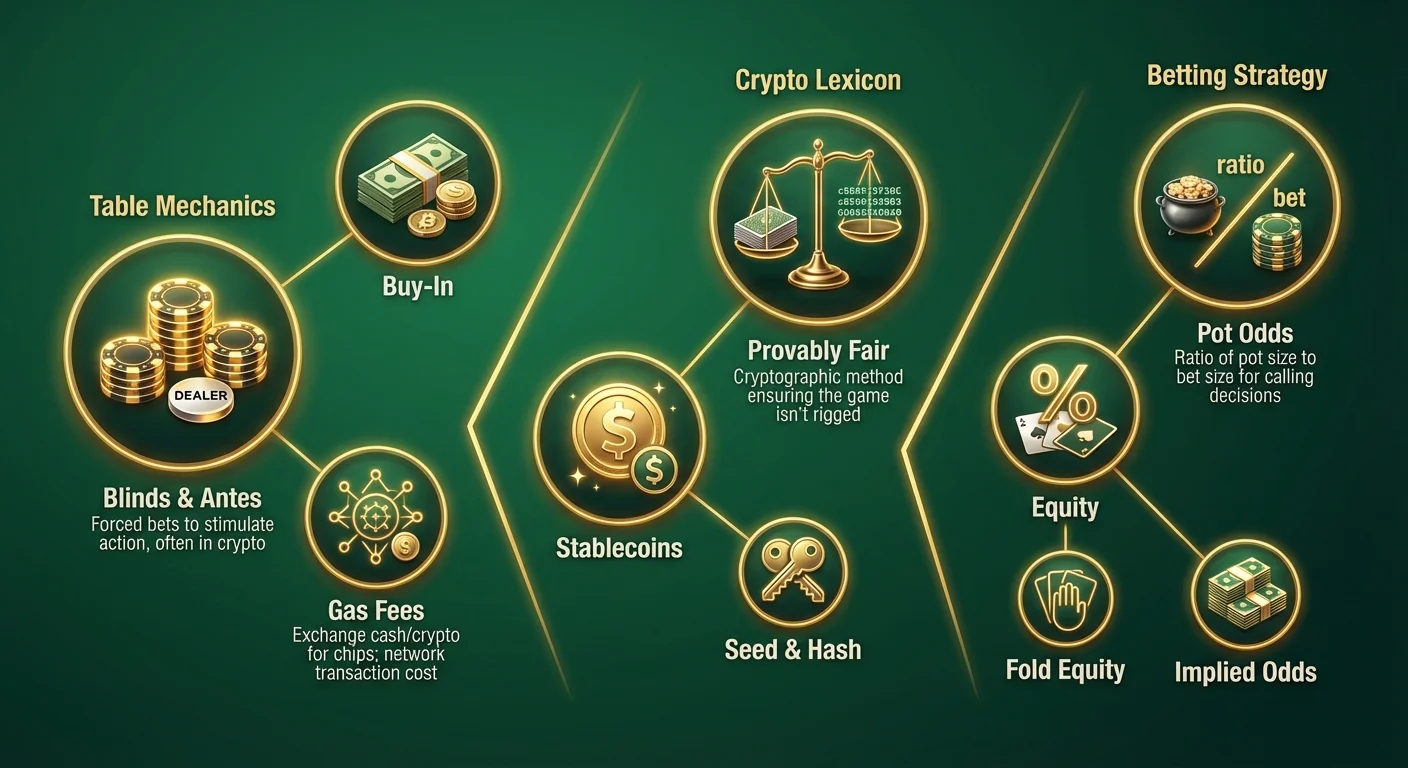
Blinds
The forced bets that stimulate action. In a standard game (like Texas Hold'em or Omaha), the player to the immediate left of the dealer posts the Small Blind (SB), and the next player posts the Big Blind (BB).
- Traditional View: Blinds ensure there is always money in the pot to fight for. Without them, players would fold until they held Aces.
- Crypto Context: In crypto poker, blinds are often denominated in milli-Bitcoin (mBTC), Satoshis (sats), or stablecoins like USDT. Always triple-check the currency value before sitting down. A 1/2 game means very different things if it's 1/2 USDT versus 1/2 ETH.
Straddle
A voluntary blind bet made by the player to the left of the Big Blind before cards are dealt.
- Strategy: Straddling doubles the stakes for that hand and buys the straddler the privilege of acting last pre-flop. It is a move used to create "action" and bloat the pot.
- Tip: In crypto cash games, straddling is often used by "whales" (players with large bankrolls) to intimidate tighter players.
Ante
Unlike blinds, which are paid by two specific positions, an ante is a forced bet paid by every player at the table before the hand begins.
- History: As noted in poker history, antes were the original method to seed the pot in games like Five Card Draw. Today, they are standard in the later stages of tournaments to punish passive play.
Buy-In (and Gas Fees)
The amount of cash (or crypto) you exchange for chips to sit at the table.
- Table Stakes: You can usually only wager the chips you have on the table. If you bust, you must "re-buy."
- Crypto Dictionary Update - Gas Fees: When depositing to a crypto poker site, you pay a network transaction fee (Gas). Smart players use blockchains with low fees (like Litecoin, Tron, or Bitcoin Cash) for deposits to avoid eating into their bankroll.
The Crypto Poker Lexicon
This section covers terms specific to playing poker on blockchain platforms. Understanding these ensures you aren't just playing good cards, but playing on a fair platform.
Provably Fair
A cryptographic technology used by crypto casinos to ensure the game is not rigged.
- How it works: The server creates a "seed" (the shuffle) and hashes it before the hand starts. You (the player) also provide a seed. After the hand, you can use these seeds to verify that the cards dealt were pre-determined by the algorithm and not altered by the site based on your bets.
- Why it matters: It replaces "trusting the casino" with "trusting the math."
Seed & Hash
- Server Seed: The casino's secret random number.
- Client Seed: The player's random number input.
- Tx Hash: The transaction identification string on the blockchain. If you win a massive pot and withdraw, the Tx Hash is your proof that the money is on its way to your wallet.
Confirmations
The number of blocks added to the blockchain after your transaction. Crypto poker sites usually require 1 to 3 block confirmations before your deposit appears in your playable balance.
- Speed: Bitcoin might take 10-30 minutes; Solana or Ripple might take seconds.
Stablecoin
Cryptocurrency pegged to a fiat currency (usually the US Dollar), such as USDT (Tether) or USDC.
- Strategy: Many pros prefer playing in stablecoins to avoid "volatility risk." You don't want to win a huge poker session in Bitcoin, only to have the price of Bitcoin crash 10% the next day, wiping out your table winnings.
Betting Strategy & Mathematical Terms
Poker is a game of incomplete information managed by probability. These terms help you define the math behind your decisions.
Pot Odds
The ratio between the size of the pot and the size of the bet you are facing. This is the fundamental calculation for determining if a call is profitable.
- The Math: If the pot is $100 and your opponent bets $50, the pot is now $150. You have to call $50. Your odds are 150:50, or 3:1.
- The Rule: If your chance of winning the hand is better than your pot odds, you call.
| Pot Size | Bet to Call | Pot Odds (Ratio) | Required Equity to Call |
|---|---|---|---|
| $100 | $100 | 2:1 | 33% |
| $100 | $50 | 3:1 | 25% |
| $100 | $33 | 4:1 | 20% |
Equity
Your specific chance of winning the pot at the showdown, expressed as a percentage.
- Example: If you hold pocket Aces (AA) against pocket Kings (KK) pre-flop, you have roughly 82% equity. You will win 82% of the time in the long run.
Fold Equity
The additional value you gain from the likelihood that your opponent will fold to your bet.
- Why it matters: You don't always need the best hand to win. If you bet aggressively, you can win the pot simply because your opponent gives up.
- Formula: It is subjective. As pro player Ashley Adams notes, you must estimate: "How often do I think they will fold?" If you estimate they will fold 50% of the time, you have high fold equity, making a bluff more profitable.
Implied Odds
This extends Pot Odds by estimating how much more money you can win on future streets if you hit your hand.
- Scenario: You have a flush draw. The immediate pot odds might not justify a call. However, if you hit your flush on the river, you believe you can stack your opponent. Those future winnings are your "implied odds."
All-In
Betting all of your remaining chips.
- The Reality: Unlike the movies, "All-In" isn't always a dramatic climax. It is a strategic tool used to deny opponents the correct odds to call.
- Note: Once you are all-in, you cannot be forced out of the hand. You are eligible to win the main pot up to the amount you contributed.
Player Types & Slang
Online poker creates specific archetypes. Whether checking a HUD (Heads-Up Display) or observing betting patterns, you will encounter these characters.
VPIP (Voluntarily Put Money In Pot)
A statistic used to track how loose or tight a player is.
- High VPIP (40%+): A "loose" player who plays many hands. often a "Fish."
- Low VPIP (<20%): A "tight" player or "Nit" who only plays premium hands.
PFR (Pre-Flop Raise)
A statistic tracking how often a player enters the pot with a raise rather than a call. High PFR indicates an aggressive player.
Whale
In both crypto and poker, a "Whale" is a player with a massive bankroll who doesn't mind losing. They are the ideal opponent because they provide action and profit for skilled players.
Donkey (or Donk)
A derogatory term for a bad player who makes mathematically incorrect moves.
- Donk Bet: A bet made into the aggressor from the previous round (usually out of position). For example, you raise pre-flop, the opponent calls. On the flop, the opponent immediately bets into you before you can act. This is usually a sign of a weak/intermediate player.
The Nuts
The absolute best possible hand at that moment.
- Crypto Slang: "Safu" (funds are safe). If you have the nuts, your chips are Safu.
Tilt
A state of emotional frustration that causes a player to adopt a suboptimal strategy.
- Causes: Taking a "Bad Beat" (losing a hand you were statistically 95% likely to win).
- Crypto Tilt: Losing money on a crypto trade and engaging in "revenge trading" or playing higher stakes poker to make it back quickly. This is the fastest way to go broke.
Game Variants Explained
While No-Limit Hold'em is the "Cadillac of Poker," crypto sites often feature various formats.
Texas Hold'em
The standard. Two hole cards, five community cards. Best 5-card hand wins.
Omaha Hi-Lo (Omaha 8-or-Better)
A complex variant popular on crypto sites due to the high action.
- The Deal: You get four hole cards. You must use exactly two of them and three from the board.
- The Split: The pot is split between the High hand and the Low hand (if a qualifying low hand exists). This creates massive pots and keeps more players in the hand longer.
Five Card Draw
The classic "Cowboy" poker.
- Gameplay: You get five cards. There is a betting round. You discard cards you don't want and draw new ones. There is a final betting round.
- Rarity: Rarely found in physical casinos anymore but enjoys a niche following on online crypto platforms and retro-style games.
Spin & Go / Jackpot Sit & Gos
Fast-paced, 3-player tournaments where the prize pool is determined by a random multiplier (spin) at the start.
- Crypto Twist: Some crypto sites use Provably Fair algorithms to determine the prize multiplier, ensuring the "Spin" wasn't rigged.
Practical Strategy: Using the Dictionary to Win
Knowing the definition of Fold Equity is useless if you don't apply it. Here is how to synthesize these terms into a winning strategy at the virtual felt.
1. Identify the "Fish" via VPIP
If you are using a poker tracker or simply observing, look for high VPIP and low PFR. This player is calling too much and raising too little. They are a "calling station." Do not bluff them. Value bet your hands relentlessly.
2. Leverage "Fold Equity" in Crypto Tournaments
In the middle stages of a crypto tournament, blind levels increase fast. If you have a medium stack (15-20 big blinds), you cannot wait for Aces. You must shove All-In with decent hands (like suited connectors or small pairs). Your goal is to utilize Fold Equity - making opponents fold hands that might actually beat you, simply because they can't risk their tournament life.
3. Calculate "Pot Odds" vs. "Gas Fees"
This is a meta-strategy. If you are a micro-stakes player (playing for pennies), do not deposit using Ethereum Layer 1, where gas fees might be $10. Your "Pot Odds" on the deposit are terrible. Use Litecoin (LTC), Ripple (XRP), or Layer 2 solutions where the transaction cost is negligible, ensuring your ROI (Return on Investment) isn't eaten by network costs.
4. Avoid "Tilt" with Stablecoins
If the price of Bitcoin is crashing, you might play poorly because you feel your bankroll shrinking even if you are winning at the table. If you are prone to emotional decisions, keep your poker bankroll in USDT or USDC. This separates your poker performance from market performance.
Summary
The fusion of cryptocurrency and poker has created an ecosystem that is faster, more transparent, and accessible globally. However, it remains a game of skill, math, and psychology.
- Master the Math: Understand Pot Odds and Equity. They are the compass that guides you through the fog of variance.
- Master the Mind: Recognize Tilt, avoid Donk Betting (unless it's a specific exploit), and respect the Variance.
- Master the Tech: Use Provably Fair verifications to ensure you aren't being cheated, and manage your Gas Fees to protect your bottom line.
Whether you are chasing the Nuts in Omaha Hi-Lo or grinding EV in Texas Hold'em, this dictionary is your toolkit. Keep it bookmarked, stay disciplined, and may your variance always be positive.