
In the rapidly evolving landscape of digital assets, the security of your cryptocurrency holdings is paramount. Unlike traditional banking where a third party safeguards your funds, cryptocurrency operates on a model of self-custody. This places the responsibility of security entirely on the owner. If you lose access to your funds or if they are stolen, there is no customer support line to call for a reversal. This reality makes the method of storage you choose the single most critical decision in your crypto journey.
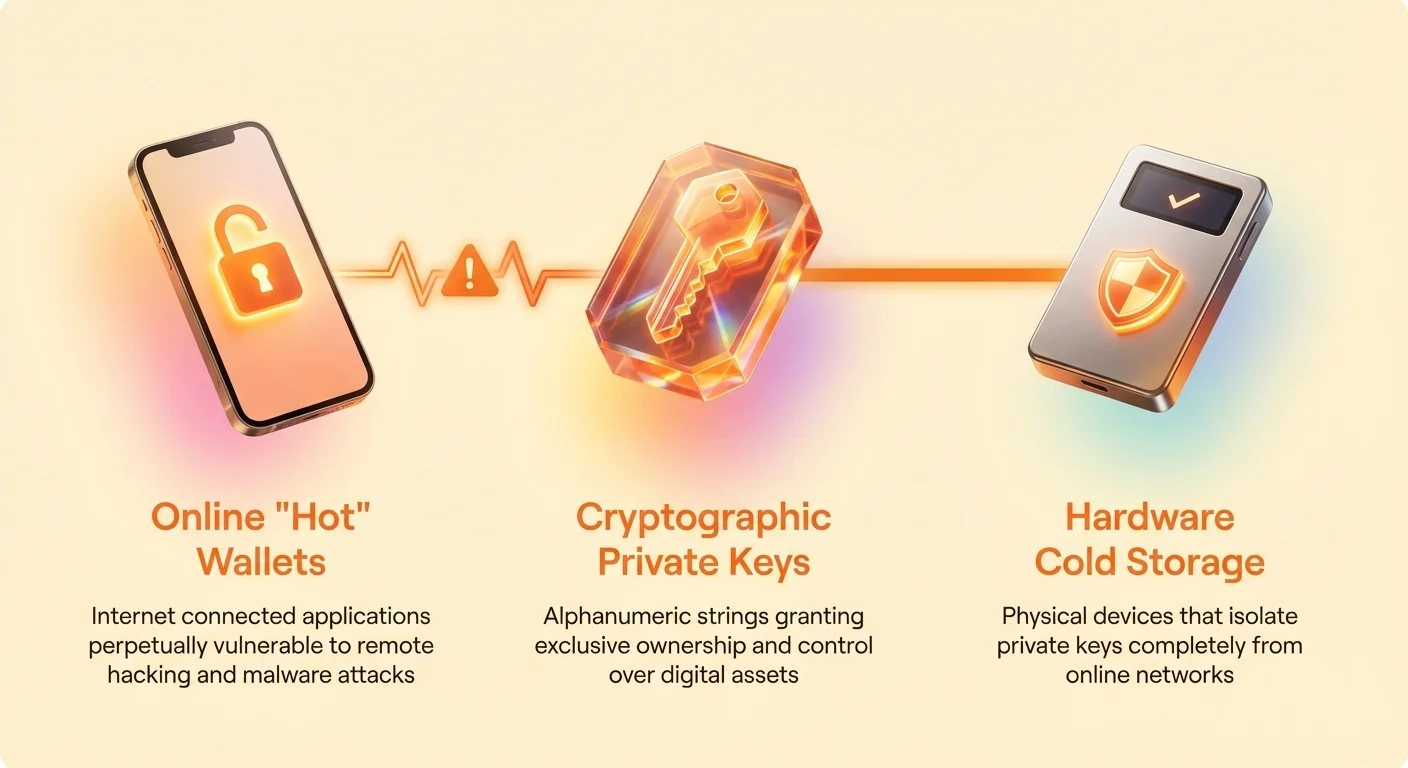
For investors holding significant amounts of Bitcoin or other digital assets, relying on exchange wallets or software applications connected to the internet is a significant risk. These "hot wallets" are perpetually vulnerable to online threats, including malware, phishing attacks, and exchange hacks. To mitigate these risks, seasoned investors turn to "cold storage." This method involves keeping the cryptographic keys that grant access to your funds completely offline.
Hardware wallets represent the gold standard for cold storage. These are physical devices designed specifically to secure cryptocurrencies. They function by isolating your private keys from internet-connected devices like computers and smartphones. Even when you need to make a transaction, the device ensures that your private keys never touch the internet. This guide explores the mechanics, benefits, and operational procedures of using hardware wallets and deep cold storage solutions.
The Core Concept of Private Key Isolation
To understand why hardware wallets are effective, one must first understand the nature of cryptocurrency ownership. You do not store Bitcoin on a device; the coins exist on the blockchain. What you actually possess are "private keys." These keys are cryptographic alphanumeric strings that function similarly to a password or a digital signature. Whoever holds the private key has the authority to move the funds associated with it.
In a software wallet (mobile or desktop), these keys are stored on your device's hard drive or memory. If that device is infected with malware or a keylogger, a hacker can easily copy the keys and drain the wallet. Hardware wallets solve this by generating and storing the private keys within a dedicated, encrypted chip inside the physical unit. This chip is often resistant to physical tampering and digital intrusion.
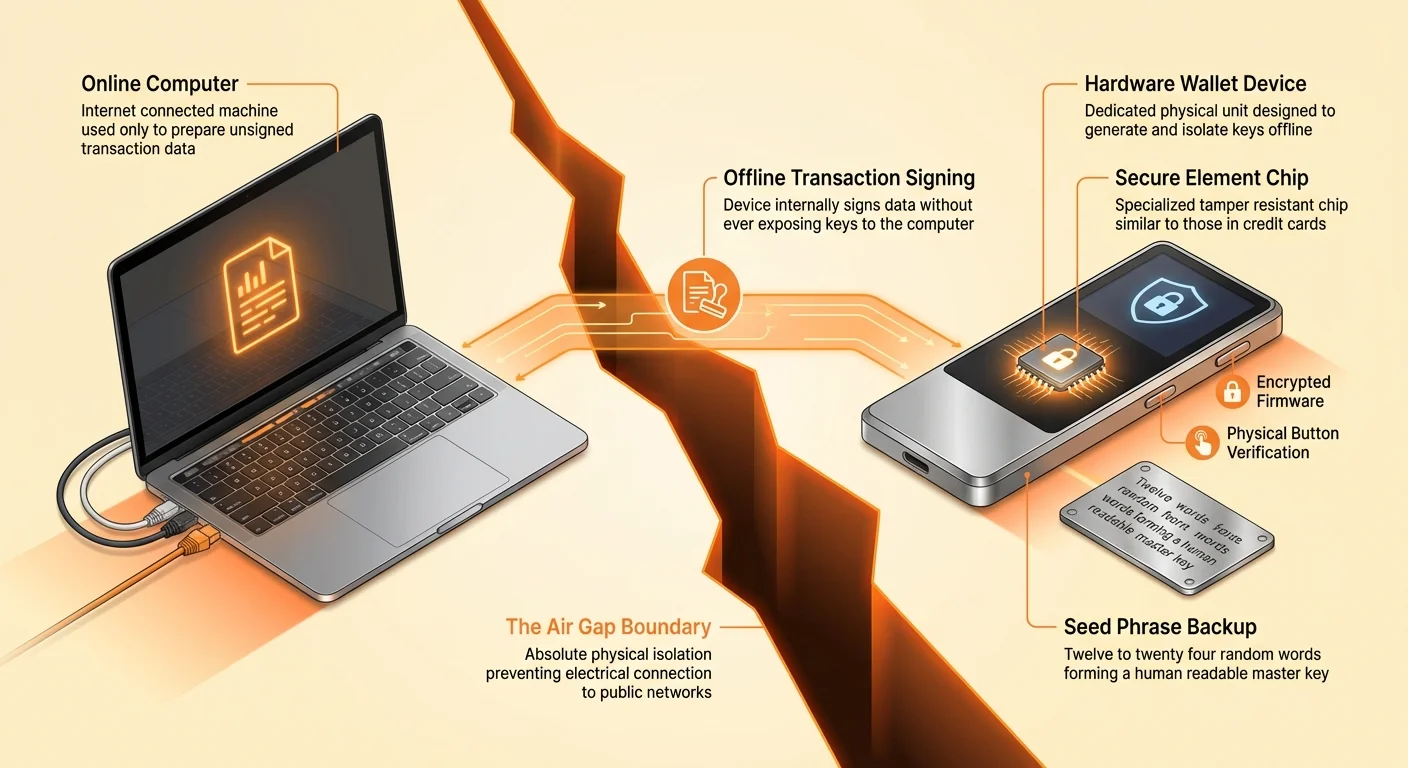
When you initiate a transaction, the software on your computer prepares the data and sends it to the hardware device. You verify the details on the device's physical screen and confirm the transaction by pressing a physical button. The device digitally signs the transaction internally using the private key and sends only the signed data back to the computer. The private key itself never leaves the safe environment of the hardware wallet.
Offline Storage vs. The "Air Gap"
The term "air gap" refers to a security measure where a computer or network is physically isolated from unsecured networks, such as the public internet. Hardware wallets create a bridge across this air gap only when necessary and in a highly controlled manner. This ensures that even if the computer you are using is compromised by viruses, the bridge remains secure because the hardware wallet acts as a strictly limited gatekeeper.
Some advanced hardware wallets take this a step further by using QR codes or microSD cards to transmit transaction data. In these setups, the hardware wallet never physically connects to the computer via USB or Bluetooth. Instead, the user scans a QR code on the hardware wallet's screen to sign a transaction. This creates an absolute air gap, ensuring there is no electrical connection that could potentially be exploited by sophisticated attacks.
Comparing Wallet Types and Security Tiers
Understanding where hardware wallets fit into the broader ecosystem helps in appreciating their value. Wallets are generally categorized by their connectivity and platform. Mobile wallets are apps installed on smartphones, offering convenience for daily spending but lower security due to the phone's constant internet connection. Desktop wallets offer more features but suffer from similar vulnerabilities as they reside on internet-connected PCs.
Hardware wallets differ fundamentally by prioritizing security over instant convenience. While a mobile wallet allows you to send funds in seconds, a hardware wallet requires you to have the physical device present, connect it, and manually approve the action. This friction is a feature, not a bug, as it prevents unauthorized remote transfers.
Below is a comparison of the primary wallet categories and their security profiles:
| Wallet Type | Connectivity | Security Level | Primary Use Case |
|---|---|---|---|
| Hardware | Offline (Cold) | Very High | Long-term storage, large holdings |
| Desktop | Online (Hot) | Moderate | Portfolio management, active trading |
| Mobile | Online (Hot) | Low to Moderate | Daily payments, small amounts |
| Web/Extension | Online (Hot) | Low | DeFi interaction, web browsing |
| Paper | Offline (Deep Cold) | High | Archival storage, gifting |
For most users, a combination of wallet types is the best approach. A hardware wallet should serve as the "vault" for the majority of your wealth, while a mobile or web wallet can act as a "checking account" carrying only small amounts for daily use.
The Architecture of Physical Security
Modern hardware wallets are built with sophisticated components designed to resist physical attacks. Many devices use a Secure Element (SE), a specialized chip similar to those found in credit cards and passports. These chips are graded by Evaluation Assurance Levels (EAL), with EAL 6+ representing a very high standard of security. The Secure Element protects the device against "side-channel attacks," where a hacker might try to read power consumption or electromagnetic emissions to guess the private key.
Furthermore, these devices often run on custom, limited operating systems. Unlike Windows or Android, which have millions of lines of code and potential vulnerabilities, the firmware on a hardware wallet is minimal. It performs a very specific set of tasks, reducing the "attack surface" available to hackers.
Some manufacturers, like Trezor, utilize open-source designs. This means the code running on the device is publicly available for audit by security researchers. The philosophy here is that security through transparency is superior to security through obscurity. If there is a flaw in the code, the community can find and fix it, rather than it remaining a hidden vulnerability known only to attackers.
Deep Cold Storage with Paper Wallets
Before hardware wallets became popular, "paper wallets" were the primary method for cold storage. A paper wallet is simply a physical printout of a public and private key pair. Because paper cannot connect to the internet, it is immune to digital hacking. This method is considered "deep cold storage" and is still relevant today for specific use cases, such as long-term archival storage or gifting Bitcoin.
Creating a secure paper wallet requires strict discipline. The generation of the keys must happen on a computer that is completely disconnected from the internet. The software used to generate the keys is typically a webpage saved to a USB drive and loaded on the offline machine. Once the keys are generated, they are printed on a "dumb" printer—one that is not connected to a network—to prevent any digital leaks.
While highly secure against hackers, paper wallets introduce physical risks. Paper can degrade, burn, or be eaten by pests. Ink can fade over time. If you lose the piece of paper, the funds are irretrievable. Unlike hardware wallets, which allow you to recover funds using a backup seed phrase if the device is broken, a paper wallet is often the only copy of the key. Therefore, paper wallets should be laminated and stored in fireproof, waterproof safes, potentially with multiple copies in different locations.
The Critical Role of the Seed Phrase
When you set up a hardware wallet, the device will generate a "recovery phrase" or "seed phrase." This is typically a list of 12 to 24 random words. This phrase is a human-readable representation of your master private key. It is the single most important piece of data in your crypto security setup. If your hardware wallet is lost, stolen, or destroyed, you can buy a new device and enter these words to restore full access to your funds.
Conversely, if anyone else obtains these words, they can clone your wallet and steal your funds without ever needing your physical device or your PIN code. Therefore, the management of your seed phrase requires extreme care. It should never be stored digitally. Do not take a photo of it, do not save it in a text file, and do not upload it to cloud storage.
The best practice is to write the seed phrase down on the physical card provided with the device. For enhanced durability, many users etch their seed phrase into stainless steel or titanium plates. These metal backups are fireproof and corrosion-resistant, ensuring that your backup survives physical disasters that would destroy paper.
Advanced Security Features: Passphrases and Multisig
For users with substantial holdings, standard hardware wallet security can be augmented with advanced features. One such feature is the "passphrase," sometimes called the "25th word." This is a custom word or sentence added to the standard 24-word seed phrase. It acts as a hidden extension to your key generation.
The utility of a passphrase is that it creates a completely hidden wallet. If an attacker forces you to unlock your device or finds your 24-word seed, they will only see the funds in the "standard" wallet. Without the specific passphrase, the hidden wallet remains invisible and inaccessible. This allows for "plausible deniability," where you can keep a small amount of funds in the standard wallet as a decoy while securing the bulk of your assets behind the passphrase.
Another advanced strategy is multi-signature (multisig) storage. Standard wallets require one signature to authorize a transaction. Multisig wallets require multiple approvals, such as two out of three keys. You could configure a setup where one key is on a hardware wallet, another is on a different hardware wallet in a bank vault, and a third is held by a trusted family member. This eliminates the single point of failure; even if a thief steals one device, they cannot move the funds.
Risks and Best Practices for Hardware Wallets
While hardware wallets are incredibly secure, they are not foolproof. The weakest link is often the human user. "Supply chain attacks" are a concern where a device is intercepted and tampered with before it reaches the user. To prevent this, always purchase directly from the manufacturer rather than third-party marketplaces. Upon receipt, verify the device's integrity and ensure the packaging was not tampered with.
Phishing is another major threat. Scammers may create fake versions of the wallet management software (like Ledger Live or Trezor Suite) that ask you to type in your recovery phrase. Remember this golden rule: you should never enter your seed phrase into a computer or smartphone. The only place you should ever enter those words is on the physical device itself.
Regular firmware updates are also essential. Manufacturers release updates to patch vulnerabilities and add support for new coins. However, you should always verify that the update notification is legitimate. Scammers have been known to send fake emails prompting users to "update" their device, leading them to a malicious site. Always navigate manually to the official website to check for updates rather than clicking links in emails.
Recovery Protocols and Inheritance Planning
One often overlooked aspect of deep cold storage is the complexity it adds to inheritance. If you pass away, your Bitcoin serves no purpose if your heirs cannot access it. Because crypto is self-custodial, there is no bank to grant access upon presentation of a death certificate. You must have a plan in place to transfer your keys or seed phrases securely.
This does not mean simply giving your keys to someone now, as that compromises security. Solutions include using dead man's switches, legal custody services that hold sealed information, or splitting the seed phrase into parts (using methods like Shamir's Secret Sharing) and distributing them among trusted parties. Shamir's Secret Sharing allows you to create multiple unique shares of your seed, requiring a specific number (e.g., 3 of 5) to combine and reconstruct the key.
Regular recovery drills are also necessary. You should periodically verify that your backup seed phrase is correct. Most hardware wallets offer a simulation feature that allows you to "check" your recovery phrase without actually wiping the device. This confirms that the words you wrote down years ago are accurate and readable.
Conclusion
Hardware wallets and deep cold storage solutions represent the bedrock of cryptocurrency security. They empower individuals to become their own banks, offering a level of asset control that is unprecedented in financial history. By isolating private keys from the vulnerabilities of the internet, these devices neutralize the vast majority of remote attacks that plague the digital asset space. Whether using a robust device with a Secure Element or a carefully generated paper wallet, the goal remains the same: absolute sovereignty over your wealth.
However, this power comes with the burden of responsibility. The technology is only as secure as the procedures surrounding it. Protecting your recovery phrase, verifying the authenticity of your device, and remaining vigilant against phishing are continuous requirements. As the crypto ecosystem grows, the tools for self-custody will likely become more user-friendly, but the fundamental principles of offline isolation and backup redundancy will remain constant.
True security is not a product you buy, but a process you follow diligently.