
The evolution of Keno from an ancient Chinese lottery system to a staple of modern crypto casinos has been driven by one major technological leap: automation. While traditional land-based Keno moves at a leisurely pace, Crypto Keno is built for speed. For the serious player, clicking a button manually for every draw is inefficient and prone to emotional errors.
This is where Keno auto bet features and scripting come into play. By using the advanced tools provided by top-tier crypto gambling platforms, you can transform Keno from a game of pure guessing into a disciplined exercise in volatility management. This guide goes beyond basic number selection to explore how to configure automated strategies, set precise stop-loss limits, and use variable betting logic to streamline your gameplay.
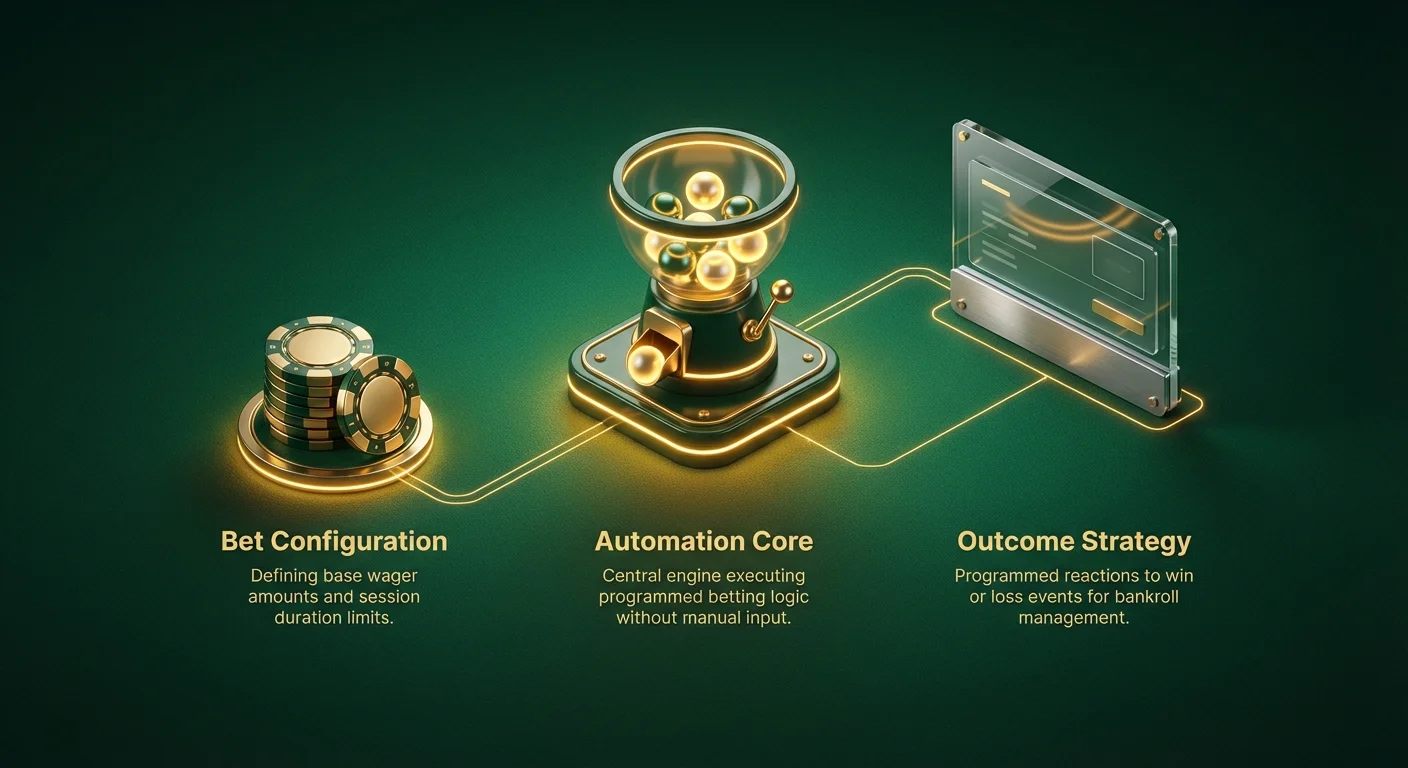
The Mechanics of Automated Crypto Keno
Before looking at complex gambling scripts, it is important to understand the interface typical of crypto casinos. Unlike standard online casinos that might offer a simple "Auto-play" button that merely repeats the same bet, crypto platforms offer a programmable logic dashboard.
At a minimum, a robust auto-bet interface allows you to control four variables:
- Bet Amount: Your base wager.
- Number of Bets: The duration of the session (often set to infinite).
- On Win: Actions to take after a winning round (e.g., reset bet, increase bet, stop).
- On Loss: Actions to take after a losing round (e.g., increase bet by percentage).
The "Net Win" Nuance in Keno
In games like Slots or Roulette, a "Win" usually covers the cost of the bet. In Keno, however, depending on the risk settings (Classic, Low, Medium, High) and the number of spots picked, you might achieve a "win" that is less than your wager.
- Example: You bet 1 BTC (hypothetically) on a High Risk 3-spot game. You catch 1 number. The payout might be 0.5x. technically, you "won" the round according to the game engine, but you are at a net loss of 0.5 BTC.
Pro Tip: When configuring auto-bet scripts, ensure your strategy distinguishes between a multiplier win (hitting the target) and a partial return. Most basic auto-bet tools treat any return as a win, which can disrupt recovery strategies like Martingale.

Mastering the Variables: Risk vs. Reward Configuration
Your automated betting strategy is entirely dependent on two factors: the Amount of Numbers Picked (Spots) and the Risk Level of the table.
Source material indicates that standard Keno payouts vary wildly. In crypto Keno, you often have a toggle for risk. This fundamentally changes the math of your script.
Comparative Table: Auto-Bet Configuration targets
| Strategy Type | Spots Selected | Risk Level | Win Chance % | Recommended On Loss % | Recommended On Win |
|---|---|---|---|---|---|
| The Grinder | 2 | Low | High (~35-40%) | Increase 10-20% | Reset to Base |
| The Recovery | 3 | Medium | Moderate | Increase 30-50% | Reset to Base |
| The Hunter | 8-10 | High | Very Low | Flat Bet (0% increase) | Stop on Profit |
| The Hybrid | 4 | Classic | Low | Increase 100% (Martingale) | Reset to Base |
Note: Win Chance percentages are approximate and depend on specific casino house edge.
Scripting Strategy 1: The Sustainable Martingale
The Martingale strategy (doubling bets after a loss) is the most common gambling script, but in Keno, it is dangerous due to the potential for long losing streaks. To master this in Keno, you must adapt the percentage increase based on the Payout Multiplier.
In a standard coin flip (2.00x payout), you need a 100% increase on loss to recover. However, if you are playing a Keno strategy targeting a 3.00x or 4.00x payout, you do not need to double your bet to recover losses. You can be more conservative to preserve your bankroll.
The Math of Recovery
If you are targeting a 4-number cluster (as suggested by "4x5 Corners" theories) with a payout of roughly 3.5x to 4x:
- Script Logic:
- Base Bet: 0.001 units
- On Loss: Increase bet by 35% - 40%
- On Win: Reset to Base
Why this works: By increasing only by 40% instead of 100%, you drastically extend your "runway" (the number of losses you can sustain before hitting the table limit or busting). You are sacrificing immediate massive profit for the ability to survive a longer cold streak.
Scripting Strategy 2: The "Cluster" Hunter
Many players look for "Winning Patterns" or "Clusters," such as the Top Half 6 or 4x5 Corners discussed in Keno literature. While Random Number Generators (RNG) ensure that every number has an equal probability of appearing, automating a cluster strategy helps you capitalize on variance when a specific section of the board heats up.
This strategy requires a script that focuses on Hit Frequency rather than payout size.
Configuration Steps:
- Selection: Select a "Cluster" of 6 to 8 numbers that are grouped together (e.g., numbers 1, 2, 11, 12, 21, 22).
- Risk Setting: Set to Low. We want frequent small wins to keep the balance moving.
- The Toggle Script:
- On Loss: Increase bet by 10%.
- On Win: DECREASE bet by 50% (but never below base).
The Theory: This is a localized D'Alembert system. When the cluster is "cold," you creep your bet up slowly. When the cluster hits (often yielding multiple small wins in a row due to the nature of variance clustering), you take profit and scale down to protect those gains.
Scripting Strategy 3: The High-Variance "Sniper"
This is an advanced strategy for players using the high maximum payouts of Crypto Keno (often 10,000x or more). This strategy abandons the idea of recovering losses and focuses purely on Stop-Loss and Stop-On-Profit.
The Setup:
Pick 8, 9, or 10 numbers. The odds of hitting 10/10 are astronomically low (1 in several million), but hitting 7/10 or 8/10 pays significantly.
The Script:
- Bet: Flat amount (e.g., $0.10). Do not increase on loss.
- Stop on Profit: $50.00 (or 500x your bet).
- Stop on Loss: $20.00 (200 bets).
Automation Logic:
You are essentially buying 200 lottery tickets. By automating this at high speed (3 bets per second), you can play through 200 rounds in just over a minute. The goal is to maximize "Attempts per Minute" (APM). If you hit a mid-tier prize (e.g., 50x or 100x), the script stops immediately.
Important Warning: Never run a high-variance script without a strict "Stop on Loss." The speed of crypto Keno means you can drain a wallet in minutes if you flat-bet on a cold streak without a hard stop.
Advanced Feature: The "Seed Change" Script
One aspect unique to crypto gambling is Provably Fair technology. The outcome of your Keno game is determined by a Server Seed and a Client Seed.
Some advanced players believe in "Seed Rotation" as part of their auto bet strategy. While this doesn't mathematically change the House Edge, it does change the stream of numbers.
If your platform allows custom scripting (using languages like Lua or Javascript, often found in "Advanced" tabs of dice/keno sites), you can add a line of code to change your Client Seed after a specific event.
Pseudo-Code Example:
var config = {
  bet: { value: 0.00000010, type: 'balance', label: 'bet' }
};

main = function () {
  var currentBet = config.bet.value;
  if (lastBet.win) {
    // Reset bet on win
    currentBet = config.bet.value;
  } else {
    // Increase bet on loss (Martingale)
    currentBet = lastBet.amount * 2;
// ADVANCED: If we lose 5 times in a row, change the seed
if (currentStreak < -5) {
  resetSeed(); // Hypothetical function to rotate client seed
}

  }
}
Note: This is logic-only. Syntax varies by casino platform.
Analyzing Payouts and "Lucky Numbers"
Source material suggests that numbers like 1, 4, 23, 34, and 72 are historically frequent hitters. In the context of a Provably Fair crypto algorithm, historical "hot" numbers from land-based casinos are irrelevant. However, the concept of Hot and Cold numbers persists in the UI of many crypto sites.
Should you script based on "Hot" numbers?
Generally, no. The "Gambler's Fallacy" is the belief that if a number hasn't appeared in a while, it is "due." In crypto Keno, each seed generation is independent.
The better approach: Use the "Randomize" feature in your auto-bet.
Instead of sticking to a static pattern (which can feel agonizing during a loss streak), configure the auto-bet to select New Random Numbers every round.
- Pros: psychologically easier to handle; avoids the frustration of watching your "lucky numbers" miss by one spot repeatedly.
- Cons: Prevents "Cluster" strategies.
Essential Safety Protocols: Stop-Loss and Limits
No guide on keno auto bet is complete unless it addresses bankroll management. Automation removes the friction of betting. In manual play, you have to think before every click. In auto-play, the machine executes your instructions relentlessly.
The 1% Rule of Automation
Your "Stop on Loss" for any single session should never exceed 1-5% of your total bankroll.
If you have 1.0 BTC:
- Session Stop Loss: 0.01 BTC.
- If the script hits this loss, stop. Do not adjust the script and restart. Walk away or change strategies.
Calculating Your Runway
Before clicking "Start," calculate your Bust Point.
If you are using a 100% increase on loss (Classic Martingale) starting at $1:
- $1
- $2
- $4
- $8
- $16
- $32
- $64
- $128
- $256
- $512
It only takes 10 consecutive losses to require a bet of $512. In Keno, 10 losses in a row is statistically common, especially if you pick more than 3 numbers. Always calculate how many losses your balance can sustain before starting a script.
Summary: The Automated Advantage
Mastering keno auto bet strategies is not about finding a magic formula to beat the house edge, that edge is mathematical and immutable. Instead, scripting allows you to:
- Systematize Risk: Enforce strict betting rules that emotions might override in manual play.
- Increase Volume: Play thousands of rounds to smooth out variance.
- Capitalize on Volatility: Use recovery scripts to survive downturns and profit from upswings.
Key Takeaways:
- Match Script to Risk: Use aggressive recovery (high %) only on high-probability (Low Risk) configurations.
- Beware the Partial Win: Ensure your script recognizes that a 0.5x payout is actually a loss.
- Hard Stops: Always set a "Stop on Loss" limit in the auto-bet panel.
- Clusters: Use visual patterns for selection, but rely on math for the betting progression.
By treating Crypto Keno as a programmable asset rather than a slot machine, you move from being a passive gambler to an active strategist. Configure your scripts wisely, watch your runway, and let the algorithm do the heavy lifting.