
The digital age of gambling has brought about a revolution in how we play, but it has also birthed a new wave of skepticism. When you play Keno at a brick-and-mortar casino, you watch the balls bounce in the bubble. You see the mechanics of luck in real-time. But when you switch to an online crypto casino, that physical reassurance is replaced by a digital interface. When you miss a 10-spot win by a single number, the nagging question often arises: Did the software cheat me?
For years, players had to rely on blind trust in "Random Number Generators" (RNG) audited by third-party companies behind closed doors. However, the rise of cryptocurrency casinos has democratized trust through a technology known as Provably Fair.
This guide delves deep into the architecture of Provably Fair Keno. We will move beyond basic gameplay strategies and winning patterns to explore the cryptographic engine that powers crypto Keno. You will learn how the results are generated, how the "black box" of RNG is cracked open, and, most importantly, how you can mathematically verify that every single draw you participate in is 100% random and unmanipulated.
The Evolution of Randomness: Black Box vs. Provably Fair
To understand why Provably Fair Keno is a game-changer, we must first understand the traditional model used by standard online casinos.
Traditional RNG (The Black Box)
In standard online Keno, the casino uses a Pseudo-Random Number Generator (PRNG). When you click "Play," the software generates numbers. The casino tells you, "Trust us, it's random." You have no way of knowing if the result was decided the moment you clicked the button based on your wager size, or if it was truly random. You cannot see the "seed" (the starting point of the algorithm), nor can you influence it.
Crypto RNG (Provably Fair)
Provably Fair Keno introduces a "Pre-commitment Scheme." This is a cryptographic concept where the casino commits to a result before you even place your bet, but keeps the result hidden until the round is over. Because they committed to it beforehand, they cannot change it mid-round. Furthermore, they allow you (the player) to insert your own random data into the generation process, ensuring the casino cannot know the outcome in advance either.
The Key Difference:
In traditional Keno, you trust the casino. In Provably Fair Keno, you trust the mathematics.
The Core Components of Provably Fair Keno
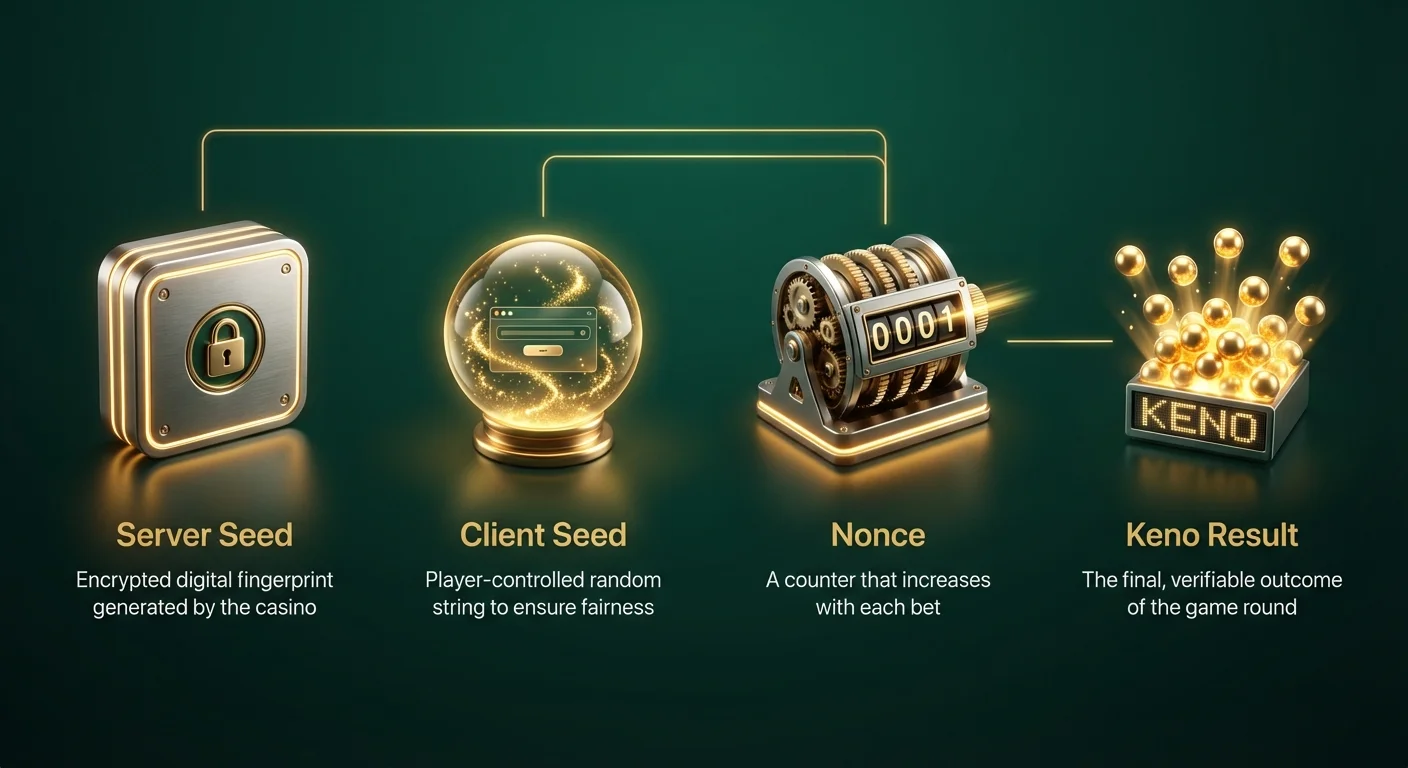
If you look at the settings menu of any reputable crypto Keno game, you will see a "Fairness" or "Provably Fair" tab. Inside, you will encounter three critical variables. Understanding these is the first step to verifying your results.
1. The Server Seed (The Casino's Secret)
This is a string of random characters generated by the casino. Before a round starts, the casino generates this seed. Because this seed determines the outcome, they cannot show it to you immediately (otherwise, you would cheat).
- The Hash: Instead of showing you the seed, the casino shows you a Hash of the Server Seed. This is an encrypted digital fingerprint. You can see the fingerprint before you bet, proving the seed exists and hasn't changed, but you can't work backward to see the actual seed.
2. The Client Seed (Your Input)
This is where the power shifts to the player. The Client Seed is a string of characters that you control. You can type anything you want here - your dog's name, a lucky phrase, or a random string generated by your browser.
- Why it matters: The game engine combines the Server Seed and the Client Seed to generate the Keno numbers. Since the casino doesn't know what Client Seed you will use until you click "bet," and you don't know the Server Seed, neither party can predict or manipulate the outcome.
3. The Nonce (The Counter)
"Nonce" stands for "Number used only once." It is a counter that starts at 0 or 1 and increases by 1 for every bet you make with the same seed pair. This ensures that even if you keep your Client Seed the same, every game yields a different result.
How Keno Results are Generated: The Technical Workflow
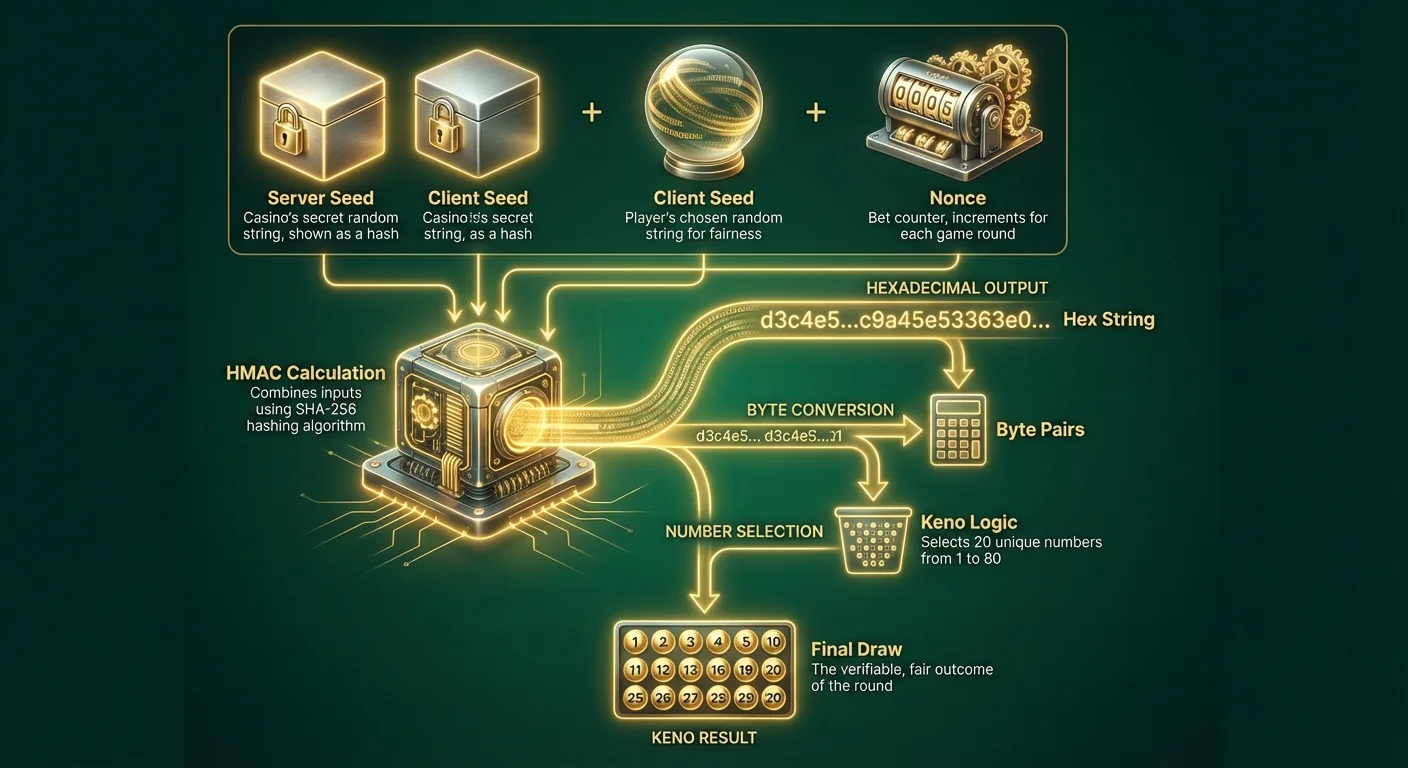
When you play a round of Provably Fair Keno, a complex cryptographic dance occurs in a fraction of a second. Here is the technical breakdown of how numbers 1 through 80 are selected:
- HMAC Calculation: The cryptographic engine takes the Server Seed, the Client Seed, and the Nonce. It uses a hashing algorithm (usually HMAC-SHA256) to mix them together.
- Formula:
HMAC_SHA256(Server_Seed, Client_Seed + Nonce)
- Formula:
- Hexadecimal Output: This calculation produces a long string of 64 hexadecimal characters (numbers 0-9 and letters a-f).
- Example:
d3c4e5...
- Example:
- Byte Conversion: The system takes this long string and breaks it down into pairs of characters (bytes). It converts these Hex pairs into Decimal (standard) numbers.
- Number Selection (The Keno Logic):
- Keno requires numbers between 1 and 80.
- The system reads the converted numbers.
- If a number is less than or equal to 80, it is selected as a "drawn ball."
- If a number is greater than 80, or if it has already been picked in this round, it is skipped.
- This process continues down the hash string until 20 unique numbers are found.
Step-by-Step Guide: How to Verify Your Keno Results
Now that you understand the theory, let's move to practice. Verifying results allows you to prove that the "lucky numbers" or "bad beats" you experienced were truly random.
Step 1: Active the Seeds
Before you start a session, go to the Provably Fair settings of your chosen crypto casino.
- Rotate your Seed: Click the button to generate a new Server Seed.
- Set your Client Seed: Enter a custom phrase. Many pros recommend using a random string generator to ensure maximum entropy, but typing "MyLuckyDay2024" works mathematically just as well.
Step 2: Play Your Rounds
Play Keno as you normally would. Select your numbers or use patterns (like the clusters or corners mentioned in standard strategy guides). Let the game run for a few bets.
Step 3: Reveal the Server Seed
You cannot verify the current active seed (because the casino is still using it). You must "rotate" or "change" the seed pair again.
- Go back to the settings.
- Click "Change Seed" or "Rotate Seed."
- The casino will now reveal the Previous Server Seed (the unhashed version) that was used for your previous bets.
Step 4: The Verification Calculation
You now have all three distinct pieces of the puzzle:
- The Unhashed Server Seed (revealed in Step 3).
- The Client Seed (which you set in Step 1).
- The Nonce (the bet number you want to check).
Using a Third-Party Verifier:The easiest way to verify is to verify off-site. Never verify using the casino's own internal tool alone; always cross-reference.
- Search for a "Provably Fair Verifier" (there are many open-source tools on GitHub or web-based verifiers specifically for standard crypto games).
- Input the Server Seed, Client Seed, and Nonce.
- The verifier will output the 20 Keno numbers.
- Compare these numbers to your game history. If they match perfectly, the game was fair.
Crypto RNG Explained: Dealing with "Hot" and "Cold" Myths
In traditional Keno lore, players obsess over "Hot" numbers (numbers that hit frequently) and "Cold" numbers (numbers that haven't hit in a while). You might read guides suggesting that numbers like 1, 4, and 23 are "statistically better."
In the world of Provably Fair, we need to reassess these myths.
The Myth of Number Memory
Source material often suggests that patterns form over time or that certain numbers are "due." In a Provably Fair environment using SHA-256 hashing, there is no memory.
- The hash generated for Nonce #50 has zero mathematical relationship to the hash generated for Nonce #49.
- Even if the number 72 hasn't appeared in 100 rounds, its probability of appearing in round 101 remains exactly the same.
Can Math Predict Keno Numbers?
In a standard offline environment, mechanical wear and tear on balls might create slight biases. In Crypto Keno, the "balls" are derived from mathematical hashes.
- The Hard Truth: You cannot predict the next hash. SHA-256 is a "one-way function." This means you can easily turn the seeds into a hash, but you cannot turn the hash back into the seeds to predict the outcome.
- The Advantage: While you cannot predict the numbers, you can confirm that the casino didn't predict them either. If the casino wanted to force a loss, they would have to change the Server Seed. But since your browser already received the Hash of that seed before the bet, the math proves they didn't switch it.
Intermediate Strategy: Optimizing Your Client Seed
While you cannot predict the numbers, you can ensure your randomization is robust. Here is an intermediate strategy for managing your Client Seed.
The "Agency" Strategy
Many players leave the Client Seed set to the default random string the casino provides. While this is likely safe, it removes your agency.
- Tip: Change your Client Seed every time you have a significant win or loss streak.
- Why? It resets the HMAC calculation chain. Psychologically, it helps reset your mindset. Mathematically, it ensures that you are effectively stepping into a "new" stream of randomness.
Understanding the "Nonce" Impact
If you play 1,000 rounds of Keno, your Nonce moves from 1 to 1,000.
- Verification Tip: When verifying a bulk session, you don't need to check every single bet. Use "Spot Checking." Verify Nonce #5, #50, #253, and #999. If these random points in the chain verify correctly, the entire chain is valid because they all stem from the same Server Seed.
Comparison: Standard vs. Provably Fair Keno
To visualize why verifying your results is worth the effort, compare the transparency levels of standard online Keno versus Crypto Keno.
| Feature | Standard Online Keno | Provably Fair Crypto Keno |
|---|---|---|
| Result Generation | Black Box RNG | Pre-commitment Scheme (SHA-256) |
| Verification | Impossible (Must trust audits) | Instant (Open source calculation) |
| Player Influence | None | Full (Via Client Seed) |
| Result Timing | Determined at "Click" | Predetermined (Seed) + User Input |
| Payout Speed | Usually 2-5 Days | Instant / Minutes (Blockchain) |
| House Edge | Generally Higher (5-15%) | Generally Lower (1-3% varies by site) |
Practical Troubleshooting: When Verification Fails
Sometimes, a player attempts to verify a result, and the numbers don't match. Before assuming the casino is cheating, check these common errors:
- Wrong Nonce: Did you input Nonce #5 when looking at the 6th bet in your history? Remember, some casinos start counting at 0, others at 1.
- Trailing Spaces: When copying the Client Seed, did you accidentally copy a blank space at the end?
luckyseedandluckyseed(with a space) produce completely different hashes. - Active vs. Archived Seeds: You cannot verify a bet using the Active hashed seed. You must ensure you have rotated the seed and are using the revealed secret key from the previous pair.
Conclusion: Trust, but Verify
The allure of Keno lies in its high volatility - the dream of hitting a 10/10 jackpot with a massive multiplier. In the past, missing that dream by one number felt suspicious. In the era of Crypto Gambling, that suspicion is replaced by certainty.
By understanding Provably Fair technology, you elevate yourself from a casual gambler to an informed participant. You aren't just hoping the casino is honest; you are enforcing it through cryptography.
Key Takeaways:
- Always set your own Client Seed. It is your digital signature on the game.
- Understand the Hash. The hash you see before the bet is your guarantee that the result wasn't changed.
- Verify periodically. You don't need to check every bet, but spot-checking keeps the ecosystem honest.
- Ignore the "Hot/Cold" fallacy. In crypto Keno, every draw is a fresh mathematical event.
Next time you play Keno, don't just watch the numbers land. Take a moment to look at the hash, verify the seed, and enjoy the game with the peace of mind that comes from true, verifiable randomness.