
The craps table is often the most intimidating area of any casino floor. In a physical setting, it is a chaotic symphony of shouting players, flying chips, and complex jargon. However, the transition to crypto casinos has stripped away the intimidation factor while keeping the thrill intact. If you are looking at a digital craps table for the first time, seeing a layout covered in numbers and unfamiliar terms like "Hardways" and "Horn Bets," do not panic.
Beneath the complex surface, craps is actually one of the easiest games to learn and offers some of the best odds in the entire gambling industry.
This guide is designed for the absolute beginner. We will deconstruct the digital table layout, explain the critical flow of the game, and show you how to navigate the user interface at top crypto casinos. By the time you finish reading, you will understand exactly why the "Pass Line" is your best friend and how to leverage Bitcoin and other cryptocurrencies to play this classic game with a modern edge.
The Digital Table Layout: A Map to the Action
When you load a craps game at a crypto casino - whether it is an RNG software version or a Live Dealer stream - you are presented with a felt table marked with various betting zones. While it looks cluttered, it is symmetrical. The left side mirrors the right side, allowing more players to stand at a physical table. In online play, you generally only focus on one half of the layout.
Here are the primary zones you need to identify:
1. The Pass Line
This is a long, curving band that runs along the outer edge of the table layout. This is where the game begins. For 90% of players, this is the "main" bet. Placing chips here means you are betting with the shooter (or the software) to win.
2. The Don't Pass Bar
Usually located just above the Pass Line, often marked with "Bar 12" (meaning a roll of 12 is a push/tie). This is the "Dark Side." Placing chips here means you are betting against the shooter. In a physical casino, this draws dirty looks. In a crypto casino, you can play the Don't Pass strategy in complete anonymity.
3. The Field
A large section in the middle of the side layout showing the numbers 2, 3, 4, 9, 10, 11, and 12. This is a "one-roll bet," meaning you win or lose immediately depending on the next roll of the dice.
4. The Place Numbers
These are the boxes containing the numbers 4, 5, 6, 8, 9, and 10 located near the top of the layout. These are the "Point" numbers. You can bet on these individually.
5. The Proposition (Prop) Bets
Located in the center of the table (often featuring images of dice combinations). These include Hardways (e.g., Hard 8), Snake Eyes (2), and Boxcars (12). These are high-risk, high-reward bets with a significant house edge.
The Game Flow: The Puck is Key
To understand how to play craps, you must understand the "Puck."
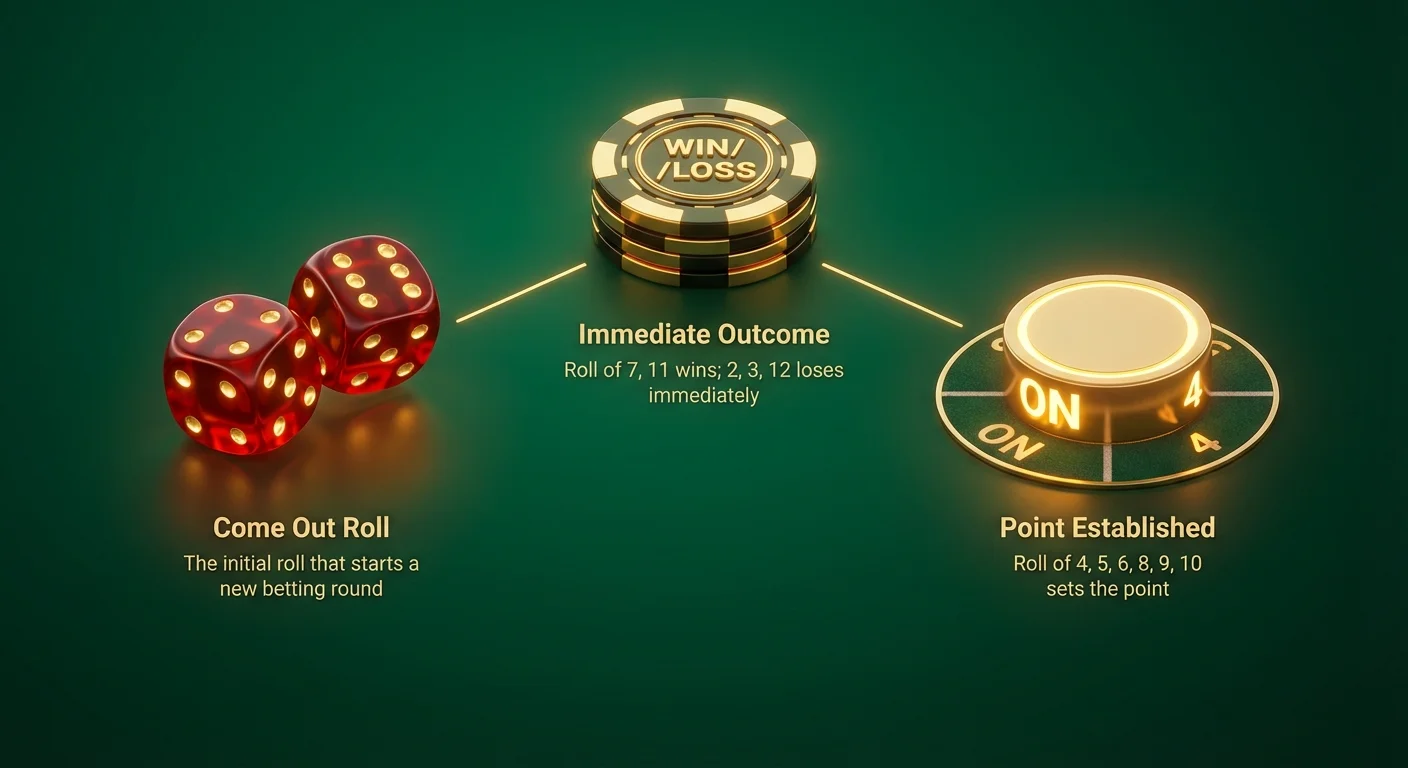
On every digital craps screen, you will see a small disc. It has two sides: a black side labeled OFF and a white side labeled ON. The state of this puck dictates the rules of the game at that exact moment.
Phase 1: The Come Out Roll (Puck is OFF)
When the puck is OFF, the game is in the "Come Out" phase. This is the start of a new round.
- The Goal: The shooter is trying to establish a "Point."
- Pass Line Rules:
- Roll a 7 or 11: You win immediately (pays 1:1). The round ends, and a new Come Out roll begins.
- Roll a 2, 3, or 12: This is called "Craps." You lose immediately.
- Roll a 4, 5, 6, 8, 9, or 10: The number rolled becomes the Point. The Puck flips to ON and moves to that number on the layout.
Phase 2: The Point Phase (Puck is ON)
Once a Point is established (e.g., the shooter rolls a 5), the game enters the second phase. The rules regarding the number 7 flip completely.
- The Goal: The shooter must roll the Point number again before rolling a 7.
- Pass Line Rules:
- Roll the Point (e.g., 5): You win (pays 1:1). The puck flips to OFF, and the game resets.
- Roll a 7: This is called "Sevening Out." You lose. The round ends.
- Roll any other number: Nothing happens to your Pass Line bet. The dice are rolled again.
Crypto Casino Tip: In RNG crypto craps, you are the shooter. You press the "Roll" button. In Live Dealer crypto craps (like Evolution Gaming), a mechanical arm or a human presenter rolls the dice, but the rules remain identical.
The Core Bets: Where to Place Your Crypto
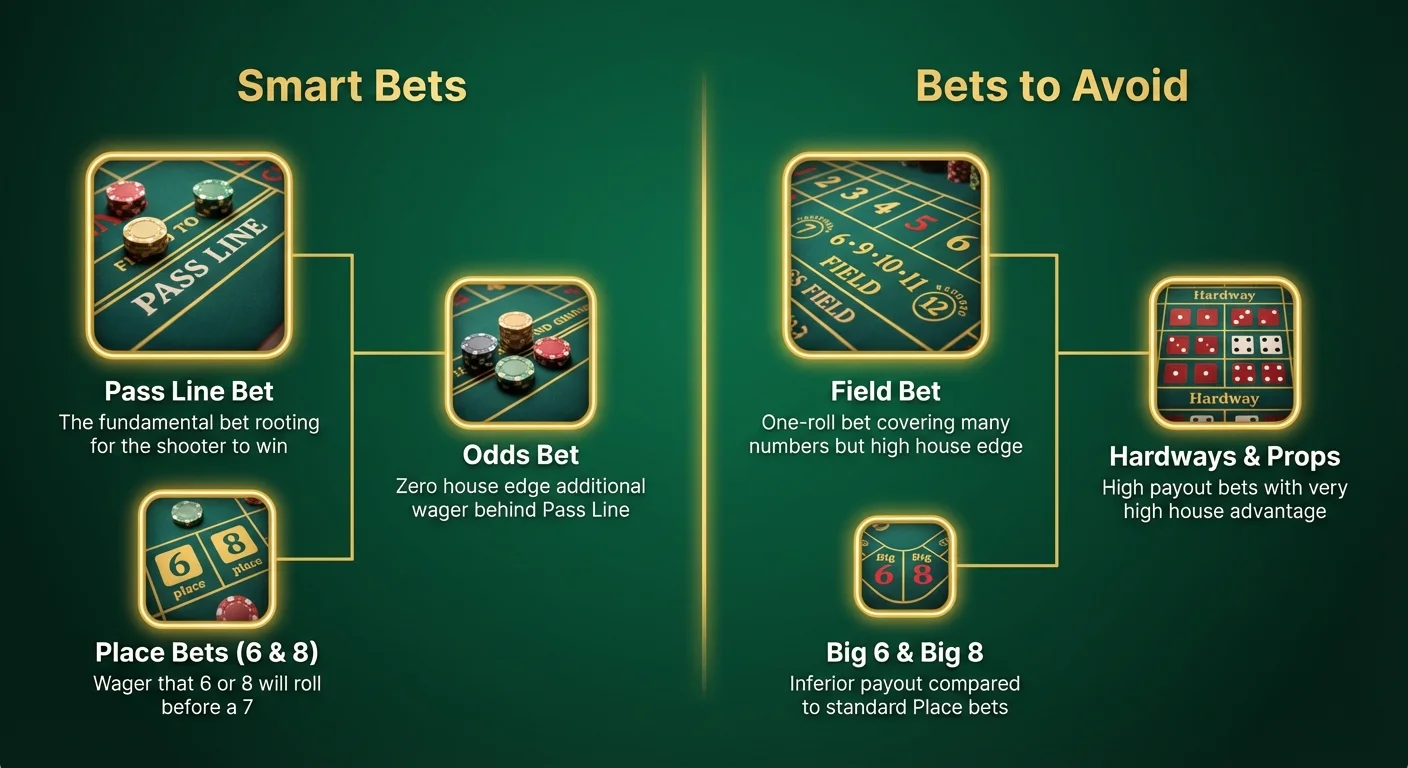
While there are dozens of bets available, smart players stick to a specific set of wagers that offer the lowest House Advantage (HA).
1. The Pass Line
- House Edge: 1.41%
- Difficulty: Beginner
This is the standard bet. You are rooting for the dice to be hot. You want 7s and 11s on the Come Out, and you want to hit Point numbers quickly.
2. The Odds Bet (The Best Bet in Gambling)
This is the most important secret in craps. Once a Point is established, you can place an additional bet behind your Pass Line wager. This is called "Taking the Odds."
- House Edge: 0.00%
- Why it's special: The casino pays you "true odds" on this bet. There is no mathematical advantage for the house here.
- How to do it: In a crypto interface, once the Puck is ON, click the empty space directly behind your Pass Line chips.
Payouts for Odds Bets:
| Point Number | True Odds Payout |
|---|---|
| 4 or 10 | 2 to 1 |
| 5 or 9 | 3 to 2 |
| 6 or 8 | 6 to 5 |
3. The Don't Pass (The Dark Side)
- House Edge: 1.36%
- Difficulty: Intermediate
This is the opposite of the Pass Line. You win on the Come Out roll if a 2 or 3 is rolled (12 is a push). Once the Point is established, you are rooting for the 7. You want the shooter to fail. While the math is slightly better than the Pass Line, most players find it more fun to root for numbers to hit rather than the round to end.
4. Place Bets
If you don't want to wait for a Point to be established, you can simply "Place" a number. For example, if you Place the 6, you are betting that a 6 will roll before a 7. You don't care about the Come Out roll or the Puck state.
- Strategy Tip: The 6 and 8 are the most frequently rolled numbers (other than 7). Placing the 6 and 8 is a very popular strategy because they hit often.
Bets to Avoid: The "Sucker" Bets
Crypto casinos display high payouts on the center of the table to tempt you. The user interface often highlights "Hardways" or "Field" bets with bright colors. Proceed with caution.
The Field Bet
You bet that the next roll will be 2, 3, 4, 9, 10, 11, or 12.
- The Trap: While it looks like you have many winning numbers, the losing numbers (5, 6, 7, 8) roll much more frequently mathematically.
- House Edge: Ranges from 2.78% to 5.56%, depending on how much the casino pays for a roll of 12.
The Big 6 and Big 8
These bets pay 1:1 if a 6 or 8 rolls.
- The Trap: If you make a "Place Bet" on 6 or 8, it pays 7:6 (better than 1:1). The Big 6/8 is mathematically inferior to a standard Place bet, yet it takes up a large space on the table layout to trick beginners. Never bet the Big 6 or Big 8.
Hardways and Props
Betting on "Hard 8" (two 4s) pays well (usually 7:1 or 9:1), but the house edge is massive, often exceeding 9%. These are fun for a lucky shot with small amounts of crypto, but they will drain your bankroll quickly if played consistently.
Navigating the Crypto Casino User Interface
Playing craps at a crypto casino is distinct from a traditional online casino. The interface is optimized for speed, fairness, and wallet integration.
The Control Panel
Unlike physical craps where you toss chips, you use a digital dashboard.
- Chip Selector: Usually at the bottom. Select your denomination (e.g., 0.1 mBTC, 1 USDT).
- Roll: The button that executes the RNG or signals you are ready in Live Dealer games.
- Repeat / Rebet: A vital button for craps. If you have bets scattered across the Pass Line and Place numbers, hitting "Repeat" saves you from clicking five different spots again after a win.
- Clear: Removes all chips from the table. Use this carefully!
- ON/OFF Button: In RNG games, you can usually toggle whether your bets are "working" on the Come Out roll. By default, Place bets are usually "OFF" during the Come Out, but you can turn them "ON" via the UI settings.
Provably Fair Technology
One of the massive advantages of crypto casino guides usually highlight is "Provably Fair" technology. In proprietary crypto craps games (like those found on BC.Game or Stake), you can verify the fairness of every roll.
- Server Seed: Generated by the casino.
- Client Seed: Generated by you (or your browser).
- Nonce: The number of bets made.
Before you roll, you are shown a hash of the Server Seed. After the roll, you can reveal the seed and verify that the outcome (the dice roll) was pre-determined by the math and not altered after you placed your bet. This transparency is impossible in traditional casinos.
Strategy 101: The "Pass and Odds" Approach
If you are a beginner looking to play safely and stretch your cryptocurrency bankroll, follow this simple routine. This strategy minimizes the house edge and keeps the game simple.
- Wait for a new round (Puck is OFF).
- Bet the Pass Line. (e.g., $10 value in BTC).
- Roll the Dice.
- If 7/11: You win $10. Keep the winnings and bet $10 again.
- If 2/3/12: You lose. Bet $10 again.
- If a Point is set (e.g., 4): Move to Step 4.
- Take Maximum Odds. Place a bet behind your Pass Line wager. If the casino allows "3x Odds," bet $30 behind your $10.
- Why? You now have $40 on the table, but the house only has an edge on the original $10. You have diluted the house edge significantly.
- Wait.
- If the Point hits: You win the Pass Line (1:1) AND the Odds bet (True Odds).
- If 7 hits: You lose both.
- Repeat.
Managing Your Crypto Bankroll at the Table
Craps is a game of streaks. Because the payouts can be high (especially with Odds bets) and the game moves fast, your balance can swing wildly.
The "Crypto" Advantage
- Micro-Betting: Unlike Vegas tables with $15 or $25 minimums, crypto craps often allows bets as low as $0.10 or even 1 Satoshi. This allows beginners to learn the mechanics without risking significant capital.
- Instant Settlements: When you win a Pass Line bet, the crypto is credited to your balance instantly. There is no waiting for the dealer to count chips and push them toward you.
- Bonuses: Be careful with welcome bonuses. Craps is often excluded from wagering requirements or contributes a lower percentage (e.g., 10%) because the House Edge is so low. Always check the Terms & Conditions before playing craps with bonus funds.
Volatility Warning
Even with the "Pass and Odds" strategy, you can run into a "Cold Table" (lots of 7s rolling before Points are made).
- Rule of Thumb: Bring enough buy-in for at least 20 shooters. If your base bet is $5, you should have at least $100-$150 to weather the variance.
Glossary of Craps Terms
To play like a pro, you should speak the language.
- Boxcars: A roll of 12 (two 6s).
- Craps: A roll of 2, 3, or 12.
- Natural: A roll of 7 or 11 on the Come Out roll.
- Seven Out: Rolling a 7 after a Point has been established (this ends the round).
- Snake Eyes: A roll of 2.
- Working: A bet that is active for the next roll.
- Yo (or Yo-Eleven): A roll of 11. (Called "Yo" to avoid confusion with "Seven" which sounds similar).
Conclusion
Craps is the most dynamic game in the casino. It offers a unique blend of strategy, luck, and camaraderie - even in a digital environment. By understanding the role of the Puck and sticking to the fundamental Pass Line strategy, you are already playing smarter than the majority of gamblers.
The integration of cryptocurrency adds a layer of efficiency and fairness that revitalizes this classic game. Whether you are using Bitcoin, Ethereum, or Litecoin, the digital craps table is open 24/7. Remember to avoid the "sucker bets" in the center of the table, always take the Odds on your Pass Line, and verify your rolls if the platform allows it.
Now that you know the layout and the rules, you are ready to hit the "Roll" button. Good luck, and may the dice stay hot!