
There is nothing quite like a Saturday during college football season. From noon until well past midnight, the action is relentless, the atmospheres are electric, and the betting opportunities are seemingly endless. Unlike the NFL, where you have 32 teams with relatively equal talent floors, the world of NCAA football involves over 130 teams in the Football Bowl Subdivision (FBS) alone. This creates a landscape of massive disparities, wild scoring variances, and unique strategic angles.
For the beginner looking to get into college football betting, the sheer volume of games can be overwhelming. However, this volume is exactly where the opportunity lies. Sportsbooks cannot price 60+ games perfectly every Saturday. By using crypto to fund your accounts, you gain the added advantages of speed, privacy, and often, higher betting limits.
This guide will walk you through the fundamentals of CFB wagering, helping you navigate the chaotic landscape of 130+ teams, understand the nuances of talent gaps, and utilize crypto to maximize your betting efficiency.

Why Bet College Football with Crypto?
Before diving into the X's and O's of handicapping, it is important to understand why experienced bettors are migrating toward crypto sportsbooks. The distinct nature of college football creates specific demands that fiat currency sportsbooks often struggle to meet.
- Speed of Transactions: College football Saturdays are marathons. If you spot a great line for the late-night "Hawaii Test" game, you need to be able to deposit instantly. Bitcoin, Litecoin, and USDT allow for near-instant funding.
- High Limits: Because the player pool in NCAA football is so large, liquidity can be an issue at smaller books. Top-tier crypto sportsbooks generally offer higher maximum bet limits, allowing you to back your conviction without arbitrary caps.
- Geographic Freedom: Crypto betting breaks down borders, allowing you to access markets that might be geo-restricted by traditional banking methods, ensuring you can shop for the best lines.
- Bonuses: Crypto deposits often trigger significantly larger welcome bonuses than credit card deposits. This extra bankroll is vital when navigating the variance of a full college season.
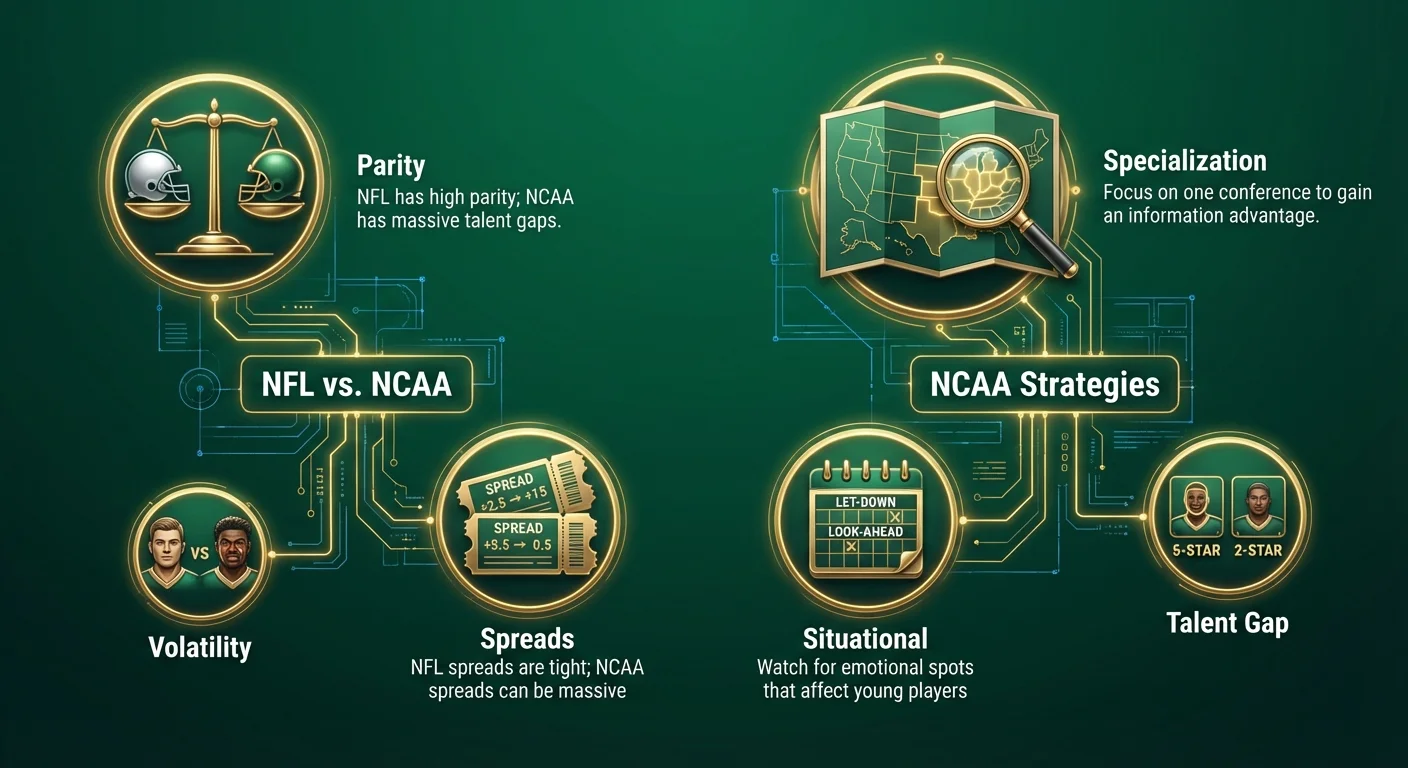
The Landscape: NFL vs. NCAA Football
The biggest mistake a beginner can make is treating college football betting exactly like the NFL. While the rules of the game are largely the same, the betting ecosystem is entirely different.
| Feature | NFL Betting | College Football Betting |
|---|---|---|
| Parity | High. Any team can beat any team. | Low. Top teams dominate; massive blowouts are common. |
| Spreads | Tight. Usually between -1 and -10. | Wide. Can range from -1 to -50 or more. |
| Roster Size | 53 players. | 85 scholarship players (plus walk-ons). |
| Home Field | Worth roughly 1.5 to 2.5 points. | Worth 3 to 6+ points depending on the stadium. |
| Volatility | Lower. Professionals are consistent. | Higher. 18-22 year olds are prone to emotional swings. |
Understanding these differences is the first step toward profitability. In the NFL, a 14-point spread is massive. In college, top-ranked teams like Georgia or Ohio State regularly cover spreads of 30+ points against lower-tier opponents.
Core Betting Markets in CFB
To navigate the 130+ teams successfully, you must master the three main betting markets.
1. The Point Spread
The point spread is the great equalizer. Because the talent gap between a team like Alabama and a team like Vanderbilt is so large, the sportsbook assigns a handicap.
- Example: Michigan (-21.5) vs. Rutgers.
- If you bet Michigan, they must win by 22 points or more.
- If you bet Rutgers (+21.5), they must win outright or lose by 21 points or less.
Strategy Note: In college football, "garbage time" (the end of a blowout game) is crucial. A coach might pull his starters in the 4th quarter to preserve health, allowing the losing team to score late touchdowns against backups. This frequently impacts the point spread, leading to what bettors call a "backdoor cover."
2. The Moneyline
This is a wager on who will win the game outright.
- The Favorite: Odds will be negative (e.g., -450). This means you must bet $450 to win $100.
- The Underdog: Odds will be positive (e.g., +350). A $100 bet wins you $350.
Strategy Note: Be very careful betting moneylines on heavy favorites in CFB wagering. Risking $1000 to win $50 on a powerhouse team is rarely worth the risk, as upsets do happen. Conversely, sprinkling small crypto wagers on live underdogs is a popular strategy for high returns.
3. Totals (Over/Under)
This is a bet on the combined score of both teams. College football totals are generally much higher than the NFL due to rule differences (the clock stops on first downs, leading to more plays) and wider hash marks (which spread the field).
- Example: Over/Under 58.5 points.
Mastering the 130+ Teams: Segmentation Strategy
The hardest part of betting on the NCAA is information overload. You cannot expertly handicap 130 teams. You need a strategy to filter the noise.
Specialization
Do not try to bet on every conference. Pick one or two conferences to specialize in.
- Power 4 (SEC, Big Ten, Big 12, ACC): High visibility, lots of media coverage, tight betting lines.
- Group of 5 (MAC, Sun Belt, AAC, etc.): Less coverage, often looser betting lines, high variance.
By becoming an expert on the "Sun Belt Conference," for example, you might know that a certain team's star quarterback is injured before the general public (and sometimes the books) react. This information advantage is harder to find in the SEC, where every practice report is scrutinized by millions.
The "MACtion" Advantage
Mid-American Conference (MAC) games are often played on Tuesday and Wednesday nights. These games are referred to as "MACtion." Because they are the only games on TV at that time, they attract heavy betting volume. However, the weather in these regions (Ohio, Michigan, Buffalo) can be brutal in November. Wind and snow often wreak havoc on passing games, making "Unders" a popular angle for savvy bettors.
Analyzing Talent and Motivation
In the NFL, everyone is a professional playing for a paycheck. In college, motivation and talent disparity are the primary drivers of game outcomes.
The Talent Gap (Stars Matter)
Recruiting rankings matter. Sites like 247Sports rank high school players from 1 to 5 stars.
- Blue Bloods: Teams like Alabama, Ohio State, and Georgia stack their rosters with 4 and 5-star recruits.
- Lower Tiers: Teams in smaller conferences rely on 2 and 3-star recruits.
When a team full of future NFL players faces a team of future accountants, scheme matters less than raw athleticism. However, the spread usually accounts for this. The edge lies in identifying when a team with superior talent is "sleeping" or underperforming, creating value on the underdog.
The Transfer Portal Impact
Modern college football betting requires tracking the Transfer Portal. Players can now switch schools instantly and play immediately. A team that was bad last year might have acquired a star quarterback and three new wide receivers in the offseason. Old data is often useless.
- Tip: Before placing a future bet on win totals, check the team's "Incoming Transfer" rankings.
Situational Handicapping
Because college athletes are young, they are highly susceptible to emotional letdowns. Watch for these spots:
- The Look-Ahead: A top team is playing a weak opponent the week before a massive rivalry game. They may lack focus, allowing the weak opponent to cover the spread.
- The Let-Down: A team just won a massive, emotional upset against a rival. The next week, they play a mediocre team. They often come out flat and exhausted.
- The Sandwich Spot: A game "sandwiched" between two huge opponents.
- Revenge Games: If a team was embarrassed by an opponent last year (lost by 40), they will be highly motivated to run up the score this year.
Practical Steps to Place Your First Crypto CFB Bet
Ready to get in on the action? Here is a simple workflow for beginner bettors.
Step 1: Choose a Reputable Crypto Sportsbook
Look for sites with a long track record, transparent "provably fair" mechanics (if using on-chain betting), and good customer support. Ensure they cover NCAA Football extensively, including props and futures.
Step 2: Acquire and Deposit Crypto
- Purchase Bitcoin (BTC), Ethereum (ETH), or Litecoin (LTC) from an exchange.
- Pro Tip: Use Litecoin or USDT (Tether) for transfers. Bitcoin network fees can be high during congestion, but Litecoin fees are usually pennies, leaving more money for your bankroll.
- Transfer the crypto to your sportsbook wallet address.
Step 3: Shopping for Lines
Don't just take the first number you see. If one book has Florida State -3.5 and another has Florida State -3, taking the -3 is significantly better. In a game decided by a field goal, that half-point is the difference between a "push" (refund) and a loss.
Step 4: Bankroll Management
This is the most critical rule.
- Unit Size: Decide on a standard "unit" for your bets (e.g., 1% of your total bankroll).
- Discipline: If you lose the noon games, do not double your bet size on the 3:30 PM games to "win it back." That is the fastest way to lose your crypto.
Advanced Metrics for Beginners
To move from a casual fan to a sharp bettor, you should familiarize yourself with a few key metrics that go beyond basic stats like "Total Yards."
- Yards Per Play (YPP): This is a better indicator of efficiency than total yards. A team might have 500 yards because they ran 100 plays, not because they were good. A team averaging 7.0+ YPP is elite.
- Success Rate: This measures how often a team stays "on schedule" (e.g., gaining 50% of needed yards on 1st down). It removes the noise of lucky, long plays.
- Returning Production: At the start of the season, teams returning their Quarterback and Offensive Line tend to cover spreads early in the year against teams breaking in new starters.
Summary: Key Takeaways for CFB Wagering
Navigating 130+ teams in NCAA football is a challenge, but it is also a puzzle that can be solved with research and discipline.
- Respect the Volume: You cannot handicap 60 games. Pick a conference and specialize.
- Mind the Gap: Understand the talent disparity between Power 4 and Group of 5 schools.
- Spot the Situation: Look for let-downs, look-aheads, and motivation factors that affect 18-22 year olds.
- Use Crypto: Leverage the speed of digital assets to deposit instantly for late games and withdraw winnings quickly on Sunday.
- Shop Lines: Always look for the best odds to decrease the house edge.
College football is chaotic, emotional, and unpredictable. By applying these strategies and maintaining strict bankroll management, you can turn that chaos into a calculated, thrilling, and potentially profitable experience. Good luck this Saturday!