
The sound of coins hitting a metal tray and the clunk of a mechanical arm pulling down are sounds of a bygone era. While the nostalgia of the "one-armed bandit" remains, the online gambling world has undergone a radical technological evolution. If you have recently logged into a crypto casino, you've likely been greeted not by three simple reels, but by expanding grids, exploding symbols, and paylines that shift with every spin.
For a beginner, modern slot machines can look less like a game of chance and more like a complex puzzle. Terms like Megaways, Cluster Pays, and Cascading Reels dominate the lobbies of top Bitcoin casinos, promising tens of thousands of ways to win. But what do these terms actually mean? How do they change your odds? And more importantly, how do you read the game to understand your winning potential?
This guide moves beyond the basics of 3-reel slots to decode the complex engines powering today's most popular crypto games. We will strip away the flashy graphics to explain the mathematics and mechanics underneath, helping you make smarter choices with your bankroll.
The Evolution of the Engine: From Lines to Ways
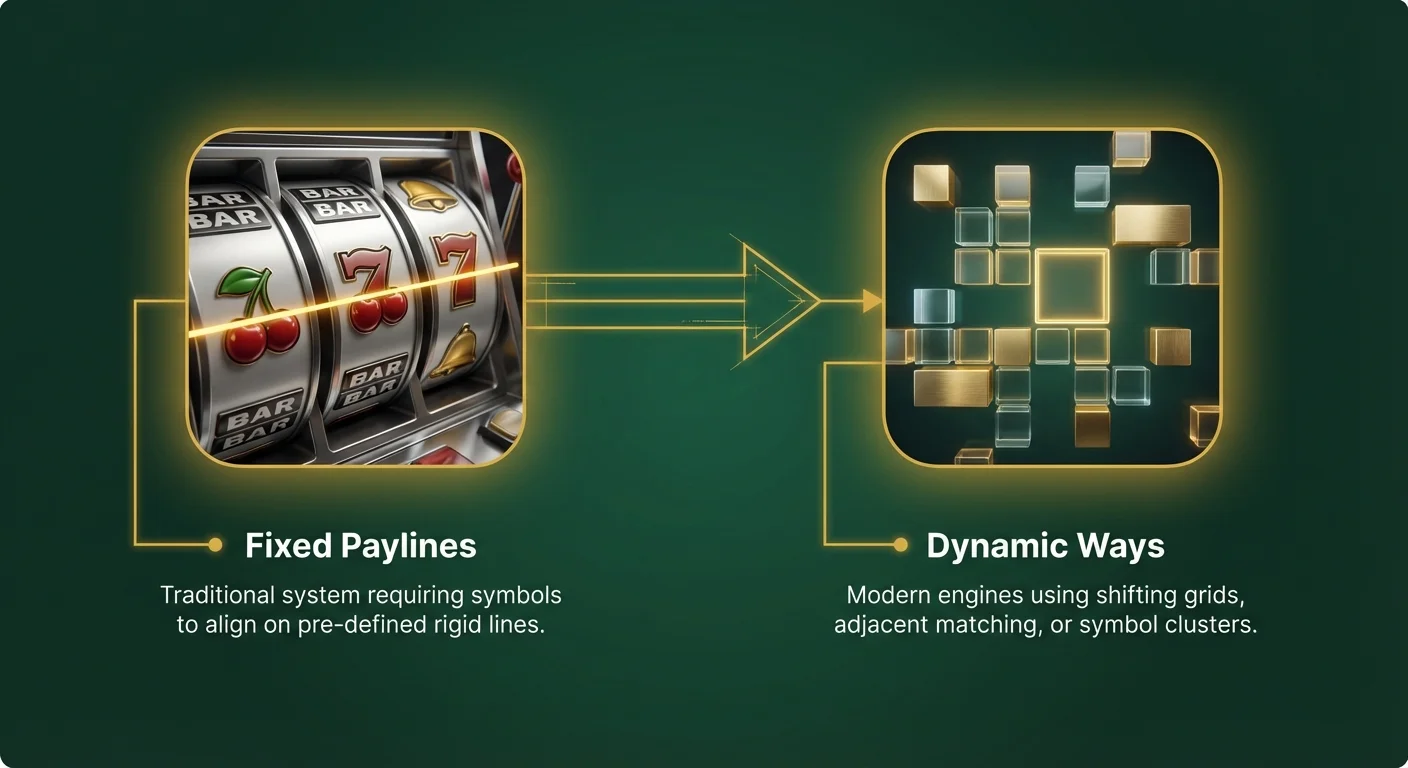
To understand where we are, we must briefly look at where we started. Traditional slot machines, as detailed in classic casino literature, relied on a fixed grid - usually 3x3 or 5x3 (reels by rows). To win, you needed to match symbols across a specific line drawn across the screen, known as a payline.
If you landed three cherries, but they weren't on an active payline, you won nothing.
Modern slots have largely abandoned this restrictive model. Developers realized that players wanted more action and less confusion regarding why a spin lost. This led to the invention of "Ways to Win," and eventually, the high-octane mechanics we see today.
Why the Mechanics Matter for Crypto Players
In the world of crypto gambling, speed and fairness are paramount. Modern mechanics like Megaways and Clusters are often paired with Provably Fair algorithms. Because these games rely on complex RNG (Random Number Generators) rather than mechanical stops, they are perfectly suited for the transparency of blockchain technology. Understanding these mechanics allows you to verify that the volatility you are experiencing is a feature of the game design, not a glitch.
Megaways: The Shapeshifting Giant
Arguably the most significant innovation in the last decade of slot development is the Megaways engine. Originally developed by Big Time Gaming, this mechanic has been licensed to countless developers because of its massive popularity.
How It Works
Unlike a standard 5-reel slot where every reel has a fixed number of rows (usually 3 or 4), a Megaways slot is dynamic.
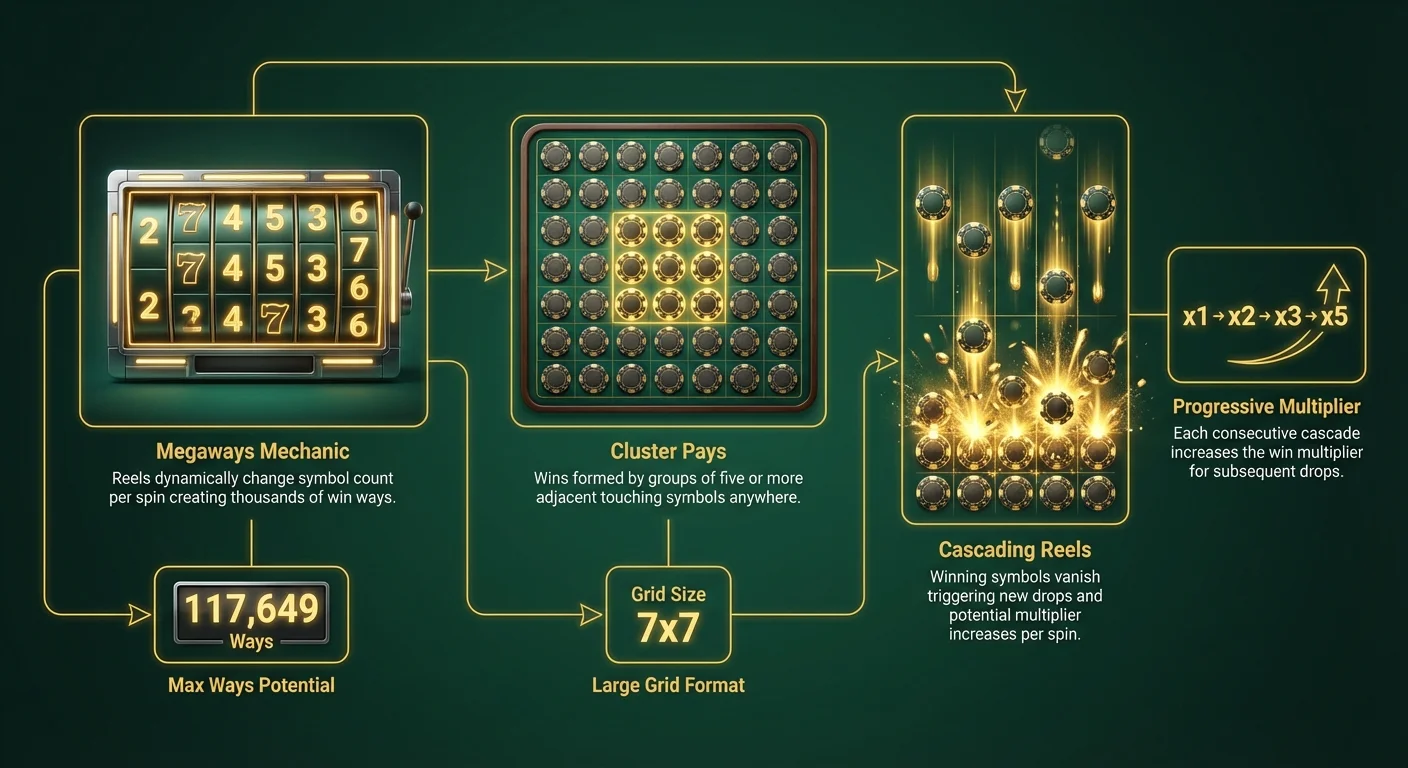
- Dynamic Reels: Each reel can display a random number of symbols on every spin, typically between 2 and 7.
- The Math: If a slot has 6 reels, and every reel lands the maximum 7 symbols, the number of ways to win is calculated by multiplying the symbols per reel: .
You don't need to line symbols up on a specific horizontal line. In a Megaways game, you simply need matching symbols to appear on adjacent reels, starting from the leftmost reel (Reel 1). It doesn't matter if the symbol is at the top of Reel 1 and the bottom of Reel 2; as long as they are adjacent, it connects.
Identifying High-Potential Megaways
Not all Megaways slots are created equal. When browsing your favorite crypto casino, look for these differentiators in the game rules:
- The Upper Tracker: Many Megaways slots add an extra horizontal reel above the main grid (usually over reels 2, 3, 4, and 5). This adds extra symbols to the count, increasing winning potential.
- Mystery Symbols: Since the grid changes size constantly, specific symbols that transform into the same matching symbol can be powerful in connecting disjointed reels.
- Unlimited Multipliers: This is the key to massive wins. In the bonus round of many Megaways titles, every win increases a global multiplier by 1x. Because there is no cap, late-stage spins can pay out massive amounts.
Pro Tip: Megaways slots are notoriously high volatility. This means you may endure long streaks of "dead spins" (no wins) followed by a massive payout. Ensure your crypto bankroll is split into smaller bet units (e.g., 0.5% of your total balance per spin) to weather the dry spells.
Cluster Pays: Breaking the Grid
If Megaways reinvented the reels, Cluster Pays removed them entirely. These games often look more like mobile puzzle games (think Candy Crush) than casino machines.
The Mechanics of the Cluster
In a Cluster Pays slot, there are no reels spinning from top to bottom in the traditional sense. Instead, symbols drop onto a large grid, often 7x7 or larger.
- Winning Condition: You win by forming a "cluster" of matching symbols.
- Adjacency: Symbols usually must touch horizontally or vertically. Diagonal touches rarely count in strict cluster mechanics.
- Minimums: Typically, you need a cluster of 5 or more symbols to trigger a payout. The larger the cluster, the exponentially higher the payout.
Why Choose Cluster Slots?
Cluster slots are engaging because they offer a different type of dopamine loop. Instead of watching reels stop one by one, you are looking for patterns.
The "High-Value" Cluster Strategy:
In traditional slots, the highest paying symbol usually pays for 5-of-a-kind. In Cluster slots, the top prize is reserved for clusters of 15+.
- Check the Paytable: Look for the gap between the low-tier clusters (5 symbols) and high-tier clusters (15+). A game with a massive jump in payout for large clusters indicates high volatility. A game with a gradual increase suggests a more balanced, low-volatility experience.
Cascading Reels: The Chain Reaction
You will rarely find a modern Megaways or Cluster slot that does not also feature Cascading Reels (also known as Tumbles, Avalanches, or Reactions). This feature changes the fundamental value proposition of a single spin.
How Cascades Work
- The Spin: You hit the spin button, and symbols land.
- The Win: You form a winning combination (either a Way or a Cluster).
- The Removal: The winning symbols explode or vanish from the screen.
- The Drop: New symbols fall from the top to fill the empty spaces.
- The Repeat: If the new symbols create a new win, the process repeats.
The Value of the Cascade
In a traditional slot, one bet equals one outcome. With cascading reels, one bet can theoretically lead to infinite outcomes. This is essentially a "free respin" mechanic built into the base game.
The Multiplier Effect:
The true power of cascading reels is unlocked when developers attach progressive multipliers to the cascades.
- Cascade 1: Win pays 1x.
- Cascade 2: Win pays 2x.
- Cascade 3: Win pays 3x.
This continues until no new wins are formed. This mechanic allows for small initial wins to snowball into massive payouts without ever triggering a separate bonus screen.
Decoding the Pay Table: A Beginner's Guide
Modern mechanics require a modern approach to reading the "Instructions" or "Info" tab of a slot. Beginners often skip this, but in the crypto gambling world, information is profit. Here is how to decipher the data.
1. Symbol Hierarchy
Every slot has a hierarchy of symbols. Modern slots split these clearly:
- Low-Paying (Royals): usually 10, J, Q, K, A. These exist to keep your balance ticking over. In Megaways slots, these often pay less than your total bet for a simple 3-of-a-kind match.
- Premiums (High-Paying): These are the thematic icons (dragons, diamonds, gods). You usually need these to make a profit on a spin.
- The "Top" Symbol: In many modern engines, the very highest paying symbol pays out even if you only land 2 of them (unlike the usual 3). Identifying this symbol is crucial as it is your volatility anchor.
2. Special Feature Symbols
Beyond the standard payouts, you must identify the modifiers:
- Scatters: These unlock the bonus rounds (Free Spins). In cascading games, sometimes scatters don't need to land all at once; they can be collected over the course of a single tumble sequence.
- Wilds: These substitute for other symbols. Look for Sticky Wilds (which stay in place during a cascade) or Expanding Wilds (which cover a whole reel). These are statistically the most potent features for generating wins.
3. RTP and Volatility Data
Always check the RTP (Return to Player) percentage. This is the theoretical payout percentage determined over millions of spins. Always look for slots with an RTP above 96.0%. The higher the number, the lower the house edge.
- Standard: 96.00%
- Good: 96.50%+
- Poor: Below 95.00%
Note on Crypto Slots: Some crypto-exclusive games allow you to adjust the volatility. You might see a slider that lets you choose between "Low Risk/Low Reward" (frequent small wins) and "High Risk/High Reward" (rare massive wins).
Comparing the Engines: Which is Right for You?
If you are depositing Bitcoin or Ethereum and wondering which game style suits your personality, use this comparison table:
| Feature | Megaways | Cluster Pays | Traditional (5-Reel) |
|---|---|---|---|
| Win Mechanics | Adjacent reels (Left to Right) | Groups of touching symbols | Fixed Paylines |
| Variance/Volatility | Typically Very High | Medium to High | Low to Medium |
| Complexity | High (Changing rows) | Medium (Grid patterns) | Low (Fixed grid) |
| Best For | Chasing massive jackpots & excitement | Gamified experience & long play sessions | Nostalgia & simple bankroll management |
| Hit Frequency | Lower (More dead spins) | High (Frequent small wins) | Moderate |
Practical Strategies for Modern Mechanics
While slots are games of chance governed by RNG, how you play them impacts how long your deposit lasts and your probability of hitting a profit target.
1. The "100 Spin" Test
Modern mechanics like Megaways have "cycles" of variance. A common strategy is to lower your bet size to the minimum and play 100 spins to gauge how the machine is behaving. Is it cascading frequently? Are the special features teasing? If the machine feels "cold" (no cascades, low RTP realization), move to a different seed or game.
2. Watch the "Buy Feature" Cost
Many crypto slots allow you to "Buy the Bonus" (often for 100x your bet).
- The Trap: This is tempting but dangerous. The volatility of a bought bonus is extreme.
- The Tip: Look at the cost. If a bonus buy costs 100x, it implies the average win is lower than that. If a game charges 300x or more (like some high-volatility Cluster games), it means the potential upside is enormous, but the chance of busting is significantly higher.
3. Bankroll Management for Cascades
In cascading slots, a single spin can last 10-20 seconds if chains occur. This can be deceptive. You might feel like you've been playing for an hour, but you've only made 50 actual bets. Conversely, on "dead" streaks, Megaways slots can burn through a balance in minutes.
- Rule of Thumb: For high-variance mechanics, require a bankroll of at least 200x your bet size. If you are betting $1 equivalent in BTC, you should have $200 ready to withstand the swings.
Summary: Embracing the Chaos
Gone are the days when a slot machine was a simple passive experience of watching three cherries align. Modern engines like Megaways, Cluster Pays, and Cascading Reels have turned slot gameplay into a dynamic, adrenaline-fueled experience.
- Megaways offer the highest potential with shifting rows and over 100,000 ways to win.
- Cluster Pays gamify the experience, rewarding pattern recognition and grid clearance.
- Cascades extend your playtime, turning single bets into multi-stage events with increasing multipliers.
By understanding how these engines calculate wins and reading the paytables correctly, you move from being a passive player to an informed participant. Remember, while the math is complex, the rule of crypto gambling remains simple: the House always has an edge (RTP < 100%), so play for entertainment, manage your crypto assets wiseley, and never chase your losses.
Ready to test these mechanics? Head over to our recommended Provably Fair slot section and watch the cascades begin.